WALT in Real Estate: Weighted Average Lease Term
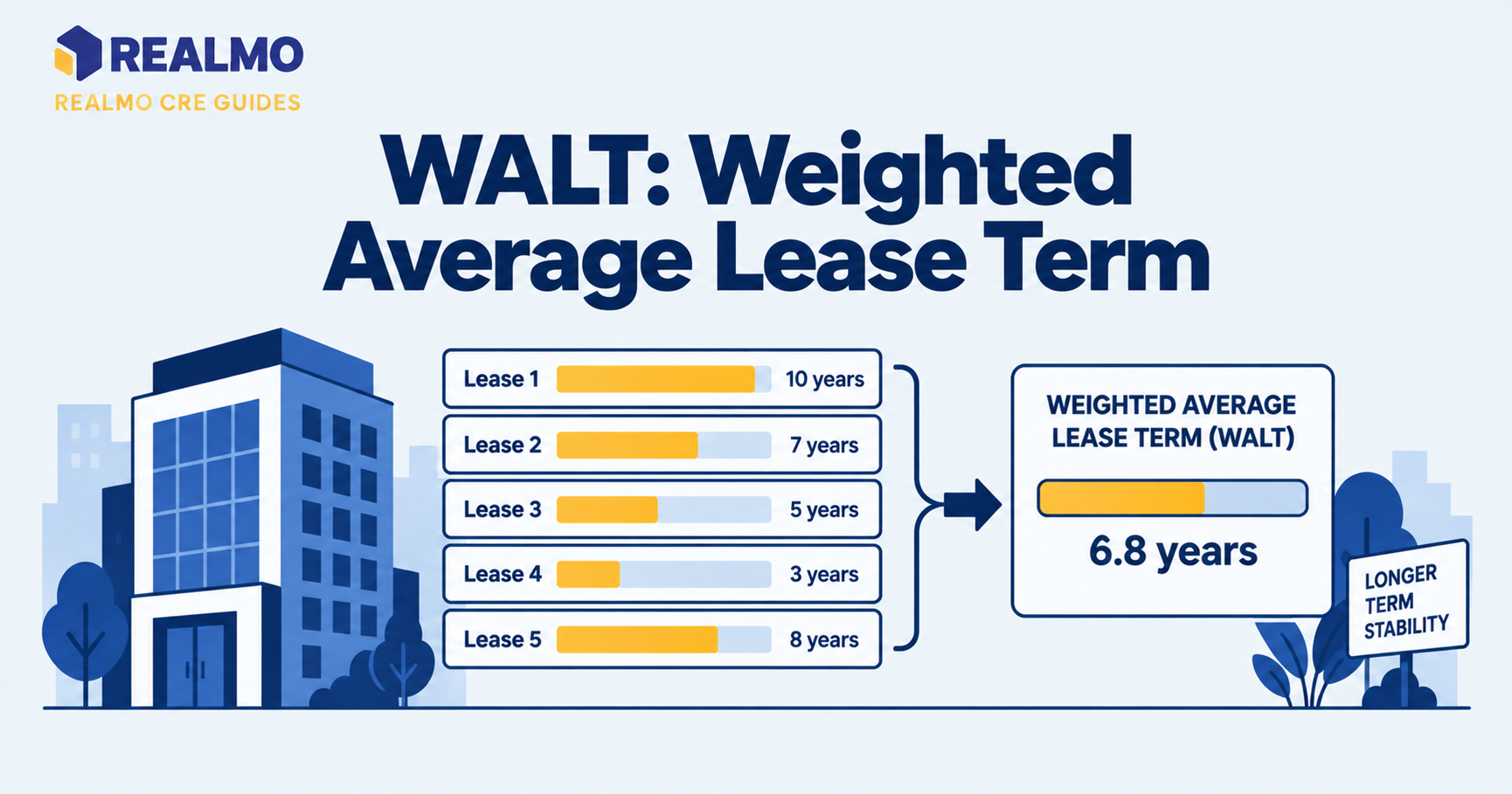
Weighted average lease term (WALT) is the average remaining lease term at a property, weighted by each tenant’s contract rent or leased square footage. In real estate, WALT answers one question: how many years of contracted income remain before rollover starts. It’s stated in years and measured on a fixed date.
| Tenant | Square feet | Annual base rent | Years remaining |
|---|
WALT = Σ (Annual Base Rent × Years Remaining) ÷ Σ Annual Base Rent
Area-Weighted Formula:
WALT = Σ (Square Feet × Years Remaining) ÷ Σ Square Feet
Why WALT changes what you can pay for a building
Two multi-tenant buildings can produce identical net operating income and trade at very different prices. One has 8.5 years of contracted rent left. The other has 2.1. The second one is a leasing assignment with a building attached, and the price has to carry the tenant improvement dollars, leasing commissions, and downtime that come with re-leasing most of the space.
The math shows up in the loan too. A five-year bridge loan against a 2.1-year WALT means the lender is underwriting your re-leasing plan, not the existing rent roll. Expect a smaller loan, a larger reserve, and tighter DSCR covenants. Your exit buyer runs the same test in reverse: if you sell in year four with 1.5 years of term left, you're selling the same problem you bought.
What WALT counts and what it leaves out
WALT is built from base rent under signed leases as of the measurement date. Vacant space contributes nothing to a rent-weighted calculation, which is why a half-empty building can post a strong number. Expense reimbursements and percentage rent stay out, because they're not fixed contractual obligations.
Unexercised renewal options don't count either. A tenant with three years of firm term and two five-year options contributes three years, not thirteen. The option belongs to the tenant, and it's exercised only when the option rent sits below market.
Month-to-month tenants and holdovers are usually entered at zero. Signed leases that haven't commenced create the opposite problem: a tenant taking occupancy in eight months adds contracted income that isn't producing cash yet. Both treatments are defensible. Disclose which one you used, since the two conventions can move the answer by half a year on a small building.
WALT to expiry vs WALT to break
WALT to expiry runs each lease to its stated end date. WALT to break runs it to the earliest date the tenant can walk without a default. The gap matters wherever termination rights exist.
U.S. office and industrial leases carry fewer break clauses than European leases, where the WAULT-to-break figure is standard. The exception in the U.S. is government space. A GSA lease written for 15 years with a 10-year firm term and a soft term after that has a 15-year expiry and a 10-year break. Retail brings co-tenancy and kick-out clauses tied to sales thresholds. Underwrite to break, then note the expiry figure separately.
Rent-weighted vs area-weighted WALT
The rent-weighted version:
WALT = Σ (tenant annual base rent × remaining term in years) ÷ Σ (tenant annual base rent)
Swap rent for square feet and you get the area-weighted version. Rent weighting is the investor's number because it tracks the income at risk. Area weighting is the asset manager's number because it tracks the space that needs re-leasing. When a small tenant pays double the building's average rent per square foot, the two figures separate.
Worked example: four tenants in one flex building
Illustrative figures, 25,000 square feet, measured January 1.
| Tenant | SF | Annual base rent | Years remaining |
|---|---|---|---|
| A | 10,000 | $250,000 | 2.0 |
| B | 6,000 | $150,000 | 5.0 |
| C | 4,000 | $120,000 | 8.0 |
| D | 5,000 | $100,000 | 1.0 |
Step one: multiply each tenant's rent by its remaining term. That gives $500,000, $750,000, $960,000, and $100,000, summing to $2,310,000.
Step two: divide by total base rent of $620,000. The rent-weighted WALT is 3.7 years.
Run it on area and you get 87,000 SF-years over 25,000 SF, or 3.5 years. Tenant C pays $30 per square foot against a building average near $25, so rent weighting pulls the figure up.
Now read it. Tenants A and D represent $350,000, or 56% of base rent, and both roll inside 24 months. A five-year loan on this asset faces its real test in month 24, not at maturity. One common error here: Tenant A holds two five-year options, and adding them lifts the reported WALT to roughly 7.4 years. Nothing about the risk changed.
Where WALT shows up in real estate underwriting
Lenders size debt against contracted term. If loan documents include a lease-expiry cash sweep, cash flow gets trapped once a major tenant's lease approaches its end date, which kills distributions in exactly the year you planned to fund improvements. Term shorter than the loan also drives TI and LC reserves at closing.
Pricing follows the same logic. A single-tenant NNN asset with 14 years remaining prices tighter than the same building with four, because the buyer of the 14-year deal is buying a bond-like stream and the buyer of the four-year deal is buying a re-leasing project. That spread widens when tenant credit is investment grade. This is one reason cap rate comparisons between two net lease properties are meaningless without the remaining term.
When you screen listings on Realmo, rebuild WALT from the rent roll rather than accepting the figure in the offering memorandum. Broker-stated numbers frequently include options.
When a long WALT is the risk
A 12-year WALT on rents signed at the bottom of the last cycle locks you out of the recovery. You own contracted income, and that's the ceiling until 2038. Mark-to-market upside sits behind a decade of fixed escalations.
Concentration is the other trap. One tenant at 90% of rent with 11 years left produces a beautiful number and a binary outcome. If that tenant's credit deteriorates, term protects nothing, because a bankrupt tenant can reject the lease in Chapter 11. Term and credit have to be read together.
Common mistakes when reading a WALT number
- Counting unexercised renewal options as term. Inflates the figure and hides genuine rollover risk.
- Treating WALT as a substitute for the lease expiry schedule. A 6-year WALT can conceal 60% of rent expiring next year against one 20-year lease, and the average tells you nothing about the shape.
- Ignoring the measurement date. A number pulled nine months ago has lost nine months of term, and stale WALT in a marketing package is the oldest trick in the book.
- Reading WALT without downtime and capital assumptions. Term ending means TI, commissions, and vacancy months land on your equity.
- Comparing a break-adjusted figure to an expiry figure across two deals.
Related terms
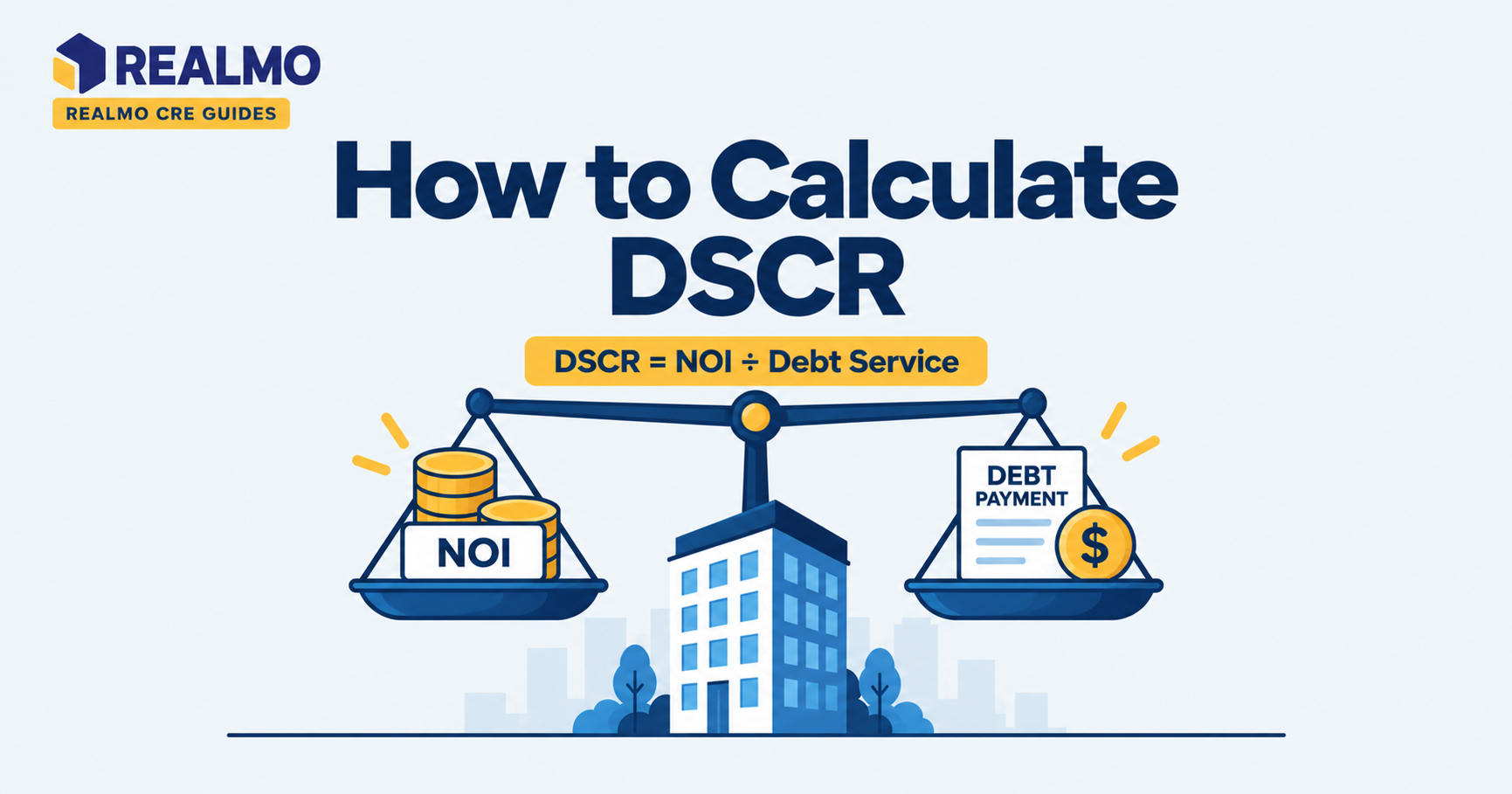
Rent roll · Lease rollover risk · Triple net lease · Net operating income · Tenant credit analysis · Cap rate
FAQ
What is a good WALT in commercial real estate?
There's no universal threshold. The working test is whether WALT extends past your loan maturity and your intended hold period. A five-year hold with a five-year loan wants contracted term beyond both. Net lease buyers seeking passive income look for term measured in double digits, while value-add buyers want short term on purpose.
Is WALT the same as WALE or WAULT?
Yes, the calculation is identical. WALE (weighted average lease expiry) is the Australian term, WAULT (weighted average unexpired lease term) is British, and WALT is standard in the U.S. Only the weighting basis and the expiry-versus-break convention actually differ between reports.
Do you include renewal options in WALT?
No. Only firm contractual term counts, because an option is the tenant's right and not an obligation. A tenant renews when the option rent sits below market, so option periods are the least reliable income in the rent roll. Show them separately if you want to illustrate upside.
How does WALT affect cap rates?
Longer contracted term with a creditworthy tenant reduces the buyer's re-leasing exposure, which supports a lower cap rate on the same NOI. Short term shifts risk to the buyer, who prices in downtime, tenant improvements, and commissions. Term drives pricing most strongly in single-tenant net lease, where one lease is the entire investment.
Should WALT be weighted by rent or by square footage?
Weight by rent for investment analysis, since it reflects the income at risk. Weight by area for operations and capital planning, since square feet drive improvement budgets. Calculate both. A wide gap between them signals uneven rents across the tenant base.