How Much Money Do You Need to Buy Commercial Property
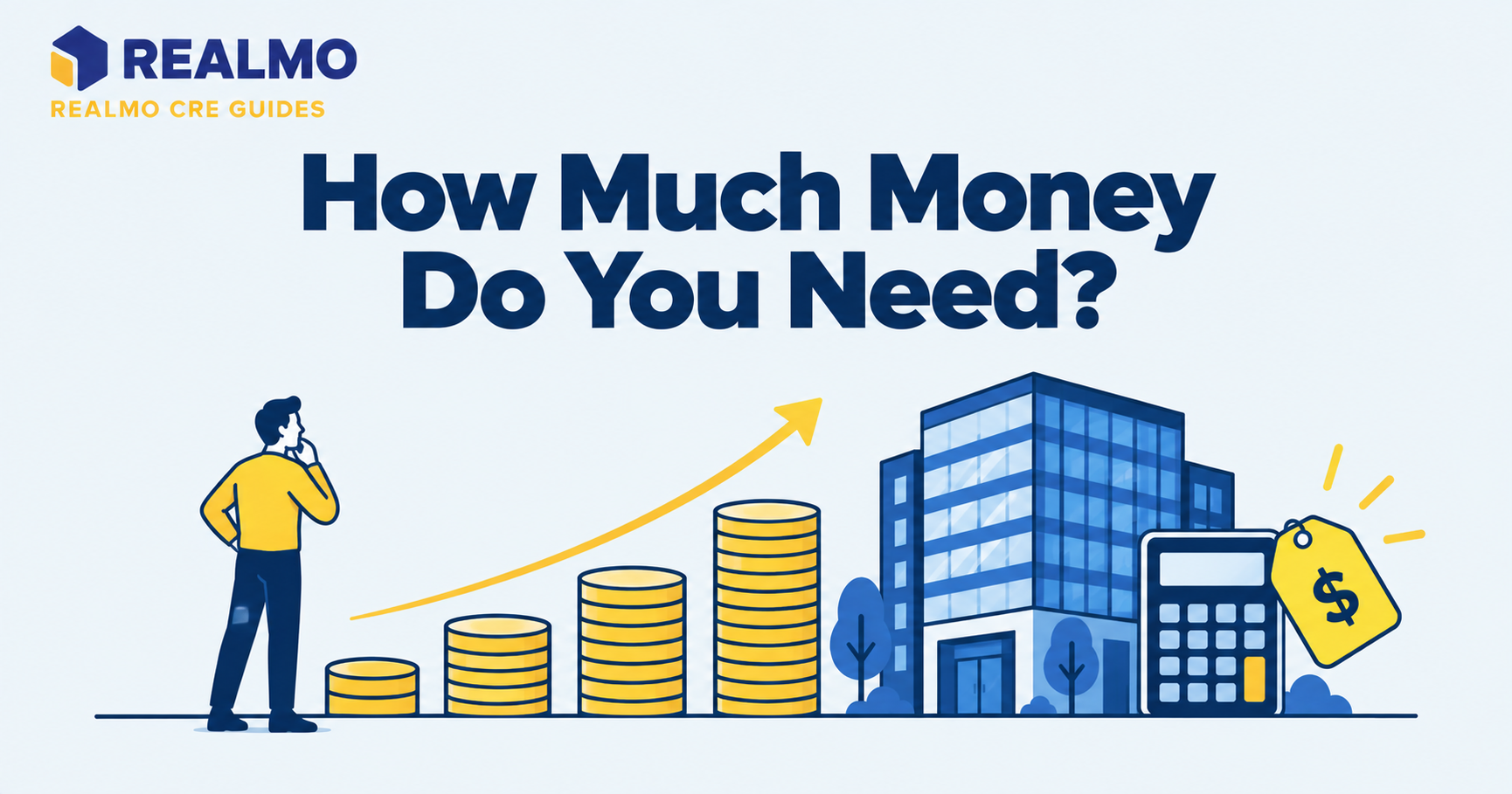
Most commercial purchases require a down payment of roughly 20% to 35% of the price, plus closing costs, due diligence expenses, and post-closing reserves. Once those are added, total cash to close usually lands between 25% and 45% of the purchase price. The exact figure depends on asset type, loan program, and building condition.
That range is the honest answer to how much to invest in commercial real estate on a single deal. The spread is wide because lenders size loans on income and risk, not on a fixed percentage. A building also rarely arrives ready to operate without additional spending.
Why the number is bigger than buyers expect
A first-time buyer with $200,000 in cash usually runs the math as $200,000 ÷ 20% and starts touring $1 million buildings. The offer gets accepted, and the gap appears in stages. The lender comes back at 70% loan-to-value instead of 80% because the property’s debt service coverage ratio is thin. Third-party reports, title work, and legal review consume tens of thousands before closing. The property condition assessment flags a roof with a few years left, and the lender escrows for it.
By the closing table, the same buyer needs closer to $400,000. Deals collapse at this stage more often than they collapse over price. Sizing all five cash buckets before writing an offer is what separates a buyer who closes from a buyer who forfeits an earnest money deposit.
The five cash buckets in a commercial purchase
Every acquisition draws on the same categories, and every one of them is real money out of your account:
- Down payment (equity): the portion of price debt won’t cover.
- Closing costs: loan fees, title, escrow, legal, recording, transfer taxes.
- Due diligence: appraisal, environmental, engineering, survey, inspections.
- Reserves: lender-required escrows plus your own operating cushion.
- Immediate capital expenditures: deferred maintenance and tenant improvements needed in year one.
Only the first bucket is negotiable through financing structure. The other four scale with property size and condition. That’s why small deals commonly carry a higher cash burden as a percentage of price than large ones.
Down payment: what lenders actually expect you to fund
Commercial lenders underwrite two constraints and apply whichever produces the smaller loan. The first is loan-to-value, which caps the loan against appraised value. The second is debt service coverage, which caps the loan against the property’s net operating income.
When a property’s income is strong relative to price, LTV binds and your equity sits at the lower end of the range. When income is thin (a partially vacant building, short remaining lease terms, weak tenant credit), coverage binds, loan proceeds shrink, and equity climbs. Two identical buildings at the same price can require materially different checks for this reason alone.
Borrower profile moves the number too. Lenders weigh net worth relative to loan size, liquidity after closing, and experience with the specific property type. A first purchase in an unfamiliar asset class draws more conservative sizing than a repeat sponsor buying what they already operate.
Closing costs, due diligence, and lender fees
Closing costs for commercial transactions commonly run in the low single digits as a percentage of price. They compress as deal size grows, because many line items are close to fixed. Loan origination, title insurance and search, escrow, borrower’s legal counsel, lender’s legal counsel, appraisal, recording, and state or local transfer taxes all appear here.
Due diligence spending happens before closing and is largely non-refundable. Expect an appraisal, a Phase I environmental site assessment, and a property condition assessment. Add an ALTA survey, zoning verification, and lease audit or estoppel work on tenanted assets. If a report kills the deal, that money is gone. That’s the correct trade, because the alternative is discovering the problem as an owner.
Transfer taxes deserve separate attention because they vary sharply by state and municipality and can be a meaningful line on larger deals. Confirm the local rate and who customarily pays it before modeling your cash requirement.
Reserves that keep the deal solvent after closing
Lenders frequently require escrows for taxes, insurance, replacement reserves, and sometimes tenant improvement and leasing commission reserves on multi-tenant assets. These are funded at closing and add directly to cash needed.
Your own operating reserve is separate and self-imposed. A practical starting point is enough cash to cover debt service and operating expenses through a realistic vacancy period for the asset type. A single-tenant building with one lease expiring in three years needs a deeper cushion than a ten-tenant strip center with staggered rollover. The downside is 100% vacancy rather than 10%.
Deferred capital expenditures belong in the same conversation. The property condition assessment produces an immediate repair list and a long-term replacement schedule. Funding the immediate list at closing, rather than hoping cash flow covers it, is the difference between a stabilized asset and a slow bleed.
How much to invest in commercial real estate by asset type
Property type shifts the equity requirement because it shifts lender risk. Stabilized industrial and net-leased retail with credit tenants commonly support the most aggressive proceeds, since leases are long and income is predictable. Multi-tenant office, hospitality, and special-purpose assets sit at the conservative end. Re-leasing is expensive, operating leverage is high, or the building can’t easily be repurposed.
Vacancy status matters as much as category. A fully leased asset is financed on in-place income. A value-add building with real vacancy is financed on a discounted view of future income, or through bridge debt with tighter terms and higher cost. Value-add strategies routinely need more equity at closing and a construction budget on top of it.
Size cuts the other way. Smaller properties carry proportionally heavier fixed transaction costs. Lenders in the small-balance space commonly hold more conservative LTV standards than institutional lenders serving larger deals.
Financing structures that reduce cash to close
Owner-occupied buyers have the strongest option. SBA programs are built for businesses purchasing their own facility. They’re structured around a substantially lower borrower contribution than conventional commercial debt, with the balance split between a bank loan and a debenture. Program terms, eligibility, and contribution requirements change, so verify current rules directly with the SBA or a participating lender before relying on them. Pure investment properties do not qualify.
Seller financing can bridge part of the equity gap when a seller carries a second position. The first lender must permit it, and usually requires the seller note to be on standby. Assuming existing debt can preserve favorable loan terms while reducing origination costs. But the assumption fee, and the equity gap between loan balance and price, both need to be funded.
Partnering is the most common route for buyers whose deal size exceeds their capital. That means giving up control and economics, and it introduces securities considerations if you raise money from passive investors. Loan programs, tax treatment, and syndication rules all carry consequences specific to your situation. Work through them with a licensed attorney, CPA, or lender before committing capital.
If you’re sizing a target purchase price against the cash you actually have, work backward from listed properties with published valuation and income data. That includes the ownership and use records on Realmo, and it’s faster than guessing at a budget and touring buildings you can’t close on.
Worked example: cash to close on a $1,000,000 property
All figures below are illustrative, chosen for clean math rather than as market benchmarks.
Inputs. Purchase price $1,000,000. Lender approves 70% LTV, giving a loan of $700,000.
Step 1: Equity: $1,000,000 − $700,000 = $300,000
Step 2: Closing costs at 3% of price: $30,000
Step 3: Due diligence (appraisal, Phase I, PCA, survey, legal): $15,000
Step 4: Lender escrows (taxes, insurance, replacement reserve): $20,000
Step 5: Immediate repairs identified by the PCA: $30,000
Step 6: Operating reserve (six months of debt service and expenses): $25,000
Total cash required: $420,000, or 42% of the purchase price.
How to read it. The equity contribution was 30%, but the cash requirement was 42%. The extra 12 points are the difference between a financing assumption and a funding plan. Run this stack before you make an offer, not after inspection.
The common error. Buyers treat due diligence and repairs as costs the deal will absorb later. Repairs deferred at closing tend to arrive during the same month a tenant vacates. That’s when the operating reserve you skipped would have been the only thing keeping the loan current.
Enter the costs and reserves that must be funded in addition to the equity contribution.
Equity + Closing Costs + Due Diligence + Lender Escrows + Immediate CapEx + Operating Reserve
Cash Requirement %:
Total Cash Required ÷ Purchase Price × 100
Work backward from the cash you actually have available. The estimate assumes the same LTV and cost percentages entered above.
Common mistakes in first-purchase cash budgeting
Budgeting from LTV instead of from lender sizing. You model 75% leverage; coverage constraints deliver 65%. The $100,000 gap surfaces two weeks before closing, when your deposit is already hard.
Treating the earnest money deposit as recoverable. After the due diligence period expires, the deposit is usually at risk. A buyer who runs out of cash mid-diligence loses it and the transaction.
Ignoring tenant improvement and leasing commission obligations. A lease expiring within a year of closing usually means renewal concessions or a re-tenanting budget. Neither is optional, and both hit within the first 24 months.
Closing with zero liquidity. Lenders usually require post-closing liquidity, but the deeper issue is operational. An owner with no cash can't fix a failed HVAC unit, and a vacancy that should cost one month's rent becomes six.
Assuming residential mortgage norms transfer. Commercial loans commonly carry shorter terms with balloon maturities, and amortization longer than the term. That makes refinancing capacity part of your capital plan from day one, not a distant concern.
Related terms
- Debt service coverage ratio
- Loan-to-value ratio
- Net operating income
- Cap rate
- Commercial mortgage basics
- Commercial due diligence
- Capital expenditures
- Cash-on-cash return
FAQ
Can I buy commercial property with 10% down?
Usually only through owner-occupied SBA financing, which is designed for businesses buying their own facility and requires a lower borrower contribution than conventional debt. Pure investment purchases rarely qualify. Some sellers carry paper to reduce cash needed, but the senior lender must approve the structure and usually restricts payments on the seller note.
Is 100% financing available for commercial real estate?
Almost never from a single lender. Buyers occasionally reach full leverage by stacking senior debt with seller carry, preferred equity, or a partner's capital contribution. Each layer adds cost and control conditions, and the combined debt service can leave the property with no margin if income dips even modestly.
How much cash do I need for a small retail or office building?
Apply the same five buckets and expect the total to land toward the upper end of the 25% to 45% range. Fixed costs like appraisal, environmental reports, and legal work don't shrink proportionally with price, so smaller deals carry a heavier percentage burden than larger ones.
Can I borrow the down payment?
Most commercial lenders require sourced and seasoned equity and will exclude funds borrowed against the subject property. Some accept a home equity line, business capital, or partner equity if disclosed and if the resulting obligations still support the borrower's global cash flow. Undisclosed borrowed equity is grounds for declining the loan.
Does the down payment change if the building is vacant?
Yes, substantially. Lenders size loans on in-place income, so a vacant or partially vacant building supports far less debt and may require bridge financing. Add the lease-up budget (tenant improvements, commissions, and carrying costs through stabilization) to the equity requirement.