Triple Net (NNN) Leases Explained
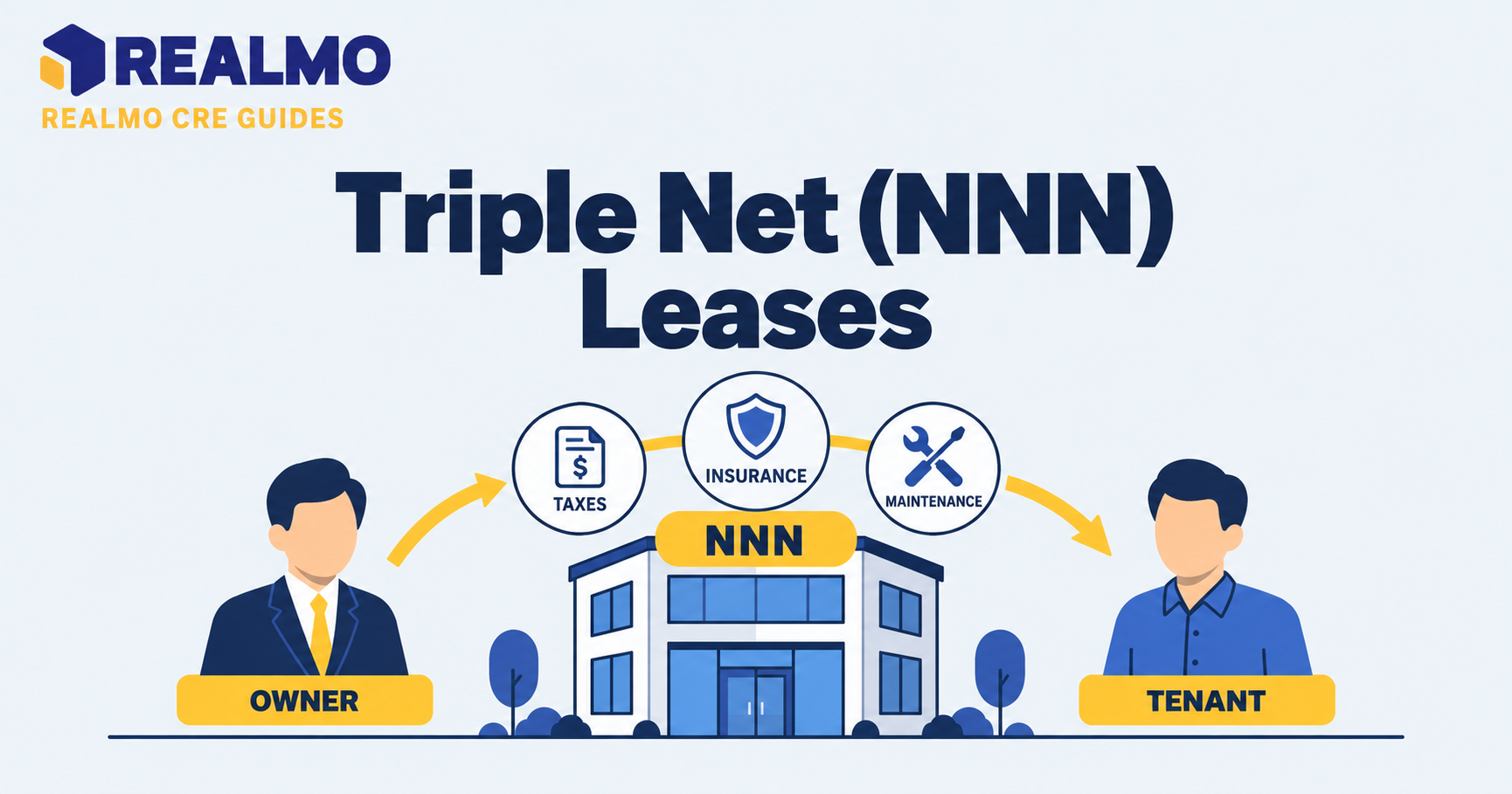
A triple net lease (NNN) is a commercial lease under which the tenant pays property taxes, building insurance, and maintenance on top of base rent. The landlord’s operating load drops sharply. What an owner actually keeps depends on the carve-outs written into the document, not on the three letters in a listing headline.
Why investors buy NNN over multi-tenant buildings
The owner of a nine-tenant flex building spends the year on nine renewals, nine CAM reconciliations, and one roof leak. Sell that building, buy a single-tenant NNN drugstore, and the work collapses into one rent check and one annual insurance certificate. That trade is the appeal.
NNN assets also fit the 45-day identification and 180-day closing clock of a 1031 exchange, because inventory is available nationwide and closings are document-driven rather than operations-driven. Lenders underwrite them faster. One rated credit is simpler to size than nine local businesses on staggered terms.
The trade-off shows up at expiration. Occupancy is 100% or zero. When a single-tenant building goes dark, income stops while taxes, insurance, and maintenance snap back onto the owner within the same month.
What a triple net lease shifts onto the tenant
The three nets are real estate taxes, property insurance, and maintenance. Base rent sits on top. In a clean single-tenant deal, the tenant pays the taxing authority, the insurance carrier, and the landscaper directly, so those dollars never touch the landlord’s bank account.
Multi-tenant NNN works differently. Each tenant pays a pro-rata share based on leasable square footage, billed monthly as an estimate and reconciled after year end. Landlords add an administrative fee on top of the CAM pool, and 10% to 15% of controllable costs is standard practice in US retail and industrial forms. Tenants with negotiating power cap that fee or strike it.
What stays with the landlord is the part investors misread. Most institutional NNN forms carve out roof structure, foundation, load-bearing walls, and latent defects. Some carve out roof membrane replacement as well, while others push membrane repair to the tenant and keep replacement. Parking lot resurfacing lands on either side depending on the draft.
Three obligations sit with the owner in almost every version. Compliance with laws that predate the lease. Environmental conditions from prior occupants. Anything the lease does not expressly assign, since ambiguity in a commercial lease runs against the drafter in many states.
The label is marketing. The rent roll is not proof. Read the expense article, the repair article, and the definitions section before accepting that a deal is truly net.
NNN vs. gross, modified gross, and absolute net
Under a gross lease, the tenant pays rent and the landlord pays everything else out of that rent. Full-service office leases work this way. A modified gross lease splits the difference using a base year stop, where the tenant covers increases above the first year’s expense level.
Net structures stack. A single net lease adds property taxes to base rent. A double net (NN) lease adds taxes and insurance while the landlord keeps roof and structure. Triple net adds maintenance. An absolute net or bondable lease removes the landlord’s remaining outs entirely, including obligations after fire damage or a partial condemnation taking.
That last distinction carries real money. Under a standard NNN form, casualty or condemnation can let the tenant abate rent or terminate. Under a bondable lease, rent continues regardless, which is why credit-tenant lenders will finance those deals at higher proceeds.
Terminology is not standardized across US markets. Brokers in some regions call a deal NNN when the landlord still owns roof and structure, which another market would price as NN. Nobody arbitrates this. The document controls, and a buyer who argues from the listing description rather than the lease article loses the argument at closing.
A ground lease sits further out on the same spectrum. The tenant leases dirt, builds the improvements, pays every cost, and hands the building back at expiry.
How tenant credit and lease term drive NNN pricing
Two NNN buildings on the same corner, with identical rent, sell at different prices. The income is the same. The probability that the income continues is not.
Credit quality comes first. A lease signed by a rated parent entity behaves like a corporate bond with a building attached. The same brand operated by a franchisee with four units and a personal guarantee is a different instrument, and it prices at a wider cap rate for that reason. Check who signed. A subsidiary shell with no assets gives you the logo without the balance sheet.
Remaining term comes second. Investors pay up for long, clean term and mark down anything approaching rollover, because a buyer five years out faces the releasing cost you avoided. Term is an asset that depreciates every month you hold.
Escalations decide whether the income keeps its value. A flat 15-year lease loses purchasing power the whole way. A 10% bump every five years compounds to about 1.92% a year, which lags most inflation assumptions. Annual increases tied to CPI with a floor and a ceiling protect the owner better, and strong tenants resist them hard.
Retail deals add one more test. Ask for unit-level sales and calculate rent as a percentage of them. A store paying 12% of sales in rent is a closure candidate at expiry, while grocery and pharmacy operators renew when occupancy cost runs in the low single digits. If the lease has no sales reporting clause, you are underwriting blind, and that gap belongs in your price.
Worked example: underwriting a single-tenant NNN deal
All figures below are illustrative and rounded for demonstration.
A 12,000 square foot freestanding retail building. Twelve years remain on a 15-year triple net lease with a 10% bump in year 11.
- Base rent: $30.00 per square foot, or $360,000 per year
- Tenant pays directly: property taxes $72,000, insurance $14,000, maintenance and landscaping $30,000
- Landlord retains roof and structure
- Roof reserve: replacement cost at $12 per square foot on a 20-year life, or $7,200 per year
- Asset management, accounting, and entity costs: $6,000 per year
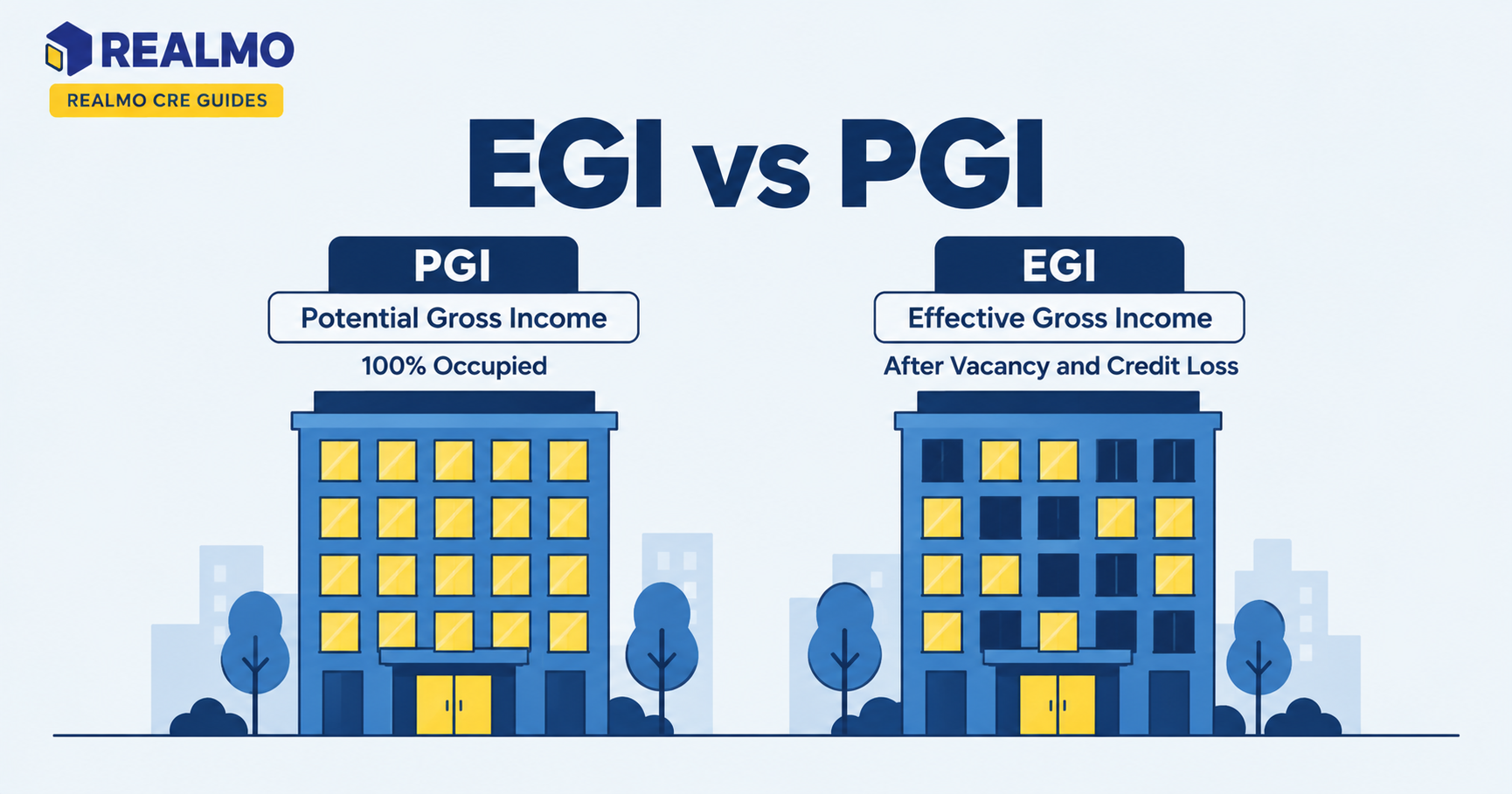
Start with effective gross income. The reimbursed items never enter it, since the tenant pays vendors directly, so EGI equals $360,000.
Subtract the costs the lease leaves with the owner. Roof reserve of $7,200 plus $6,000 of administration equals $13,200. Net operating income is $346,800.
Apply an illustrative 6.50% cap rate. Value lands at $5,335,000. Now run the version most offering memoranda show, where NOI equals base rent of $360,000. That produces $5,538,000.
The gap is roughly $203,000, or about seven months of net rent.
Interpret it as a reserve question, not an accounting quibble. The roof has a finite life, and whoever owns the building when it fails writes the check. A buyer who skips the reserve is financing a capital item with the sale proceeds of the next owner.
One error repeats constantly here. Buyers assume the tenant’s current tax bill carries forward after closing. In states that reassess on transfer, including California under Proposition 13, a sale resets assessed value to the purchase price. The tenant absorbs the increase, total occupancy cost rises, and renewal odds fall. Your NOI is unchanged and your residual just got worse.
Tax treatment of net lease income and exchange transactions turns on facts specific to each owner, so confirm the mechanics with a licensed CPA or attorney before acting.
Lease clauses that decide who really pays
Price the document, not the summary. These provisions move more value than a 25 basis point negotiation on the cap rate.
- Reimbursement method. Direct payment by the tenant beats landlord-billed reimbursement, which leaves you exposed between the vendor invoice and the tenant’s check.
- Tax protest rights. Some leases give the tenant sole authority to contest assessments. Others give it to the landlord and require tenant consent, which stalls appeals in reassessment states.
- Insurance and self-insurance. Large credit tenants negotiate the right to self-insure. That removes a third-party carrier from the structure, and your recovery after a loss depends on the tenant’s solvency.
- Controllable CAM caps. A 5% annual cap on controllable expenses is a common negotiated position in US retail leases, and it holds even when your vendor pricing rises faster.
- Go-dark and continuous operation. A tenant that keeps paying while the store sits empty satisfies the lease, kills co-tenancy clauses next door, and destroys the value of percentage rent.
- Assignment and guarantor release. Watch for language releasing the original guarantor once the lease is assigned. You bought one credit and can end up with another.
- Renewal option rent. Options at fixed rents set a decade earlier cap your upside while giving the tenant a free look at the market.
- Right of first refusal. An ROFR chills your buyer pool at resale, because bidders spend diligence dollars knowing the tenant can step in and take the deal.
Collect a tenant estoppel certificate before closing, and read it against the lease. Discrepancies between what the tenant certifies and what the file says surface most side letters.
Rollover risk and what the building is worth empty
Every NNN deal contains two assets. A stream of contractual rent, and a building that will one day need a new occupant. The first is easy to underwrite. The second is where money is lost.
Ask what a second-generation user would pay. A generic 12,000 square foot rectangle with clear frontage releases at market rent after a few months of downtime. A former bank branch with a vault and a drive-through, or a purpose-built medical suite, releases at a discount and only after demolition. Special-purpose improvements have negative value to the next tenant.
Budget the full re-tenanting cost before you buy: broker commissions, tenant improvement allowance, free rent, legal fees, and carrying taxes and insurance during vacancy. In many single-tenant deals that package consumes more than a year of net rent.
Financing compounds it. When loan maturity falls after lease expiry, you refinance a building with no income and no visibility, and debt service coverage is theoretical at that point. Match loan term to lease term, or shorten the hold.
Property taxes deserve a second look here as well. Big-box owners across several states have pursued dark store valuation appeals, arguing an occupied store should be assessed like a vacant one. Outcomes differ by jurisdiction and the litigation continues, which means an assessment assumption that holds in one county fails in the next.
Before you sign, size demand for the box empty rather than leased. Realmo’s property analytics show ownership records, current and suggested use, and comparable inventory across 9M+ US properties, which is the fastest way to see what else a tenant could occupy within a few miles.
Common mistakes investors make with NNN leases
Treating base rent as NOI. Reserves, administration, and non-reimbursable costs vanish from the model, and the buyer overpays by the capitalized value of every dollar missed.
Buying the brand instead of the signature. A well-known logo on a building signed by a thin franchisee entity gives you operator risk at corporate pricing. Pull the guarantor structure and the lease signature page.
Ignoring escalations. Flat rent across a long term looks stable and erodes in real value each year, which shows up when you sell into a market that has repriced rents upward around you.
Assuming taxes stay put after closing. Reassessment on transfer raises the tenant’s occupancy cost, not yours, until renewal arrives and the tenant walks.
Skipping the residual question entirely. Underwriting stops at lease expiry, as though the building disappears. It does not, and the exit price reflects what the next tenant pays.
Related terms
Absolute net lease · Double net (NN) lease · Common area maintenance (CAM) · Weighted average lease term (WALT) · Sale-leaseback · Percentage rent · SNDA agreement
FAQ
Who pays for the roof in a triple net lease?
It depends on the carve-outs. Most NNN forms leave roof structure, foundation, and load-bearing walls with the landlord, while roof membrane repair goes to the tenant. Replacement is negotiated separately. Read the repair and maintenance article rather than relying on the NNN label, and budget a reserve whenever replacement stays with ownership.
Is a triple net lease the same as an absolute net lease?
No. A standard triple net lease still gives the tenant remedies, including rent abatement or termination rights after a casualty or condemnation. An absolute net or bondable lease removes them, so rent continues under nearly all circumstances. That difference affects financing proceeds and the price a credit-focused buyer will pay.
What cap rate do NNN properties trade at?
There is no single answer, and any figure dates quickly. Pricing moves with tenant credit, remaining lease term, escalation structure, and location. Long-term leases signed by rated corporate entities price tighter than franchisee deals with short term remaining. Compare a specific asset against recent closed sales of similar credit and duration.
Can a triple net property be used in a 1031 exchange?
Yes. Net lease assets are common replacement property because they close on documents rather than operations, which suits the 45-day identification and 180-day closing deadlines. Fractional ownership through a Delaware Statutory Trust is another route. Eligibility and structuring depend on individual facts, so involve a qualified intermediary and a licensed tax advisor.
What happens if the tenant goes dark but keeps paying rent?
The lease stays in force and the income continues. The damage is elsewhere. A dark box can trigger co-tenancy rights for neighboring tenants, ends percentage rent, and signals that renewal will not happen. Lenders and buyers discount dark assets heavily, so the value hit arrives long before the lease expires.