How to Calculate DSCR: Formula, Inputs, and a Worked Example
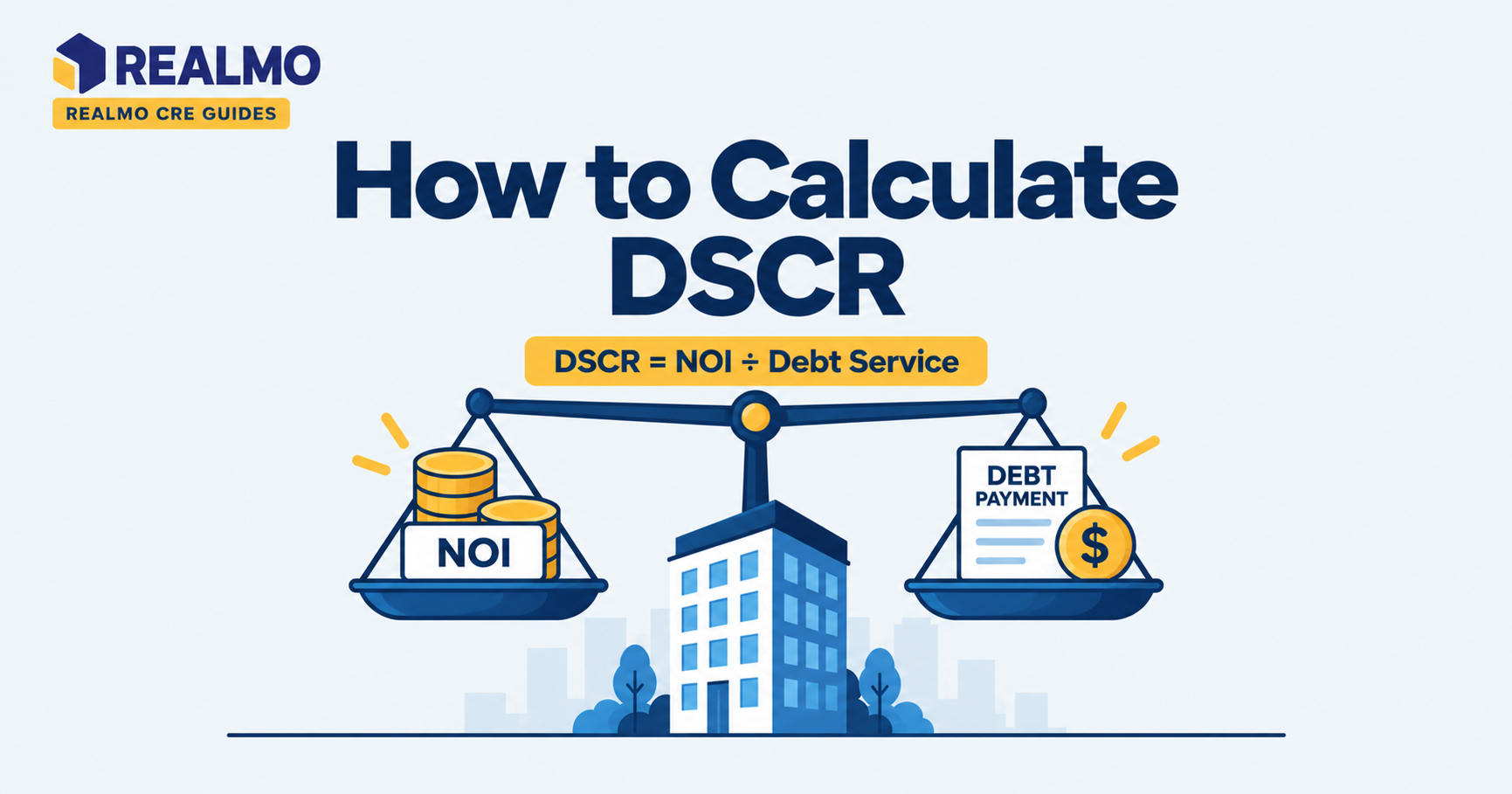
DSCR, or debt service coverage ratio, measures how many times a property’s net operating income covers its annual loan payments. To calculate DSCR, divide annual NOI by annual debt service. A 1.25x result means the property produces $1.25 of income for every $1.00 owed to the lender that year.
DSCR = Net Operating Income ÷ Annual Debt Service
Why DSCR Decides How Much Debt You Can Carry
Learning how to calculate DSCR matters most at two moments: when a loan matures and when you want to pull equity out. Say you own a leased flex building and your loan comes due in eight months. You assume the same balance will roll. Your lender runs its own NOI, applies a management fee you never paid because you self-manage, adds a replacement reserve, and stresses the interest rate. The DSCR that looked comfortable on your books lands below the program minimum, and the quoted proceeds come in short of the payoff.
That gap is a cash call. Owners who calculate DSCR the way lenders calculate it, before an application, not after a term sheet. Have time to raise rents at renewal, trim controllable expenses, or plan for the paydown instead of scrambling for it.
How to Calculate DSCR: The Formula and Its Inputs
The formula is short:
DSCR = Net Operating Income ÷ Annual Debt Service
Both inputs cover the same twelve-month period, and both are property-level. NOI is income after operating expenses but before financing, capital expenditures, depreciation, and income taxes. Annual debt service is twelve months of principal and interest on the mortgage, not interest alone.
The formula is trivial. Almost every disagreement over DSCR is a disagreement about the numerator or the denominator. This is why the rest of this page is about the inputs.
How Lenders Normalize NOI Before the Test
Start with gross potential rent, subtract vacancy and credit loss, add reimbursements and other income to get effective gross income, then subtract operating expenses. The result is net operating income. Your trailing-twelve statement is the starting point, not the answer.
Underwriters adjust that number in predictable ways. They apply a market vacancy factor even if the building is fully leased, since a single tenant rolling changes the picture. They insert a management fee at a market percentage of EGI whether or not you hire a third-party manager. They deduct replacement reserves per unit or per square foot. They exclude one-time income and non-recurring expense credits, and they may reset property taxes to a reassessed basis if the loan accompanies a purchase.
They also haircut income that will not persist through the loan term: rent from a tenant whose lease expires inside the first year, percentage rent that has not been stable, and any gross-up of recoveries the leases do not support. If you want to see how your expense load compares with similar assets nearby, property-level data on Realmo , ownership records, current use, and location context on 9M+ properties , is a reasonable place to sanity-check your assumptions before a lender does it for you.
How to Build the Annual Debt Service Figure
Annual debt service is the sum of twelve scheduled payments of principal and interest. Pull it from the amortization schedule, not from the interest expense line on your P&L, which excludes principal and understates the denominator.
Three details change the number more than owners expect. First, amortization term: a loan amortized over a longer schedule carries a lower annual constant and a higher DSCR at the same rate and balance. Second, interest-only periods: DSCR during an IO period is flattering, and lenders usually size on the amortizing payment that begins later. Third, the underwriting rate: many lenders test coverage at a stressed rate or a minimum debt constant rather than the coupon on the term sheet.
If the property carries more than one obligation , mezzanine debt, a seller note, or a ground lease payment structured as debt , ask which stack the lender is testing. Senior-only coverage and total-debt coverage can differ enough to change the loan you get. Ground rent under a true ground lease is commonly treated as an operating expense, which reduces NOI instead of increasing debt service.
Worked Example: DSCR on a Leased Flex Building
All figures below are illustrative round numbers chosen to show the mechanics, not market data.
A flex building generates gross potential rent of $900,000. Apply a 5% vacancy and credit loss factor, or $45,000, for effective gross income of $855,000. Operating expenses, taxes, insurance, utilities, repairs, a market management fee, and reserves, total $355,000. NOI is $500,000.
The requested loan is $5,000,000 at an illustrative 6.5% interest rate on a 25-year amortization schedule. That payment works out to roughly $33,760 per month, or about $405,120 per year.
DSCR = $500,000 ÷ $405,120 = 1.23x
Interpretation: the property covers its payments with about 23% of NOI to spare. Against a 1.25x minimum, it falls short. Run the test backward to find the loan that clears: $500,000 ÷ 1.25 = $400,000 of allowable annual debt service. This at the same rate and amortization supports roughly $4.94 million. The DSCR constraint costs about $60,000 of proceeds, and every dollar of underwritten NOI you fail to defend costs roughly four dollars of loan.
The most common error at this step is testing coverage against the going-in payment during an interest-only period. At $5,000,000, interest-only annual debt service is $325,000 and DSCR reads 1.54x , a number that has nothing to do with what the loan requires once amortization starts.
What DSCR Thresholds Lenders Underwrite To
There is no universal minimum. Conventional lenders commonly look for 1.20x to 1.25x on stabilized income-producing property, with higher coverage required as perceived risk rises: shorter remaining lease term, single-tenant exposure, secondary markets, or asset types with volatile expenses like hospitality. Agency multifamily programs (Fannie Mae and Freddie Mac), SBA (Small Business Administration) loans, and life company debt each apply their own floors and their own NOI adjustments, so a DSCR calculated for one program does not transfer to another.
Direction matters more than any specific threshold. Longer weighted-average lease term, stronger tenant credit, and lower expense volatility all support lower required coverage. This is because the lender's confidence in next year's NOI is higher. Transitional or vacant assets are underwritten to a stabilized DSCR at exit rather than a current one. This is why coverage tests and debt yield tests disagree.
DSCR vs. Debt Yield and LTV in Loan Sizing
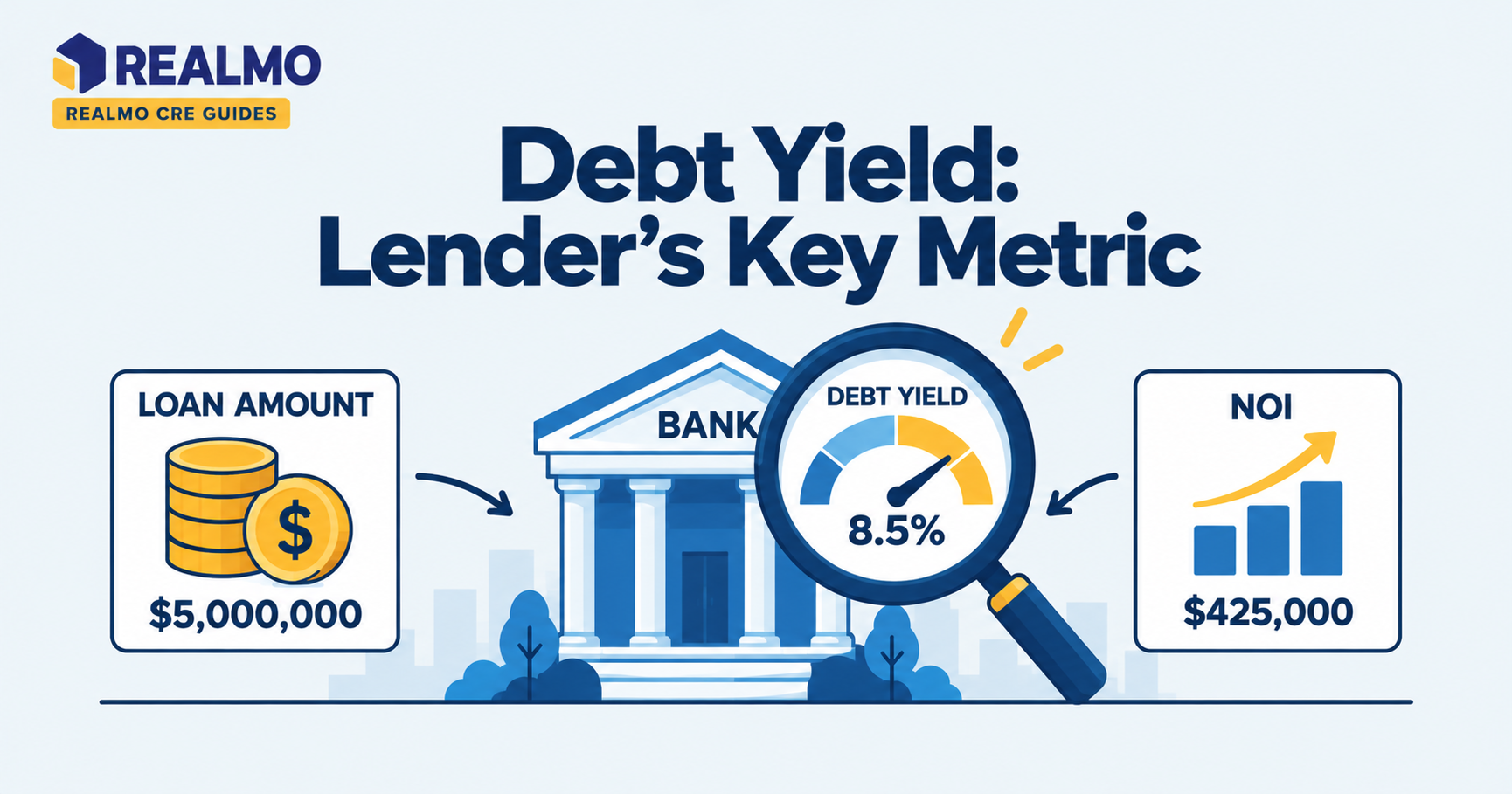
DSCR is rate-sensitive; debt yield is not. Debt yield divides NOI by the loan amount and asks what unlevered return the lender earns if it takes the property back. LTV compares the loan to appraised value and is sensitive to cap rate movement.
Lenders size to all three and lend the lowest result. When rates are low relative to cap rates, LTV usually binds first. When financing costs rise, DSCR binds first, and loans get smaller even though nothing about the building changed. Understanding which constraint controls your deal tells you whether to argue about NOI, about the appraisal, or about the amortization schedule.
Common Mistakes When Calculating DSCR
- Using interest expense instead of full debt service. This inflates DSCR and produces a proceeds estimate the lender will never match.
- Using your actual NOI instead of underwritten NOI. Self-management, deferred maintenance, and unreserved capex all disappear from owner statements and reappear in the lender's model, usually as a lower loan amount.
- Counting expiring income at full value. A lease rolling in month nine gets haircut or excluded; building your refinance plan around it invites a shortfall at closing.
- Ignoring subordinate debt. Seller notes and mezzanine pieces reduce total-debt coverage even when senior DSCR looks fine, and can trip covenants you already signed.
- Confusing the sizing test with the ongoing covenant. Many loans require a minimum DSCR measured quarterly or annually after closing, with cash management triggered on a breach. Clearing the test at origination is not the same as staying clear of it.
Loan programs, underwriting adjustments, and covenant definitions vary by lender; confirm how your specific documents define NOI and debt service with your lender and a licensed professional before relying on any DSCR figure.
FAQ
What is a good DSCR for a commercial property?
Most conventional lenders want at least 1.20x to 1.25x on stabilized assets, but the required level rises with risk. Short lease terms, single-tenant exposure, and volatile expense structures push the minimum higher. A DSCR below 1.0x means income does not cover payments without outside cash.
Does DSCR use NOI or cash flow after debt service?
It uses NOI, income after operating expenses but before principal, interest, capital expenditures, depreciation, and income taxes. Cash flow after debt service is what remains once the loan is paid. This is the output of the DSCR calculation rather than an input to it.
How do I calculate DSCR with an interest-only loan?
Divide NOI by twelve months of interest payments for the current-period ratio. But also calculate coverage on the fully amortizing payment that begins after the IO period ends. Lenders size the loan on the amortizing figure, and covenant tests follow the same convention.
Can DSCR be improved without raising rents?
Yes, though the levers are limited. Extending the amortization schedule lowers annual debt service, reducing controllable operating expenses raises NOI, and paying down principal shrinks the denominator. Contesting an assessed property tax value can also help where taxes represent a large share of the expense load.
Related terms: Net Operating Income · Debt Yield · Loan-to-Value Ratio · Cap Rate · Amortization Schedule · Cash-on-Cash Return · Operating Expense Recoveries