Commercial Property Types: A Complete Overview
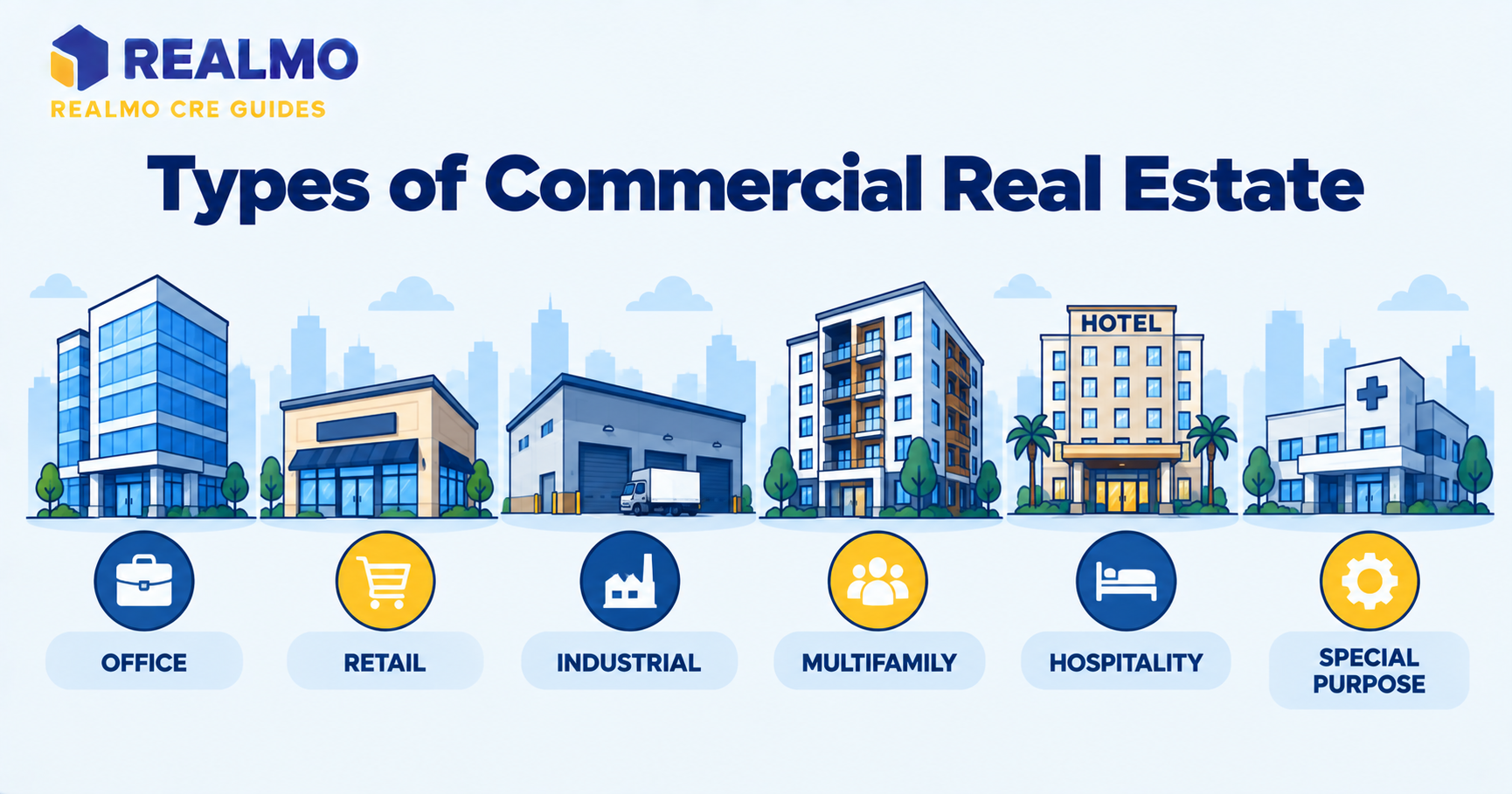
Commercial property is real estate held to produce income rather than to shelter its owner. The primary types of commercial property are office, retail, industrial, multifamily, and hospitality. Specialty categories add self-storage, data centers, and medical outpatient buildings. Each type carries its own lease structure, tenant profile, and capital demands.
Why Property Type Drives Every Underwriting Decision
An investor comparing two buildings at the same price and the same going-in yield is not comparing two versions of the same deal. A single-tenant industrial building leased to a distributor on a long-term net lease throws off predictable cash flow with minimal owner involvement. Its main risk sits in one event: what happens at lease expiration. A limited-service hotel at an identical price re-prices its entire revenue stream every night. It also needs a management contract and consumes a meaningful share of revenue in furniture and equipment replacement.
Those two deals require different debt structures, different reserve assumptions, different holding periods, and different skills from the owner. Property type is the variable that sets all of them. Investors who skip this step tend to underwrite a hotel with an office mindset, or price multifamily turnover using retail assumptions. The error shows up in year two rather than at closing.
What Counts as Commercial Property
The dividing line is use, not size or appearance. Property held to generate rental income, support a business operation, or be resold at a profit is commercial. Property occupied by its owner as a primary residence is not. A duplex the owner lives in sits on the residential side of the line. A twenty-unit apartment building is commercial, even though every tenant inside it is a household.
Residential rental property crosses into commercial territory at five or more units under most lender conventions. Below that threshold, lenders usually underwrite the borrower’s personal income and credit. At and above it, they underwrite the property’s own cash flow and require different documentation. They also commonly price the loan off a spread over a benchmark index rather than a consumer rate sheet. That single distinction changes who can buy the asset and on what terms.
Valuation follows the same split. Small residential property is valued primarily by comparable sales. Commercial property is valued primarily by the income it produces. That’s why net operating income and cap rate sit at the center of nearly every commercial conversation. Two identical buildings across the street from each other can carry very different values if one has strong leases and the other does not.
Tax treatment splits along a related line. The IRS assigns a 39-year recovery period to nonresidential real property and 27.5 years to residential rental property. This falls under the modified accelerated cost recovery system described in IRS Publication 946. An apartment building therefore depreciates faster than an office building of the same cost basis. That difference affects after-tax returns even when pre-tax cash flow is identical. Depreciation rules, cost segregation, and exchange treatment are fact-specific; confirm your position with a licensed tax professional before relying on it.
The Five Core Types of Commercial Property
Most of the U.S. investment market organizes itself around five property types. Institutional reporting standards, lender credit boxes, and broker specializations all track these categories, so understanding them is the practical entry point to everything else.
Office
Office buildings house administrative, professional, and corporate work. They range from single-story suburban buildings to central business district towers. Leases usually run multiple years, with landlord obligations for common areas and building systems, and commonly a tenant improvement allowance.
Office carries the heaviest re-leasing cost burden of the core types. When a tenant vacates, the owner usually funds a build-out for the next occupant, pays leasing commissions, and absorbs downtime. That combination means office cash flow looks smooth in the middle of a lease term and lumpy at the edges. Underwriting that ignores rollover reserves will overstate returns.
Retail
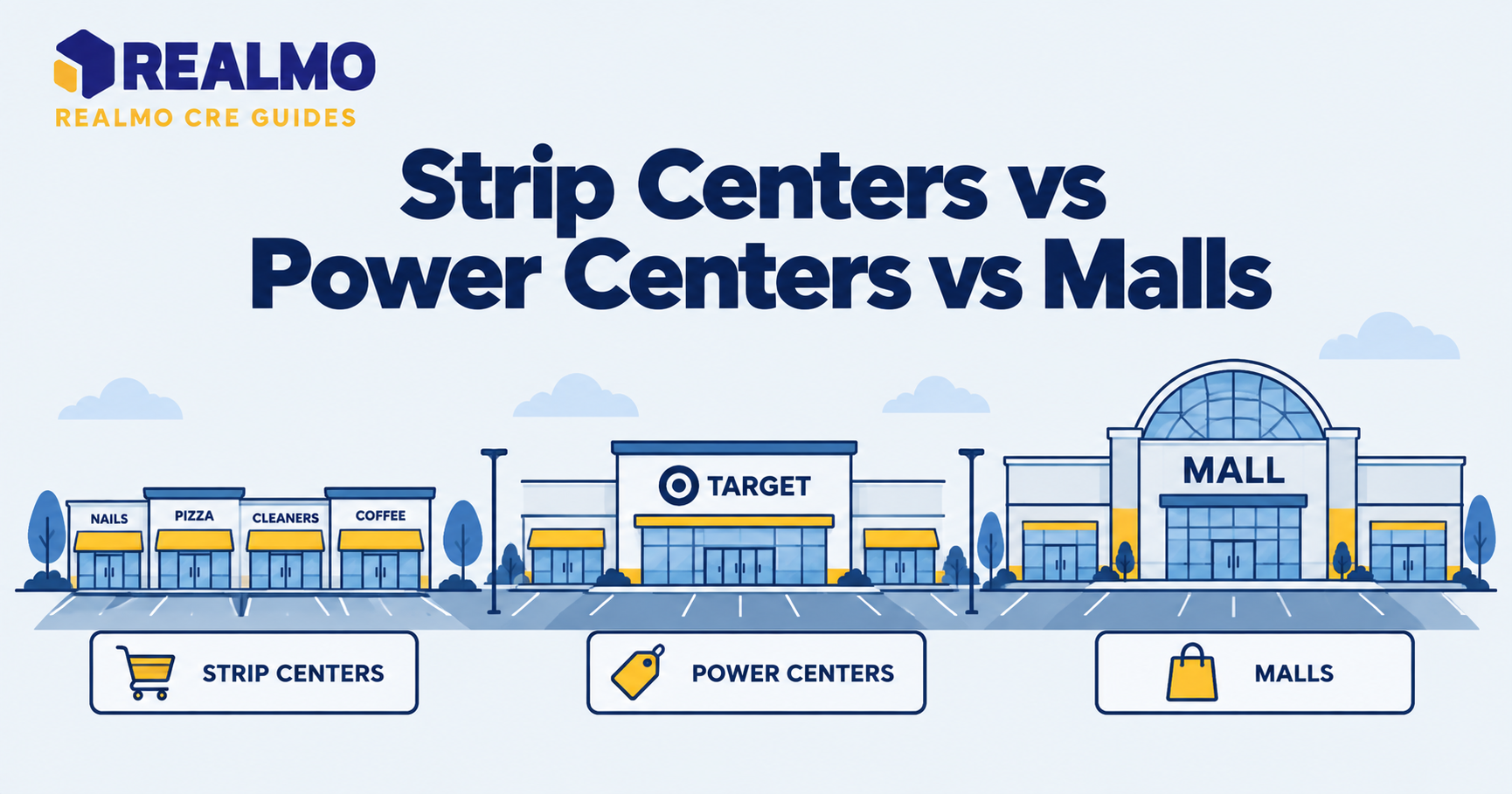
Retail covers property leased to businesses selling goods and services directly to consumers, from single-tenant net-leased pharmacies to enclosed regional malls. The category is best understood by format rather than by size. Neighborhood centers anchored by grocers behave differently from power centers, which behave differently from urban high-street storefronts.
Retail leases frequently include percentage rent, a mechanism where the tenant pays base rent plus a share of sales above a stated breakpoint. Retail also brings co-tenancy clauses, exclusive-use provisions, and anchor dependencies that have no direct equivalent in other property types. Reading a retail lease closely matters more here than almost anywhere else.
Industrial
Industrial property covers warehouses, distribution centers, light manufacturing, flex space, and cold storage. Physical specifications drive value in this category more than aesthetics. Clear height, column spacing, dock door count, truck court depth, power capacity, and highway access determine which tenants can use the building at all.
Industrial buildings are usually the simplest core type to own. Leases run long, and tenants handle most operating obligations under net structures. Re-tenanting a generic box also costs far less per square foot than re-tenanting an office floor. That efficiency is priced in. It’s why industrial cap rates in a given market usually sit below retail of comparable quality: longer leases and lower capital intensity command a premium.
Multifamily
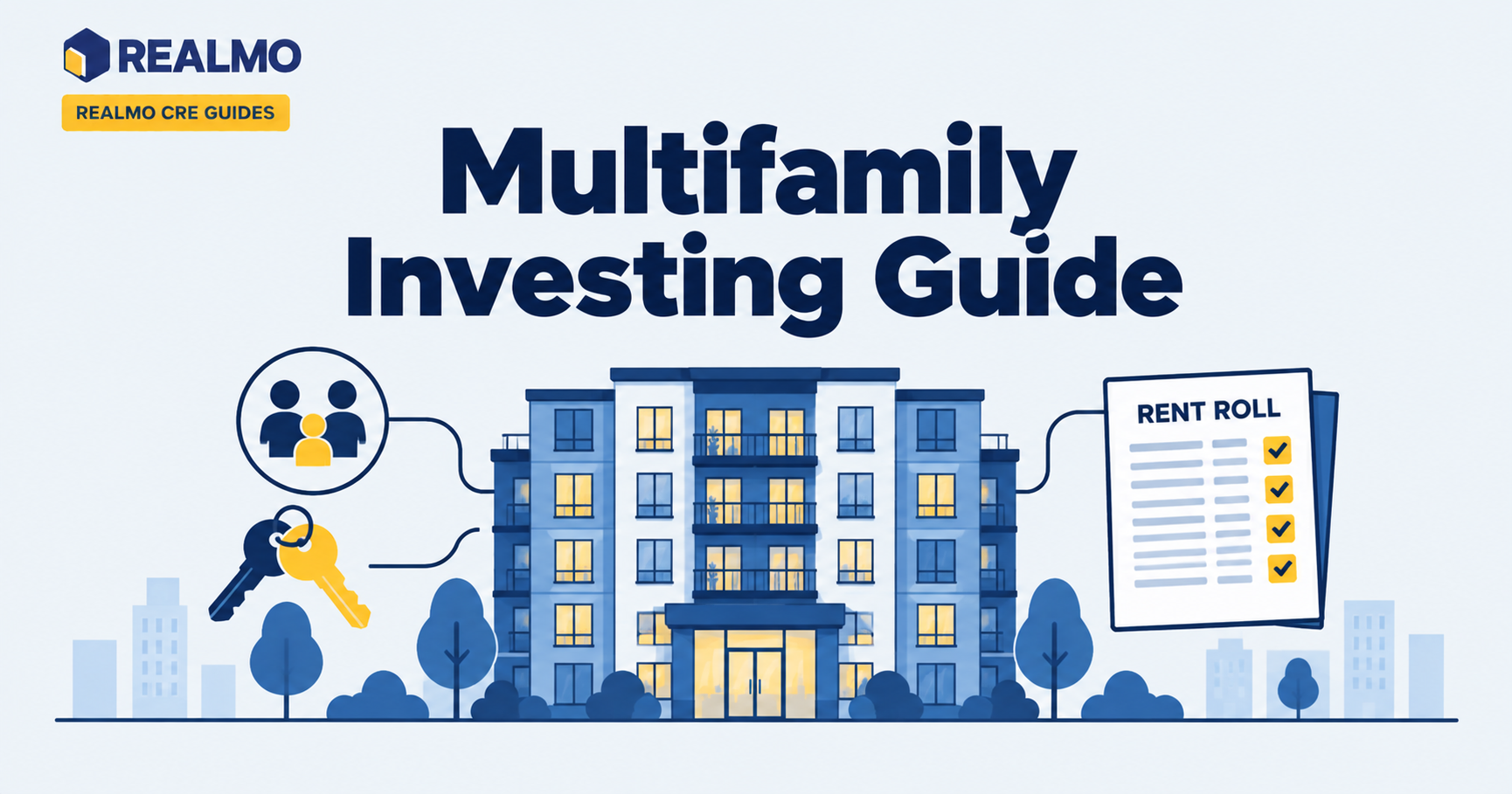
Multifamily is apartment property with five or more units, spanning garden-style suburban communities, mid-rise urban buildings, and high-rise towers. Leases usually run twelve months, so the entire rent roll re-prices within a year.
That short duration cuts both ways. Rents adjust upward quickly when demand strengthens and downward just as quickly when it weakens. That gives multifamily less contractual protection than a net-leased asset, but more responsiveness. Multifamily also has the deepest debt market of any commercial type. Fannie Mae and Freddie Mac multifamily loan programs support it, alongside banks and life companies, which affects both financing terms and liquidity at sale.
Hospitality
Hotels are operating businesses that happen to occupy real estate. Revenue depends on nightly rate and occupancy rather than contractual rent. Expenses include labor, food and beverage, brand fees, and reservation costs that no landlord in the other four categories carries.
Hotels are also the most capital-hungry core type. Furniture, fixtures, and equipment wear out on a recurring cycle, and brand standards force periodic renovation whether the owner wants it or not. Hospitality returns tend to move with travel demand faster than any other property type, which makes it the most cyclical of the five.
How Building Class A, B, and C Ratings Work
Class ratings describe quality and competitive position within a specific submarket. They are conventions, not certifications, and no governing body issues them.
Class A means newer construction, strong location, modern systems, and the rents to match. Class B means functional, well-located, and somewhat dated: it’s usually a candidate for renovation. Class C means older buildings with deferred maintenance, functional obsolescence, or weaker locations, competing primarily on price.
The critical point is that class is relative to the market. A Class A building in a mid-sized metro would be Class B or lower in a major coastal downtown. Comparing a “Class A” asset in one city to a “Class A” asset in another without examining the actual buildings produces misleading conclusions.
Class also correlates with tenant behavior. Higher-class buildings tend to attract tenants with stronger credit and longer time horizons, while lower-class buildings commonly trade rent stability for higher yield. Investors pursuing value-add strategies usually target Class B and C property where a physical or operational improvement can move the asset up a tier.
How Lease Structures Differ by Property Type
The lease determines who pays which expenses, and that allocation shapes both risk and reported income. Two buildings with the same gross rent can produce very different net operating income depending on lease form.
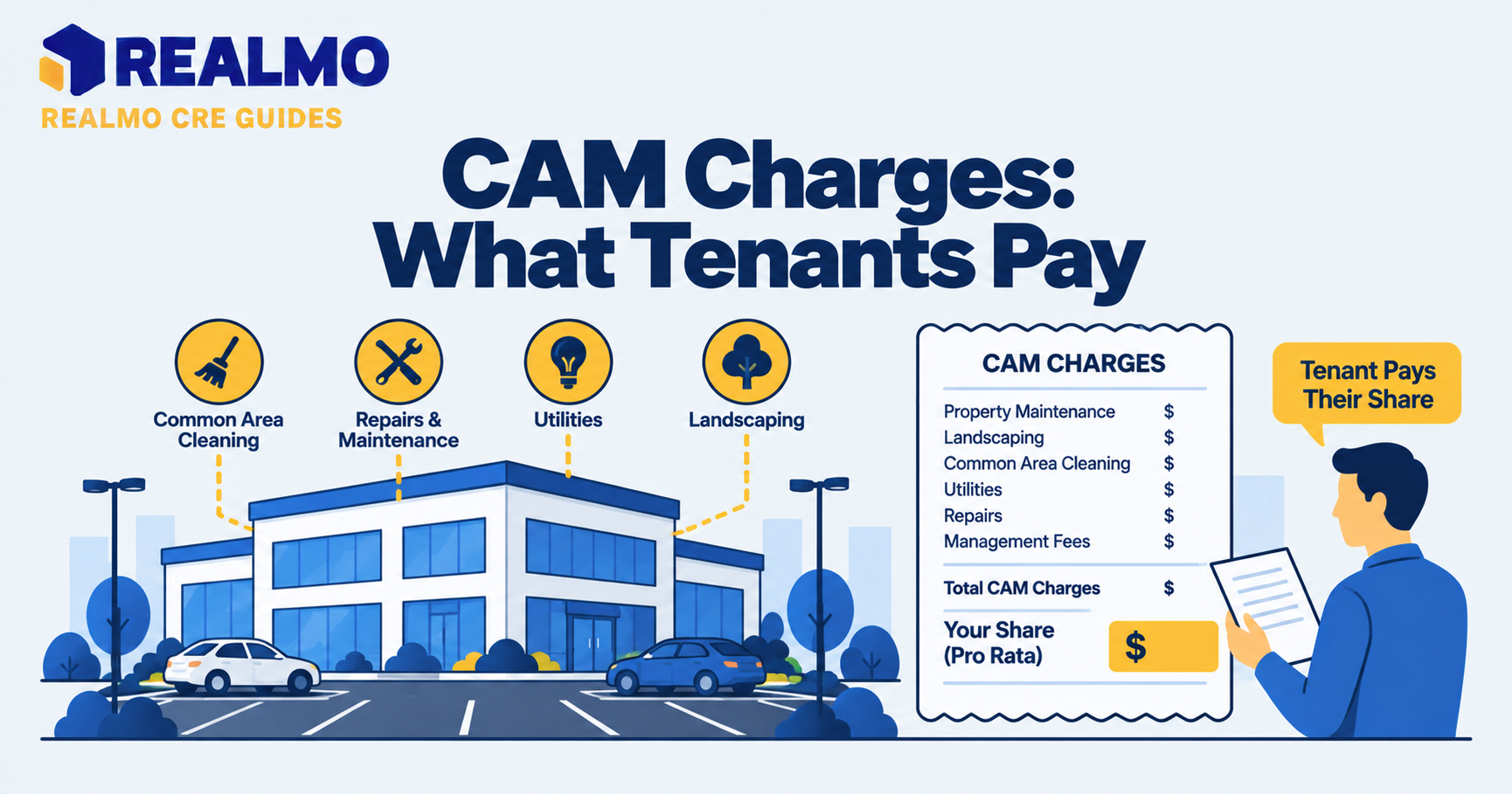
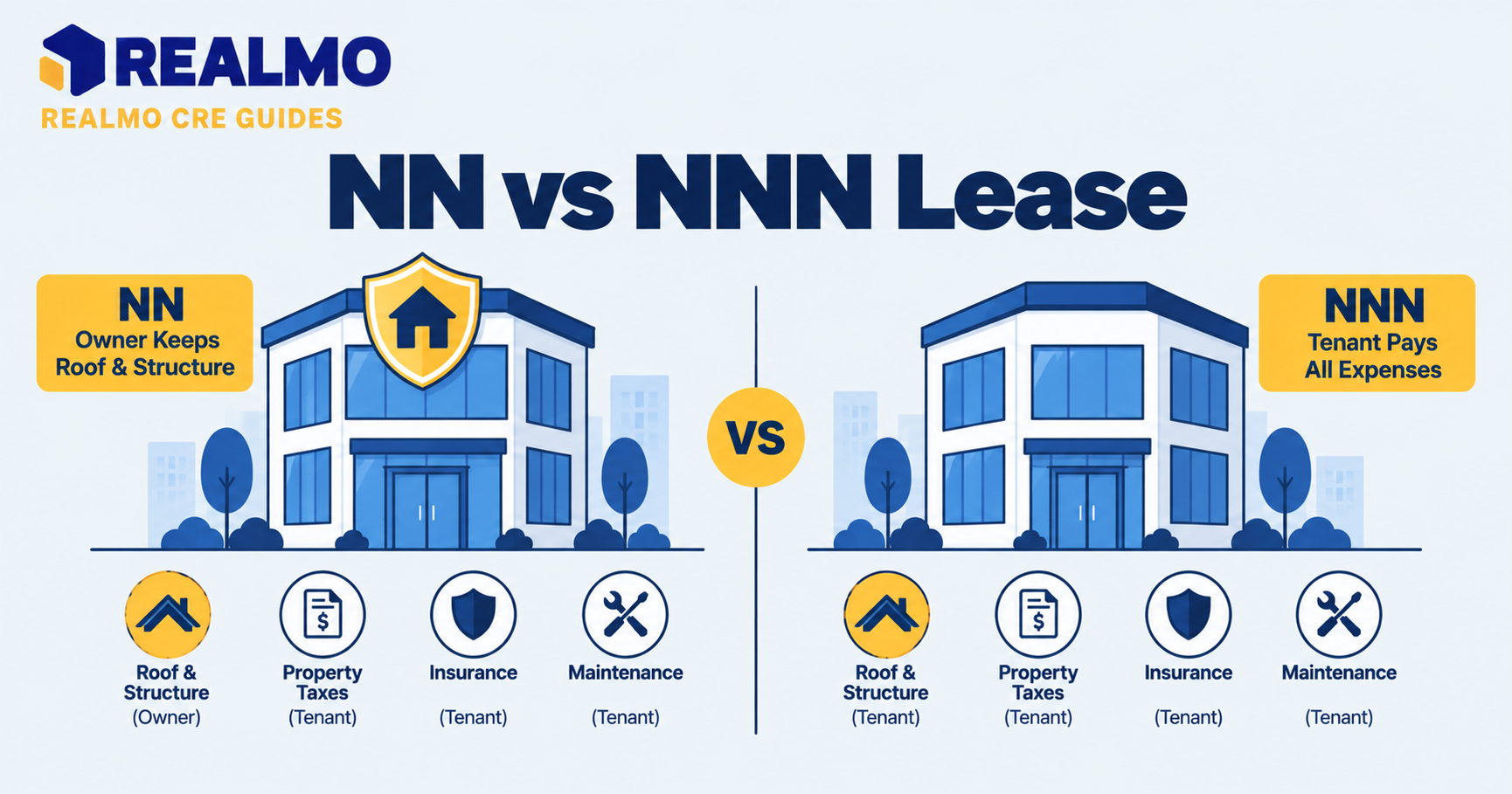
Under a gross lease, the tenant pays one rent figure and the landlord covers taxes, insurance, and maintenance. Under a modified gross lease, the tenant reimburses some expenses above a base-year amount. Under a triple net lease, the tenant pays taxes, insurance, and maintenance directly, leaving the landlord with a thinner but more predictable stream. Absolute net structures push even structural and roof obligations to the tenant.
Property type predicts which structure prevails. Office commonly uses full-service or modified gross terms, with operating expense escalations tied to a base year. Industrial and freestanding retail lean heavily net. Multifamily uses short gross leases where the landlord absorbs nearly every operating cost. Hotels use no lease at all. The operator agreement replaces it.
Lease term length follows the same pattern. Single-tenant net-leased retail and industrial commonly carry initial terms measured in decades with contractual rent escalations and renewal options. Office terms are usually shorter and negotiated suite by suite. Apartments turn annually. The longer and more creditworthy the income stream, the more the asset behaves like a bond and the less it behaves like an operating business.
How Risk and Capital Intensity Vary by Type
Place the property types on a spectrum from passive to operational and most of their differences fall into order.
At the passive end sits single-tenant net-leased property, where the owner collects rent and the tenant runs the building. Risk concentrates in a single credit and a single expiration date. At the operational end sits hospitality, where the owner is exposed to daily revenue management, labor costs, and brand requirements. Multifamily, office, and multi-tenant retail fall in between, each requiring active leasing and expense management but not daily operations.
Capital intensity tracks the same order. Recurring capital expenditure runs lowest in generic industrial and highest in hotels. Office sits in between, because of tenant improvement and leasing commission obligations at every rollover. Underwriting that models only mortgage payments and operating expenses, without reserves for capital items, will overstate free cash flow in every category. It will overstate it badly in office and hospitality.
Tenant diversification changes the shape of risk rather than its amount. A hundred-unit apartment building losing one tenant loses one percent of its rent roll. A single-tenant building losing its tenant loses everything until it re-leases. Neither is inherently safer; they simply fail differently, and lenders size debt accordingly. Understanding how debt service coverage ratio requirements shift by property type explains much of why the same buyer gets different loan proceeds on different assets.
Specialty and Niche Commercial Property Types
Beyond the five core categories sits a growing set of specialty types, most of which combine real estate with a service operation.
Self-storage rents small units on short terms with low staffing and low build-out cost. That produces high operating margins and heavy reliance on street-level marketing and unit-mix management. Data centers lease power and cooling capacity as much as square footage. Their value depends on utility access, redundancy, and connectivity rather than curb appeal. Medical outpatient buildings serve healthcare providers whose equipment and licensing make relocation expensive, which tends to produce longer tenure than conventional office.
Senior housing spans independent living, assisted living, and memory care, moving further toward operating business at each step. Life science buildings require specialized ventilation, floor loading, and lab infrastructure that ordinary office cannot economically retrofit. Cold storage adds refrigeration systems, insulated envelopes, and power redundancy to a warehouse shell.
Two categories sit slightly apart. Land is commercial property with no income stream, valued on entitlement status and highest and best use rather than on rent. Mixed-use combines two or more types in one asset. That means the owner underwrites each component separately, then accounts for how they interact. A residential tower over failing ground-floor retail is not a single asset with a blended cap rate.
Specialty types usually offer thinner buyer pools and fewer comparable sales. Exit liquidity deserves explicit attention during underwriting, not an assumption borrowed from core property.
Where to Go Next in the Asset Classes Section
This hub introduces the categories. The pages below go deeper into each one. Most investors work through the two or three that match their capital, timeline, and appetite for operations.
Office property fundamentals covers building classifications, the mechanics of tenant improvement allowances and leasing commissions, and base-year expense stops. It also covers how to model rollover risk across a multi-tenant rent roll. Start here if you are evaluating suburban or urban office. You need to understand why the same rent produces different net income in different lease forms.
Retail property fundamentals breaks down center formats from neighborhood strips through regional malls, and explains anchor and co-tenancy dynamics. It also walks through percentage rent, exclusive-use clauses, and how trade area analysis supports rent conclusions. The guide also addresses what distinguishes durable retail locations from ones that depend on a single traffic generator.
Industrial property fundamentals focuses on the physical specifications that determine tenant demand: clear height, dock configuration, truck court depth, power, and site coverage. It explains why functional obsolescence in industrial usually comes from building geometry rather than age.
Multifamily property fundamentals covers unit mix, turnover cost, loss to lease, and agency debt programs. It also covers the operating detail that separates a stabilized community from one running on concessions. It is the natural starting point for investors moving up from small residential rentals.
Hospitality property fundamentals explains the operating metrics hotels use and the difference between brand affiliation and management agreements. It also explains why replacement reserves are treated as a fixed obligation, not a discretionary line item.
Self-storage, data centers, and other specialty assets each get their own treatment covering the operating layer that sits on top of the real estate. Coverage also includes the infrastructure requirements that limit competing supply, and the narrower buyer pool that affects exit pricing.
Land and development addresses entitlement risk, zoning, and highest and best use analysis, plus carrying costs during the approval period. It also covers the point at which a land basis stops working for a proposed project.
Mixed-use property explains component-by-component underwriting and the operational friction between residential and commercial uses in one building. It also covers the financing complications that arise when a single asset spans two lender credit boxes.
If you are comparing types before you commit to one, property-level data helps more than category-level generalization. Realmo publishes valuation estimates, ownership records, current and suggested use, and location insights across more than nine million U.S. properties, without a paywall. That lets you test how a category actually behaves in the specific submarket you’re considering, rather than in the aggregate.
Related Terms
- Net operating income
- Cap rate
- Triple net lease
- Debt service coverage ratio
- Highest and best use
- Value-add real estate
- Tenant improvement allowance
FAQs
What are the main types of commercial property?
The five core types are office, retail, industrial, multifamily, and hospitality. Specialty categories include self-storage, data centers, medical outpatient buildings, senior housing, life science, and cold storage. Land and mixed-use property are also treated as commercial. Each type differs in lease structure, tenant profile, capital requirements, and how actively the owner must manage the asset.
Is an apartment building commercial or residential property?
An apartment building with five or more units is usually treated as commercial for lending and investment purposes, even though its occupants are households. Below five units, most lenders underwrite the borrower rather than the property. For tax depreciation, residential rental property uses a 27.5-year recovery period while nonresidential property uses 39 years, per IRS Publication 946.
Which commercial property type is easiest to start with?
There is no consensus answer, and the honest framing is a trade-off. Multifamily has the deepest financing market and the most familiar tenant relationship, but rents reset annually and management is hands-on. Single-tenant net-leased retail or industrial requires far less operational involvement but concentrates all risk in one tenant and one lease expiration.
What does Class A, B, or C mean for a commercial building?
Class ratings describe a building’s quality and competitive standing within its own submarket. Class A means newer construction and top-tier location and finishes. Class B means functional but dated. Class C means older, with deferred maintenance or weaker positioning. No agency assigns these ratings, and they are relative. A Class A building in one metro may not qualify as Class A in another.
How does property type affect commercial financing?
Lenders set loan-to-value limits, coverage requirements, and amortization terms by property type based on income durability and capital intensity. Multifamily usually accesses the widest range of lenders, including agency programs. Hospitality and specialty operating assets usually face more conservative sizing because their revenue is not contractual. Loan terms are market-dependent; confirm current parameters with your lender.