Debt Yield: The Metric Lenders Actually Watch
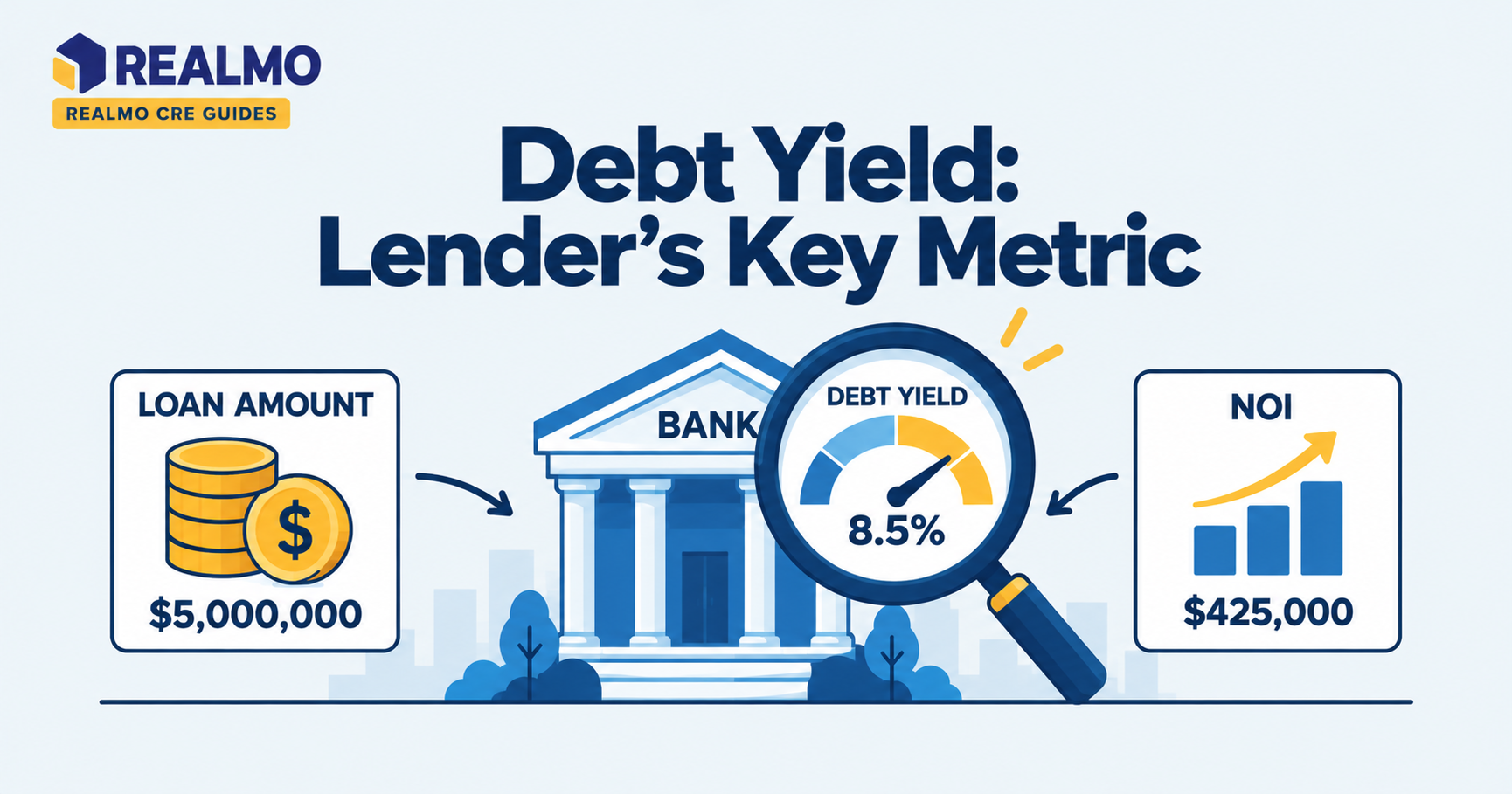
Debt yield is a lender’s measure of loan risk, calculated as a property’s net operating income divided by the loan amount. Expressed as a percentage, it shows the annual cash return a lender would earn if it foreclosed, and took the asset back, with no reliance on appraised value, interest rates, or amortization terms.
Debt Yield = Net Operating Income ÷ Loan Amount × 100
Maximum Loan = Net Operating Income ÷ Required Debt Yield
Why debt yield decides your refinance proceeds
You own a stabilized retail strip, your loan matures in nine months, and you assume the refinance will clear. This is because the property appraises well and covers its payments comfortably. Then the term sheet arrives smaller than expected. The appraisal was fine. The debt service coverage ratio penciled. What cut the proceeds was debt yield, the one test that ignores everything a soft interest rate environment or an aggressive appraisal can flatter.
For an owner, that gap has direct consequences. Short proceeds mean writing a check at closing, raising preferred equity at a cost that eats your distributions, or selling on someone else's timeline. Understanding debt yield months before you apply lets you either fix the income side or size your expectations correctly.
What debt yield measures and why lenders trust it
Debt yield answers a blunt question: if the borrower stops paying tomorrow, and the lender ends up owning the building, what unlevered return does the loan balance earn? Because the calculation uses only in-place net operating income and loan dollars, it strips out every variable a lender cannot control.
That independence is the point. Loan-to-value depends on an appraisal, and appraised values move with market cap rates. DSCR depends on the interest rate and amortization schedule, stretch amortization to 30 years and coverage improves without the property earning an extra dollar. Debt yield can't be engineered by structure. It only improves if income rises or the loan shrinks.
The metric moved to the center of commercial underwriting after the 2008 credit cycle. When securitized loans that passed LTV and DSCR tests at origination proved badly oversized once values corrected. Commercial mortgage-backed securities (CMBS) lenders adopted debt yield as a floor, and balance-sheet and agency lenders followed.
How to calculate debt yield
The formula is short:
Net operating income is trailing, in-place, and underwritten by the lender, not your pro forma. Expect the lender to mark rents to market, apply its own vacancy, and credit loss assumption, deduct a management fee whether or not you pay one, and subtract replacement reserves. Owners are routinely surprised that the NOI in the loan file is lower than the NOI in their own model.
Rearranged, the formula sizes the loan directly:
That version is the useful one. Before you speak to a lender, you can estimate your own ceiling in about a minute.
Debt yield vs. DSCR and LTV as sizing constraints
Lenders run all three tests and lend on the smallest result. The three answer different questions: loan-to-value asks how much equity cushion sits beneath the debt, DSCR asks whether current income covers current payments, and debt yield asks what the loan is worth if both of those assumptions fail.
Which test binds shifts with conditions. When rates are low relative to cap rates, DSCR and LTV are generous, and debt yield usually becomes the binding constraint, that's precisely when it does its job. When rates rise faster than values reprice, DSCR binds first. Owners who track only one metric get blindsided when the constraint rotates.
Debt Yield Thresholds by Lender Type
There is no universal minimum, and any specific number you read should be treated as a convention rather than a rule. As a matter of long-standing practice, required debt yields cluster in the high single digits to low double digits, and the level moves with perceived cash flow durability rather than with the borrower.
Stabilized multifamily financed through agency programs (Fannie Mae and Freddie Mac) faces the lowest floor, reflecting long-run occupancy stability and standardized underwriting. Office, retail, and industrial sit higher, with the spread driven by lease term, tenant credit, and rollover concentration. Hotels carry the highest requirements of the major property types, because revenue reprices nightly and operating leverage is severe. Assets with heavy near-term rollover, single-tenant exposure, or an unproven business plan get pushed up regardless of type.
Consult your lender and a licensed advisor on the specific terms that apply to your loan; program requirements differ by lender, product, and asset.
Worked example: sizing a refinance three ways
All figures below are illustrative, chosen for round math rather than drawn from any market.
An owner refinances a stabilized property with underwritten NOI of $600,000. The appraisal comes in at $10,000,000. The lender quotes a 6.5% rate on a 30-year amortization schedule, which produces a mortgage constant of roughly 7.585%. Its parameters are 70% LTV, 1.25x minimum DSCR, and a 10% minimum debt yield.
The LTV test allows $7,000,000. Annual debt service on that balance would be about $530,950, giving a DSCR of 1.13, below the 1.25 requirement, so this test fails on its own terms. The DSCR test allows maximum annual debt service of $480,000 ($600,000 ÷ 1.25), which supports a loan of roughly $6,328,000. The debt yield test allows $6,000,000 ($600,000 ÷ 0.10).
The lender sizes to $6,000,000. Debt yield binds, cutting about $328,000 from the DSCR-implied amount and $1,000,000 from the LTV-implied amount.
Interpret the result as a statement about income, not about the deal's quality. The $6,328,000 figure would have delivered a debt yield of 9.48%, the shortfall exists. This is because in-place income is roughly half a percentage point of debt yield short, not because the property is weak. The common error here is arguing the appraisal. Raising the value to $11,000,000 changes the LTV test and nothing else; the debt yield ceiling stays at $6,000,000.
How owners raise debt yield before a refinance
Because the numerator is underwritten NOI, every lever is an income lever, and most take two to four quarters to show up in trailing statements. Burning off free rent and getting concession-heavy leases to their full contract rate is the fastest legitimate move. Recovering underbilled CAM, insurance, and tax reimbursements adds more than owners expect and requires no leasing at all. Backfilling vacancy raises income, though lenders may discount leases signed within a few months of application.
What does not work is trimming expenses the lender will add back, deferring maintenance, dropping the management fee because you self-manage, or skipping reserves. Underwriting normalizes all three.
Knowing your likely NOI and value before you apply is the practical starting point. Realmo's property analytics cover valuation estimates and current-use data across 9M+ U.S. properties. This lets you sanity-check your own numbers against comparable assets before a lender does it for you.
Common mistakes
- Using pro forma NOI instead of trailing, underwritten NOI. Your proceeds estimate comes in high, and you learn the real number at term sheet, too late to fix the income.
- Assuming a strong appraisal solves a debt yield shortfall. Value does not enter the formula, so the extra appraised dollars buy nothing and you still arrive at closing short.
- Treating the metric as a borrower quality score. Debt yield measures the collateral's income against the loan, so a strong sponsor balance sheet will not move the ceiling.
- Comparing thresholds across property types. A number that reads conservative for multifamily can read aggressive for hospitality, leading owners to under-reserve for the equity gap.
- Waiting until the application to check the ratio. Income fixes take quarters to season, and a loan maturing in 90 days leaves no room to execute them.
Related terms
Debt service coverage ratio (DSCR) · Loan-to-value ratio (LTV) · Net operating income (NOI) · Mortgage constant · Cap rate · CMBS loans · Commercial loan underwriting
FAQ
There is no single answer, because requirements are set by property type and cash flow durability rather than by a market-wide standard. Stabilized multifamily faces the lowest floor and hotels the highest. Ask your lender for its specific minimum for your asset class and loan product, since programs differ meaningfully even among lenders quoting the same deal.
No. Both divide NOI by a dollar figure, but cap rate uses property value and debt yield uses the loan amount. When a loan is sized below value, which is nearly always, debt yield exceeds the cap rate. The gap between them reflects the equity cushion beneath the debt.
LTV depends on an appraisal, and appraised values move with market conditions the lender cannot control. Debt yield uses only in-place income and loan dollars, so it cannot be improved by a higher valuation, a lower interest rate, or longer amortization. That makes it a stable floor across credit cycles.
Sometimes. Recovering underbilled operating expense reimbursements, burning off free rent periods, and stepping concession-heavy leases up to contract rent all raise underwritten NOI without new tenants. Expense cuts do not work, because lenders add back management fees and replacement reserves during underwriting regardless of your actual spending.
Yes, but usually as a stabilized test rather than a current one. Since a property under lease-up has little or no in-place income, lenders apply the requirement to projected stabilized NOI, paired with a required debt yield at loan maturity as a condition for extension options.