CAM Charges: What Tenants Actually Pay
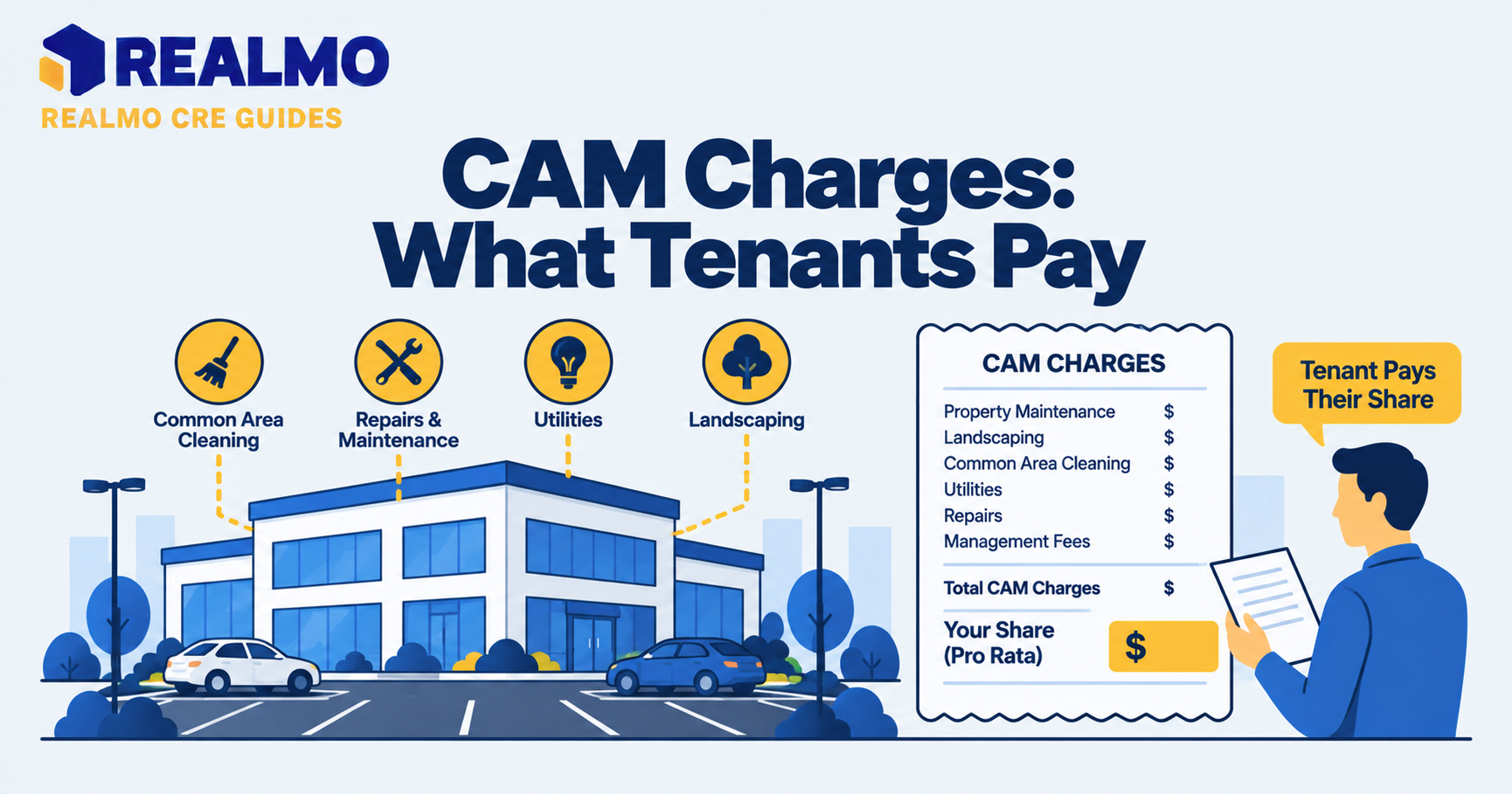
CAM charges are the tenant’s share of operating and maintaining shared areas of a commercial property: parking lots, lobbies, landscaping, snow removal, security, and common-area utilities. Landlords bill them monthly as an estimate, then reconcile against actual spending after year-end. Most disputes come from what the landlord folds into the pool, not the math.
Why CAM charges decide your real rent
A tenant signs a 5,000 SF retail lease at $28/SF base rent and budgets $140,000 a year. The landlord’s estimate sheet adds $9/SF in CAM, taxes, and insurance. Real cost: $185,000. Then the reconciliation arrives in March showing the parking lot was resurfaced, and the tenant owes another $14,000 in one payment.
That gap is where leasing negotiations actually live. Base rent is visible, comparable, and easy to shop. CAM is buried in Article 6 of a 40-page lease, defined by a paragraph the tenant’s attorney reads once and the landlord’s attorney wrote. Small changes to that paragraph move more money than a dollar off base rent.
The tenant who negotiates the CAM definition before signing controls costs for the full term. The tenant who waits until the first reconciliation is arguing about a bill that the lease already says is valid.
What CAM charges cover in a typical lease
Common area maintenance covers costs the landlord incurs on space no single tenant occupies. In a shopping center that means the parking field, sidewalks, exterior lighting, landscaping, trash removal, and the property management fee. In an office building it includes lobby cleaning, elevator service, HVAC for common corridors, and building security.
Recoverable items usually break into four groups: physical maintenance and repairs, utilities serving common areas, services like janitorial and security, and administrative costs such as the management fee and on-site staff.
Real estate taxes and property insurance are separate line items in most leases, even though tenants lump all three together as “NNN” or “the extras.” Keep them separate when you audit. Tax and insurance are third-party bills you can verify against public records and certificates. CAM is where the landlord has discretion.
Which costs landlords should not pass through
Certain items belong to ownership, not occupancy, and a well-negotiated lease excludes them by name. Capital replacements are the biggest one. Replacing a roof or resurfacing a lot extends the life of the asset, and a tenant with three years left shouldn’t fund a 20-year improvement.
Standard exclusions worth naming in the lease:
- Leasing commissions, marketing, and tenant improvement allowances for other tenants
- Costs reimbursed by insurance proceeds or warranty
- Ground lease payments, debt service, and depreciation
- Repairs caused by the landlord’s negligence or by construction defects
- Legal fees for disputes with other tenants
- Costs of services provided to one tenant only and billed as if shared
If capital items can’t be excluded outright, the common compromise is amortization. The landlord recovers the cost over the useful life of the improvement, at a stated interest rate, and bills only the annual slice. A $200,000 lot resurfacing amortized over 15 years hits the pool at roughly $13,300 a year plus interest, not $200,000 in one hit.
How your pro rata share gets calculated
Pro rata share is your rentable square footage divided by the building’s rentable square footage. That denominator is where the argument starts.
Some leases use gross leasable area, the total space available to lease. Others use occupied area, which shrinks the denominator and raises every remaining tenant’s percentage when the center empties out. A tenant in a 60%-occupied center paying on an occupied-area basis absorbs the vacancy risk that belongs to the landlord.
Ask for the denominator to be defined as total gross leasable area, stated as a fixed number in the lease. If the landlord insists on an occupancy-based calculation, cap the effect: pro rata share is calculated on the greater of actual occupancy or 90% of GLA.
Anchor tenants complicate this further. A grocery anchor in a shopping center often pays a fixed CAM contribution, or maintains its own parking field, or pays nothing at all. If the anchor’s square footage stays in the denominator while its dollars stay out of the pool, small tenants cover the difference. Read the anchor’s arrangement before you agree to yours.
Worked example: reconciling a CAM bill
Illustrative figures. Do not treat as market data.
Setup: retail tenant occupies 4,000 SF in a center with 80,000 SF of gross leasable area. Pro rata share is 5%. Monthly CAM estimate billed at $1,400, so $16,800 collected for the year.
Landlord’s year-end statement shows total CAM expenses of $400,000.
Step 1. Review the expense schedule line by line. Two items stand out: $60,000 for parking lot resurfacing, and $18,000 in leasing commissions coded as “administrative.”
Step 2. Apply the lease exclusions. Commissions are excluded outright, so $18,000 comes out. Resurfacing is a capital item; the lease requires amortization over useful life, 15 years. That converts $60,000 into $4,000 for the year, removing $56,000 from the pool.
Step 3. Adjusted pool: $400,000 − $18,000 − $56,000 = $326,000.
Step 4. Tenant’s share: $326,000 × 5% = $16,300.
Step 5. Compare to amounts paid. The tenant paid $16,800 in estimates against $16,300 owed, so the landlord owes a $500 credit. Before the audit, the same statement showed $20,000 due and a $3,200 balance owed.
How to read the result: the swing was $3,700 on a $16,000 obligation, and none of it came from disputing the landlord’s arithmetic. It came from lease language written before the first rent check cleared.
Common error: tenants check the multiplication and stop. The multiplication is almost always right. The pool is where the money moves.
Caps, base years, and gross-up clauses
Three provisions control CAM growth over a term, and tenants routinely negotiate only the first one.
A cap limits how much controllable CAM can rise year over year. Push for a cumulative cap, not a year-by-year one. Cumulative caps let unused headroom carry forward, so a flat year offsets a spike later. Also insist the cap apply to controllable expenses only, and define which costs are uncontrollable. Snow removal, utility rates, and insurance premiums usually qualify. Management fees do not.
A base year applies mostly in office leases quoted on a gross basis. The tenant pays operating expenses above a stated year’s level. If the base year is understated because the building was half-empty, the tenant pays for occupancy that the landlord always expected.
That’s what a gross-up clause fixes. It restates variable expenses as if the building were 95% occupied, in both the base year and every comparison year. Applied consistently, gross-up protects both sides. Applied only to comparison years, it’s a rent increase disguised as an accounting convention.
Tenants comparing lease structures should also read our explanation of triple net vs. gross lease structures before deciding which quoted rent is actually cheaper.
How to audit your CAM reconciliation
Your audit rights come from the lease. If the lease doesn’t grant them, you don’t have them.
Negotiate for: a minimum 90-day window after the statement arrives, access to the landlord’s supporting invoices and general ledger, the right to use an outside accountant, and a provision that the landlord pays audit costs if the overcharge exceeds a threshold like 3% or 5%.
Watch for two clauses that gut the right in practice. First, a requirement that you pay the disputed amount in full before auditing. Second, a ban on contingency-fee auditors, which effectively bars the specialists who do this work for smaller tenants.
Then read the reconciliation the way an auditor would. Compare each line to the prior year and ask about any item that moved more than 10%. Confirm capital items were amortized. Check that the management fee matches the lease formula, usually a percentage of gross receipts or of the CAM pool itself, not both. Verify the occupancy figure used in any gross-up. Request invoices for the three largest line items.
For tenants comparing properties before they get to lease negotiation, Realmo’s listing data and Location Insights let you check a center’s occupancy and ownership history, which tells you something about how the CAM pool is likely to behave.
Common mistakes tenants make with CAM charges
Budgeting from the estimate. The estimate is the landlord’s forecast, and reconciliations run over more often than under. A tenant with no reserve for the true-up covers it from working capital in Q1.
Accepting “market standard” CAM language. There is no standard. Landlord forms vary widely on exclusions, caps, and audit rights, and the first draft always favors the landlord.
Ignoring the denominator. Occupancy-based pro rata calculations transfer vacancy risk to tenants. In a declining center, that cost compounds every year.
Letting the audit window close. Most leases include a deadline, often 60 to 120 days. Miss it and the statement becomes final, including errors.
Skipping the anchor’s deal. If the anchor pays a fixed amount or self-maintains, the shortfall lands on inline tenants.
Related terms
- Triple net lease (NNN)
- Operating expenses in commercial leases
- Base year and expense stops
- Gross leasable area (GLA)
- Pro rata share
- Load factor and rentable vs. usable square footage
- Percentage rent
- Tenant improvement allowance
Lease terms and expense recovery rules vary by state and by contract. Have a licensed attorney review the operating expense provisions of any lease before signing.
FAQ
What is included in CAM charges?
CAM covers the cost of maintaining shared areas: parking lot upkeep, exterior lighting, landscaping, snow removal, common-area utilities, janitorial service for lobbies and corridors, security, and the property management fee. Real estate taxes and building insurance are usually billed separately, even when tenants describe all three together as triple net charges.
Are CAM charges negotiable?
Yes, before signing. The negotiable pieces are the definition of recoverable costs, the exclusion list, annual caps on controllable expenses, how pro rata share is calculated, and audit rights. Once the lease is executed, you’re negotiating within language you already agreed to, which is a much weaker position.
Can a landlord charge tenants for a new roof through CAM?
It depends on the lease. Many leases exclude capital expenditures outright. Others allow recovery but require the cost to be amortized over the improvement’s useful life, so the tenant pays only the annual portion during the term. Without an exclusion or amortization clause, the full cost can land in one year’s pool.
How often do landlords reconcile CAM charges?
Annually, after the calendar or fiscal year closes. The landlord compares actual expenses to the estimates collected and issues a statement showing a balance due or a credit. Delivery timing is set by the lease, commonly within 90 to 150 days of year-end.
What is a CAM cap and why does it matter?
A cap limits how much controllable CAM can increase year over year, often expressed as a percentage. It protects tenants from expense growth that outpaces their business. Cumulative caps are better than annual ones because unused increases carry forward, smoothing out a year with heavy spending.