Investing in Multifamily Property: A Complete Guide for Investors
Multifamily investing means acquiring residential buildings with five or more units and operating them as commercial real estate. That means underwriting on net operating income, financing tied to the property’s own cash flow, and valuation by cap rate rather than by comparable sales. The five-unit threshold matters. It separates multifamily from residential lending and residential appraisal.
Why multifamily sits at the center of most CRE portfolios
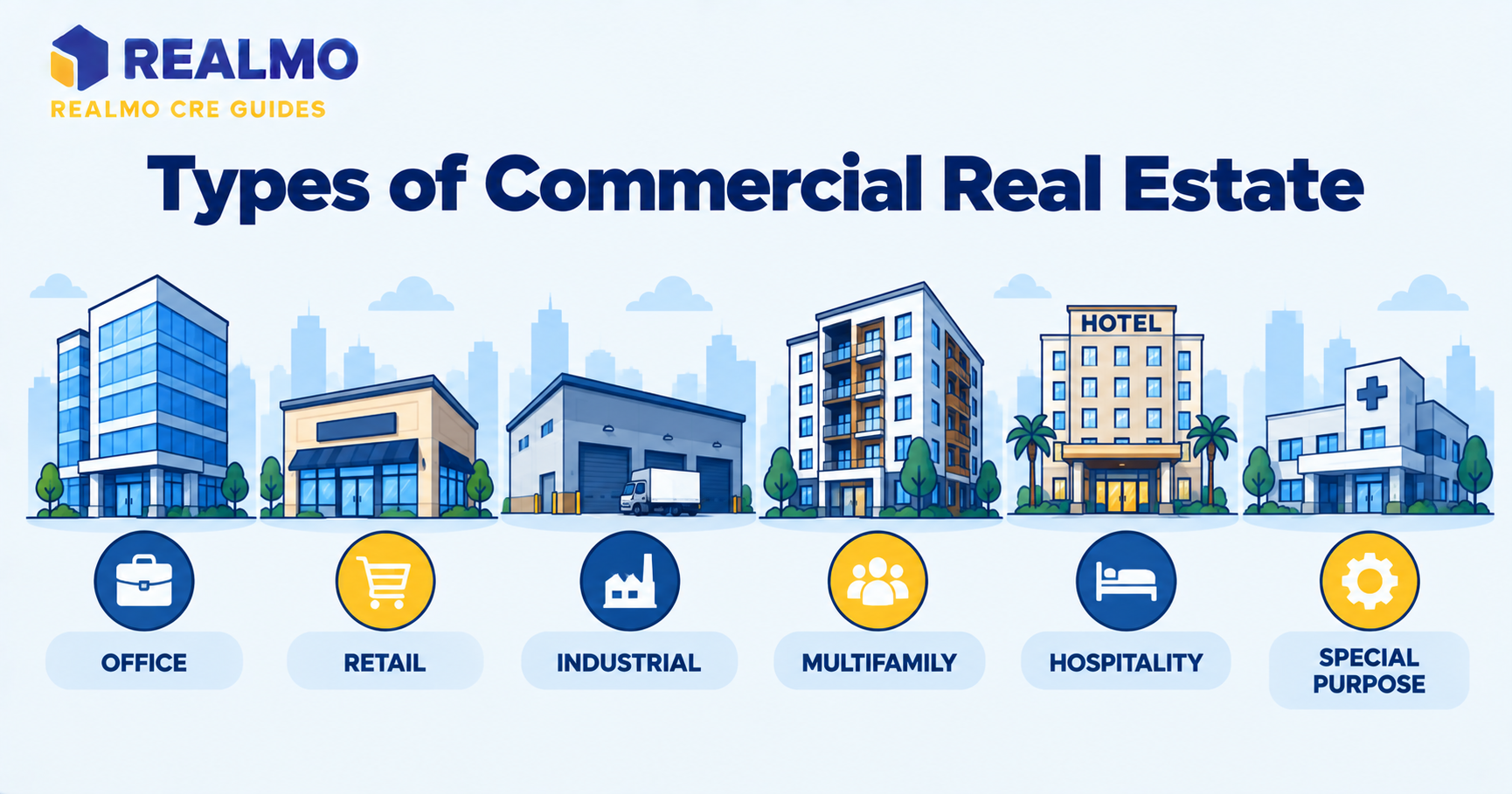
An investor buying a first commercial asset usually compares a small apartment building against a strip retail center or a single-tenant net lease building. The apartment building carries an operational burden the other two don’t: turnovers, maintenance calls, collections, and leases that reset every twelve months. In exchange, it offers something the others rarely do: income spread across dozens of tenants instead of one or two.
That distinction drives the risk profile. When a single-tenant retail building loses its tenant, income goes to zero and stays there until re-leased. When a 40-unit apartment building loses four tenants, it loses roughly ten percent of gross rent and keeps operating. Lenders price that difference. Multifamily accesses cheaper debt, longer amortization, and higher leverage than most other commercial property types. Part of that comes from agency programs through Fannie Mae and Freddie Mac, which have no equivalent in retail or industrial.
The trade-off is that short leases cut both ways. Annual rent rolls let an owner capture rent growth quickly, and they let market softness reach the income statement just as quickly.
What counts as multifamily and where the five-unit line falls
A property with two to four units is residential for financing and appraisal purposes. It qualifies for conventional residential mortgages, gets valued against comparable sales of similar duplexes and fourplexes, and can be bought with residential-style down payments. A property with five or more units crosses into commercial territory: commercial loan underwriting, income-based appraisal, and different reserve and reporting expectations.
That line matters most. It matters more than the physical difference between a fourplex and a five-unit building. The same investor, buying the same brick walk-up on the same street, faces a different loan product and a different valuation method. Which side of the line the unit count falls on also decides the buyer pool at exit.
Within the commercial side, the market segments further by scale and quality. Garden-style properties (two- and three-story buildings across a landscaped site, surface parked) dominate suburban submarkets. Mid-rise and high-rise are different. That product concentrates in urban cores, with structured parking and higher construction costs per unit. Buildings are also graded informally as Class A, B, or C, reflecting age, finish level, and amenity package rather than any standardized rating. Class designations are relative to the local market: a Class A building in a secondary market may resemble Class B product in a gateway city.
Learn more about how these tiers behave in apartment building classes and what they signal about risk.
How multifamily properties are valued
Commercial multifamily is valued on income, not on what the building next door sold for. The core relationship is straightforward:
Value = Net Operating Income ÷ Cap Rate
Net operating income is all revenue the property collects after vacancy and credit loss, minus all operating expenses, including property taxes, insurance, and utilities. It also nets out repairs and maintenance, payroll, management fees, and turnover costs. It excludes debt service, capital expenditures, depreciation, and income taxes. Those exclusions are deliberate. NOI describes the property, not the buyer’s financing or tax position.
Two consequences follow. First, every recurring dollar of expense reduction raises value by a multiple, because it flows straight into NOI. Cutting $10,000 of annual expenses at a 6% cap rate adds roughly $167,000 of value. Second, one-time capital work (a roof, a parking lot, unit renovations) does not increase NOI directly. It only creates value if it supports higher rents or lower ongoing costs.
Cap rates themselves move with interest rates, perceived risk, and rent growth expectations. Skip memorizing a number. Understand the ranking instead. Within the same market, newer and better-located multifamily trades at lower cap rates than older, workforce-oriented product. Buyers accept less current yield in exchange for more predictable income and less deferred maintenance. Detailed treatment lives in how cap rates work in commercial real estate.
Worked example: underwriting a 40-unit acquisition
All figures below are illustrative and rounded for clarity. They are not market data.
Inputs. A 40-unit garden-style property. Average asking rent of $1,400 per unit per month. Other income (parking, laundry, pet fees, and utility reimbursements) totals $50 per unit per month. Assume 6% vacancy and credit loss, operating expenses of 42% of effective gross income, and a purchase price of $5,600,000.
Step 1: Gross potential rent. 40 units × $1,400 × 12 = $672,000. Other income: 40 × $50 × 12 = $24,000. Gross potential income = $696,000.
Step 2: Effective gross income. Vacancy and credit loss at 6% of $696,000 = $41,760. EGI = $654,240.
Step 3: Operating expenses. 42% of $654,240 = $274,781.
Step 4: Net operating income. $654,240 − $274,781 = $379,459.
Step 5: Implied cap rate. $379,459 ÷ $5,600,000 = 6.78%.
Step 6: Debt and cash flow. Assume a loan at 65% loan-to-value: $3,640,000. At an illustrative 6.5% interest rate on a 30-year amortization schedule, annual debt service is approximately $276,000. Cash flow after debt service = $379,459 − $276,000 = $103,459. Debt service coverage ratio = $379,459 ÷ $276,000 = 1.37×. Cash-on-cash return on the $1,960,000 of equity, before closing costs and capital reserves, = $103,459 ÷ $1,960,000 = 5.3%.
How to interpret it. The 1.37× coverage matters as much as the return. Most commercial lenders set a minimum DSCR as a loan condition, and the gap between actual and required coverage is the property’s margin for error. At 1.37×, NOI could fall roughly 27% before debt service is no longer covered. That cushion is the real answer to “how risky is this deal.”
The common mistake. Underwriting the seller’s expense ratio instead of your own. A 42% expense ratio assumes a specific tax assessment, insurance quote, and management fee. Property taxes in many jurisdictions reassess on sale, which can push the expense line materially higher the year after closing. That can turn a 1.37× coverage into something much thinner. Model taxes at the reassessed basis, not the seller’s historical basis.
For the underlying mechanics, see debt service coverage ratio explained and how to calculate net operating income.
What actually drives returns in an apartment deal
Multifamily returns come from four sources, and confusing them leads to bad decisions.
Cash flow is the residual after operating expenses and debt service. It is the most visible return and usually the smallest in the early years of a leveraged deal.
Principal paydown builds equity silently as amortizing debt reduces the loan balance. It converts to cash only at refinance or sale.
Appreciation in commercial multifamily is primarily forced, not passive. Because value derives from NOI, an owner who raises effective rents or lowers recurring expenses creates value directly. Market-driven appreciation (cap rate compression) also occurs. It sits outside the owner’s control entirely, though, and should never be the underwriting assumption that makes a deal work.
Tax treatment includes depreciation of the building over 27.5 years for residential rental property under IRS rules. That depreciation shelters part of the cash flow from current taxation. Cost segregation studies help. They can accelerate portions of that depreciation into shorter recovery periods. Depreciation is recaptured on sale, so the benefit is largely deferral rather than elimination. Tax treatment varies by entity structure and individual circumstances; consult a licensed tax professional before relying on any of it.
The practical point: a deal that only works because of assumed appreciation is a bet on the market. A deal that works on in-place income, with appreciation as upside, is an investment.
How multifamily acquisitions get financed
Multifamily has a financing advantage. No other commercial property type shares it. Agency lending (loan programs backed by Fannie Mae and Freddie Mac, which purchase and securitize multifamily loans) provides a consistent source of long-term debt. That debt is usually non-recourse and stays open through market cycles when other lenders pull back. Agency programs impose their own requirements around borrower experience, net worth, liquidity, property condition, and replacement reserves.
Beyond agency, the main channels are:
- Banks and credit unions, usually recourse, with shorter terms and balloon structures. They’re commonly the most flexible lenders on smaller or unconventional properties.
- Life insurance companies, which favor stabilized, well-located assets and offer long fixed terms at conservative leverage.
- Debt funds and bridge lenders, which finance transitional deals: properties with occupancy or renovation risk that permanent lenders won’t touch. Cost is higher; duration is shorter.
- HUD-insured programs, which offer unusually long fixed terms and high leverage but carry a longer, more documentation-heavy process.
Lenders size loans on the lower of two constraints: a maximum loan-to-value ratio and a minimum debt service coverage ratio. In higher-rate environments, DSCR binds first, and the loan amount falls below what LTV alone would allow. That is why acquisitions requiring more equity than expected are common. See commercial mortgage types compared. It explains how these products differ in practice.
Reading a rent roll and T-12 before you trust the numbers
The rent roll and the trailing twelve-month operating statement are the two documents that determine whether an offer holds up. Both are prepared by the seller.
On the rent roll, the number that matters is not asking rent but in-place rent, unit by unit, with lease expiration dates and concessions disclosed. A property showing full occupancy may be full because of two months of free rent granted to every new tenant. That’s economic occupancy well below physical occupancy. Compare the sum of contract rents against actual deposits in the bank statements.
On the T-12, look for expense lines that are suspiciously absent or suspiciously low. Common gaps include a few patterns. No property management fee can mean the owner self-manages. No payroll can mean a resident manager works in exchange for a free unit. Repairs and maintenance running far below what a building of that age should require is another red flag. So is insurance quoted at a legacy policy rate that won’t survive a change of ownership.
Also separate recurring maintenance from capital work. Sellers sometimes classify a roof replacement as repairs, which understates NOI in that year. Or they classify routine turn costs as capital, which overstates it. Either way, the number you underwrite should reflect what the property will actually cost to run.
Lease expiration concentration deserves specific attention. A rent roll where a large share of leases expire in the same month exposes the new owner to a single leasing season. That season then carries most of the year’s turnover risk.
Value-add versus stabilized: two different businesses
A stabilized multifamily acquisition is an income purchase. The property is fully leased at market rents, and capital needs are current. The return comes from cash flow, amortization, and whatever rent growth the market delivers. Underwriting focuses on expense accuracy and debt structure.
A value-add acquisition is a business. It has a construction component. The thesis is that in-place rents sit below achievable rents because of unit condition, weak management, mispriced amenities, or uncollected fee income. Renovation plus better operations is meant to close that gap. Returns depend on execution: renovation cost per unit, days of downtime per turn, and the actual rent premium achieved versus the premium underwritten.
The failure mode in value-add deals is rarely the renovation budget itself. It is the rent premium assumption. An investor who budgets $12,000 per unit in renovations to achieve a $200 monthly premium needs that premium to be real and durable. It has to be supported by comparable renovated units in the same submarket, not by a spreadsheet. If the achieved premium comes in at $120, the yield on cost falls below the entry cap rate and the entire thesis inverts.
Bridge financing compounds this. Transitional debt is shorter and more expensive, and it usually requires the property to hit performance benchmarks to extend. A renovation running two quarters behind schedule can collide with a loan maturity.
Related reading: value-add real estate strategy explained.
What operating a multifamily property actually requires
Ownership economics differ sharply from the passive image. Every twelve months, a meaningful share of units turns over. Each turn costs money (paint, cleaning, flooring, minor repairs) and costs time in vacancy days between move-out and move-in. Turnover cost and downtime, multiplied across a rent roll, is one of the largest controllable expense categories in the business.
Fees scale with size. Third-party property management charges a percentage of collected revenue, and that percentage usually declines as unit count rises. Very small properties usually can’t attract quality management at economics that work for either side. Below a certain scale, owners either self-manage or accept management that reflects the fee.
Payroll appears eventually. It shows up once a property reaches a size that supports a leasing agent and a maintenance technician. Between self-management and full staffing lies an awkward middle. Properties there are too large to run personally and too small to staff. That scale problem pushes many investors toward larger assets, or toward clustering several small properties in one submarket under shared management.
Capital reserves are not optional. Roofs, HVAC systems, parking lots, and plumbing risers have finite lives, and lenders on agency loans usually escrow replacement reserves monthly. An underwriting model without a per-unit annual reserve line is understating the true cost of ownership.
How to evaluate a multifamily market before you evaluate a building
Submarket fundamentals set the ceiling on what any individual property can do. Four questions carry most of the weight.
Demand concentration. Employment concentration matters more than employment level. A submarket dependent on one employer or one industry carries correlated risk across the entire rent roll.
New supply nearby. New supply competes directly for the same renters, usually with newer finishes and lease-up concessions. Permits and units under construction are public information in most jurisdictions through local planning departments and U.S. Census Bureau building permit data. Supply arriving in the same year as your renovation completion is a specific and avoidable problem.
Rent-to-income relationship. Rent growth is constrained by what renters can pay. When rent-to-income ratios in a submarket sit at the high end of historical norms, further rent growth requires income growth or it produces delinquency instead.
Regulatory environment. Rent regulation, just-cause eviction requirements, and local licensing regimes vary enormously by state and municipality. They materially affect the ability to raise rents and manage turnover. This is jurisdiction-specific and changes; verify current local rules with counsel before underwriting any assumption about rent increases.
Realmo’s Location Insights and property-level analytics cover ownership records, valuation estimates, and submarket context across 9M+ properties. That makes the market screen faster than assembling it from separate sources.
For deeper treatment, see how to analyze a commercial real estate submarket.
Ways to invest without buying a building directly
Direct ownership is not the only entry point, and the alternatives carry genuinely different risk and control profiles.
Syndications and private funds pool investor capital under a sponsor who acquires and operates the asset. Investors are usually passive limited partners with no operational control and limited liquidity. Capital is committed for the life of the deal. Sponsor track record, fee structure, and the waterfall determining how profits split between sponsor and investors matter as much as the property itself. These are securities offerings, usually restricted to accredited investors, and subject to federal and state securities law.
Public REITs that own apartment portfolios offer daily liquidity and professional management, at the cost of stock market correlation and no control over asset-level decisions.
Joint ventures pair an operating partner who sources and manages with a capital partner who funds. Control and economics are negotiated in the JV agreement rather than set by market convention.
Each of these involves securities or partnership law considerations that vary by structure and jurisdiction; consult a licensed attorney and investment professional before participating.
Common mistakes in multifamily investing
Underwriting the seller’s expenses instead of your own. Property taxes reassess, insurance reprices, and self-managed properties show no management fee. Consequence: NOI comes in below projection, DSCR tightens, and the equity return the deal was bought on never materializes.
Confusing physical occupancy with economic occupancy. A building can be 96% physically occupied while collecting well under that in effective rent because of concessions, delinquency, and employee units. Consequence: revenue underperforms from day one, and the shortfall is discovered after closing.
Assuming exit cap rate equals entry cap rate. Modeling a sale at the same cap rate paid at acquisition treats a market variable as a constant. Consequence: if cap rates widen during the hold, the exit value falls even when NOI grew as planned. The deal’s return then depends on something that never had to go right.
Skipping the capital needs assessment. A property with an aging roof, original HVAC, and a failing parking lot has a capital bill that arrives regardless of what the T-12 shows. Consequence: capital spending consumes the cash flow the deal was supposed to produce, and reserves prove inadequate at the worst time.
Buying at a scale that can’t support management. A property too small for professional management and too large to self-manage sits in a gap where operations degrade. Consequence: rising vacancy, deferred maintenance, and declining NOI, which reduces value at a multiple.
Related terms
- Net operating income (NOI)
- Capitalization rate
- Debt service coverage ratio (DSCR)
- Loan-to-value ratio
- Value-add real estate
- Rent roll
- Economic occupancy
- Cost segregation
Frequently asked questions
How many units make a property “multifamily” for commercial financing?
Five or more. Properties with two to four units qualify for residential mortgage financing and are appraised against comparable sales. At five units and above, lenders underwrite on the property’s income, appraisers use the income approach, and commercial loan terms apply.
How is an apartment building valued?
By dividing net operating income by a market capitalization rate. NOI is revenue after vacancy and operating expenses, before debt service and capital spending. This is why reducing recurring expenses raises value by a multiple of the savings, while one-time capital work does not directly increase value.
What is a good DSCR for a multifamily loan?
Lenders set minimum thresholds as loan conditions, and requirements vary by lender, property type, and loan program. The practical way to read DSCR is as a cushion: coverage of 1.30× means NOI can fall roughly 23% before debt service is uncovered. More cushion means more tolerance for underperformance.
Can you invest in multifamily without managing property?
Yes, through syndications, private funds, joint ventures with an operating partner, or publicly traded apartment REITs. Each trades control for passivity and carries different liquidity terms. Private offerings are securities and usually limited to accredited investors.
What is the difference between value-add and stabilized multifamily?
Stabilized properties are fully leased at market rents with current capital needs; returns come from in-place income. Value-add properties have a gap between in-place and achievable rents that renovation and better operations are meant to close. Value-add returns depend on execution and carry construction and lease-up risk.