Percentage Rent in Retail Leases
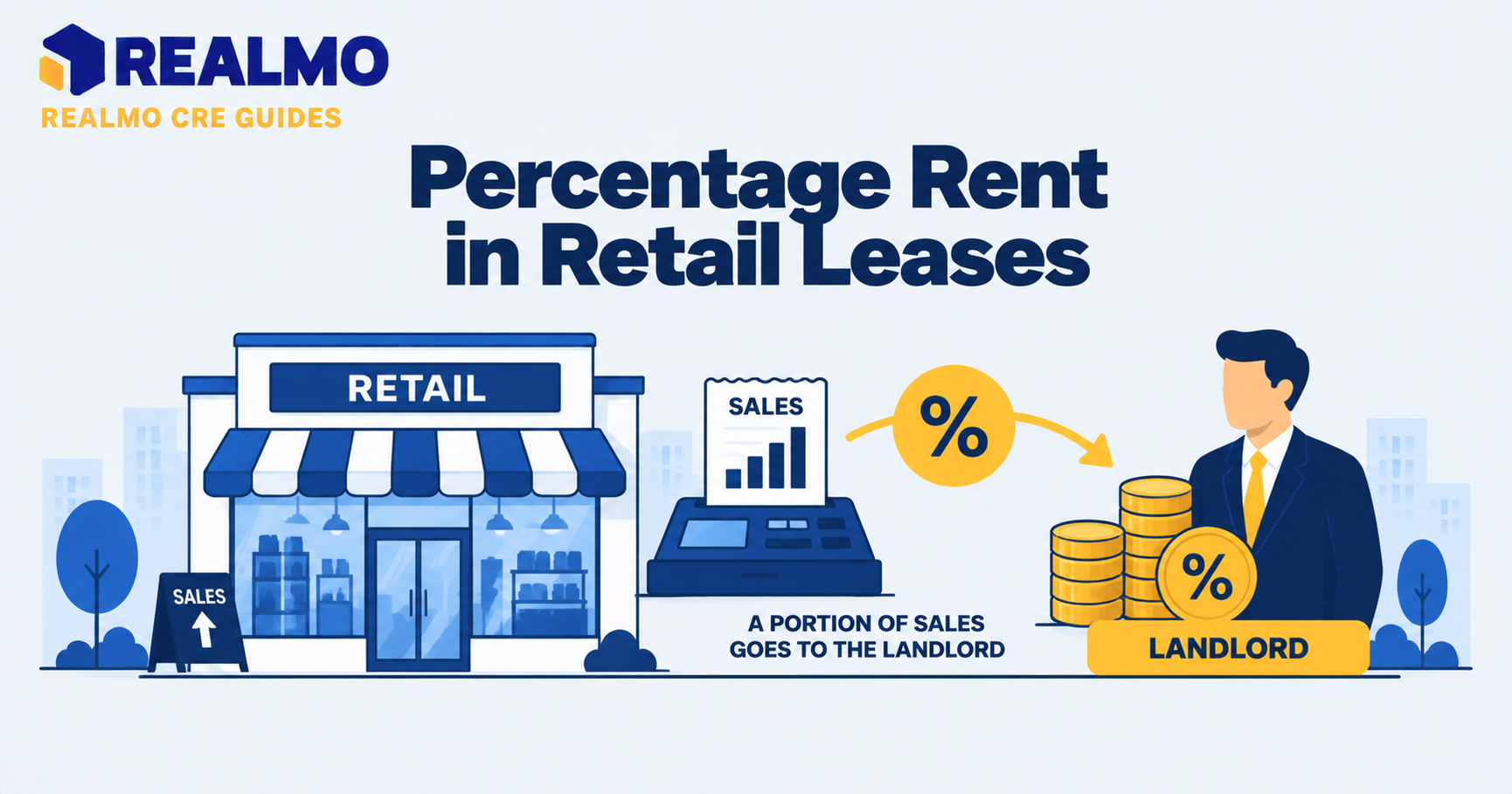
Percentage rent is additional rent a retail tenant pays as a share of gross sales above an agreed threshold, called the breakpoint. It sits on top of base rent. Landlords use it to capture upside from strong stores, most often in enclosed malls, outlet centers, and grocery-anchored strips.
Why landlords still use percentage rent
You own a 3,200 SF end-cap leased to a quick-service restaurant on a ten-year term with 2% annual bumps. Year three, the operator adds a drive-thru lane and delivery. Sales climb sharply. Your rent does not, because the escalator was set in year one and runs on autopilot until renewal.
Percentage rent closes that gap. It ties part of your income to the tenant’s actual performance at your address, not to a number negotiated years earlier. It also gives you something else: reported sales figures. Those numbers tell you which merchandising categories work on your site, which tenants are candidates for expansion, and which ones will fight the next renewal. A landlord with five years of sales data underwrites the next lease renewal negotiation from a stronger position.
How the natural breakpoint is calculated
The natural breakpoint is annual base rent divided by the percentage rate. At $120,000 of base rent and a 6% rate, the breakpoint is $2,000,000 in gross sales.
The logic behind that formula matters more than the arithmetic. At the breakpoint, base rent equals exactly 6% of sales. Below it, the landlord is already collecting more than the agreed share of the tenant’s revenue. Above it, the landlord collects 6% of every additional dollar.
Rates follow industry convention by merchandise category rather than by negotiation from scratch. Apparel and specialty retail sit in the 5% to 7% band. Food service runs higher, often 6% to 10%, because gross sales per square foot are large relative to the space. Jewelry, electronics, and grocery carry lower rates, sometimes 1% to 3%, since margins are thin and sales volumes high. Owners comparing rent structures across retail submarkets can pull property-level data and current use profiles on Realmo before setting a rate.
Natural vs. artificial breakpoints
An artificial breakpoint is any threshold the parties negotiate that does not equal base rent divided by the rate.
Landlords push for a breakpoint below natural when they want participation earlier. Tenants push for one above natural, usually to protect a store carrying heavy buildout costs in its first years. Both are common in ground-up development and in deals with large tenant improvement allowances.
Watch the direction of the trade. A tenant that accepts a low artificial breakpoint often extracts something in return: reduced base rent, a longer free-rent period, or a wider co-tenancy clause. Price the whole package, not the breakpoint alone. A breakpoint set 20% below natural on a store that never reaches it produces nothing.
What counts as gross sales, and what doesn’t
Gross sales definitions are where percentage rent clauses are won and lost. Standard exclusions include sales tax collected, bona fide refunds and returns, interstore transfers of merchandise, employee discounts, and gift card sales until the card is redeemed at that store.
The contested items now are digital. Buy-online-pickup-in-store, ship-from-store fulfillment, and returns processed at the location but sold online all move revenue across the boundary of the lease. National tenants routinely propose language excluding all e-commerce. That exclusion can strip meaningful volume from a store that functions as a fulfillment node.
A workable middle position: include sales fulfilled from store inventory or picked up at the premises, exclude pure pass-through orders shipped from a distribution center. Define it in the lease. Do not rely on the tenant’s internal accounting to sort it out later.
Also cap the exclusions list. Tenants add categories one at a time during redlines.
Sales reporting and audit rights
The reporting clause is the enforcement mechanism. Without it, percentage rent is unenforceable in practice.
Monthly statements are common, due 15 to 20 days after month end, with an annual certified statement 60 to 90 days after the lease year closes. Percentage rent is then reconciled once a year, even where the tenant remits monthly estimates. Annual reconciliation prevents a strong holiday quarter from triggering overage that a weak spring would have offset.
Audit rights should name a window, usually two to three years back, and assign cost. Standard practice: the landlord pays for the audit unless it uncovers an understatement above 2% or 3%, at which point the tenant pays the audit cost and the shortfall with interest. Add a default trigger for repeated failure to report. Some leases convert a chronic non-reporter’s rent to a fixed higher amount.
Worked example: calculating percentage rent
All figures below are illustrative.
Inputs. 4,000 SF space, base rent $32/SF NNN, percentage rate 6%, natural breakpoint, reported gross sales of $2,600,000 for the lease year. CAM and taxes run $10/SF.
Step 1. Annual base rent: 4,000 × $32 = $128,000.
Step 2. Natural breakpoint: $128,000 ÷ 0.06 = $2,133,333.
Step 3. Overage sales: $2,600,000 − $2,133,333 = $466,667.
Step 4. Percentage rent: $466,667 × 0.06 = $28,000.
Step 5. Total rent: $128,000 + $28,000 = $156,000, or $39/SF.
How to read it. The tenant’s occupancy cost ratio is total occupancy divided by sales: ($156,000 + $40,000) ÷ $2,600,000 = 7.5%. That ratio, tracked in ICSC benchmarks, is the number both sides should watch. It tells you whether the store can absorb the next base rent bump, and it is the first figure a tenant’s real estate committee looks at before closing a location.
The frequent error. Applying the 6% rate to all $2,600,000 in sales, which produces $156,000 of percentage rent instead of $28,000. The rate applies to overage only, above the breakpoint.
Lease structuring and sales-reporting language carry tax and accounting consequences. Have a licensed attorney and CPA review the clause before execution.
Common mistakes in percentage rent clauses
- No definition of “lease year.” A tenant on a fiscal calendar and a landlord on a calendar year will reconcile different twelve-month periods, and the breakpoint math will not agree.
- Failing to prorate the breakpoint. Partial first years, early terminations, and mid-year expansions all need a prorated threshold. Without it, a nine-month period is measured against a twelve-month breakpoint and produces no overage.
- Leaving out radius restrictions. A tenant opening a second unit two miles away shifts sales off your site. A radius restriction clause either bars the second store or folds its sales into the reported total.
- No adjustment on assignment. A new operator with a different concept may sit under a breakpoint set for the original use.
- Skipping the estoppel tie-in. Buyers underwriting your center will discount unverified percentage rent income. Unreported sales figures reduce the price a lender or buyer will support.
Related terms
Base rent · Gross sales · Occupancy cost ratio · Triple net lease · Anchor tenant · Sales per square foot · Lease audit rights
FAQ
What is a natural breakpoint in a retail lease?
The natural breakpoint is annual base rent divided by the percentage rate. At $150,000 of base rent and a 5% rate, it equals $3,000,000 in gross sales. Below that number, base rent already exceeds 5% of the tenant’s sales. Above it, the landlord collects the stated share of each additional dollar.
Is percentage rent charged on all sales or only sales above the breakpoint?
Only on sales above the breakpoint, unless the lease says otherwise. The overage is the amount by which reported gross sales exceed the threshold for that lease year. A handful of leases use a first-dollar structure with no breakpoint at all, but that arrangement is rare outside temporary and pop-up space.
Do online sales count toward percentage rent?
It depends entirely on the gross sales definition in your lease. Orders picked up at the store or shipped from store inventory can be included if the clause says so. Orders placed online and fulfilled from a distribution center are usually excluded. Silent leases favor the tenant in disputes.
Can a landlord audit a tenant’s sales reports?
Only if the lease grants audit rights. Well-drafted clauses allow a look-back of two to three years and shift the audit cost to the tenant when an understatement above a stated threshold is found. Without an express audit provision, the landlord has no contractual route to the underlying records.