Why Two Appraisals Disagree: Sources of Appraisal Discrepancy
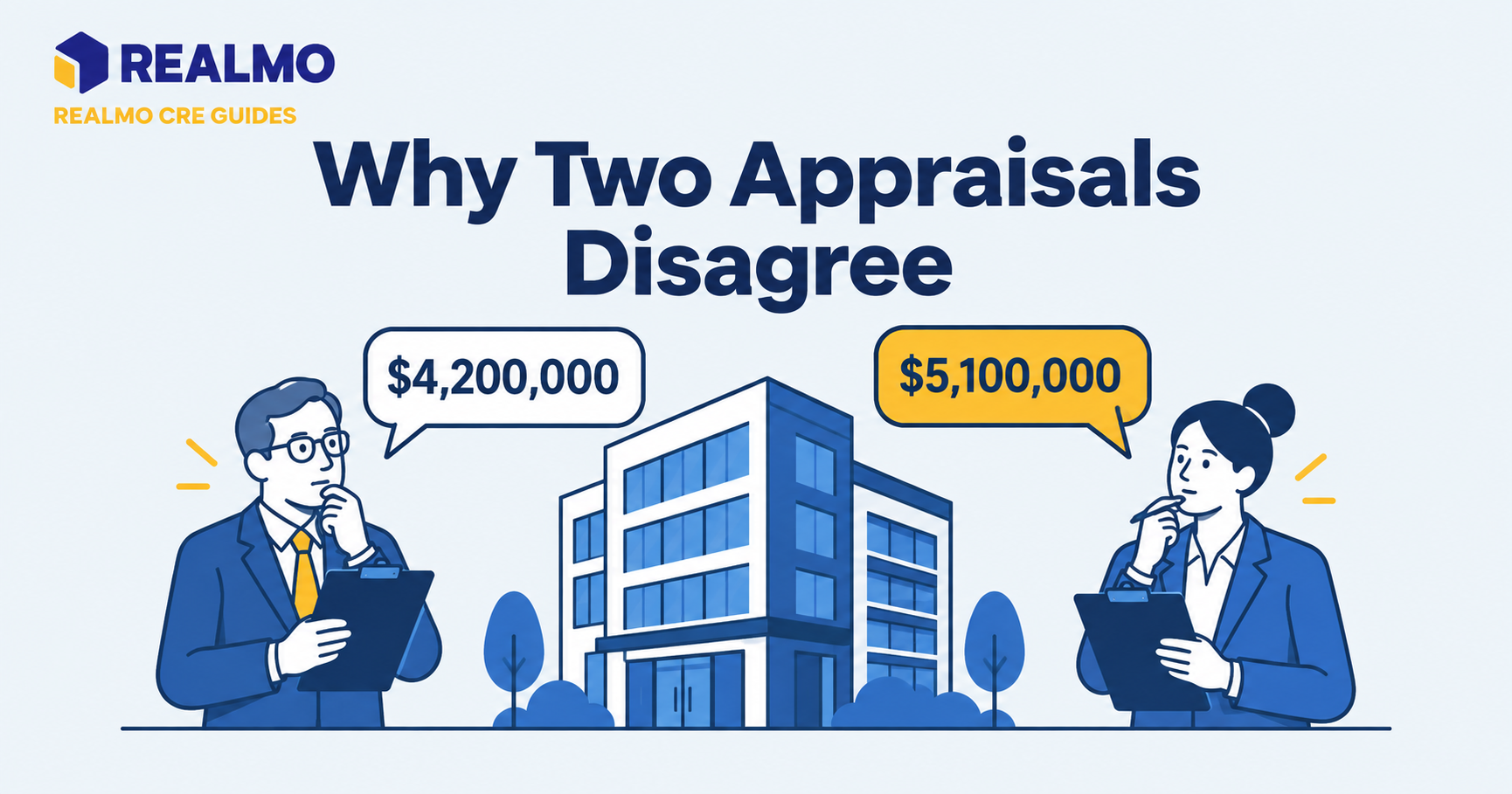
Two appraisals disagree because appraisal is an opinion of value built from selected inputs, not a measurement. An appraisal discrepancy can arise when two credentialed appraisers choose different comps, income assumptions, or scopes. Each defensible choice can move the final number.
Why it matters to an owner
You refinance a multi-tenant flex building. The lender’s appraisal comes in below the value your broker used for a prior sale pitch. Loan proceeds then shrink enough to force cash into closing. Nothing about the building changed. The lender’s appraiser modeled stabilized vacancy and a replacement reserve. The appraiser then leaned on older single-tenant sales because those were the closest verified transactions.
That gap can decide whether you refinance without new equity or support a property tax assessment appeal. It also affects what a buyer’s lender will accept at contract. Owners who understand where the two numbers separate can respond with evidence. Owners who treat the appraisal as a verdict absorb the difference.
What counts as a normal appraisal discrepancy
Two competent appraisals of the same property can still differ, even when ordered close together for the same purpose. Wider gaps appear as the asset gets harder to compare. Examples include special-purpose buildings, heavy deferred maintenance, thin markets with few confirmed sales, and unusual tenant credit or lease structures.
Reviewers flag a gap when reasonable input choices cannot explain it. They also question reports supported by weaker data. The size of the difference matters less than whether each appraiser can trace the number back to verified evidence.
How scope of work changes the number
Scope of work is set before the analysis begins, and it constrains everything that follows. Mortgage lending, estate settlement, and partnership buyouts can produce different appraisal values without any report being wrong. Intended use dictates the value definition, effective date, and assumed exposure period.
Market value assumes a willing buyer and seller and reasonable exposure time. Liquidation value assumes a compressed marketing period. A report may also value the leased fee interest, reflecting existing leases, while another values the fee simple interest at market rent. On a building leased well below market, that distinction alone explains a large leased fee versus fee simple gap.
Extraordinary assumptions and hypothetical conditions widen the gap further. One appraiser may value the property as-is; another may value it as stabilized, assuming lease-up that hasn’t happened.
Why comp selection drives most of the gap
The sales comparison approach depends on which transactions the appraiser found, verified, and considered similar enough to use. In markets with limited recent activity, two appraisers pull different sets, and each adjusts for age, condition, location, size, and terms using their own judgment.
Adjustments compound quickly. A comp adjusted upward for inferior condition and downward for a superior corner location can end up near its unadjusted price. In contrast, a second appraiser can apply the same adjustments at different magnitudes and land elsewhere. Neither grid is provably correct, so reviewers examine support for the adjustments rather than the adjustments alone.
Data access also separates reports. One appraiser may verify a sale directly with a broker and learn it included seller financing or a portfolio allocation. Another may take the recorded price at face value. Before ordering a second opinion, owners can pull nearby ownership and transaction history through Realmo. That shows which sales an appraiser is likely to use.
How income-approach inputs compound small differences
The income approach turns a stream of assumptions into one number, and small assumption changes multiply. Vacancy and collection loss, management fee, replacement reserves, and treatment of tenant improvements and leasing commissions each shift net operating income. Market rent conclusions shift it more when leases roll during the holding period.
Then the cap rate applies. Because value equals NOI divided by the rate, lower NOI and a higher cap rate move value in the same direction. The effects stack. This is the most common structural reason a lender’s appraisal lands below an owner’s expectation. The appraiser deducts reserves the owner never books and applies a rate drawn from sales of assets with different lease durations.
Worked example: two appraisals, one building
All figures below are illustrative round numbers chosen to show mechanics, not market indications.
A 40,000-square-foot multi-tenant flex building.
Appraiser A: stabilized NOI of $600,000, capitalization rate of 7.0%. Value: $600,000 ÷ 0.070 = $8,571,000, rounded to $8,570,000.
Appraiser B deducts a 3% collection loss and a $45,000 annual replacement reserve. NOI falls to $555,000, and the appraiser applies 7.5% after weighting older comps. Value: $555,000 ÷ 0.075 = $7,400,000.
Gap: $1,170,000, roughly 14%.
Isolate each driver. Holding the rate at 7.0%, the NOI difference alone accounts for $45,000 ÷ 0.070 = $643,000. Holding NOI at $555,000, the rate difference from 7.0% to 7.5% accounts for $7,929,000 − $7,400,000 = $529,000. Neither input is extreme; together they produce a gap large enough to change loan sizing.
Interpret the result by attacking inputs, not conclusions. If your operating history shows three years of collections above the assumed level, that is evidence. If capital expenditures have run below the reserve, that is evidence.
One frequent error: treating the midpoint as the true value. The midpoint has no analytical basis. One report is usually better supported, and identifying which one is the work.
Common mistakes owners make with conflicting values
- Arguing the conclusion instead of the inputs. A letter saying the value is too low gets filed. A rent roll, T-12, and capital expenditure history that contradict a specific assumption gets read.
- Submitting the higher appraisal as proof. Lenders rely on reports they ordered, under appraiser independence rules from Title XI of FIRREA. An owner-supplied appraisal carries little weight in that channel and can signal shopping for value.
- Ignoring the effective date. Two reports with different effective dates are not directly comparable, and comparing them as if they were wastes the argument.
- Overlooking measurement and gross-up conventions under the ANSI/BOMA Z65 standard. A rentable area difference of a few percent flows straight into rent per square foot conclusions and every unit-of-comparison adjustment.
- Missing the lender’s reconsideration window. Requests for reconsideration of value are usually time-bound; once the loan file moves, the number is fixed and the shortfall becomes your equity.
How to challenge or reconcile a disputed appraisal
Read both reports for scope first: intended use, property rights appraised, effective date, and any extraordinary assumptions. Differences there explain the gap without any dispute over the market.
If scope matches, build a factual submission. Identify missed comparable sales and document why they are more similar. Correct factual errors in square footage, zoning, condition, or lease terms. Supply operating data supporting your income assumptions. Lenders route this through a formal reconsideration of value process handled by their appraisal function rather than by the loan officer.
A review appraisal is the escalation step when the two reports remain irreconcilable. A reviewer examines methodology and support rather than producing a competing opinion, which is what a decision-maker actually needs.
Appraisal practice, lender independence rules, and assessment appeals vary by jurisdiction. Confirm your options with a state-licensed appraiser. If taxes or litigation are involved, also consult qualified counsel.
Related terms
- Cap rate
- Net operating income (NOI)
- Income approach to value
- Sales comparison approach
- Leased fee vs. fee simple
- Highest and best use
- Appraisal review
- Broker opinion of value (BOV)
FAQ
How much can two commercial appraisals differ before something is wrong?
There is no fixed threshold. Reviewers judge whether each conclusion is supported by verified data and consistent methodology. Wide gaps are expected on special-purpose assets, properties in thin markets, and buildings with unstabilized income. A wide gap on a stabilized, heavily traded asset type suggests a scope difference or a weak comparable set.
Can I use my own appraisal to challenge the lender’s?
Rarely with direct effect. Appraiser independence rules keep lenders relying on reports they ordered through their own channel. Your appraisal can still be useful as a source of comparable sales and factual corrections submitted through the lender’s reconsideration of value process.
Does a low appraisal mean my property lost value?
Not necessarily. It means one appraiser, under a specific scope and effective date, reached that opinion using a specific comp set and income assumptions. Check whether the report values the leased fee interest, assumes stabilized occupancy, or deducts reserves your operating statements do not include.
Who pays for a second appraisal?
In lending, the borrower bears appraisal costs, including reviews, unless the loan agreement says otherwise. Before ordering one, confirm the lender will accept it and understand whether a review appraisal, which is usually cheaper, would resolve the dispute instead.