Equity Multiple in Real Estate: How to Read It
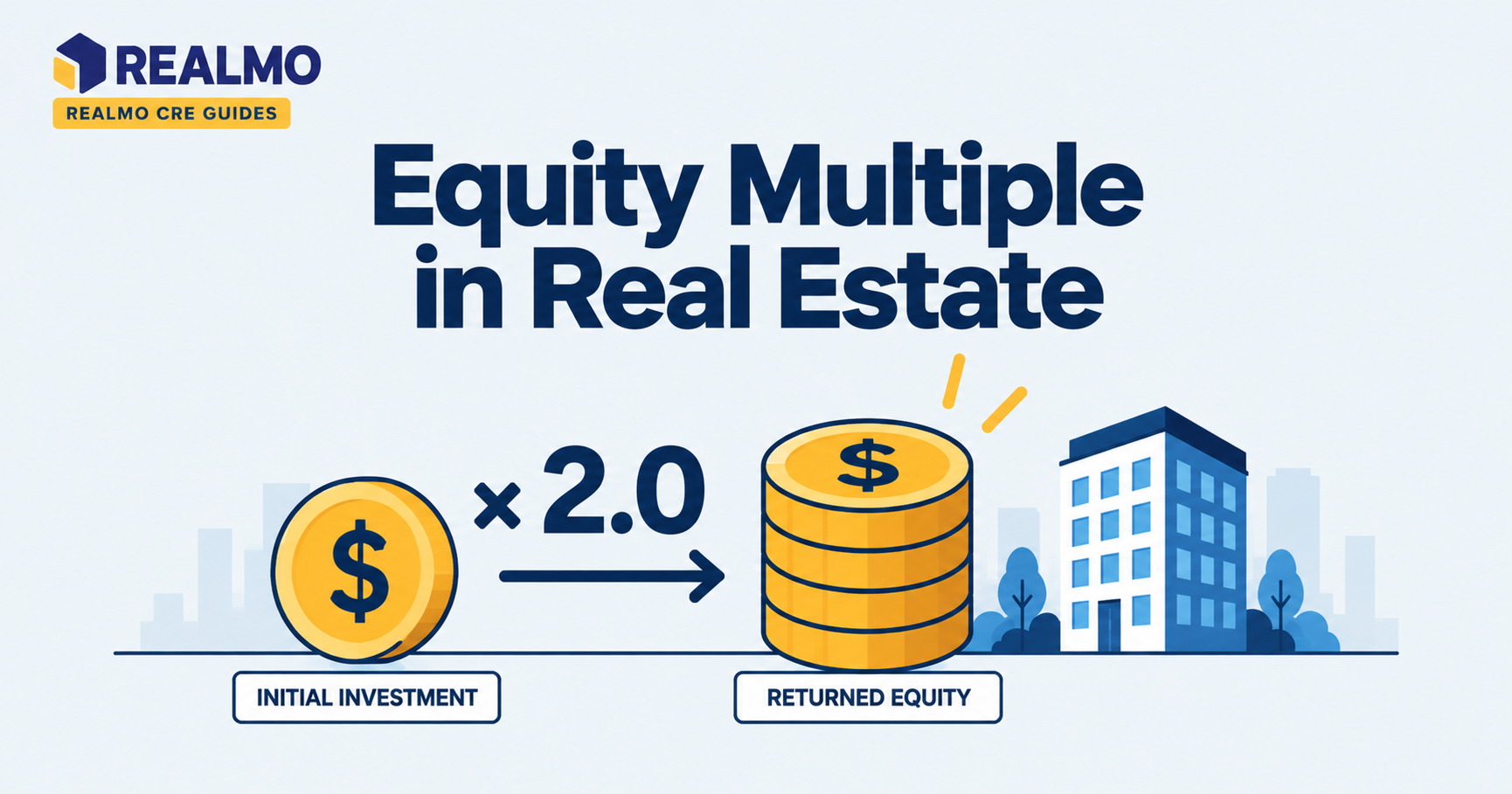
Equity multiple in real estate is the total cash an investor receives from a deal divided by the total equity invested. A 1.8x multiple means every dollar of equity came back as $1.80, the original dollar plus $0.80 of profit. The metric measures how much money a deal returns, not how quickly.
Why the multiple shapes your hold decision
An investor comparing two offerings sees 1.5x on a stabilized industrial building and 2.2x on a value-add retail center. The multiple alone makes the second deal look obviously better. It isn’t, until you know the hold period, the fee load, and where the cash actually comes from.
The multiple answers a question IRR cannot: how much wealth does this deal create per dollar committed? An investor with $500,000 to place who needs $1 million for a future acquisition cares about absolute dollars, not annualized percentages. A 25% IRR on a nine-month flip is excellent math and a poor way to build a position. This is because the capital comes back before it compounds into anything meaningful. The multiple exposes that gap immediately.
What the equity multiple actually measures
The formula is total distributions divided by total equity contributed:
Equity Multiple = Total Cash Distributions ÷ Total Equity Invested
Total distributions include everything paid to the equity position: operating cash flow, refinance proceeds, and net sale proceeds. Total equity includes the initial contribution plus every follow-on capital call, not just the check written at closing.
Three reference points anchor the scale. A multiple of 1.0x means the investor got exactly the original capital back and earned nothing. Below 1.0x is a loss of principal. Above 1.0x, the decimal portion is the profit: 1.63x means 63 cents of profit per dollar. Because the metric ignores time entirely, a 1.63x over three years and a 1.63x over twelve years are identical numbers describing very different outcomes.
Reading an equity multiple real estate projection
Sponsors present the multiple in a projection, which means it rests on assumptions. Three of them do most of the work.
The exit value is the largest single driver, and it usually depends on an assumed exit cap rate applied to projected stabilized income. Compress that cap rate by a small amount in the model and the multiple moves materially, without any operating improvement. Ask what exit cap rate the projection uses relative to the going-in cap rate, and whether the spread is justified by the business plan or simply assumed.
The hold period sets the denominator of every time-based comparison. A multiple quoted without a stated hold is not information.
The leverage assumption changes both directions of the outcome. Higher loan-to-value shrinks the equity base, so a given profit divides into a smaller denominator and the multiple rises. The same leverage magnifies losses if the exit value disappoints. Two deals showing the same multiple with different debt levels are not comparable risk.
Why equity multiple and IRR tell different stories
Internal rate of return discounts each cash flow by when it arrives. The equity multiple treats a dollar in year one and a dollar in year ten as the same dollar. That difference produces the most common contradiction in real estate underwriting: a deal with the higher IRR frequently has the lower multiple.
Short holds inflate IRR and suppress the multiple. A merchant build that returns 1.4x in eighteen months prints a high IRR, but the investor now holds cash and must find the next deal. A long-hold core asset returning 2.1x over ten years produces a modest IRR and far more absolute profit.
When a deal has no interim distributions, the two metrics connect directly. The annualized return equals the multiple raised to the power of one divided by the hold years, minus one. Interim cash flow breaks that relationship, pushing IRR above the annualized multiple because capital comes back sooner. Reading both metrics together tells you whether returns are front-loaded from operations or back-loaded into a sale.
Gross multiple, net multiple, and the promote
The number in a marketing deck is the gross multiple, calculated before sponsor compensation. The number an investor actually receives is the net multiple, after acquisition fees, asset management fees, disposition fees, and the sponsor’s promote.
The promote does its damage at the top of the distribution waterfall, where the sponsor’s profit share increases as returns rise. That structure compresses upside: doubling the property-level profit does not double the limited partner’s multiple, because a larger share of the incremental dollars crosses into higher promote tiers. Model the net multiple at the projected case and at a downside case, and confirm which figure the sponsor is quoting.
Worked example: a five-year hold at 1.63x
Illustrative figures, rounded for clarity.
- Equity invested: $2,000,000 at closing, no capital calls
- Distributions, years 1–2: $120,000 per year
- Distributions, years 3–5: $140,000 per year
- Net sale proceeds to equity, year 5: $2,600,000
Total distributions: $240,000 + $420,000 + $2,600,000 = $3,260,000
Equity multiple: $3,260,000 ÷ $2,000,000 = 1.63x
Interpretation: the investor got the $2,000,000 back plus $1,260,000 of profit, or 63 cents per dollar over five years. If all of that cash had arrived only at sale, the equivalent annual growth rate would be roughly 10.3%. Because $660,000 arrived during the hold, the IRR runs higher , approximately 11.3% on these cash flows. The gap between 10.3% and 11.3% is the entire value of receiving cash early.
One frequent error: comparing this 1.63x directly against a 1.63x on an eight-year hold and calling them equivalent. The five-year deal produces the same profit in less time and returns capital for redeployment three years sooner.
Common mistakes when reading an equity multiple
- Quoting the multiple without the hold period. Two deals at 2.0x can differ by a factor of three in annualized return, and an investor who anchors on the multiple alone will systematically overpay for long holds.
- Comparing gross to net across sponsors. One deck shows property-level returns, the next shows returns after promote. The comparison rewards the sponsor with the more aggressive fee load.
- Ignoring capital calls in the denominator. A deal that requires additional equity mid-hold dilutes the multiple, sometimes severely. Underwrite the reserve budget and ask what triggers a call.
- Treating refinance proceeds as profit. A cash-out refinance returns capital and increases debt service. It raises the multiple on paper while leaving less equity cushion for the exit.
- Accepting an exit assumption without testing it. Run the multiple at a higher exit cap rate than the projection uses. If the deal only clears the target under a compressed exit, the return depends on market movement rather than execution.
Related terms
Internal rate of return · Cash-on-cash return · Equity waterfall · Preferred return · Exit cap rate · Loan-to-value ratio · Return on investment
Because the exit value drives the multiple more than any other input, sanity-checking that assumption against comparable sales and ownership history is the highest-value hour in the process; Realmo’s property analytics cover valuation and ownership records across 9M+ properties without a paywall.
Equity multiples in syndicated offerings are securities returns under SEC Regulation D, governed by the offering documents. Consult a licensed attorney or investment advisor before relying on any projection.
Frequently asked questions
What is a good equity multiple in real estate?
There is no universal threshold, because the multiple has no time dimension. A 1.5x over three years and a 1.5x over ten years describe very different results. Judge the multiple against the hold period, the risk profile of the strategy, and the net figure after promote, not against a benchmark number.
Can the equity multiple be less than 1?
Yes. A multiple below 1.0x means the investor received less than the capital contributed and lost principal. A 0.8x means 20 cents of every dollar did not come back. Projections rarely show this, which is why downside cases matter more than base cases.
Is equity multiple the same as ROI?
They are close but not identical. Return on investment is usually expressed as profit divided by investment, so a 1.63x multiple corresponds to a 63% ROI. The multiple includes the return of capital in the numerator; ROI excludes it. Confirm which convention a sponsor is using.
Does the equity multiple account for leverage?
It reflects leverage but does not disclose it. Debt shrinks the equity denominator, so a leveraged deal shows a higher multiple than the same asset bought for cash, with correspondingly higher risk. Always read the multiple alongside loan-to-value and debt service coverage.