What a Broker Opinion of Value Is
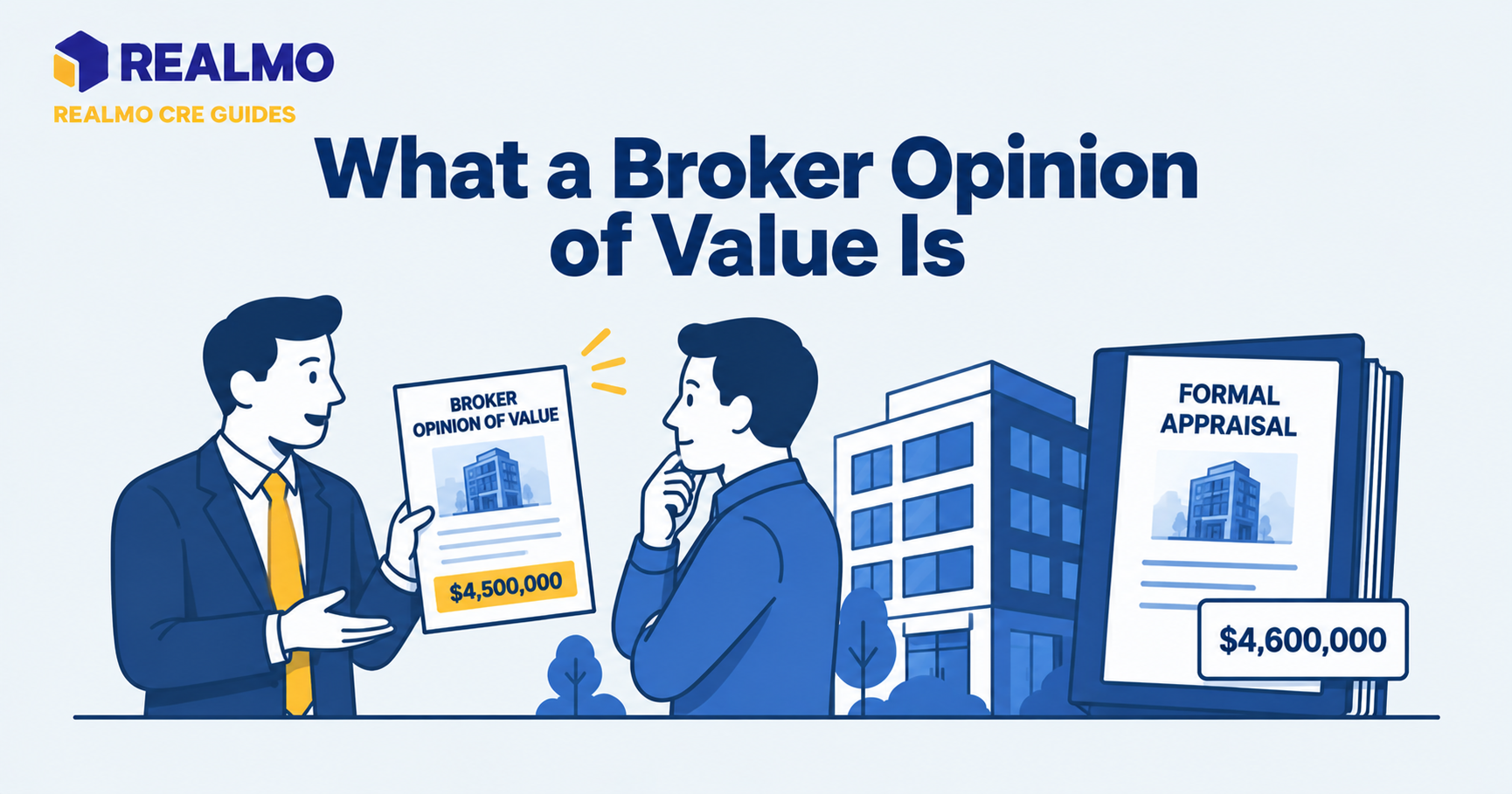
A broker opinion of value (BOV) is a licensed broker’s written estimate of a commercial property’s market value. It uses comparable sales, current listing activity, and the property’s income profile. It is not an appraisal, carries no federal certification requirement, and is produced in days rather than weeks.
Why it matters
An owner calls you on Tuesday asking what her 42,000-square-foot flex building would bring if she listed in the spring. She does not want to pay $4,500 for an appraisal to answer a question she may not act on. What she wants is a defensible number, a range around it, and the reasoning behind both.
That document is your first billable-adjacent deliverable in most listing pursuits, and it decides whether you win the assignment. A thin BOV (three comps, a price, no narrative) reads as a pitch. A rigorous one reads as analysis, and it sets the pricing expectation before a competing broker anchors her somewhere unrealistic. The BOV stage sets the pricing expectation before the listing is won or lost. Inflating the number or failing to support it weakens the assignment.
What a broker opinion of value actually contains
A complete BOV opens with a value conclusion (usually a range rather than a point estimate) and then earns it. The property description covers physical characteristics, zoning, current and permitted use, and any deferred maintenance that will surface in due diligence. The tenancy section summarizes the rent roll: lease expirations, escalations, options, reimbursement structure, and tenant credit where it is knowable.
From there the analysis usually runs on two or three tracks. The sales comparison approach adjusts recent closed transactions for size, location, age, and quality. The income approach capitalizes stabilized net operating income at a rate supported by comparable trades. Some BOVs add a replacement-cost sanity check, which matters most for newer buildings and for special-purpose assets where comps are thin.
The document closes with market context plus explicit assumptions and limiting conditions. Market context includes submarket absorption, competing supply, and buyer-pool depth at that price point. Those conditions are not boilerplate. They are what separates an opinion from a representation.
How a BOV differs from an appraisal
The distinction is legal, not merely one of thoroughness. An appraisal is prepared by a state-certified or state-licensed appraiser. For most federally related transactions, it must conform to the Uniform Standards of Professional Appraisal Practice (USPAP). It carries a defined scope of work, a signed certification, and professional liability that follows the appraiser.
A BOV is prepared by a real estate broker under a license to broker transactions, not to appraise them. Federal appraisal regulations and most state statutes exclude broker price opinions from the definition of appraisal. The broker is not holding the work out as an appraisal. That carve-out is conditional in several states. Some require disclosure language, some prohibit a separate fee, and others bar BOV use for mortgage origination. Confirm your own state’s rule before you deliver one, and consult licensed counsel if the intended use is anything other than an owner’s own decision-making.
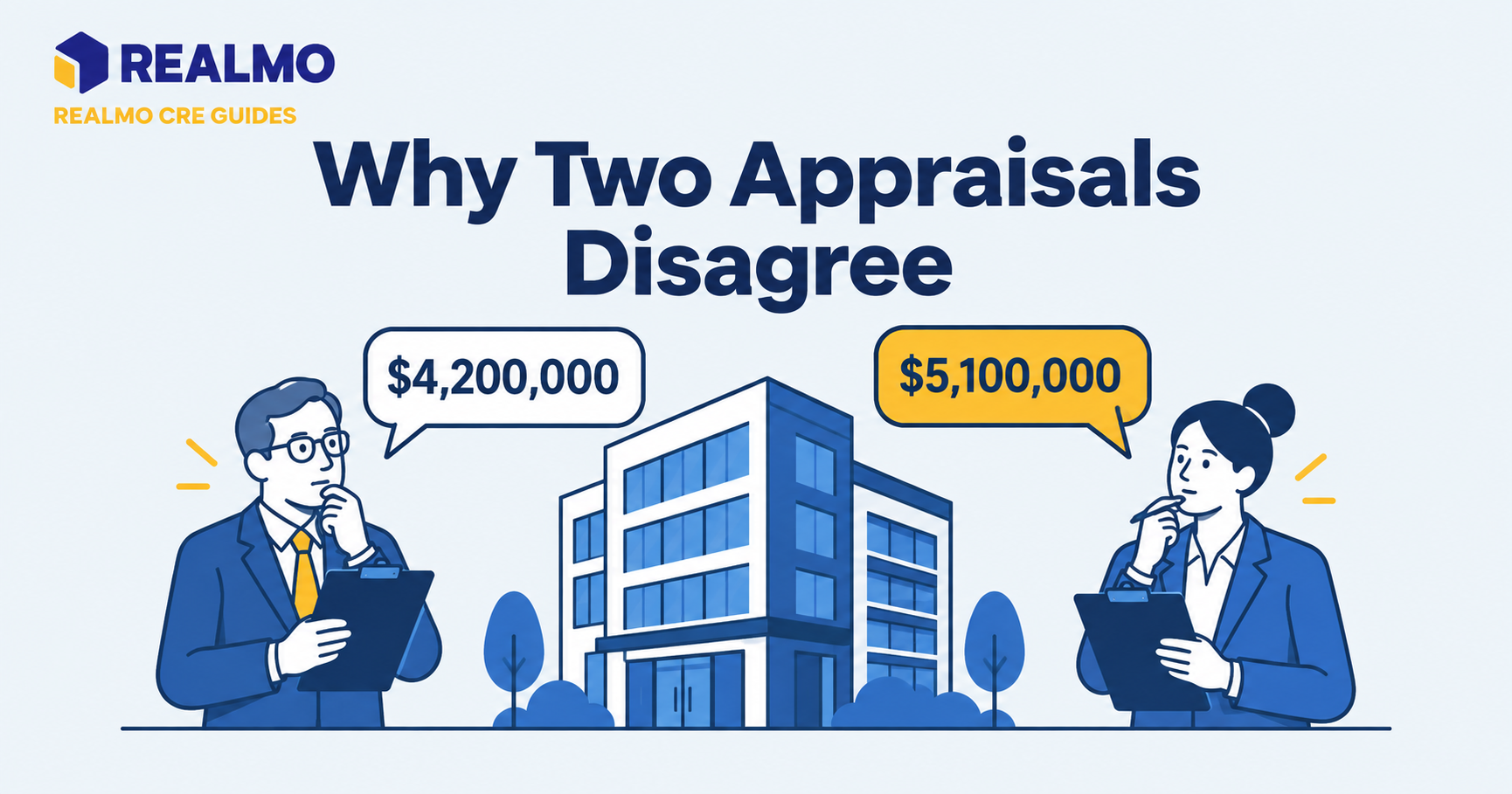
Practically, the differences that matter to your client are turnaround, cost, and admissibility. A BOV is fast and usually free or nominally priced because it is a business-development instrument. It is not acceptable to a lender for underwriting, not usable in most litigation, and not appropriate for estate or tax filings. See our overview of commercial appraisal methods and when lenders require them for where the line falls in financing.
When brokers and clients use a BOV
The dominant use is listing pursuit, an owner testing the market before committing. Institutional portfolios also use BOVs for disposition planning. Asset managers request them from covering brokers to mark holdings informally and identify sale candidates. Lenders sometimes order them on smaller loans or for internal portfolio monitoring, though that use is constrained by regulation on the origination side.
Other recurring uses include partnership buyouts, tenant purchase-option reviews, and rapid triage by receivers or special servicers. In each case, the BOV provides a starting number without a formal appraisal. Each of these implies a different emphasis. A partnership buyout BOV needs a tight, well-supported range because someone will argue with it. A portfolio-monitoring BOV needs consistency with prior years more than precision.
Worked example: pricing a small multi-tenant retail center
Illustrative figures only. A 12,000-square-foot neighborhood center, fully leased, three tenants on NNN leases with a weighted average remaining term of five years.
Start with in-place gross rent of $240,000, or $20 per square foot. Deduct a vacancy and credit loss allowance of 5%, or $12,000, giving effective gross income of $228,000. Operating expenses recoverable under the leases wash out, but non-recoverable costs (management, ownership-level administration, structural reserve) run $28,000. Net operating income is $200,000.
Now the judgment. Three verified submarket comps show different cap rates. One has a lower rate with longer-tenure credit, while two have higher rates with near-term rollover. The subject sits between them on lease term and above them on location quality. For this illustration, you select 7.0% at the tighter end of that range. Value indication: $200,000 ÷ 0.070 = $2,857,000, call it $2.85 million.
Cross-check against the sales comparison approach. If those same comps traded between $215 and $260 per square foot after adjustment, your $238 per foot lands inside the range. This supports the income conclusion. Present the result as a range, roughly $2.75 to $2.95 million, and state what moves it. An anchor extension tightens the rate; a departing tenant widens it.
The most common error here is capitalizing in-place NOI when in-place rents sit meaningfully above or below market. If two of three leases roll within eighteen months at rents 15% under market, the buyer is underwriting the mark-to-market, and so should you. Show both the in-place and the stabilized indication rather than picking one silently.
Common mistakes that undermine a BOV
Anchoring to the owner’s number. Delivering the value a seller wants to hear can win the listing. It can also produce ninety days without offers, followed by a price cut and stale marketing. You lose the fee and the referral.
Unverified comps. Unverified sale prices can corrupt every conclusion downstream. Confirm arm’s-length terms, seller financing, portfolio allocations, and any 1031-driven premium before using a transaction. Verify with a party to the transaction where you can. Cross-referencing recorded ownership data and sale history through Realmo’s property analytics before you call a broker is a faster path to the same verification.
Omitting the limiting conditions. A BOV without stated assumptions, an effective date, and a clear non-appraisal disclosure creates avoidable disputes. The risk appears when the market moves and clients remember a higher number.
Ignoring capital needs. Buyers will deduct for a roof near end of life, a parking lot due for replacement, or an unaddressed accessibility condition under the Americans with Disabilities Act (ADA). Those items belong in the analysis. Pricing as if the building is stabilized when it is not sets up a retrade.
One approach only. A single-method conclusion has nothing to check it against. When the income and sales comparison indications diverge sharply, that divergence is itself information about the asset.
Related terms
Cap rate · Net operating income · Comparable sales analysis · Appraisal · Listing agreement · Rent roll · Highest and best use · Mark-to-market rent
FAQ
Is a broker opinion of value the same as a BPO?
Broadly yes, broker price opinion (BPO) and broker opinion of value (BOV) describe the same instrument. BPO is more common in residential and lender-servicing contexts; BOV is the standard term in commercial brokerage and usually implies a longer, more analytical document.
Can a lender use a BOV instead of an appraisal?
Not for federally related mortgage originations, where appraisal requirements apply. Lenders may use broker opinions for internal portfolio monitoring, workout evaluation, or below-threshold transactions, subject to their regulator’s rules and their own policy.
How much does a broker opinion of value cost?
Most are provided at no charge as part of a listing pursuit. Where a fee is charged (portfolio assignments, receivership work) it reflects the labor involved. Several states restrict charging separate compensation for a BPO, so check state licensing rules.
How long does a BOV take to prepare?
A straightforward single-tenant asset can be turned in two to three business days. A multi-tenant property requiring rent roll analysis, lease abstraction, and comp verification takes one to two weeks.
How accurate is a BOV compared to an appraisal?
On assets with deep comparable data, the two land close. Divergence widens on special-purpose properties, thin submarkets, and assets with complex tenancy, precisely where an appraiser’s expanded scope of work earns its cost.