Medical Office Building Investment: How the Asset Class Works
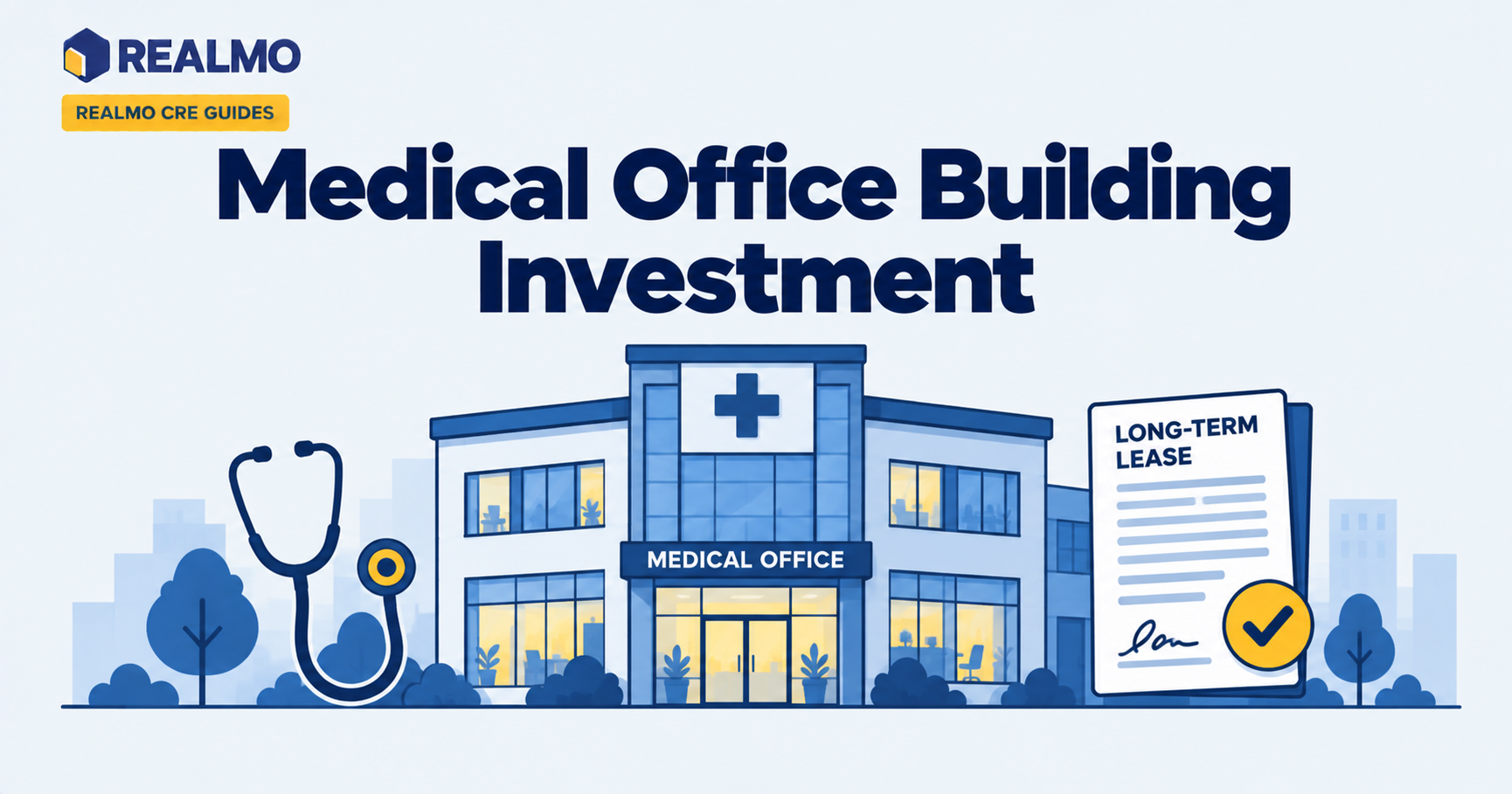
Medical office building investment means acquiring buildings leased to healthcare providers: physician groups, imaging centers, dialysis clinics, and ambulatory surgery centers. These are not conventional office tenants. The asset class trades on tenant retention driven by specialized buildouts and patient referral patterns, not on the flexible-space demand that drives traditional office.
Why This Asset Class Rewards Different Underwriting
An investor moving from suburban office into a medical building usually gets the rent roll right and the reversion wrong. Consider a buyer acquiring a 40,000-square-foot building where seven of nine suites are occupied by independent practices on staggered leases. In conventional office, that profile signals rollover risk, and the underwriting reflects it with heavy renewal downtime. In a medical building, the same practices have spent hundreds of thousands of dollars on plumbing, medical gas lines, and lead-shielded imaging rooms. Their patient base is geographically anchored to the address. Retention runs materially higher.
The opposite error costs more. When a medical tenant does leave, the suite is not re-leasable at office-level tenant improvement allowances. Reconfiguring a former OB-GYN suite for an orthopedic group can consume a year of that suite’s net operating income. Underwriting that assumes office economics on the upside and office costs on the downside will be wrong in both directions.
What Counts as a Medical Office Building
The label covers purpose-built outpatient facilities and converted conventional office space occupied by licensed providers. The most useful split is on-campus versus off-campus. On-campus buildings sit on or adjacent to a hospital campus, frequently on a long-term ground lease from the health system. They draw tenancy from physicians with admitting privileges. Off-campus buildings sit in retail-adjacent or suburban locations and compete on patient convenience, parking, and visibility. The economics run closer to single-tenant net lease retail than to a downtown tower.
Physical specifications separate medical buildings from office stock more than any lease clause does. Exam rooms need plumbing at each sink. Procedure rooms need dedicated exhaust and higher air changes. Imaging suites need structural floor loading and shielding, and waiting rooms push parking demand well above the office standard. Parking ratios in the range of five to six spaces per 1,000 square feet are common practice for outpatient use. General office runs roughly three to four spaces per 1,000 square feet. A building that cannot physically park its tenants limits its own leasable specialty mix.
Why MOB Cash Flow Behaves Differently From Office
Three mechanics drive the difference. First, relocation cost: a practice moving suites replicates its entire clinical infrastructure. That capital cost sits against a renewal rent increase the tenant will usually accept instead. Second, patient geography: outpatient volume is drawn from a defined radius. Moving even a few miles can shed referral flow the practice spent years building. Third, licensure and accreditation tie certain uses (surgery centers, pharmacies, imaging) to a specific licensed address, adding regulatory friction to any move.
The result is a cash flow stream with lower turnover and lower re-leasing frequency, but higher cost per turnover event. Investors should model that shape directly rather than importing office assumptions and adjusting the vacancy factor downward.
How to Read Medical Tenant Credit and Guarantees
The tenant on the lease and the credit behind the lease are commonly different entities. A suite leased to a three-physician practice may carry a personal guarantee from the partners. It might instead carry a corporate guarantee from a physician management platform, or a guarantee from a regional health system. Each supports a different capitalization rate, and the distinction shows up in the estoppel and guaranty documents, not on the rent roll summary.
Health system credit deserves particular attention. Systems carry public ratings from the major agencies, but the guaranteeing entity is sometimes a local hospital subsidiary rather than the rated parent. Confirm which entity signs and whether the obligation is joint and several. For independent groups, the substantive credit review is practice-level: payer mix, physician age, and succession plan. Review should also cover whether the group has an acquisition agreement pending with a larger platform that could consolidate its locations elsewhere.
Why Stark Law Shapes Landlord Economics
Federal healthcare law constrains how landlords can price space to physician tenants. This applies when the landlord is a hospital, health system, or other entity in a position to receive referrals. The Stark Law and the Anti-Kickback Statute broadly require that rent be set at fair market value, be commercially reasonable, and be fixed in advance. It cannot vary with the volume or value of referrals. In practice, that removes several standard leasing tools. Percentage rent tied to practice revenue, unusually deep free rent, and above-market improvement allowances all create compliance exposure in these relationships.
For third-party investors with no referral relationship, the direct exposure is limited, but the effects still reach the deal. Health-system-affiliated buildings are frequently supported by third-party fair market value opinions, and buyers should expect those files to exist and to review them. A rent roll with concessions inconsistent with the FMV opinions is a diligence issue. It can surface at exit, when a health system or REIT buyer runs the same review. Any deal touching physician tenancy or hospital affiliation warrants review by healthcare regulatory counsel.
What Ground Leases and Reimbursement Rules Change
On-campus buildings are commonly held on ground leases from the hospital, with terms of several decades. Those leases also carry restrictions on use and assignment, and health system rights of first refusal on sale. Two items drive value: remaining ground lease term relative to the amortization schedule of any loan. The other is whether improvements revert to the ground lessor at expiration. A building with fewer remaining years than a lender’s preferred cushion will finance on shorter, more expensive terms regardless of tenant quality.
Reimbursement policy sits underneath demand. Payers have historically reimbursed procedures performed in hospital outpatient departments at different rates than the same procedures in freestanding settings. Provider-based billing rules turn on the relationship and proximity between the facility and the hospital. Changes to that differential shift where health systems want to place volume, which moves leasing demand between on-campus and off-campus product. Investors should track the direction of federal site-neutral payment policy as a demand input rather than treat outpatient absorption as a fixed trend.
How MOB Pricing Compares to Other Asset Classes
Medical office prices at a lower capitalization rate than conventional suburban office in the same submarket. Retention runs higher, tenant defaults are less frequent, and the specialized improvements act as collateral holding tenants in place. It prices above long-term net-leased assets with investment-grade corporate credit. Multi-tenant medical buildings carry rollover management, higher re-leasing capital, and operational demands that a single-tenant net lease does not.
Within the class, spreads follow credit and location: a health-system-guaranteed building on campus prices tighter than a multi-tenant off-campus building leased to independent practices. Compare a target against comparable outpatient assets rather than against office comps, and reconstruct why any spread exists before accepting it. Ownership records and current-use data on Realmo can identify which nearby buildings a health system already controls. That is a strong signal of where the system intends to place volume.
Worked Example: Underwriting a Suburban MOB
All figures below are illustrative round numbers chosen to show the mechanics, not market observations.
A 40,000-rentable-square-foot off-campus building is 92% leased on triple-net terms at $30 per square foot. Operating expenses run $10 per square foot and are recoverable from occupied space.
| Line item | Calculation | Amount |
|---|---|---|
| Potential base rent | 40,000 × $30 | $1,200,000 |
| Vacancy loss | 8% of base rent | ($96,000) |
| Expense reimbursements | 36,800 SF × $10 | $368,000 |
| Effective gross income | $1,472,000 | |
| Operating expenses | 40,000 × $10 | ($400,000) |
| Capital reserve | 40,000 × $0.25 | ($10,000) |
| Net operating income | $1,062,000 |
At an illustrative 7.0% capitalization rate, the value is roughly $15.2 million, or about $379 per square foot.
Now test the downside. A 5,000-square-foot imaging tenant vacates. Re-tenanting at a medical improvement allowance of $100 per square foot costs $500,000, plus leasing commissions and six to twelve months of downtime. That single event consumes roughly half a year of building-level NOI. The interpretive point: value here is set by NOI. The equity return is set by how many of those events occur and how they are funded. Model a capital reserve sized to medical improvement costs, not office costs.
The frequent error is applying an office-standard allowance of $40 to $50 per square foot to a clinical suite. That understates the reserve by more than half and makes the internal rate of return look stronger than the asset can deliver.
Common Mistakes in Medical Office Building Investment
- Treating rentable square feet as comparable to office. Medical buildings carry higher load factors because of corridor and mechanical space. A $30 rent on a 20% load factor is a different economic rent than $30 on a 12% load factor. Comparisons that skip BOMA measurement standards misstate the whole rent roll.
- Accepting a guarantee without reading the guarantor. A lease “with the health system” may be signed by an unrated local subsidiary. The capitalization rate paid for system credit is unearned if the parent is not obligated.
- Ignoring remaining ground lease term. Financing terms compress as the ground lease shortens, and the exit buyer pool narrows to those who can underwrite reversion.
- Underfunding re-tenanting capital. Office-level improvement allowances in the model produce a reserve that cannot fund a single clinical suite turnover.
- Overlooking parking capacity against specialty mix. A building parked for general office use cannot absorb a high-volume clinic, which caps the tenant pool at renewal and at sale.
Related Terms
Capitalization rate · Net operating income · Triple net lease · Ground lease · Tenant improvement allowance · Rentable vs. usable square feet · Single-tenant net lease
FAQ
Is medical office a defensive asset class?
Outpatient demand is driven by care utilization rather than by employer space decisions, which historically makes occupancy less sensitive to office-market cycles. That does not remove risk. Reimbursement policy, health system consolidation, and physician group succession all affect tenancy, and a single-tenant building concentrates every one of those risks in one lease.
Can a first-time investor buy a medical office building?
Yes, and smaller off-campus buildings with one or two tenants are a common entry point. The diligence burden is heavier than for comparable retail. Review needs to cover guarantor structure, ground lease terms if applicable, clinical systems condition, and the fair market value documentation behind existing rents before closing.
Do medical office buildings work in a 1031 exchange?
They qualify as like-kind real property on the same terms as other commercial assets, subject to the standard 45-day identification and 180-day closing deadlines. The practical constraint is diligence time: those deadlines are unforgiving, and medical assets carry more document review than a comparable net-lease property. Consult a qualified intermediary and tax advisor.
What lease structure is standard in medical office?
Both triple-net and modified gross structures are common, with the split varying by market and by whether the landlord is a health system. Modified gross is more frequent in multi-tenant buildings with shared clinical infrastructure, where allocating utility and HVAC costs by suite is impractical.