What Is Included in NOI: What Counts and What Doesn’t

Net operating income is a property’s rental and ancillary income minus the operating expenses required to run it, measured before financing and income taxes. What is included in NOI: contract rent, expense reimbursements, and recurring other income on one side. Taxes, insurance, utilities, management, and routine maintenance on the other. Debt service, capital expenditures, and depreciation stay out.
Why the NOI Line Decides What Your Building Is Worth
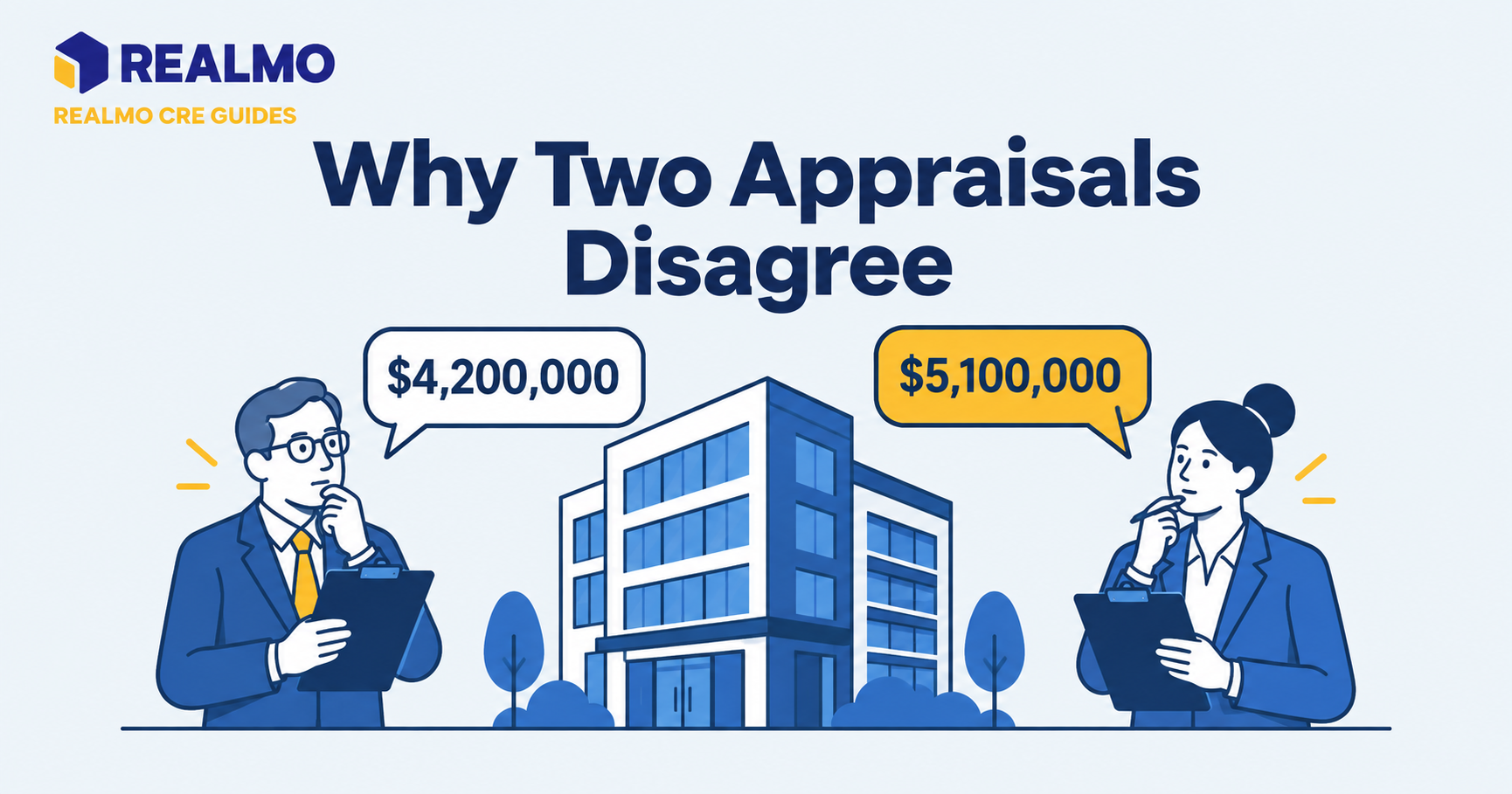
An owner refinancing a multi-tenant retail strip submits a trailing-twelve operating statement showing $520,000 of NOI. The lender’s underwriter removes a $38,000 parking-lot resurfacing job as capital, adds a 4% management fee the owner never paid because he self-manages, and reclassifies a lease termination payment as non-recurring. The lender’s NOI comes back near $460,000. At the same capitalization rate, that gap moves appraised value by roughly a million dollars and shrinks loan proceeds by hundreds of thousands.
Nothing about the building changed. Only the classification of five line items changed. For an owner, NOI is not an accounting exercise, it is the number that sets refinance proceeds, sale price, property tax appeals, and percentage-rent negotiations. Knowing which dollars belong above the line is the difference between an appraisal that confirms your expectations and one that resets them.
The NOI Formula and What It Deliberately Excludes
NOI is built in two steps. First, gross potential rent less vacancy and credit loss, plus reimbursements and other income, produces effective gross income. Second, effective gross income less operating expenses produces NOI.
The exclusions follow one rule: NOI describes the asset, not the owner. Two buyers looking at the same building will finance it differently, depreciate it differently, and pay different income tax rates. Strip all three out and you get a figure that compares cleanly across properties and across owners. This is exactly what makes it the numerator in cap rate math. Anything that varies with who holds title, rather than with how the building operates, belongs below the NOI line.
What Is Included in NOI on the Income Side
Base rent counts at contract rent actually in place, not asking rent and not the rent a vacant suite would command if leased. Space that is leased but not yet occupied or paying belongs in a separate lease-up analysis, not in current NOI.
Expense reimbursements count as income: common area maintenance recoveries, tax and insurance pass-throughs, and utility billbacks. So does recurring ancillary income , percentage rent, parking, storage, rooftop antenna and signage leases, and vending. The test is repeatability. Income a new owner would also collect next year belongs in NOI.
Several receipts do not. Security deposits are a liability, not income, until applied. Proceeds from a sale or refinance never touch NOI. Insurance settlements and lease termination fees are non-recurring by definition; underwriters commonly strip them out, or normalize them across the remaining lease term. Interest earned on operating reserves is portfolio income, not property income.
One technical split matters if your books are on an accrual basis. Straight-line rent spreads free-rent periods and escalations evenly across the term, while cash rent records what tenants actually paid. Most CRE underwriting runs on cash NOI, so a GAAP statement usually needs adjusting before anyone will lend against it.
Which Operating Expenses Belong Above the Line
Operating expenses are the recurring costs of keeping the building open and tenantable: property taxes, property and liability insurance, unreimbursed utilities, routine repairs and maintenance, janitorial, landscaping and snow removal, security, elevator and HVAC service contracts, on-site payroll, general and administrative costs, and ordinary professional fees.
Property management deserves its own attention. A market-rate management fee, commonly quoted as a percentage of effective gross income. With 3% to 5% a familiar range across asset classes, belongs in NOI even when you self-manage and pay yourself nothing. Your labor is real, and every lender and appraiser will add it back. Leaving it out inflates NOI on your own statements and guarantees a downward adjustment later.
Marketing and leasing advertising is an operating expense. Leasing commissions and tenant improvement allowances usually are not, though practice varies. Appraisers frequently deduct TI and leasing commissions after NOI when building a discounted cash flow, while brokers marketing a property rarely show them at all. Ask which convention a given statement follows before comparing two deals.
Why Debt Service, CapEx, and Depreciation Stay Out
Mortgage principal and interest are excluded because financing is a function of the buyer, not the building. Once debt is subtracted, the result is cash flow before taxes, and the ratio lenders build from NOI , the debt service coverage ratio , would become circular.
Capital expenditures are excluded because they extend the life of the asset rather than sustain current operations. Patching a roof leak is maintenance; replacing the roof is capital. The line is genuinely blurry, and the capital expenditures versus repairs distinction is where owners and underwriters argue most.
Depreciation is excluded because it is a tax accounting entry, not a cash cost. Commercial improvements are depreciated over 39 years and residential rental over 27.5 years under the Modified Accelerated Cost Recovery System (MACRS) (see IRS Publication 946), but no cash leaves the property. Income tax is excluded for the same reason financing is: it depends on the owner’s entity and situation, not on the asset.
Replacement reserves sit in the contested middle. Appraisers and many lenders deduct an annual reserve above the NOI line to reflect recurring capital needs. Brokers and owners present NOI without it. Neither approach is wrong, but comparing one to the other without adjusting is.
How Lease Structure Changes What Lands in NOI
In a triple net structure, tenants pay taxes, insurance, and maintenance directly or through reimbursement, so both income and expenses run higher on paper while NOI stays close to the base rent. In a full-service gross lease, the owner absorbs those costs and shows a much larger expense load against a larger base rent. Modified gross leases split the difference, frequently with a base year expense stop in office buildings.
The practical consequence: an operating expense ratio is meaningless without knowing the lease structure behind it. Read the triple net lease mechanics before benchmarking one property’s operating expense ratio against another’s.
Worked Example: NOI for a Multi-Tenant Retail Strip
All figures below are illustrative round numbers, not market data.
| Line item | Amount |
|---|---|
| Gross potential rent | $600,000 |
| Less vacancy and credit loss (5%, illustrative) | ($30,000) |
| Plus CAM and tax reimbursements | $120,000 |
| Plus signage and parking income | $10,000 |
| Effective gross income | $700,000 |
| Property taxes | ($90,000) |
| Insurance | ($25,000) |
| Common area utilities | ($18,000) |
| Repairs and maintenance | ($32,000) |
| Landscaping and snow removal | ($15,000) |
| Management fee (4% of EGI) | ($28,000) |
| Administrative and professional | ($12,000) |
| Total operating expenses | ($220,000) |
| Net operating income | $480,000 |
Excluded below the line: $310,000 of annual debt service, a $150,000 roof replacement, and $60,000 of tenant improvements and leasing commissions on a new lease. Cash flow after debt service is $170,000 before those capital items , a number that tells the owner about liquidity, while the $480,000 tells the market about the asset.
Interpretation runs through the cap rate. At an illustrative 7% cap, this NOI supports roughly $6.86 million of value, and every $10,000 of misclassified expense moves that figure by about $143,000. Owners preparing for a sale or refinance can cross-check the implied value against comparable property analytics on Realmo before committing to a number.
The common error in this example is netting: showing reimbursements as a reduction of expenses rather than as income. NOI comes out identical, but effective gross income and the expense ratio both collapse, and the property no longer compares to anything.
Common Mistakes Owners Make When Calculating NOI
- Omitting a management fee on self-managed assets. The lender adds it back during underwriting, NOI falls, and loan proceeds shrink days before closing.
- Running one-time items through NOI. A storm repair or a legal settlement gets capitalized at the market cap rate. Swinging apparent value by ten to fifteen times the actual dollar amount.
- Using asking rent or signed-but-not-occupied rent. The appraisal reverts to in-place contract rent, and the valuation gap surfaces after the buyer has already priced the deal.
- Netting reimbursements against expenses. The expense ratio becomes unreadable and the property fails comparison against brokered comps.
- Deducting principal, depreciation, or partnership overhead. The resulting figure is cash flow or taxable income, not NOI, and any cap rate derived from it is wrong.
Tax treatment of depreciation, repairs, and capitalization rules is fact-specific; confirm classifications with a licensed CPA or tax advisor before relying on them for filings.
Related terms
- Effective gross income
- How to calculate cap rate
- Operating expense ratio
- Debt service coverage ratio
- Capital expenditures vs. repairs and maintenance
- Triple net lease
- Cash-on-cash return
- Gross potential rent
FAQ
Does NOI include mortgage payments?
No. Neither interest nor principal is included in NOI. Financing depends on the owner rather than the property, and excluding it lets buyers compare assets on equal terms. Subtracting debt service from NOI produces cash flow before taxes, which is a different metric used for return analysis rather than valuation.
Is property management included in NOI?
Yes. A market-rate management fee is an operating expense and belongs above the NOI line even when the owner self-manages and pays no third party. Lenders and appraisers add the fee back during underwriting, so leaving it out only creates a discrepancy that surfaces at the worst moment.
Are capital expenditures included in NOI?
No. Roof replacements, HVAC unit replacements, parking lot resurfacing, and similar work that extends useful life sit below the NOI line. Routine repairs that keep existing systems running are operating expenses and stay above it. The classification of borderline items is the most common point of disagreement in underwriting.
Do replacement reserves come out of NOI?
It depends on the convention. Appraisers and many lenders deduct an annual reserve for recurring capital needs before reporting NOI; brokers and owners present NOI without any reserve. Both presentations circulate in the market, so check which one a statement uses before comparing it to another property.
Is NOI calculated before or after income taxes?
Before. Property taxes are an operating expense and count in NOI. But income taxes are excluded because they depend on the owner’s entity structure, basis, and tax position rather than on how the property performs.