What Is a Good Cap Rate
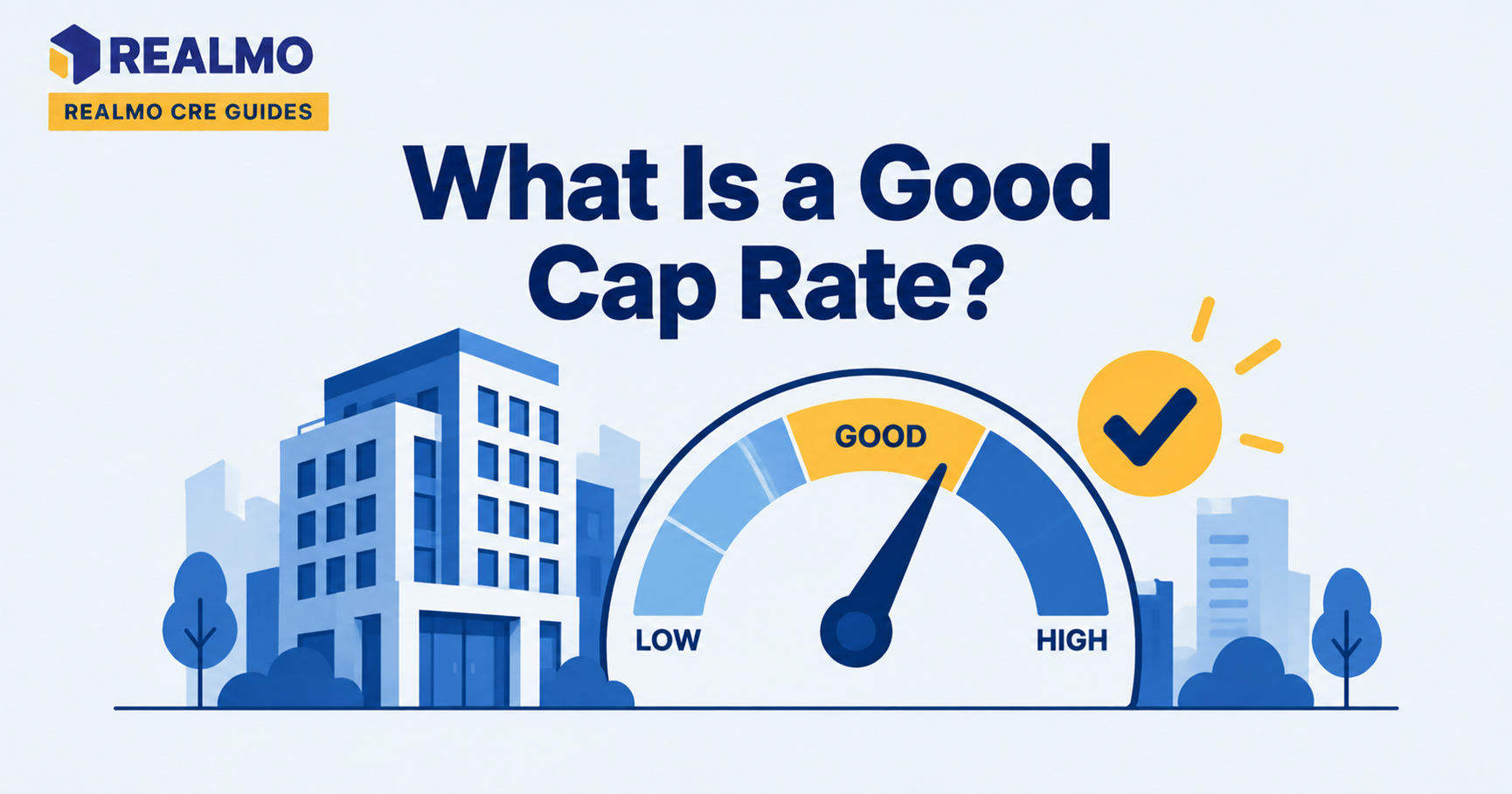
A good cap rate is one that pays you enough for the risk, income durability, and growth potential of a specific property in a specific market. There is no universal number. Investors asking what is a good cap rate usually want a threshold; the useful answer is a method for setting one deal by deal.
Why the cap rate you accept drives your return
Suppose you are buying your second property and two brokers send you deals in the same metro at the same going-in cap rate. Accepting that number as “the market” hides the fact that one is a single-tenant building with eight years of remaining term and the other has 40% of its space rolling next year. You are paying the same price for two different income streams.
The cap rate is the price you pay per dollar of current income. Get it wrong on the way in and every later decision, financing, hold period, capital budget, inherits the error. Get it right and you have a defensible basis, which matters most at exit. When a buyer applies their own cap rate to whatever income you have produced. Understanding how to calculate cap rate is step one; knowing what number to accept is the harder half.
What the cap rate is actually pricing
A cap rate compresses four judgments into a single figure: how likely the income is to continue, how likely it is to grow, how much capital the building will consume, and how liquid the asset will be when you sell.
Lower cap rates signal that buyers view the income as durable and the asset as easy to resell. Higher cap rates signal the opposite, shorter leases, weaker tenant credit, thinner buyer pools, deferred maintenance, or a submarket with limited demand depth. A high cap rate is not a discount. It is compensation, and the question is whether the compensation is sufficient for the risk you are actually taking.
This is why the cap rate cannot be evaluated apart from the net operating income it sits on top of. A cap rate calculated on a seller’s projected NOI, with no management fee and no replacement reserve, is a different metric from one calculated on trailing, normalized income.
What is a good cap rate: the risk-spread test
The practical test is relative, not absolute. Compare the going-in cap rate to three reference points.
The risk-free rate. Long-term Treasury yields are the floor for any income investment. The gap between a property’s cap rate and that yield is the spread you are being paid to accept illiquidity, management burden, and tenant risk. Current yields are published daily by the U.S. Treasury and tracked in the Federal Reserve’s FRED database, pull them at the time you underwrite rather than relying on a remembered figure. When spreads compress, the same cap rate that looked adequate a year earlier no longer is.
Your cost of debt. If the going-in cap rate sits below your loan constant (annual debt service divided by the loan amount), debt reduces your first-year cash return rather than increasing it. That is not automatically disqualifying , it is the normal condition for low-cap, high-growth assets , but it must be a deliberate choice, verified through a cash-on-cash return calculation rather than assumed.
Comparable trades. What similar assets, with similar lease structures, actually sold for. Not asking prices, and not averages across an entire property type.
A cap rate that clears all three tests for the risk you are underwriting is a good cap rate for you. One that clears none is a price problem.
How property type shifts the acceptable range
Cap rates sort predictably by asset class, and the ordering is more stable than the levels.
Net-leased assets with investment-grade tenants and long remaining term trade at the tightest cap rates, because the income requires little management and carries little re-leasing risk , see triple net lease for how that structure shifts cost burden to the tenant. Industrial has in prevailing market practice priced tighter than retail in the same market, since leases run longer, tenant improvement costs are lower, and the tenant base has been expanding. Office commonly prices wider, reflecting heavier capital requirements per lease and greater uncertainty about occupancy at renewal. Hotels sit at the wide end because their income resets nightly and operating leverage is extreme.
Within a type, the range is wide again. A newer building leased to a national credit tenant and a fifty-year-old building with local tenants can differ by hundreds of basis points while sitting on the same street.
How market, tenant, and building move the number
Three property-level factors explain most of the variation you will see between deals that look similar on paper.
Location depth matters more than location prestige. A submarket with many active buyers and lenders supports lower cap rates because exit risk is lower. Thin markets require a wider cap rate even when current income is strong, since you may be selling to a single logical buyer.
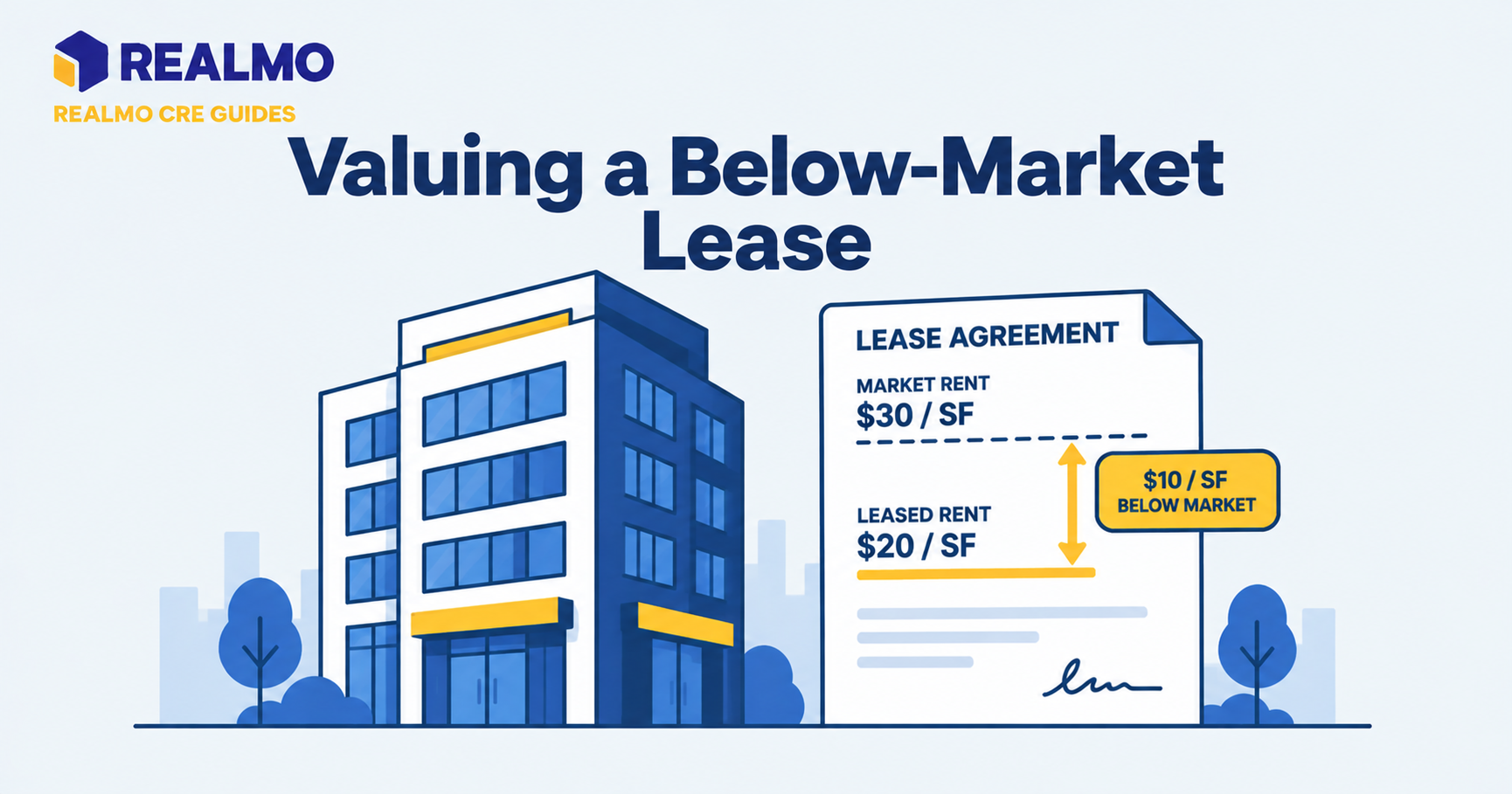
Tenant credit and lease term set the durability of the income. Weighted average lease term, rollover concentration in any single year, and whether rents sit above or below market all belong in the analysis before you judge the cap rate. Below-market rents with near-term expirations justify accepting a lower going-in number; above-market rents on a tenant that could leave justify demanding a higher one.
Building condition sets the capital drag. Roof, HVAC, parking, and elevator age determine how much of your NOI never reaches you. Two properties at an identical cap rate deliver different cash flow if one needs a structural reserve three times the size of the other.
For comparable sales, ownership records, and cap rate estimates across property types. Realmo’s property analytics let you check a broker’s stated cap rate against what similar assets in the same submarket actually support.
Worked example: two deals at the same cap rate
All figures below are illustrative and rounded for clarity.
Both properties are priced at $2,000,000 with in-place NOI of $140,000, producing a 7.0% going-in cap rate.
Deal A is a single-tenant building with eight years of remaining term, flat rent, and a corporate tenant. In-place NOI is close to stabilized NOI. Your 7.0% is what you own.
Deal B is a 12,500-square-foot multi-tenant building. Of that, 5,000 square feet expires in 18 months at $18 per square foot, while comparable space in the submarket leases at $22. Rolling that space to market adds $20,000 of annual income, taking NOI to $160,000. Reaching it costs an estimated $60,000 in tenant improvements, leasing commissions, and downtime.
Stabilized basis: $2,000,000 + $60,000 = $2,060,000. Stabilized cap rate: $160,000 ÷ $2,060,000 = 7.8%.
How to read it: Deal A gives you 7.0% with little execution risk. Deal B gives you 7.8% only if you fund the capital, sign the lease at the assumed rent, and absorb the vacancy period. The 80-basis-point pickup is the payment for taking on that work. Whether it is enough depends on how confident you are in the $22 rent, which is an underwriting question, not a cap rate question.
The frequent error: comparing Deal B’s stabilized 7.8% to Deal A’s going-in 7.0%. Compare going-in to going-in and stabilized to stabilized, or the higher-risk deal will always appear to win.
Common mistakes when judging a cap rate
- Using the seller’s pro forma NOI. A cap rate built on projected income with no management fee, no reserves, and no vacancy allowance overstates the return. Rebuild NOI from trailing statements and a rent roll before dividing anything.
- Treating a high cap rate as a bargain. The market prices risk. A cap rate well above comparable trades usually reflects a problem the seller has already identified, and you will inherit it at exit.
- Ignoring the exit cap rate. Buying at a low cap rate and assuming you sell at the same one embeds an optimistic assumption. Model a wider exit and see whether the deal still works; the terminal cap rate drives most of the return in a five-to-ten-year hold.
- Comparing across property types. A 7% cap on a net-leased asset and a 7% cap on a value-add office building are not the same investment. Cross-type comparison only works after adjusting for lease term, capital needs, and liquidity.
- Anchoring on a remembered number. Cap rates move with debt costs and buyer demand. A threshold that made sense in one rate environment can be wrong in the next. This is why the spread test travels better than any fixed figure.
Cap rate analysis is not a substitute for full underwriting, and none of the above is investment or tax advice , review deal-specific decisions with a licensed professional before committing capital.
Related terms
- How to Calculate Cap Rate
- Net Operating Income (NOI)
- Cash-on-Cash Return
- Terminal Cap Rate
- Debt Service Coverage Ratio
- Value-Add Investment Strategy
- Triple Net Lease (NNN)
FAQ
Is a higher or lower cap rate better?
Neither by itself. A lower cap rate means you paid more per dollar of income, usually for safer, more liquid income. A higher cap rate means more current yield with more risk. The better cap rate is the one whose spread over your alternatives matches the risk you are actually accepting.
What is a good cap rate for a first commercial purchase?
Can two properties have the same cap rate but different value?
Yes. Identical cap rates say nothing about lease term, tenant credit, deferred capital needs, or below-market rents. Two assets at the same going-in number can produce very different cash flow and very different sale proceeds.
Does the cap rate include the mortgage?
No. Cap rate is calculated on net operating income before debt service, which makes it comparable across deals with different financing. To see the effect of a loan, use cash-on-cash return or the debt service coverage ratio instead.
Why do cap rates differ so much between cities?
Buyer depth, lender appetite, population and employment trends, and how easily new supply can be built. Markets with many active buyers and constrained development support lower cap rates, because exit risk is lower and rent growth expectations are higher.
Can two properties have the same cap rate but different value?
Yes. Identical cap rates say nothing about lease term, tenant credit, deferred capital needs, or below-market rents. Two assets at the same going-in number can produce very different cash flow and very different sale proceeds.