The Income Approach to Valuation
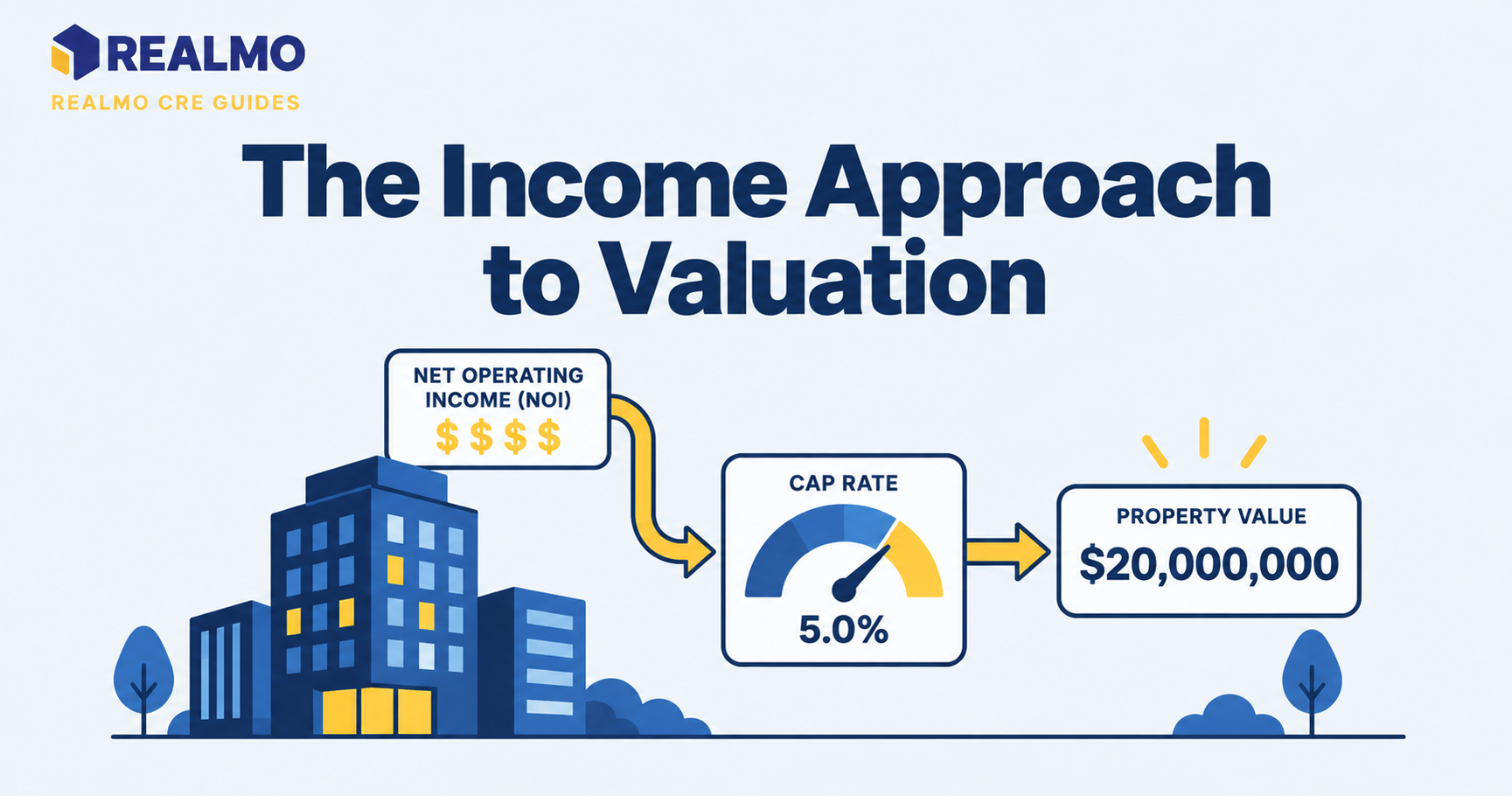
The income approach estimates what a commercial property is worth by converting the income it produces into a capital value. An appraiser stabilizes net operating income, then either divides it by a market capitalization rate or discounts a multi-year cash flow forecast to present value. An income approach appraisal is the method lenders weight most heavily for income-producing assets.
Why income approach appraisal decides your price
You are 30 days into due diligence on a 25,000-square-foot neighborhood retail strip. Your offer came from the broker’s package. It used in-place rents, trailing seller expenses, and a cap rate from two recent submarket sales. The lender orders an appraisal, and the number comes back roughly eight percent under your contract price.
Nothing was falsified. The appraiser marked two below-market leases to contract rent, not projected market rent. The appraiser also added a replacement reserve omitted from the seller’s statement. The appraiser normalized a property tax line that had not yet been reassessed after the last sale. Each adjustment reduced NOI by a few thousand dollars. At the cap rate used, each lost NOI dollar cut value by roughly fourteen dollars.
That is the whole game. Your equity check, your loan proceeds, and your renegotiation leverage all trace back to how income is defined and what rate is applied to it.
Direct capitalization vs. discounted cash flow
The income approach has two branches, and they answer slightly different questions.
Direct capitalization converts a single year of stabilized income into value:
Value = Net Operating Income ÷ Capitalization Rate
It assumes the income stream is stable, or at least that its growth pattern resembles the properties from which the cap rate was extracted. Direct capitalization is fast and transparent for stabilized, multi-tenant assets with staggered leases. The cap rate imports the market’s collective view of growth and risk. Its weakness is that it compresses everything about timing into one number. Two buildings with identical NOI today receive the same direct-cap value. One may roll half its space next year while the other has a fifteen-year corporate lease.
Discounted cash flow (DCF) models each year separately, over a ten-year holding period, then adds a reversion value for the assumed sale:
Value = the sum of each year’s cash flow discounted at the required rate of return, plus the discounted reversion
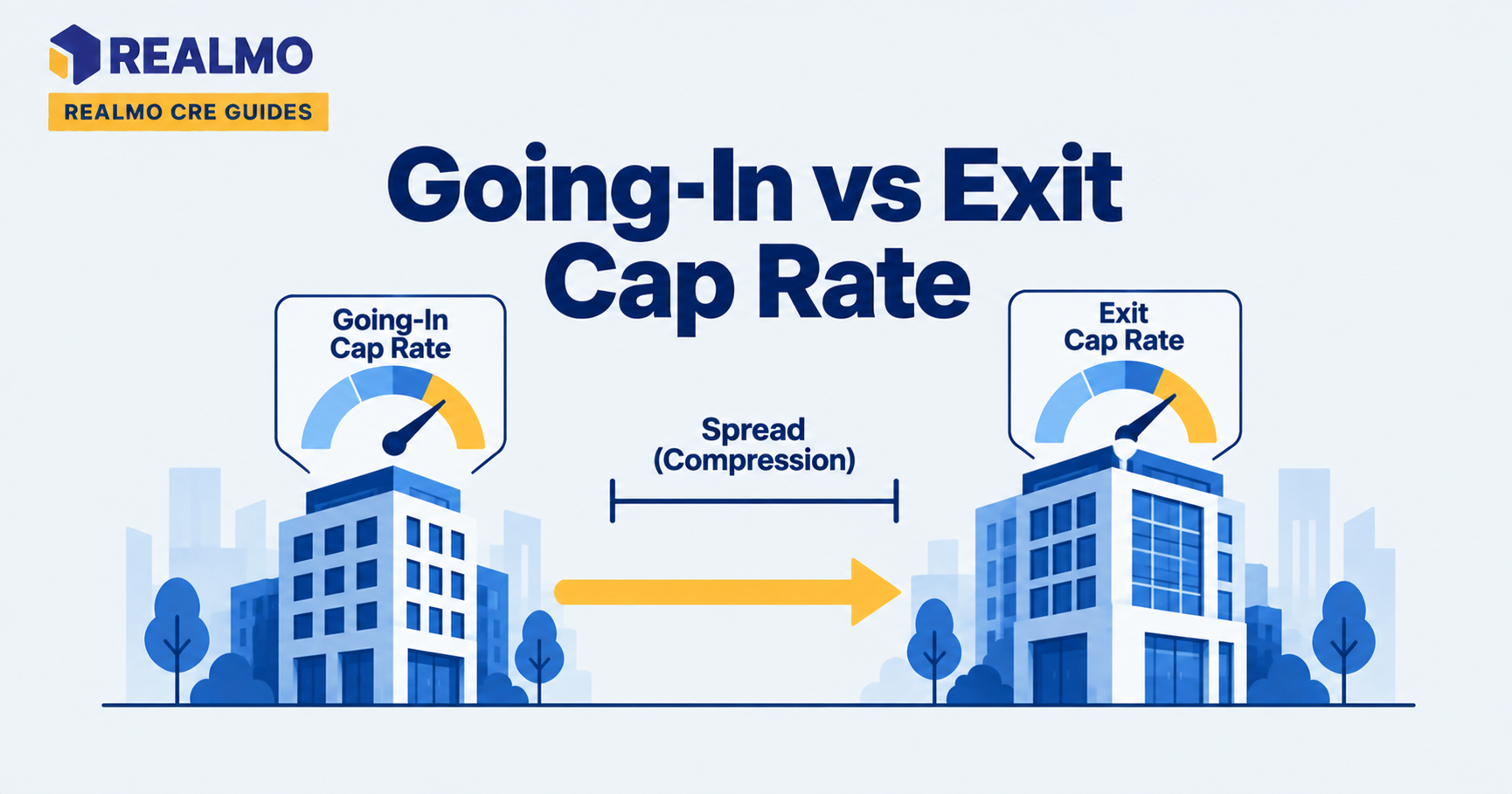
The reversion is normally calculated as the following year’s NOI divided by a terminal capitalization rate, less costs of sale. Practitioners set the terminal rate at or slightly above the going-in rate. The asset will be older and its remaining lease term shorter at exit. The discount rate is a total return requirement, not a cap rate. It sits above the going-in cap rate by roughly the expected income growth.
DCF earns its complexity when timing matters. Examples include vacancy lease-up, concentrated rollover, contractual step-ups, planned capital work, or a transition to another use. It is also the language institutional buyers speak, so a discounted cash flow analysis is standard in offering memoranda for larger assets. A DCF also has dozens of inputs. Small changes to the discount rate, growth assumption, or terminal rate can swing the answer. More assumptions do not mean more accuracy.
Appraisers frequently run both and reconcile. When the two methods diverge sharply, the divergence is itself a finding. It usually points to rollover risk or a materially off-market rent roll.
How to build a stabilized net operating income
Value flows from a defensible income statement, so most valuation disputes are really NOI disputes. The build runs top down.
Start with potential gross income. Include every occupied square foot at contract rent, vacant space at market rent, reimbursements, percentage rent, parking, and recurring revenue. Then subtract vacancy and credit loss. Stabilized means what the property should sustain across a normal cycle, not what it happens to be doing this month. A fully leased building still carries a vacancy allowance, because tenants eventually leave. The result is effective gross income.
From effective gross income, subtract operating expenses: real estate taxes, insurance, utilities, common area maintenance, repairs, management, and non-recoverable administrative costs. Reassess taxes if a sale will trigger reassessment, and use a market management fee even when the owner self-manages. This is because the buyer’s cost structure is what is being valued. The result is net operating income.
Four items stay out of NOI: debt service, depreciation (governed by the Modified Accelerated Cost Recovery System, MACRS), income taxes, and the owner’s non-property expenses. Excluding financing is what makes NOI comparable across buyers with different capital stacks. It is why NOI, not cash flow after debt service, feeds the cap rate.
Replacement reserves are the honest disagreement in this build. Appraisers deduct an annual reserve for roofs, HVAC, and parking lots, on the reasoning that these costs are certain and merely irregular. Many brokers and sellers report NOI before reserves, arguing that reserves are capital, not operating expense. That comparable sales were also reported on a pre-reserve basis. Neither convention is wrong, but mixing them is: a pre-reserve NOI capitalized at a rate extracted from post-reserve sales overstates value. Establish which convention your cap rate comps used before you apply anything.
Contract rent versus market rent is the second recurring judgment. In direct capitalization, occupied space uses contract rent and vacancy uses market rent. The appraiser then adjusts separately for material above- or below-market leases over their remaining terms. Capitalizing market rent on space locked into a long below-market lease values an income stream the buyer will not receive for years.
Where the capitalization rate comes from
A cap rate is not a market fact you look up. It is derived, and the method matters.
The primary technique is extraction from comparable sales: divide each comparable’s stabilized NOI by its sale price. This is only as good as your knowledge of that comp’s income statement. That is why cap-rate discipline starts with verifying the numerator. A price is public; the NOI behind it usually is not. Confirming ownership, sale price, and property characteristics is the first step. Platforms with commercial property comparable sales data let you assemble the set before third-party work.
Two other derivations serve as cross-checks. The band of investment weights the mortgage constant and equity dividend requirement by their shares of the capital stack. The result is a rate consistent with prevailing financing terms. The debt coverage formula multiplies the required debt service coverage ratio by the mortgage constant and the loan-to-value ratio. This reflects how a lender-constrained market actually prices assets. Published investor surveys such as the PwC Investor Survey and the RERC/SitusAMC Real Estate Report provide a third reference point for expected ranges by property type and market tier.
The relationships between cap rates are more durable than the rates themselves. Longer WALT, stronger tenant credit, and lower capital intensity compress cap rates. Short rollover, single-tenant concentration without strong credit, and functional obsolescence expand them. Industrial and grocery-anchored retail in the same market price tighter than unanchored strip retail, because lease terms run longer and replacement demand is deeper. Assets with month-to-month income, such as self-storage, reprice faster in both directions than assets on ten-year leases. Learn the logic and you can evaluate any quoted rate, including one quoted to you at a time when the rate itself has moved.
Match the rate to the income. A rate extracted from trailing-twelve NOI applies to trailing-twelve NOI, not to a forward pro forma. Mismatching them is the single most common way an income approach appraisal produces a number that cannot be defended.
Worked example: a multi-tenant retail strip
All figures below are illustrative and rounded for clarity. They demonstrate mechanics, not current market pricing.
Inputs. A 25,000-square-foot strip center, fully leased on triple-net leases at an average of $24 per square foot, with expense recoveries of $130,000. Assume 8 percent stabilized vacancy and credit loss, management at 4 percent of EGI, and a $0.25-per-square-foot replacement reserve.
Step 1, Effective gross income. Rental income of $600,000 plus recoveries of $130,000 equals potential gross income of $730,000. Vacancy and credit loss of $58,400 leaves effective gross income of $671,600.
Step 2, Operating expenses. Real estate taxes are $95,000, insurance $22,000, and CAM $58,000. Management is $26,864, replacement reserve $6,250, and non-recoverable administrative costs $8,000. Total operating expenses: $216,114.
Step 3, Net operating income. $671,600 less $216,114 equals $455,486.
Step 4, Capitalize. At a 7.0 percent cap rate, $455,486 ÷ 0.07 gives approximately $6,507,000. That is about $260 per square foot.
How to interpret it. The output is a point estimate inside a range, so test the range. Hold NOI constant and move the rate. At 6.5 percent, the indication is roughly $7,007,000. At 7.5 percent, it is roughly $6,073,000. A one-percentage-point spread in the rate moves value by more than $930,000, or roughly 14 percent. That sensitivity makes rate derivation as important as the income statement. A local sales check on price per square foot takes little time and catches obvious errors.
The common error here. Notice that recoveries are $130,000 while recoverable expenses are $153,000. That gap is real in a fully leased building only if some expenses are excluded from the recovery pool or subject to caps. Reconciling recoveries to the actual lease language, rather than assuming full pass-through, is where amateur models overstate NOI. On the illustrative numbers above, treating recoveries as fully matched would add $23,000 to NOI and roughly $329,000 to value.
Common mistakes in income approach valuations
- Capitalizing pro forma income at a market cap rate. Applying a stabilized-asset rate to income the property has never produced double-counts optimism, since the rate already assumes normal operations. Consequence: an appraisal gap at closing and a shortfall in loan proceeds.
- Using the seller’s expense history unadjusted. Taxes reassess on sale, insurance reprices, and self-managed properties show no management fee. Consequence: overstated NOI that collapses in year one, exactly when debt service coverage is tightest.
- Ignoring lease rollover concentration. Direct capitalization treats a rent roll with 60 percent rolling in eighteen months the same as one with staggered ten-year terms. Consequence: unmodeled downtime, leasing commissions, and tenant improvement costs after closing.
- Mixing pre-reserve and post-reserve conventions. Capitalizing NOI before reserves at a rate derived from post-reserve comps inflates value by the capitalized amount of the reserve. Consequence: a systematic overpayment that compounds across a portfolio.
- Treating one cap rate as the answer. A single rate implies precision the data does not support. Consequence: no negotiating range, and no framework for responding when an appraisal lands below contract.
How the income approach fits with sales and cost
Appraisal practice recognizes three approaches, and a credible report considers all three before reconciling to a single opinion of value. The sales comparison approach adjusts recent transactions of similar properties for differences in location, size, age, and condition. The cost approach estimates land value plus depreciated replacement cost of improvements.
For income-producing property, the income approach usually carries the most weight, because it mirrors how buyers actually decide. Sales comparison serves as the reality check, particularly on a per-square-foot or per-unit basis. The cost approach matters most for new construction, special-purpose buildings, and insurance work. It also sets a practical ceiling where building is cheaper than buying.
The income approach weakens for owner-occupied buildings, single-purpose assets without a leasing market, land, and properties with a different highest and best use. In those cases an appraiser may still apply it using hypothetical market rent, or may lean on the other approaches instead. Understanding highest and best use is what determines which income stream should be capitalized in the first place.
Federally related transaction appraisals follow USPAP. Lenders order them from state-licensed or certified appraisers who are independent of the transaction. Your own income analysis informs your bid; it does not substitute for that report. Valuation, tax, and lending questions specific to your transaction should go to a licensed appraiser, CPA, or attorney.
Related terms: net operating income · capitalization rate · discounted cash flow analysis · effective gross income · terminal capitalization rate · debt service coverage ratio · gross rent multiplier
FAQs
What is the difference between the income approach and the sales comparison approach?
The income approach values a property from the income it generates, converting NOI to value through a cap rate or a discounted cash flow. The sales comparison approach values it from what similar properties sold for, with adjustments for differences. Income leads on leased investment property; sales comparison leads on owner-user buildings and land.
Does the income approach use in-place rent or market rent?
Both, in different places. Occupied space uses contract rent for its remaining term, while vacant space uses market rent. A separate adjustment captures materially above- or below-market leases. Using market rent everywhere values income the buyer will not collect until leases roll.
Why is the lender’s appraised value lower than the broker’s asking price?
The two use different NOI definitions. Appraisers deduct replacement reserves, apply a market management fee, reassess property taxes at the new basis, and use contract rather than projected rent. Each adjustment reduces NOI, and each dollar of NOI is worth many dollars of value once capitalized.
When should I use a DCF instead of direct capitalization?
Use DCF when timing drives value: significant vacancy to lease up, concentrated lease rollover, contractual rent steps, a planned capital program, or a repositioning. Use direct capitalization for stabilized assets with staggered leases. Institutional buyers frequently run both and treat any large divergence as a signal about rollover risk.
Can the income approach value a vacant building?
Yes, using hypothetical market rent and a lease-up analysis that deducts downtime, leasing commissions, tenant improvements, and carrying costs. The result is a value that reflects the cost and delay of reaching stabilization, which is normally well below the stabilized indication.