Highest and Best Use Analysis: How Appraisers Determine a Property’s Most Profitable Use
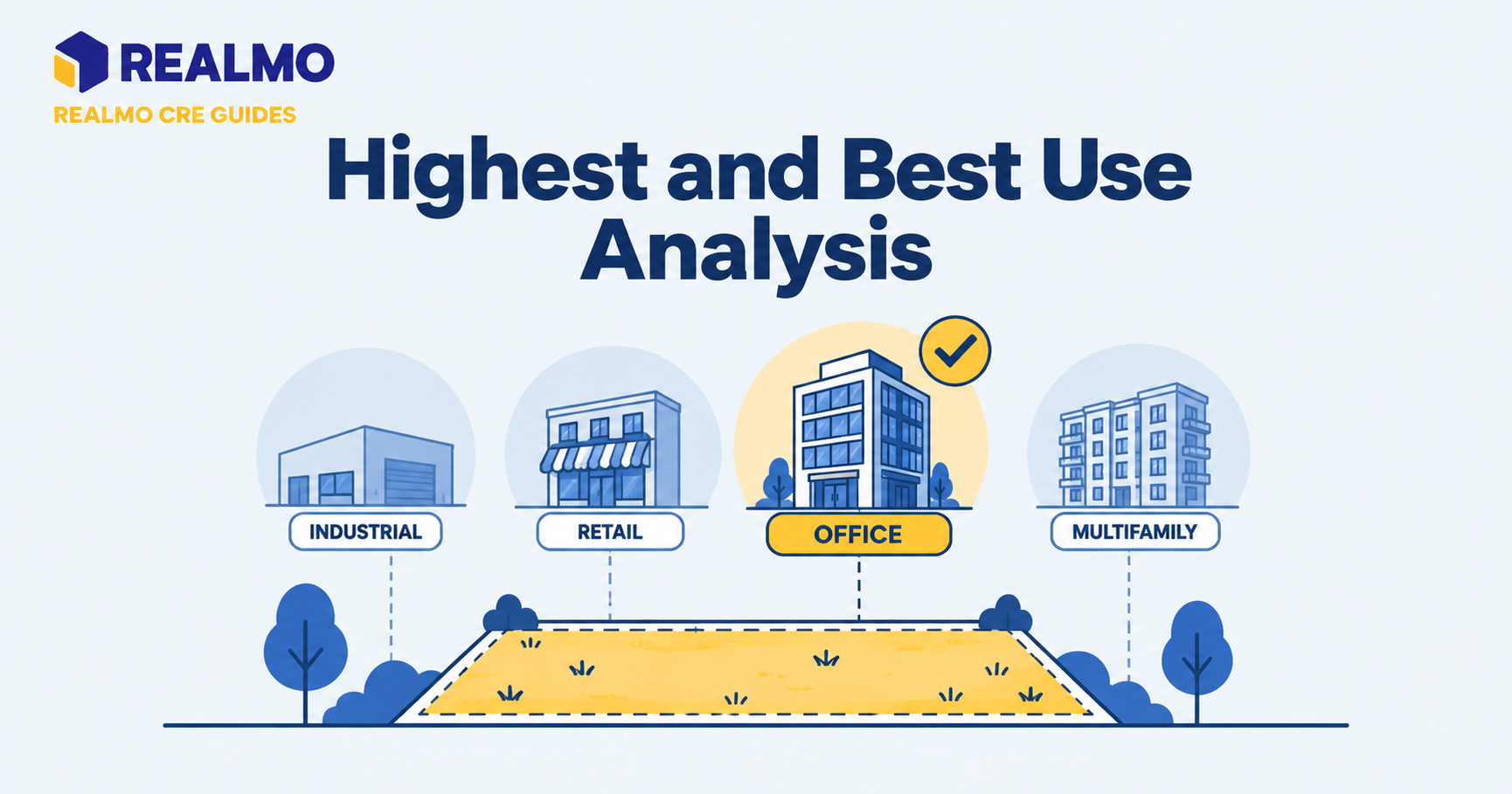
Highest and best use is the reasonably probable use of a property that is physically possible, legally permissible, financially feasible, and maximally productive. Appraisers apply these four tests in sequence to identify the use that produces the highest land value. This becomes the foundation for every valuation that follows.
Why highest and best use drives the entire appraisal
An investor reviewing a 1970s single-story retail strip on a commercial corridor sees a rent roll: six tenants, modest income, deferred maintenance. The appraisal comes back materially above what that income stream justifies. The gap is not an error. The appraiser concluded the site’s highest and best use was denser mixed-use redevelopment permitted under current zoning. The land was valued accordingly. The existing structure was treated as an interim use with limited remaining economic life.
That conclusion changes the underwriting completely. Cap rate analysis on in-place income becomes secondary. The relevant questions shift to demolition cost, entitlement timing, absorption for the new product, and how long the existing tenants can carry holding costs. Investors who skip the highest and best use section and jump to the value conclusion can misprice a transitional site. They miss both its risk and upside.
The four tests appraisers apply, and their required order
The Appraisal Institute’s framework runs four screens in a fixed sequence. Order matters because each test narrows the field before the next one is applied. A use that fails an earlier screen is never carried forward.
Physically possible. The first test asks whether the site can accommodate the use. It covers parcel size and shape, topography, soil bearing capacity, flood exposure, access points, and utility capacity. A 15,000-square-foot parcel with a 40-foot frontage cannot support a truck-served distribution facility regardless of what the zoning says.
Legally permissible. The second test checks whether the use is allowed. Zoning, overlay districts, deed restrictions, recorded easements, historic designations, environmental covenants, and existing lease encumbrances all constrain development. Long-term leases matter here: a ground lease with decades remaining can effectively fix the use for the appraisal’s relevant horizon.
Financially feasible. The third test checks whether the use can justify the required capital. Construction cost, absorption period, financing cost, and stabilized income all enter this test. A use can be legal and physically buildable yet fail because submarket rents do not support replacement cost.
Maximally productive. The final test selects the surviving use that produces the highest residual land value. If two feasible uses remain, the appraiser selects the one with the greater land value after improvement costs.
As vacant versus as improved: two conclusions, not one
Standard appraisal practice requires two separate highest and best use conclusions for an improved property.
The as vacant analysis asks what would be built on the site if it were cleared today. It establishes land value and identifies the site’s underlying potential independent of what currently sits on it.
The as improved analysis asks what should be done with the property in its current condition. There are three possible answers: continue the existing use, modify it through renovation or conversion, or demolish and redevelop.
These conclusions diverge whenever improvements no longer represent the site’s optimal use. The existing building remains the answer as improved only when the value it contributes exceeds the land value as vacant minus demolition cost. Once that inequality flips, the improvement has reached the end of its economic life even if it remains structurally sound and physically occupied. Understanding how appraisers separate land value from improvement value is essential to reading these two conclusions correctly.
What triggers a change in highest and best use
Highest and best use is not permanent. Four categories of change move it.
Regulatory change is the most common trigger. Upzoning, density bonuses, adaptive reuse ordinances, and parking minimum eliminations all expand the legally permissible set. When a jurisdiction rezones a commercial corridor for residential density, the highest and best use of underimproved parcels can shift overnight. No physical change is required.
Demand shifts move the financial feasibility test. When achievable rents for one property type rise relative to another in the same submarket, the residual land value calculation reorders. This is the mechanism behind office-to-residential conversion analysis. The conversion becomes feasible not because construction got cheaper but because the value gap between the two uses widened enough to cover conversion cost.
Infrastructure changes affect physical possibility and demand simultaneously. New interchange access, transit stations, and utility capacity expansions can each unlock uses that were previously impossible.
Improvement obsolescence works from the other direction. As a building ages, functional obsolescence (inadequate ceiling heights, obsolete floor plates, insufficient power) erodes the improvement’s contribution until redevelopment becomes the maximally productive answer.
Worked example: testing redevelopment against the existing building
The figures below are illustrative and rounded for clarity. They are not market data.
Situation. A 1.5-acre corner parcel holds a 12,000-square-foot single-story retail building, fully leased, generating $180,000 in NOI. Current zoning permits a four-story mixed-use building with roughly 60,000 square feet of gross building area.
Step 1, Value as improved, existing use. Applying an illustrative 7.0% cap rate to $180,000 NOI gives a value of approximately $2,570,000 for the property as currently operated.
Step 2, Estimate the value of the redevelopment scenario. Assume the completed mixed-use project would stabilize at $900,000 NOI. Applying an illustrative 6.0% cap rate for the new product yields a stabilized value of $15,000,000.
Step 3, Subtract the cost to create it. Assume hard and soft construction costs of $11,400,000, demolition of $200,000, and a developer’s profit requirement of $1,500,000. Total: $13,100,000.
Step 4, Solve for residual land value. $15,000,000 − $13,100,000 = $1,900,000.
Step 5, Compare. The site as vacant supports $1,900,000 under the redevelopment scenario. The property as improved is worth roughly $2,570,000. The existing building contributes more than the redevelopment residual, so the highest and best use as improved is continuation of the current use. The building has not reached the end of its economic life.
How to interpret this. The conclusion is sensitive to inputs, not fixed. If achievable rents pushed stabilized NOI to $1,050,000, residual land value would rise to roughly $4,400,000. The conclusion would then flip to redevelopment. This is exactly why highest and best use conclusions get revisited when submarket conditions move.
The common error. Investors frequently compare the $15,000,000 completed value against the $2,570,000 existing value and conclude that redevelopment obviously wins. That comparison is meaningless. The completed value must be reduced by every dollar required to produce it, including profit, before it can be compared to anything. See how residual land value analysis works for the full mechanics.
Where investors misread highest and best use conclusions
Treating speculative rezoning as legally permissible. A use requiring a variance or rezoning that has not been granted fails the legal test as of the valuation date. Appraisers may address it as a hypothetical condition or reflect probability of approval, but the base conclusion rests on current entitlements. Investors who underwrite the rezoned outcome as if it were secured are paying today for an approval risk that has not resolved. The consequence is overpayment with no recourse if the entitlement is denied.
Ignoring the interim use period. When redevelopment is the conclusion, the property still must be carried through entitlement, design, and construction. Investors who model redevelopment economics without the holding period (taxes, insurance, debt service, and declining income as tenants roll off) understate capital requirements substantially.
Confusing possible with probable. The standard is reasonably probable use, not any conceivable use. A use with no demonstrated market demand fails feasibility no matter how attractive the pro forma looks. The consequence is a valuation built on absorption that never occurs.
Overlooking lease encumbrances. An existing tenant with a long-term lease and no demolition clause can block redevelopment entirely. Buyout costs belong in the feasibility analysis. Skipping them produces a residual land value that cannot be realized.
Applying residential logic to commercial parcels. Residential highest and best use conclusions are frequently driven by neighborhood conformity. Commercial conclusions are driven by income capacity and entitlement. Importing the wrong framework produces conclusions that appraisers and lenders will reject.
How to research highest and best use before you make an offer
Start with the current zoning designation and pull the actual district regulations, not a summary. Setback, height, FAR, and parking requirements determine buildable area more than the district name. Check for overlay districts and pending amendments to the jurisdiction’s adopted land-use plan. Order a title report early to identify easements and restrictive covenants that zoning maps do not show.
Then test feasibility against comparable new construction in the submarket. If nothing of the proposed type has been built recently, that absence is itself information about feasibility.
Realmo’s property records show current and suggested use alongside ownership and valuation data across 9M+ properties. This shortens the initial screen on whether a site’s existing improvement matches its underlying potential.
For conclusions affecting tax treatment, entitlement strategy, or a transaction decision, consult professionals familiar with the jurisdiction. That may include a licensed appraiser, land use attorney, or tax professional.
Related terms
- Residual land value
- Economic life and remaining economic life
- Functional obsolescence
- Cap rate
- Adaptive reuse
- Entitlements in commercial real estate
- Land value
FAQ
What are the four tests of highest and best use?
Physically possible, legally permissible, financially feasible, and maximally productive. Appraisers apply them in that order. A use must pass each test before advancing to the next. The maximally productive test then selects the surviving alternative with the highest land value.
Can highest and best use be different from the current use?
Yes, and it frequently is. A building can remain occupied and income-producing while its highest and best use shifts to redevelopment. The shift occurs when alternative land value, net of demolition cost, exceeds the building’s contribution.
Does highest and best use assume a rezoning will be approved?
No. The base analysis relies on entitlements in place as of the valuation date. An appraiser may separately address a rezoning as a hypothetical condition or reflect probability of approval, but this must be disclosed explicitly in the report.
Who determines highest and best use?
A licensed appraiser reaches the conclusion as part of a formal appraisal, supported by zoning research, market analysis, and feasibility testing. Investors, developers, and brokers perform their own informal versions during due diligence, but only the appraiser’s conclusion carries weight with lenders.
What is the difference between as vacant and as improved analysis?
As vacant asks what would be built on a cleared site, establishing land value. As improved asks whether to keep, modify, or demolish the existing structure. Both conclusions appear in a complete appraisal, and they can differ.