How Automated Valuation Models Work
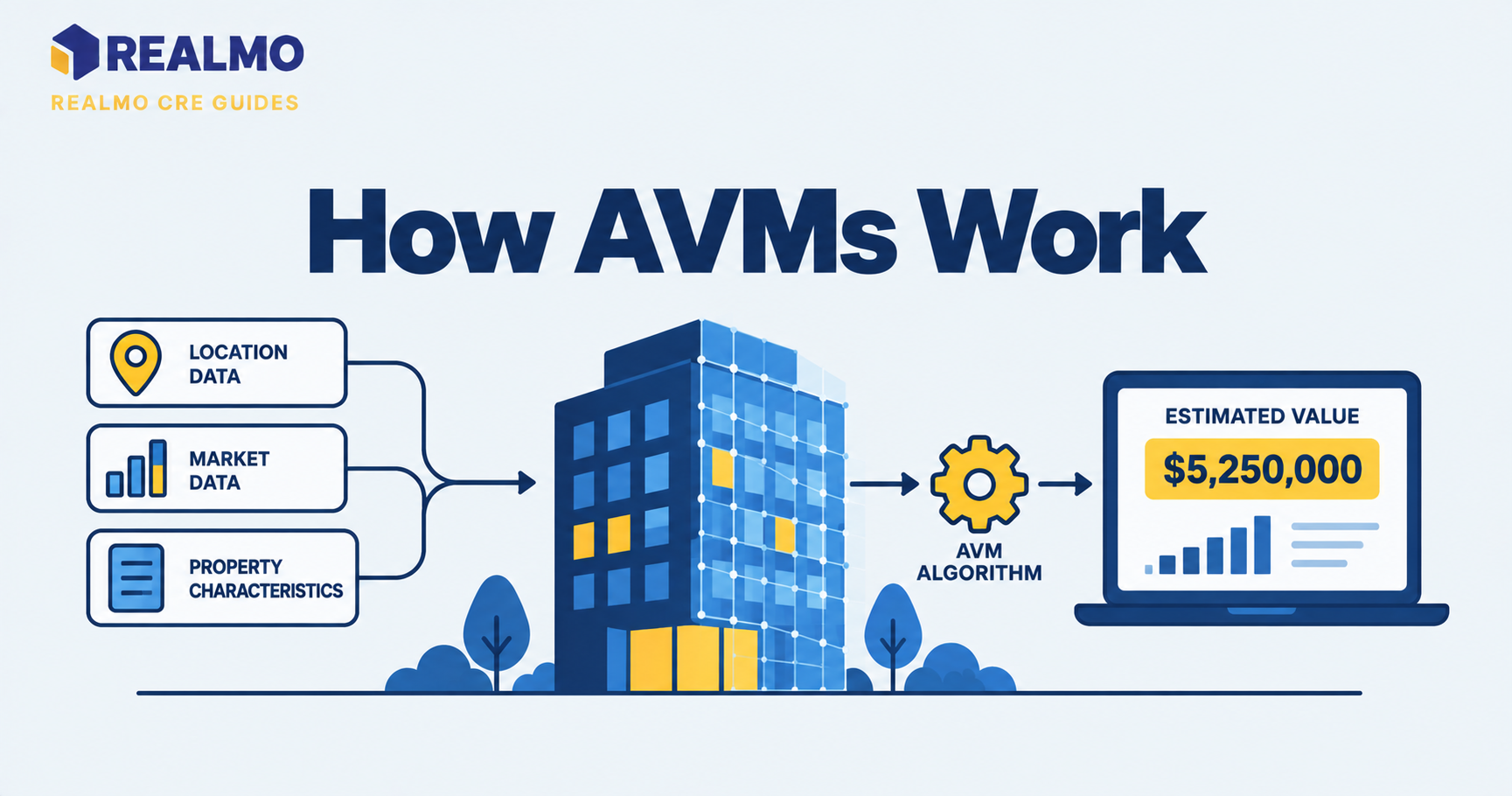
An automated valuation model estimates property value from data instead of a site visit. It combines public records, transactions, income data, and statistical or machine-learning methods. In commercial real estate, an AVM returns a value estimate, usually a range, and a confidence measure, not a certified appraisal.
Why AVM output matters to an investor
You find a 45,000-square-foot industrial building listed at $6.2 million. Before you spend a week on underwriting, you want to know whether that ask is defensible. Ordering an appraisal costs several thousand dollars and takes weeks. A broker opinion of value depends on who you ask. An AVM returns a value in seconds and shows supporting inputs. These can include assessed value, sale history, size, year built, zoning, and modeled submarket rent.
That number is not the answer. It is a filter. Investors who screen fifty properties a month use AVMs to kill the obvious mispricings and rank what deserves real work. The failure comes from treating the estimate as a conclusion instead of a starting hypothesis. Diligence can reveal that a vacant box was modeled as fully leased.
What data feeds an automated valuation model
Every AVM is downstream of its data. The core data layer is public record. It includes assessor files, deeds, mortgages, parcel geometry, zoning, and building attributes such as size, age, lot area, and construction class. This layer is broad but slow, assessor data can lag reality by a year or more. Building attributes are wrong on properties that have been renovated or subdivided.
The second layer is transactional. Recorded sale prices, listing and asking prices, and time on market tell the model what buyers actually paid. Coverage here is uneven. In non-disclosure states, sale prices are not recorded publicly, so models must infer price from transfer tax stamps, loan amounts, or contributed data. An AVM that looks confident in Ohio may be extrapolating heavily in Texas.
The third layer is income. Lease comparables, asking rents, expense benchmarks, and occupancy data let a model reconstruct net operating income. This matters far more in commercial property than in housing. The fourth layer is spatial: traffic counts, demographics, employment concentration, flood and seismic overlays, and proximity to freight corridors or transit.
Platforms differ mostly in how many of these layers they actually have. Realmo publishes modeled values, cap rate estimates, and ownership records across 9M+ properties without a paywall. This means you can inspect the inputs before deciding whether the output deserves any weight.
The three modeling approaches AVMs use
Hedonic regression treats a property as a bundle of measurable attributes and estimates what the market pays for each one. Examples include 10,000 additional square feet, a dock-high door, or a 2005 build year instead of 1978. It works well where attributes are standardized and transaction volume is high. It degrades badly on unique assets, because a regression has nothing to learn from a single specialty property.
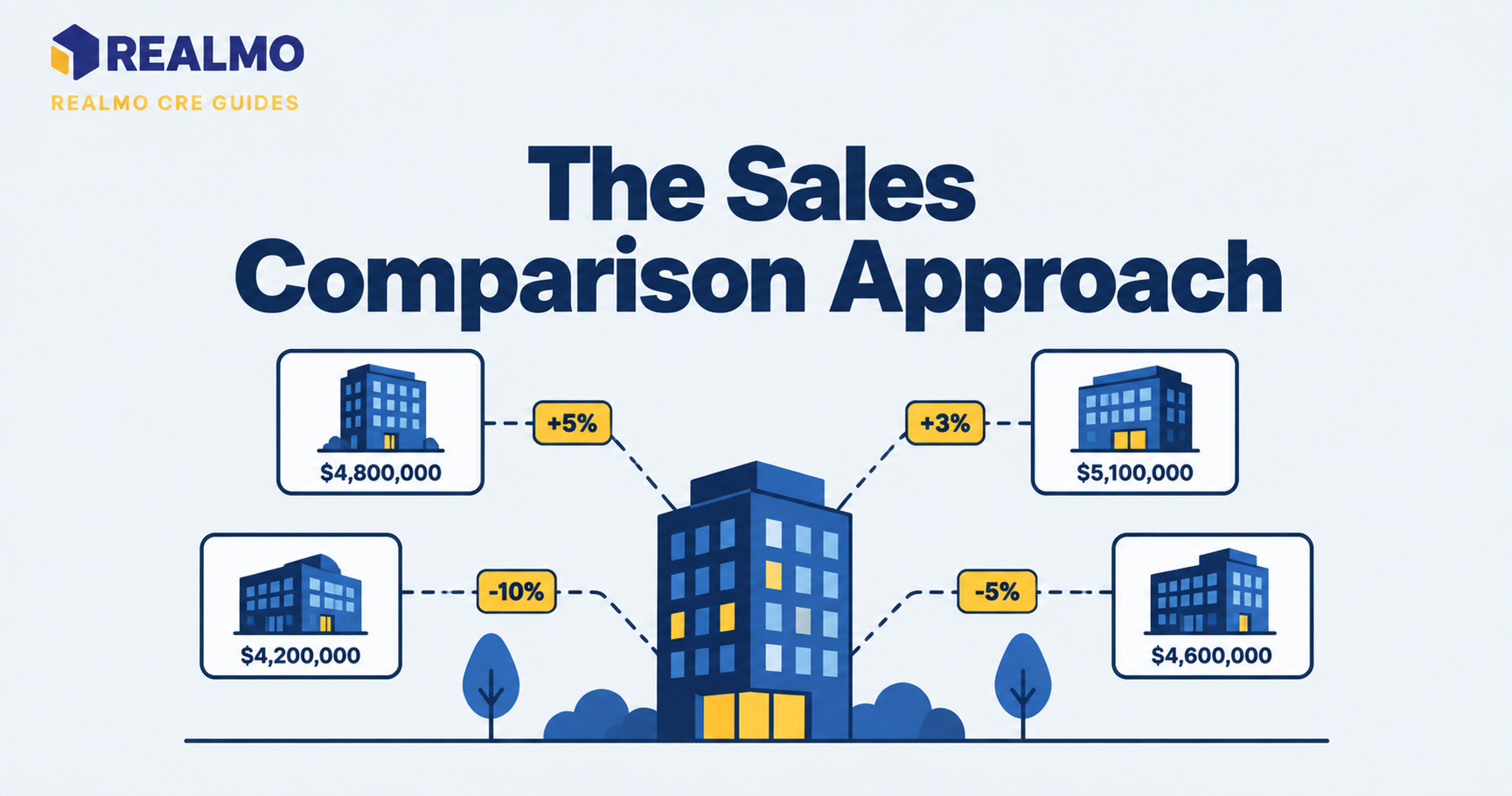
Comparable-sales models mimic what an appraiser does in the sales comparison approach: select recent sales that resemble the subject, adjust for differences, and reconcile. The automation is in the selection and weighting, not the logic. These models are transparent (you can see which comps drove the number) but they inherit every weakness of a thin comp set.
Income-capitalization models estimate stabilized NOI and divide by a modeled capitalization rate, mirroring the income approach to value. This method dominates stabilized leased-asset modeling. It is also highly sensitive to input error because two modeled variables combine in the result.
Most production AVMs today are ensembles. Production AVMs run several methods and blend their outputs. A meta-model can weight the method that performed best for a property type, size band, and market. The blend is why the reported number is frequently more stable than any single method, and also why it can be hard to explain.
Why AVM accuracy varies sharply by asset type
Residential AVMs are accurate because tract housing is close to fungible and has frequent sales. Commercial property is neither. The same model architecture that hits within a few percent on suburban houses can miss a value-add office building by a third.
Accuracy tracks three conditions. First, transaction density: multifamily and industrial trade frequently and in comparable configurations, so models have signal. Special-purpose assets (churches, marinas, self-storage in rural markets, single-tenant manufacturing built for one user) trade rarely, and each sale is idiosyncratic. Second, income visibility: an AVM that cannot see in-place rents is guessing at the single most important variable. A building leased at 30% below market for eleven more years is worth much less than the model’s market-rent reconstruction implies. Third, physical condition, which no public dataset captures. Deferred maintenance, a failing roof, or environmental contamination are invisible to the model and very visible to a buyer.
This is also why AVM confidence tends to be highest on stabilized, multi-tenant, generic product in dense markets. Lowest exactly where the interesting returns are.
How to read a confidence score or FSD
Serious AVMs publish an uncertainty measure alongside the point estimate. Forecast standard deviation expresses expected model error as a percentage of value. A $5,000,000 estimate with 15% FSD suggests a range of roughly $4.25M to $5.75M for about two-thirds of outcomes. Confidence scores on a 0–100 scale are vendor-specific and not comparable across providers.
Two other metrics matter when evaluating a provider. Hit rate is the share of properties the model prices. A model covering 95% of a market behaves differently from one covering 40%. PPE10, the percentage of estimates within 10% of actual sale price, measured against subsequent arms-length transactions, is the standard backtest. Ask for both, segmented by property type and market, because a national average hides everything you care about.
Treat a wide range as information, not noise. It usually means thin comps, unusual attributes, or missing income data, all things worth investigating before you underwrite.
Worked example: pricing a small industrial building
The figures below are illustrative and chosen for round arithmetic, not drawn from any current market.
An income-based AVM prices a 40,000-square-foot NNN industrial building. It models submarket rent at $10.00 per square foot, producing gross potential rent of $400,000. The model applies 5% vacancy and credit loss, leaving $380,000 of EGI. It then deducts 8% for non-reimbursed expenses, management, and reserves. NOI becomes $349,600. Dividing by a modeled 7.0% cap rate returns $4,994,000, which the model reports as roughly $5.0 million with a 15% FSD.
Now test the sensitivity. Hold NOI constant and move the cap rate 50 basis points in each direction: 6.5% gives $5.38M, 7.5% gives $4.66M. A rate assumption you cannot verify swings value by about 8% in either direction. Then change the rent. If the building is actually leased at $8.50 per square foot with nine years remaining, NOI falls to roughly $297,000. At 7.0% the value is about $4.25M, 15% below the model, entirely inside the stated FSD.
Interpret this as a range, not a price. The model narrows the asset to a five-million-dollar problem, not a two- or ten-million-dollar one. It also identifies the two variables driving the answer. The common error is anchoring on $4,994,000 because it has four significant figures. Precision in the output is not evidence about the inputs. Pull the rent roll, confirm the lease structure against how NNN leases allocate expenses, and rebuild NOI from actuals before the number means anything.
Where AVMs can and can’t replace an appraisal
For internal screening, portfolio marking, prospecting, tax-appeal triage, and pre-LOI pricing, AVMs are the fastest tool available and nobody objects. AVMs are not enough for most federally related transactions. Title XI of FIRREA requires licensed or certified appraisals for most commercial mortgage lending above applicable thresholds. Separate rules govern model quality control. Lenders commonly use AVMs for portfolio monitoring and renewal screening while still ordering a full commercial appraisal at origination.
The practical division: a model is a screening instrument and an appraisal is an opinion of value that carries professional liability. For legally consequential decisions, confirm requirements with a licensed appraiser and counsel in the relevant jurisdiction. This includes lending, litigation, estate work, buyouts, and tax appeals.
Common mistakes investors make with AVM output
- Treating the point estimate as the answer. The range carries the information; the midpoint is a convenience. Investors who ignore FSD end up defending a price they cannot support in negotiation.
- Not checking the input record. If the model has the wrong square footage or a stale year-built after a gut renovation, every downstream number is wrong. Two minutes of input review prevents this.
- Assuming market rent equals in-place rent. Legacy leases, below-market renewals, and free rent periods can move value by double digits, and public data rarely sees them.
- Comparing confidence scores across vendors. They are not standardized. A 90 from one provider and a 90 from another describe different things.
- Using an AVM on special-purpose or heavily distressed assets. These are precisely the cases where comp scarcity and unobservable condition break the model, and where an inflated estimate does the most damage.
Related terms
- Cap Rate
- Net Operating Income (NOI)
- Broker Opinion of Value (BOV)
- Sales Comparison Approach
- Income Approach to Value
- Assessed Value vs. Market Value
- Commercial Appraisal Process
FAQ
Are automated valuation models accurate for commercial real estate?
Accuracy depends on property type and data density. Stabilized multifamily and industrial in active markets price well because comps are plentiful and configurations are similar. Special-purpose, vacant, or value-add assets price poorly. Judge any provider by segmented backtest results (the share of estimates within 10% of subsequent sale prices) rather than a headline national figure.
What is the difference between an AVM and an appraisal?
An AVM is software producing a statistical estimate from data, delivered instantly at low or no cost. An appraisal is a licensed professional’s opinion of value based on inspection, verified comparables, and documented reasoning, carrying professional liability and a defined scope. Lenders, courts, and tax authorities require the appraisal; investors use AVMs to screen.
Can I use an AVM to get a commercial mortgage?
Not for most originations. U.S. banking rules require licensed or certified appraisals for most federally related commercial transactions above the applicable threshold. Lenders do use models for portfolio monitoring, loan renewals, and preliminary sizing. Confirm current requirements with your lender.
Why does an AVM value differ from the assessed value?
Assessed value serves property taxation and follows statutory formulas, assessment cycles, and caps that vary by jurisdiction. It lags market conditions by a year or more and may apply a fixed ratio to market value. An AVM targets current market value directly, so divergence between the two is normal rather than evidence of error.
What data do commercial AVMs use that residential ones don’t?
Commercial AVMs rely heavily on income data because value comes from cash flow. Inputs include lease comps, asking rents, expense ratios, occupancy, and modeled cap rates. They also weight zoning, permitted use, traffic counts, and employment geography more than residential models, which lean on neighborhood sales of similar homes.