The Commercial Real Estate Process: How a Deal Works, Start to Finish
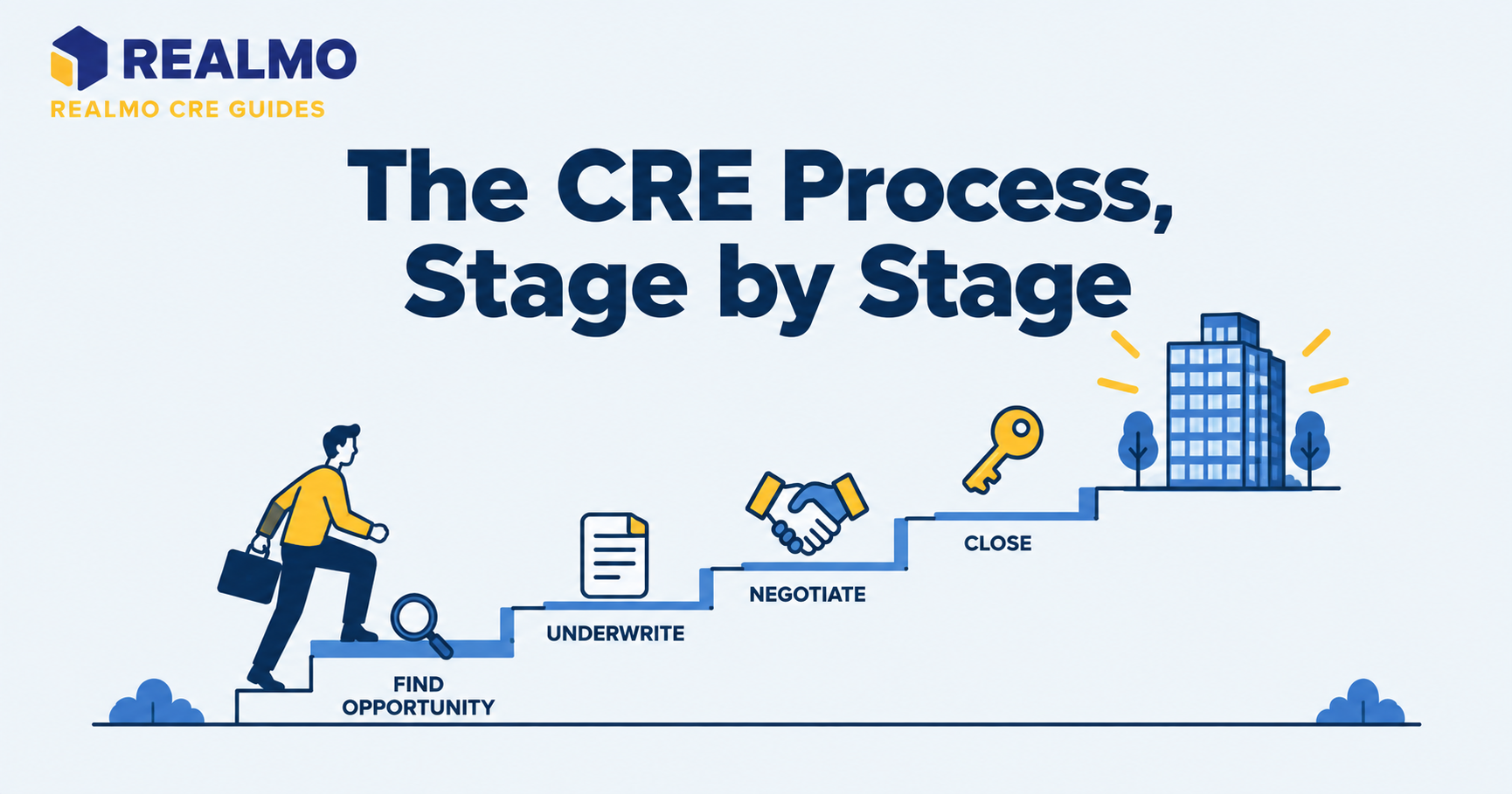
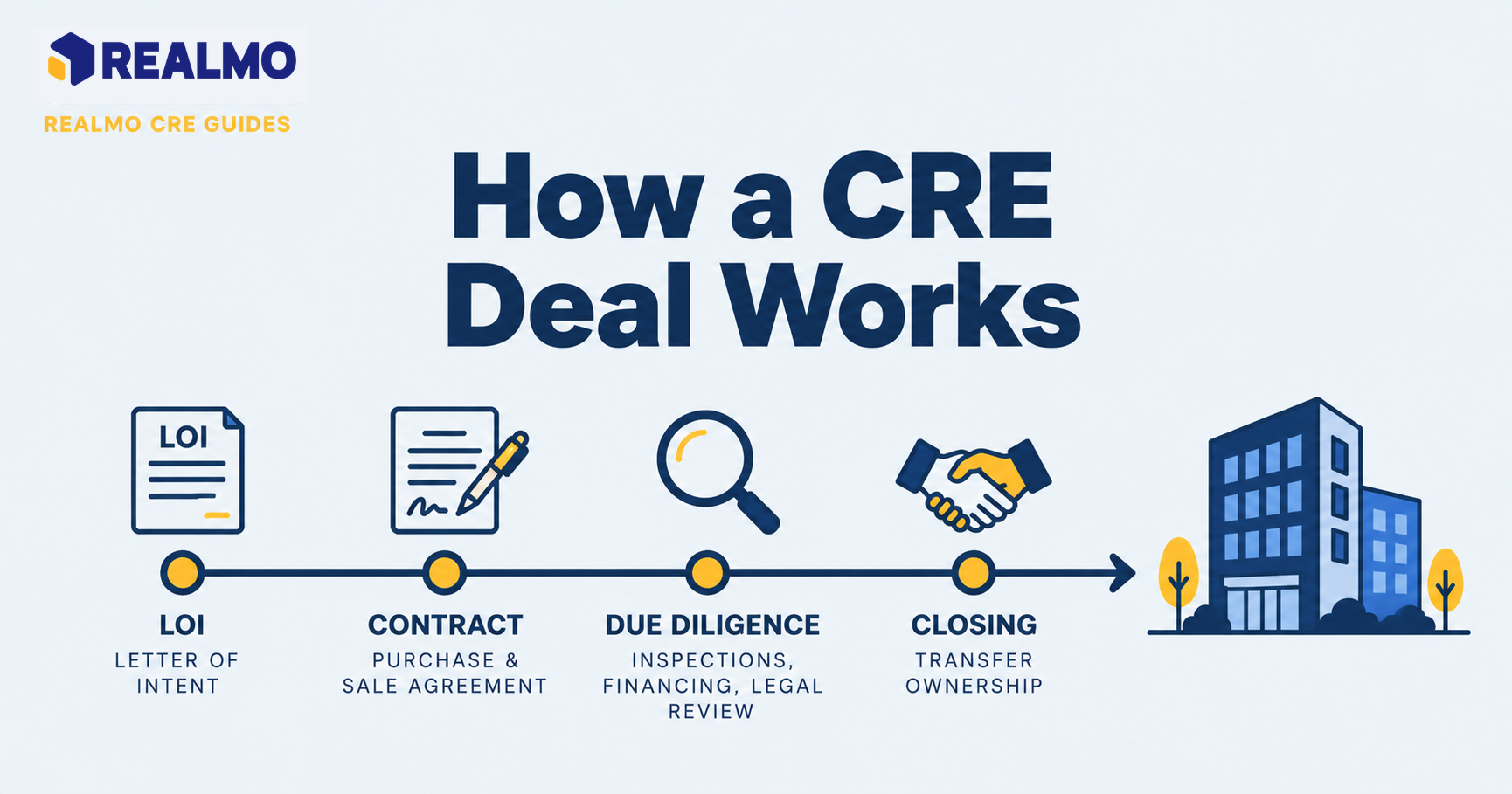
The commercial real estate process is the sequence a buyer works through to convert a target into an owned, income-producing asset. It runs through seven moves: set investment criteria, source and screen listings, underwrite, sign a letter of intent, run due diligence, arrange debt, and close. Each stage narrows the deal set and raises the cost of walking away.
Why the sequence matters more than any number
An investor with roughly $1.5M of equity moves from four single-family rentals into a first retail strip. She finds a property she likes, emails the broker an informal price, and assumes the details get settled later. The seller counters through a different buyer’s letter of intent. That LOI already specifies a 30-day inspection period, a hard deposit after day 30, and a seller-paid roof credit. She loses the deal on structure, not on price.
That outcome is common because the commercial real estate process front-loads decisions residential buyers make late or never. Financing contingencies are commonly negotiated away. Environmental liability transfers with the deed. Existing leases bind the new owner. By the time a first-timer learns which stage governs which risk, the money is usually already hard.
What the commercial real estate process covers
A private commercial acquisition under roughly $25M moves through seven stages. Criteria and capital, sourcing and screening, underwriting, letter of intent, due diligence, financing, and closing. The stages overlap. Lender underwriting runs in parallel with your own inspection work. The appraisal usually gates the final loan amount well after your deposit has gone hard.
The cast is larger than most first-time buyers expect. On your side: a commercial broker or your own sourcing effort, a real estate attorney licensed in the state, and a lender or mortgage broker. Add a property inspector, an environmental consultant, a title company or attorney handling escrow, an accountant, and eventually a property manager. On the seller’s side: a listing broker, seller’s counsel, and sometimes an asset manager who controls what the seller will actually concede.
Timelines vary by asset class and financing type. Cash purchases of stabilized single-tenant properties compress into weeks because there is no appraisal, no loan committee, and one set of documents. Bank-financed multi-tenant deals run longer for a structural reason: the appraisal, the environmental report, and the credit committee calendar sit in series, not in parallel. Your pace is set by the slowest third-party vendor in the chain. That’s why ordering reports the day the contract is signed changes the closing date more than anything your attorney does.
The one structural rule worth memorizing: your leverage as a buyer peaks the moment before you sign the letter of intent and declines from there. Everything you want costs less to ask for before the property comes off the market. That includes a longer inspection period, a soft deposit, a seller credit, and a rent roll certification.
Stage 1: Set buy criteria and line up capital
Criteria are a filter, not a wish list. A usable set specifies asset type, geography, price band, minimum in-place NOI, acceptable tenancy profile, and the conditions you won’t accept. “Retail, $3M–$6M, within 90 minutes of home, at least four tenants, no tenant above 35% of rent, no underground storage tanks” is a criteria set. “Good cash flow in a growing market” is not.
Capital comes before search for a practical reason: sellers and listing brokers screen buyers on ability to perform. Before you tour anything, you should know your total equity and how much you will hold back for capital expenditures and operating reserves. You should also know whether any of it belongs to partners, and what your lender says you can borrow. A lender relationship established in advance, even an informal sizing conversation, turns into a credibility document later.
Ownership structure is decided here as well. Whether you buy in an LLC, a partnership, or a tenancy-in-common changes liability, financing terms, and how the eventual sale is taxed. Entity selection carries tax and legal consequences that vary by state and by investor. Work through the options with a licensed attorney and CPA before you sign anything.
Write the criteria down. The document’s real job is to make you refuse a property that is attractive but wrong, at the moment when refusing feels like losing.
Stage 2: Source deals and screen them in a day
Deal flow comes from four channels: listing platforms, broker relationships, direct owner outreach, and off-market referrals from lenders, attorneys, and property managers. Most first-time buyers over-index on the first channel and under-invest in the second. Brokers route the best deals to buyers who have closed with them before, which creates a chicken-and-egg problem that only volume of contact solves.
Screening is a discipline of elimination. For each candidate, you need five things within an hour: the rent roll, a trailing 12-month operating statement, and the asking price. Add the going-in cap rate implied by in-place income, and a rough read on market rent versus in-place rent. If in-place rents sit well above market, the income is a liability rather than an asset, because every renewal is a step down. If the trailing statement shows no repairs and maintenance for a 40-year-old building, someone has been deferring.
Ownership and use data closes the gap on off-market targets. Realmo’s property records cover ownership, estimated value, and current versus suggested use across 9M+ U.S. properties. That lets you build an outreach list for a submarket before anything is formally listed.
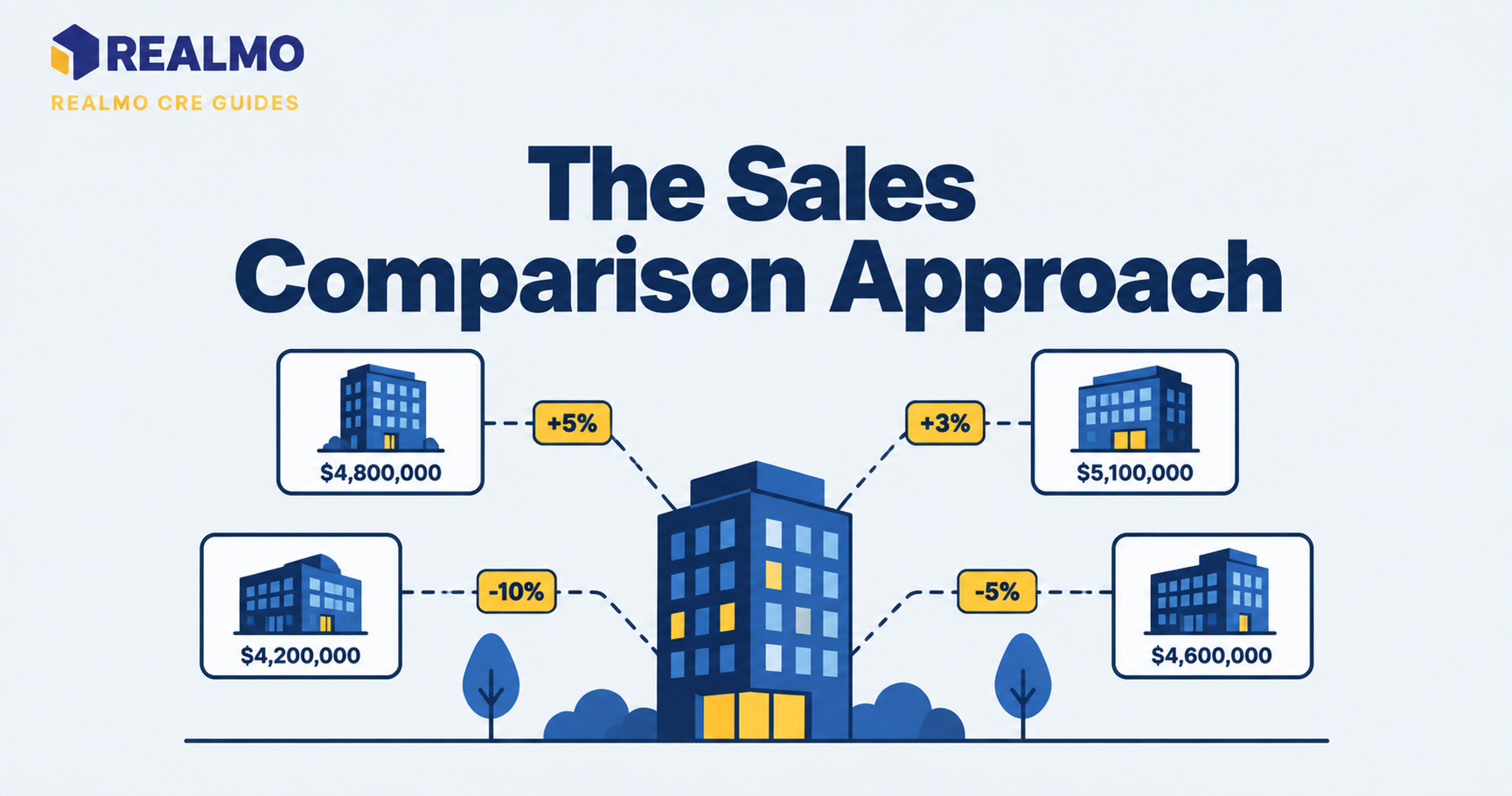
Comparable sales anchor whether the ask is defensible. Pull recent trades of similar size, vintage, and tenancy within a tight radius, then compare price per square foot and going-in cap rate. Radius discipline matters more than sample size. A handful of trades within a few miles describes your rent pool and your buyer pool, while a metro-wide average describes neither. A property priced well above its comps needs a story you can verify, not one you simply accept. That story might be below-market rents rolling within two years, a credit tenant, or excess land.
Kill deals fast and without regret. Screening ten properties to reject nine is the normal ratio, and the time you save is what funds real work on the tenth.
Stage 3: Underwrite income, debt, and the exit
Underwriting converts a broker’s marketing package into your own numbers. Start with gross potential rent from the rent roll, not the offering memorandum. Apply a vacancy and credit loss assumption based on the submarket rather than on the seller’s current occupancy. Add expense reimbursements only where leases actually require them. That means reading the reimbursement clause in each lease rather than trusting the summary.
Then rebuild operating expenses from the ground up. Property taxes usually reset on sale — a reassessment at your purchase price is one of the largest and most predictable errors in first-time underwriting. Insurance quotes should come from your own broker, not the seller’s renewal. Management fees belong in the model even if you plan to self-manage, because your exit buyer will underwrite them. Replacement reserves belong in the model even though lenders and sellers treat them inconsistently.
The result is net operating income, and NOI divided by price gives you the going-in cap rate. Read it against recent trades of comparable assets in the same submarket. The absolute number matters less than the spread. Pricing inside local comps means you are paying a premium. You should be able to name what the premium buys. Maybe it’s a longer weighted average lease term, stronger tenant credit, or in-place rents that roll upward on a known schedule.
Debt underwriting runs alongside. Lenders size loans to the lower of a loan-to-value ceiling and a debt service coverage ratio floor. When borrowing costs sit close to or above cap rates, the DSCR test binds first. The loan you get is smaller than the LTV headline suggests. Ask each lender for both constraints in writing before you model. They differ by lender type, asset class, and whether the loan stays on the balance sheet or gets sold.
Finally, underwrite the exit. Assume a sale in year five or seven at a cap rate at or above your going-in cap rate. Subtract selling costs, and see whether the deal still works. Models that only survive on cap rate compression are bets on the market, not on the property.
Stage 4: Negotiate the LOI, then paper the PSA
The letter of intent is non-binding on price but sets the terms that binding documents inherit. Six items decide the rest of the deal: purchase price, deposit amount and when it becomes non-refundable, and inspection and financing periods. The rest: what the seller must deliver and by when, and the closing date.
The delivery schedule is the item first-time buyers underweight. The LOI needs to list what the seller must deliver: certified rent roll, all leases and amendments with exhibits, and three years of operating statements. It also needs tax bills, service contracts, existing survey, existing title policy, environmental reports, and permits. Without that list, your inspection clock starts running against a seller who has no obligation to hand you anything quickly.
Once the LOI is signed, counsel drafts the purchase and sale agreement. The PSA is where representations and warranties live, and where the survival period for those reps is set. It’s also where casualty and condemnation risk is allocated, and where the estoppel condition appears. An estoppel certificate is a tenant’s signed confirmation of its own lease terms, rent, deposit, and any landlord defaults. Requiring estoppels from tenants representing a stated share of rent is how you avoid discovering a side agreement after funding. Make delivery a closing condition.
Deposits commonly go to escrow in two tranches. An initial deposit is refundable during inspection, and an additional deposit goes hard when the inspection period ends. Understand exactly which day your money stops being yours, and put that date in your calendar before you sign.
Stage 5: Run diligence and decide whether to retrade
Due diligence is verification under a deadline. Four workstreams run at once, and each one can independently kill the deal.
Financial. Reconcile the rent roll to actual bank deposits and to each lease. Confirm security deposits, escalations, renewal options, and any free rent. Read the co-tenancy and exclusive-use clauses. An exclusive granted to one tenant can block the leasing plan your model depends on. Compare in-place rent to current asking rents for comparable space nearby, then discount those asks for concessions. Free rent and tenant improvement allowances make headline asking rents overstate effective rent.
Physical. A property condition assessment covers roof, structure, HVAC, parking, and ADA compliance, with remaining useful life and replacement cost estimates. Get roof and HVAC inspected separately if the building is over 20 years old.
Environmental. A Phase I environmental site assessment reviews historical use, adjacent sites, and records for recognized environmental conditions. Completing an appropriate Phase I is the basis for the innocent landowner and bona fide prospective purchaser defenses under federal law. That’s why lenders require one, and why you’d order one even in a cash deal. If the Phase I flags a concern, a Phase II with soil and groundwater sampling follows, and the timeline extends.
Legal and title. Title commitment, survey, zoning verification, certificate of occupancy, and open permit search. Easements and setback encroachments show up here, and so does the discovery that a use you planned is legal nonconforming rather than permitted.
Retrading (reopening price after diligence) is legitimate when you find something material and undisclosed, and corrosive when it becomes a negotiating habit. An undisclosed roof at the end of its life supports a credit request. A tenant you decided you dislike does not. Sellers and brokers talk to each other, and a reputation for reflexive retrading limits your future deal flow more than one discount is worth.
Stage 6: Close the loan and take over operations
Loan processing starts as soon as the PSA is signed. The lender orders an appraisal, an environmental report, and commonly its own property condition report, all at your expense. The appraisal is the single largest late-stage risk. If it comes in below contract price, the lender sizes the loan to appraised value, and the difference lands on your equity check.
Loan documents arrive late in the process and deserve real attention. Recourse or non-recourse, prepayment structure, the definition of default, reserve escrows for taxes and insurance, and lockbox provisions all shape what ownership actually feels like. Rate lock timing matters too. A floating quote moves with its underlying index until it locks. Ask three questions in writing: when the rate locks, what index and spread it locks against, and what an extension costs if closing slips. A sizing assumption can break in the final two weeks, and the equity call moves with it.
Closing itself is a settlement statement exercise. Prorations cover rent collected for the month of closing, real estate taxes, utilities, and CAM reconciliations. Security deposits transfer to you as a credit. Confirm which deposits are actually held in cash versus which appear only on the rent roll.
Day one is operational, not ceremonial. Tenants receive notice of the ownership change and new payment instructions. Utility accounts, insurance, and vendor contracts transfer or terminate. The property manager takes over. The first month’s collection rate is the fastest real-world test of whether the rent roll you underwrote was accurate.
Worked example: retail strip from LOI to close
All figures below are illustrative. They are chosen as round numbers to show the mechanics of loan sizing. They are not representative of current pricing, rents, or loan terms in any market.
A 12,400 SF neighborhood retail strip, six tenants on triple net leases, asking $4,200,000.
| Line item | Amount |
|---|---|
| Base rent at full occupancy ($22.00/SF) | $272,800 |
| Expense reimbursements | $74,400 |
| Gross potential income | $347,200 |
| Less vacancy and credit loss (5%) | ($17,360) |
| Effective gross income | $329,840 |
| Less recoverable operating expenses | ($74,400) |
| Less non-recoverable (management, reserves) | ($11,500) |
| Net operating income | $243,940 |
Going-in cap rate: $243,940 ÷ $4,200,000 = 5.81%.
The buyer assumes 65% loan-to-value, or $2,730,000, at an illustrative 6.50% over a 25-year amortization. That produces annual debt service of about $221,200 and a DSCR of 1.10, below the coverage floor lenders commonly apply to stabilized multi-tenant retail. The loan does not get made at that size.
Resizing to a 1.25x DSCR: maximum annual debt service is $243,940 ÷ 1.25 = $195,152. At the same rate and amortization, the annual constant is 8.10%, so the loan supported is about $2,408,000, or 57.3% LTV. Equity required rises to $1,792,000, plus roughly $105,000 in closing costs and third-party reports.
Cash flow before taxes: $243,940 − $195,152 = $48,788, a cash-on-cash return near 2.6% on approximately $1,897,000 of equity.
How to read it: the debt constant of 8.10% exceeds the 5.81% going-in cap rate, which is negative leverage. Borrowing reduces the return on each dollar of equity rather than increasing it. That is not automatically disqualifying. A buyer may accept it because in-place rents sit below market and roll upward within two years. But it must be a deliberate choice supported by a releasing plan, not a surprise discovered after the deposit goes hard.
The common error here is modeling the loan at the LTV ceiling. The DSCR test governed, and the loan came in $322,000 smaller than assumed. A buyer who had not stress-tested that outcome would have been short on the equity call.
Common mistakes that break first-time CRE deals
Underwriting the seller’s property taxes. Most jurisdictions reassess on transfer. Using the seller’s current bill inflates NOI. Because value is NOI divided by cap rate, the valuation error is roughly the annual tax understatement divided by the cap rate. At cap rates in the 5% to 6% range, that’s a multiple of 16 to 20 times.
Treating the LOI as informal. Deposit hardening dates, inspection length, and delivery obligations set in the LOI carry into the PSA with little room to renegotiate. A vague LOI produces a contract you cannot use.
Skipping lease abstraction. Reading the broker’s lease summary instead of the leases hides exclusives, co-tenancy triggers, termination options, and landlord obligations that transfer to you at closing.
Ignoring appraisal gap risk. A low appraisal after the deposit goes hard forces a choice between a larger equity check and forfeiting the deposit. Model the outcome before the inspection period ends.
Buying with no operating reserve. A vacated 2,000 SF suite means lost rent, unrecovered CAM, tenant improvement dollars, and leasing commissions simultaneously. Deals that pencil only at full occupancy fail on the first move-out.
Related terms: net operating income · cap rate · debt service coverage ratio · letter of intent · estoppel certificate · Phase I environmental site assessment · triple net lease · 1031 exchange
Questions investors ask about the CRE process
How long does a commercial real estate deal take to close?
From signed LOI to funding, bank-financed deals commonly run two to four months, driven by third-party report turnaround and lender committee schedules. All-cash purchases of stabilized single-tenant properties can close in weeks. Deals requiring Phase II environmental work, rezoning, or estoppels from many tenants extend well past those ranges.
How much cash do I need to buy a commercial property?
Equity equals purchase price minus the loan the property actually supports, plus closing costs, third-party reports, and reserves. Because DSCR commonly governs loan sizing before the LTV ceiling does, required equity is frequently larger than the advertised down payment percentage implies. Budget an operating and capital reserve on top.
Can I use a residential agent for a commercial purchase?
Licensing usually permits it, but the work differs. Commercial transactions require lease abstraction, NOI reconstruction, zoning and use analysis, and familiarity with LOI and PSA conventions. A broker who has closed comparable deals in your asset class and submarket adds more than one learning the mechanics on your transaction.
What is the difference between due diligence and inspection?
Inspection refers to the physical assessment of the building. Due diligence is the full verification period covering financial, physical, environmental, legal, and title workstreams. The PSA defines the due diligence window, and the deposit commonly becomes non-refundable when it expires, whether or not every report has arrived.
Do I need an attorney if the broker prepares documents?
Commercial purchase and sale agreements allocate liabilities that survive closing, and loan documents define recourse and default. Have a real estate attorney licensed in the property’s state review both. Legal, tax, and entity questions in a commercial acquisition are specific to your circumstances and require licensed professional advice.