Early Termination Clauses in Commercial Leases
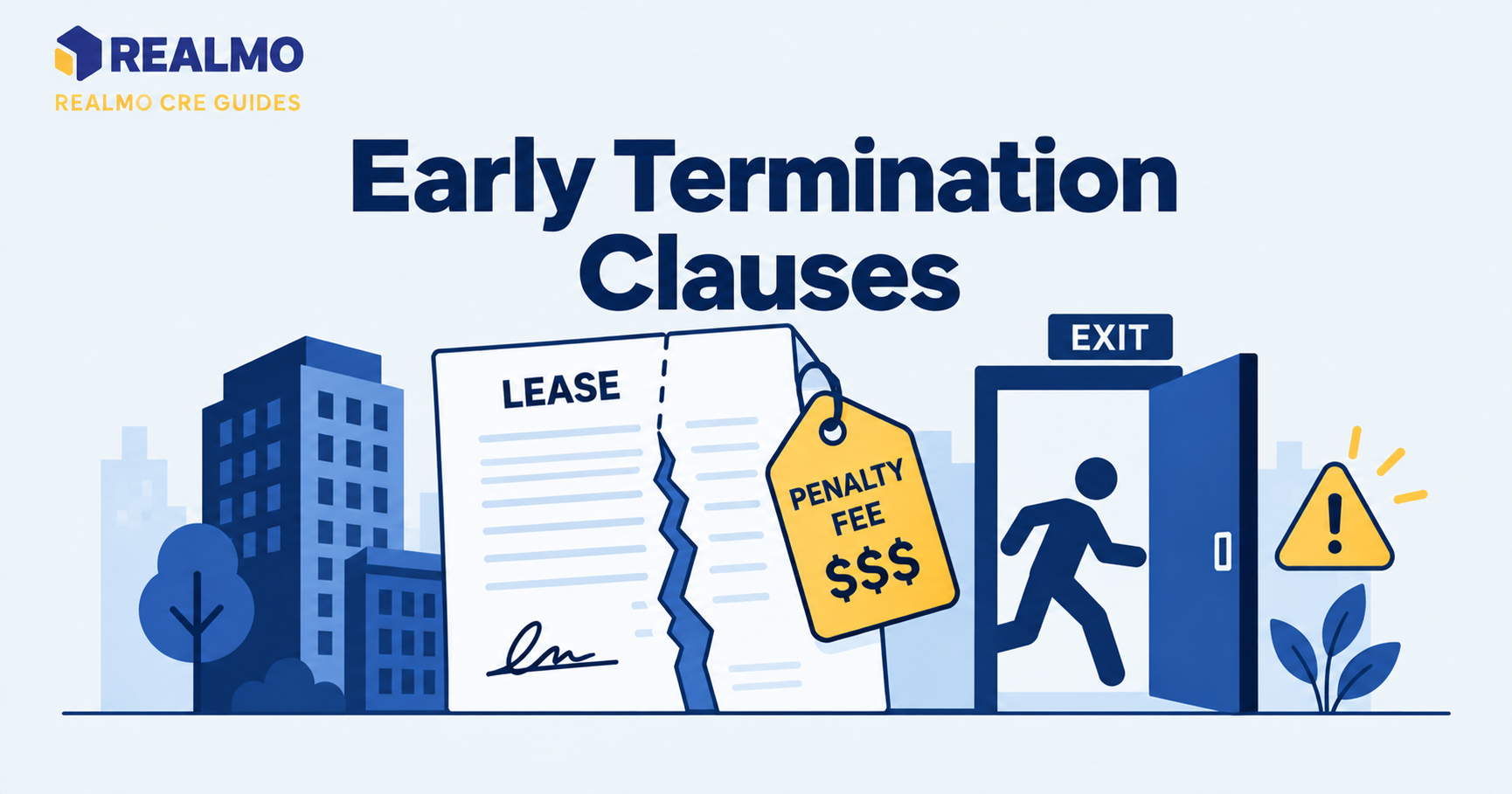
An early termination clause lets a tenant end a commercial lease before the stated expiration date, usually after a fixed lock-in period and in exchange for a termination fee. Early lease termination in commercial space is contractual, not automatic. Without the clause, a tenant stays liable for rent through the full term.
Why tenants pay for an exit right they may never use
A 12,000 SF office tenant signs a seven-year lease in year one of a funding cycle. By year four the headcount plan has changed twice, and the space fits either 40 people or 140, depending on which quarter you ask. The lease has no exit. The tenant’s choices shrink to three: keep paying for empty desks, sublease into a market with more supply than demand, or negotiate a surrender with a landlord who now holds all the leverage.
That is the scenario a termination option is priced against. Landlords charge for it in one of several currencies: a higher base rent, a smaller improvement allowance, a shorter free-rent period, or an explicit termination fee payable at exit. The tenant is buying optionality. The landlord is selling certainty of income and pricing the risk of re-leasing.
What a termination clause actually contains
A workable clause has five moving parts, and a missing one usually means litigation later.
The trigger date sets the earliest effective termination date, often the end of month 36 or 60 in a longer term. The notice period sets how far in advance the tenant must declare, commonly 9 to 12 months. The termination fee sets the payment. Conditions precedent state what must be true for the option to work, typically that the tenant is not in default and has paid the fee in full. And the survival language confirms which obligations continue past termination: indemnities, restoration, unpaid operating expense reconciliations.
Notice mechanics matter more than tenants expect. If the lease says notice must be delivered by certified mail to a named address, an email to the property manager is not notice. Courts read these provisions strictly. A missed window by a week can cost the remaining term.
How termination fees are calculated
Most fees are built from the landlord’s unrecovered transaction costs plus a rent component. The standard formula:
Termination Fee = Unamortized TI + Unamortized Leasing Commission + Unamortized Free Rent + (X months of gross rent)
Unamortized means the portion of the landlord’s upfront spend not yet recovered through rent by the termination date. The amortization usually runs straight-line over the initial term at a stated interest rate, often 6% to 10%, spelled out in the lease.
Worked example (illustrative figures)
A tenant leases 10,000 SF on a 60-month term. The landlord funded:
- TI allowance: $400,000
- Leasing commission: $120,000
- Free rent: 3 months at $25,000/month = $75,000
Total landlord investment: $595,000. Amortized straight-line over 60 months, that’s $9,917 per month, ignoring interest for simplicity.
The tenant terminates effective end of month 36. Months remaining: 24.
Unamortized balance: 24 × $9,917 = $238,000
The lease also requires four months of gross rent as a penalty component: 4 × $25,000 = $100,000
Total termination fee: $338,000
How to read that number: the fee equals about 13.5 months of rent. If the tenant’s alternative is paying 24 months on space it cannot use, terminating saves roughly 10 months of rent, before counting the cost of the new space. If the tenant could sublease at 80% of face rent, subleasing may beat termination. Run both.
One mistake shows up constantly. Tenants assume “unamortized” means the straight-line balance and forget the interest factor written into the lease. At 8% on a $595,000 balance, the interest component adds tens of thousands. Read the amortization schedule attached as an exhibit, and if there is no exhibit, ask for one before signing.
When landlords agree to grant the option
Leverage decides this. A landlord with a building at high occupancy and a waiting list has no reason to grant an exit. A landlord filling a vacancy in a submarket with new deliveries coming online will trade the option for term and credit.
Three tenant profiles get the option most often. Large tenants taking a meaningful share of the building, because the deal economics justify concessions. Credit tenants, because the landlord can finance against the lease regardless. And tenants signing unusually long terms, where a mid-term break makes a 15-year commitment palatable.
Lenders complicate this. If the building carries a loan, the lender’s approval may be needed for any clause that shortens a major lease. Loan documents often bar termination rights in leases above a certain square footage without consent. That approval can take weeks. Ask early.
Contraction rights and other alternatives to a full exit
Full termination is not the only structure. A contraction option lets the tenant give back a defined block of space, say one floor of three, on the same notice-and-fee mechanics. It costs less than full termination and solves the more common problem: the tenant needs less space, not zero space.
Sublease and assignment rights are the fallback when a landlord refuses termination. Both usually require landlord consent, and the standard is negotiable. “Consent not to be unreasonably withheld, conditioned, or delayed” with a 15-business-day deemed-approval backstop is materially better than bare consent language. Watch for recapture rights, which let the landlord take the space back instead of approving the sublease, and profit-sharing clauses that split any above-market sublease rent.
A kick-out clause is the retail version. It ties the exit right to a sales threshold: if gross sales fail to hit a stated number by a measurement date, either party can terminate. Landlords often reserve a cure right, paying the tenant or waiving the option to keep the space occupied.
Common mistakes
Treating the notice deadline as approximate. Missing a 12-month notice window locks the tenant into the full remaining term with no remedy. Calendar it the day the lease is signed, with a reminder 60 days ahead.
Signing a fee formula without an exhibit. “Unamortized costs” undefined means the landlord defines it at exit, and the number will be larger than expected.
Ignoring the personal guaranty. A termination clause that ends the lease does not automatically release a guarantor. If the guaranty survives, the principal remains exposed to post-termination claims.
Skipping the restoration question. Many leases require removal of specialty improvements at term end. Early termination often accelerates that obligation, and a lab or data center buildout can carry a six-figure removal cost nobody budgeted.
Assuming the option survives an assignment. Termination rights are frequently personal to the original tenant. Sell the company, and the buyer may inherit the space without the exit.
Related terms
- Sublease vs. assignment in commercial leases
- Tenant improvement allowance
- Lease commencement and rent commencement dates
- Personal guaranty in commercial leases
- Recapture rights
- Percentage rent and kick-out clauses
Tenants comparing exit terms across competing spaces can pull ownership records and building-level detail on Realmo before the letter of intent stage, which shortens the guessing about who actually controls the decision.
Lease provisions carry legal and tax consequences. Have counsel licensed in the property’s state review any termination clause before signing.
FAQ
Can a tenant break a commercial lease without a termination clause?
Not unilaterally. Without a contractual right, the tenant needs the landlord’s agreement to a lease surrender, which is a negotiated deal with its own price. Some states recognize constructive eviction or failure of an essential service as grounds, but those are defenses to a claim, not a clean exit.
How much notice is required to exercise a termination option?
Whatever the lease says, most commonly 9 to 12 months before the effective date. Shorter notice appears in small-suite leases. The landlord needs the runway to re-lease.
Is a termination fee negotiable after the lease is signed?
The stated formula is binding. What is negotiable is timing and structure: paying in installments, offsetting against a security deposit, or agreeing to a lower figure if the landlord already has a replacement tenant lined up.
Does terminating early release a personal guarantor?
Only if the guaranty says so. Read the guaranty as a separate document. Many run until all lease obligations are satisfied, including post-termination reconciliations.
What is the difference between termination and contraction?
Termination ends the lease for the entire premises. Contraction gives back a defined portion, and the tenant keeps occupying the rest under the same lease.