How to Buy Your First Commercial Property
How to Buy Commercial Property: Your First Deal
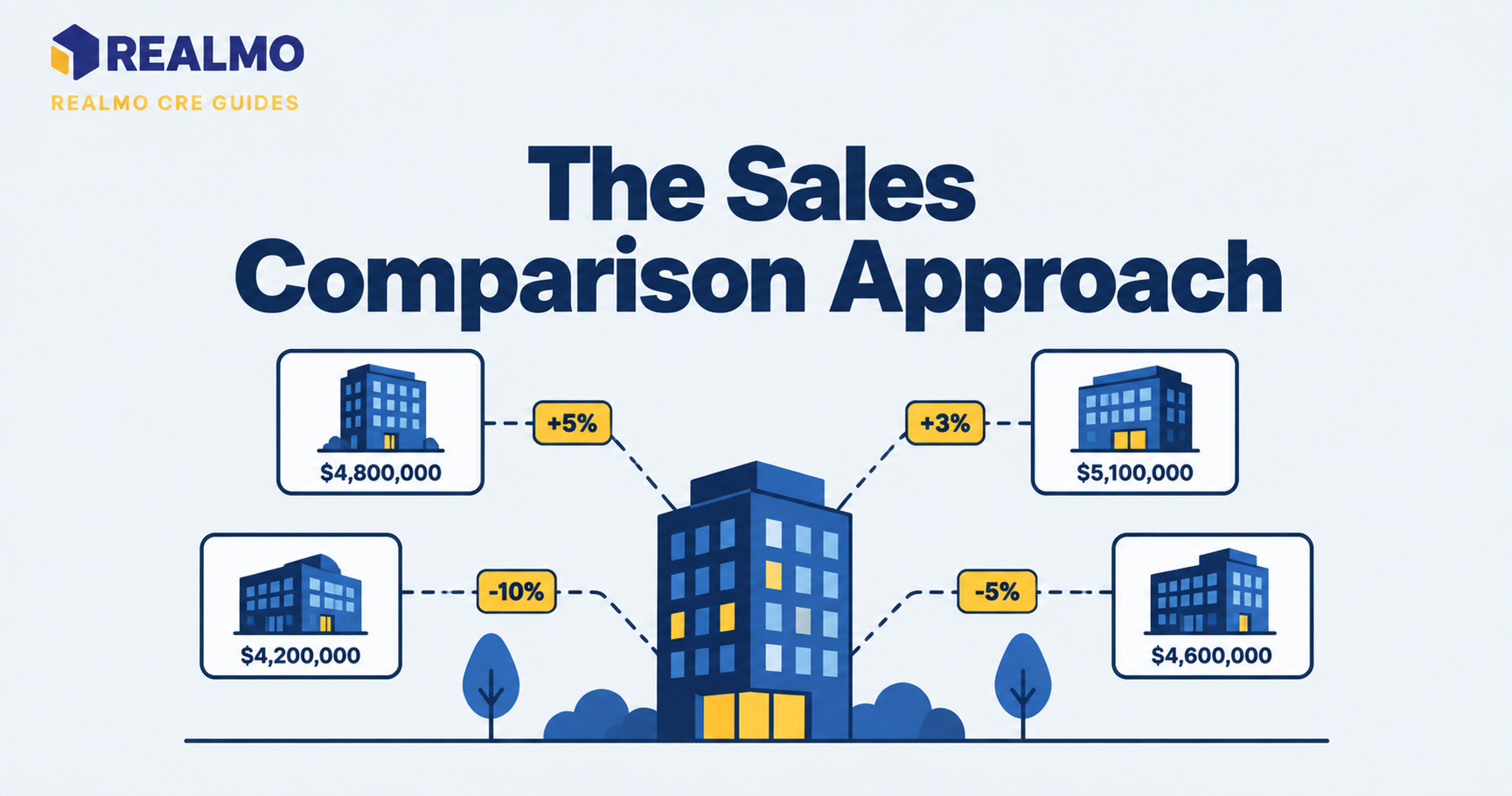
Buying commercial property means acquiring an income-producing asset: retail, industrial, office, multifamily of five or more units, or a specialty building. It’s priced on the cash flow it produces, not on comparable sales alone. Value follows net operating income and risk, and loan size depends on the property’s ability to service debt.
Why the First Deal Breaks Residential Habits
Anyone learning how to buy commercial property for the first time usually arrives from residential. Almost none of the process transfers. An investor who owns two rental houses tours a small retail strip, expecting an appraisal anchored to nearby sales. Instead, value gets set by income, lease quality, and the cap rate a buyer will accept. The loan is not a 30-year fixed quoted on a website. It is a five- or ten-year term on a 20- to 25-year amortization, sized by a coverage test and usually personally guaranteed. Due diligence becomes a paid investigation: environmental screening, survey, structural review, lease abstraction, estoppel certificates, costing five figures before anyone signs. Understanding that shift early separates a deal that closes from a deposit burned in the first thirty days.
Which Property Types Work for a First Purchase
Commercial real estate covers any property held to produce income from business use. The categories a first-time buyer actually encounters are neighborhood retail, small industrial and flex buildings, low-rise office, multifamily with five or more units, and self-storage. Mixed-use buildings, ground-floor retail with apartments above, sit in between. They get financed as commercial once the residential unit count or the commercial income share crosses a lender’s threshold.
Deal size matters more than category at the start. Below the point where institutional capital bothers to bid, a threshold that moves by market and asset type, individual investors compete mostly against other individuals. Above it, you are bidding against syndicators and funds with lower return thresholds and faster closing timelines. That competitive gap, not the asset label, is what makes a first deal winnable.
Asset class determines how much of your time the building consumes. A single-tenant property on a triple net lease shifts taxes, insurance, and maintenance to the tenant and can be managed remotely. But it concentrates the entire risk in one credit. A twelve-unit apartment building spreads tenant risk across twelve leases and generates constant operational work. Neither is objectively better. The question is which risk you are equipped to carry.
Set Your Buy Box Before You Open Any Listings
A buy box is a written filter: geography, asset type, price range, minimum unit or square-foot count, acceptable lease structure, and a return threshold. Below that threshold, you walk. Investors who skip this step evaluate every listing on its own terms and talk themselves into whichever one had the best photography.
Define geography by drive time, not by market reputation. For a first deal, choose a property you can reach within an hour. It lets you attend inspections, meet tenants, and catch problems before they become line items. Out-of-state acquisition is a second-deal skill, because it depends on a property manager you already trust.
Set price range from equity, not ambition. Work backward. Take the equity you can deploy without draining reserves, and divide it by the loan-to-value ratio a lender will offer on that asset type. That gives your ceiling. Include closing costs, immediate capital repairs, and an operating reserve inside the equity number. A common structural error is computing maximum purchase price from the down payment alone and arriving at closing short of funds.
Express your return threshold in at least two metrics. Cap rate tells you what you are paying relative to unlevered income. Cash-on-cash return tells you what the deal produces on the equity you actually put in. A property can show an attractive cap rate and still return little cash if debt is expensive. A low-cap deal can cash-flow well under the right loan structure.
How to Buy Commercial Property Step by Step
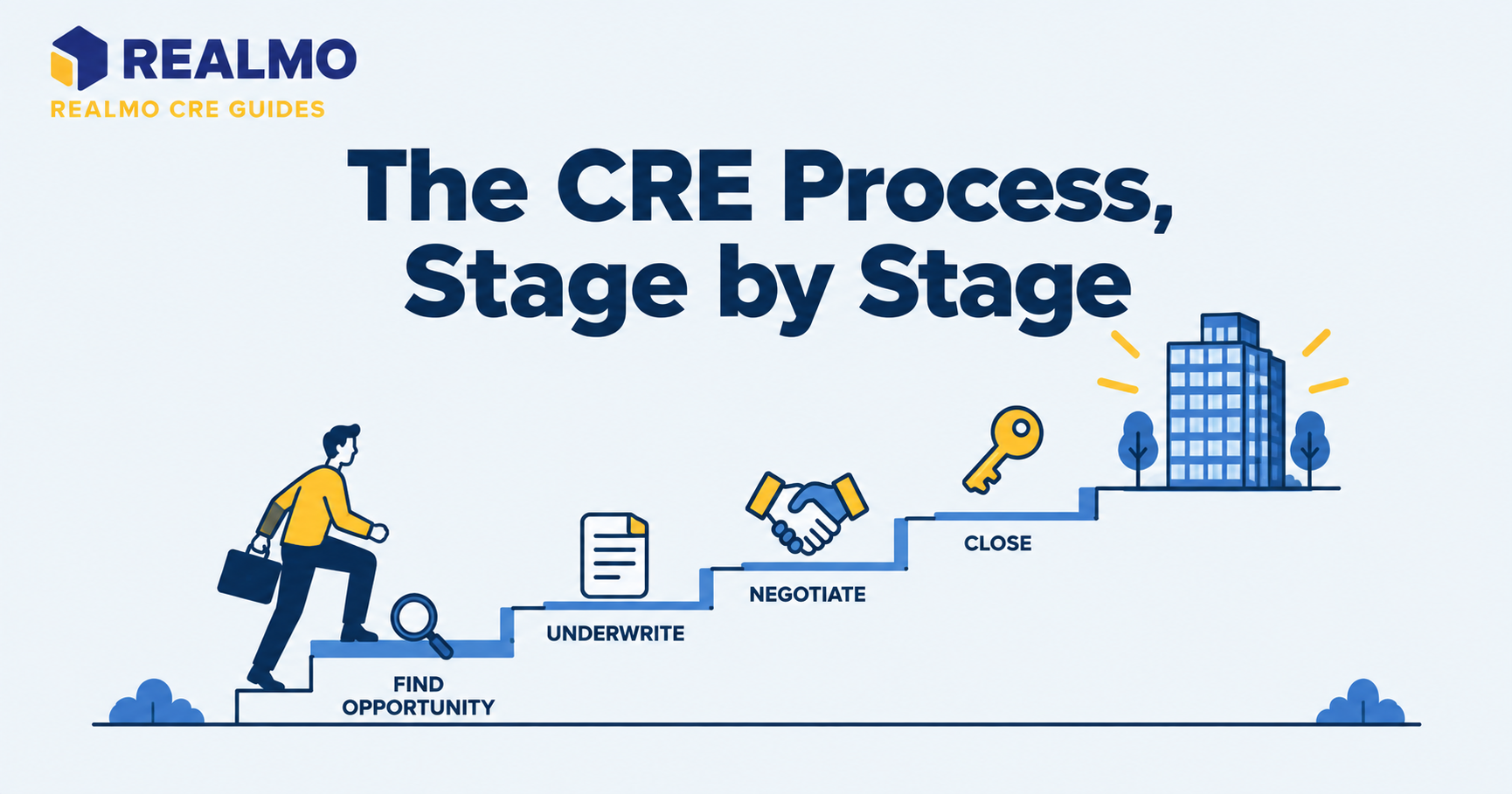
The order of operations matters because each step gates the next.
Get pre-qualified before making offers. Commercial pre-qualification is not a consumer pre-approval letter. It is a conversation with two or three lenders: a local bank, a credit union, and either a Small Business Administration (SBA) lender or a life company. Depending on asset type, ask what they will lend on your target profile, at what coverage ratio, and with what guarantee requirements. Ask each one what their minimum DSCR and maximum LTV are for your asset class. Those two numbers set your purchasing power more than your bank balance does.
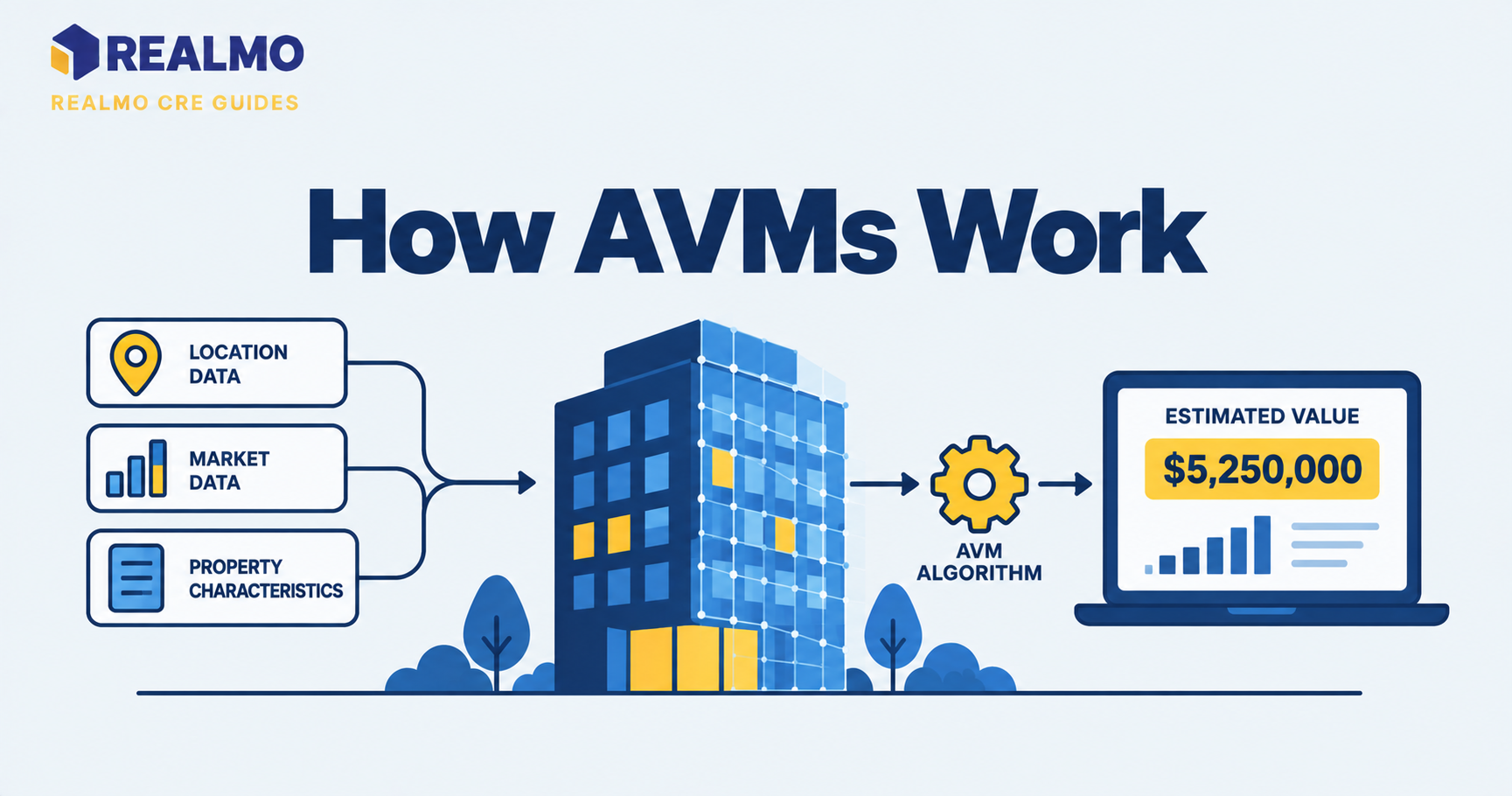
Source through more than one channel. Listing platforms, broker relationships, and direct owner outreach surface different inventory. Off-market deals are not automatically better priced. They are less shopped, which means less competition and also less pricing discipline. Realmo’s listing and analytics coverage lets you check a property’s estimated value, ownership record, and neighborhood indicators before you spend a broker’s time. That shortens the list of properties worth a site visit.
Request the deal package and underwrite before touring. The package should include a rent roll, trailing twelve months of operating statements, a copy of each lease, and the tax bill. If a seller will not release a rent roll before an offer, that is information about how the rest of the process will go.
Rebuild the seller’s numbers from scratch. Never underwrite off the broker’s pro forma. Reconstruct net operating income from actual income and actual expenses. Then add what the seller omitted: property management at market rate even if you plan to self-manage, and replacement reserves. Add a vacancy factor too, even if the building is currently full.
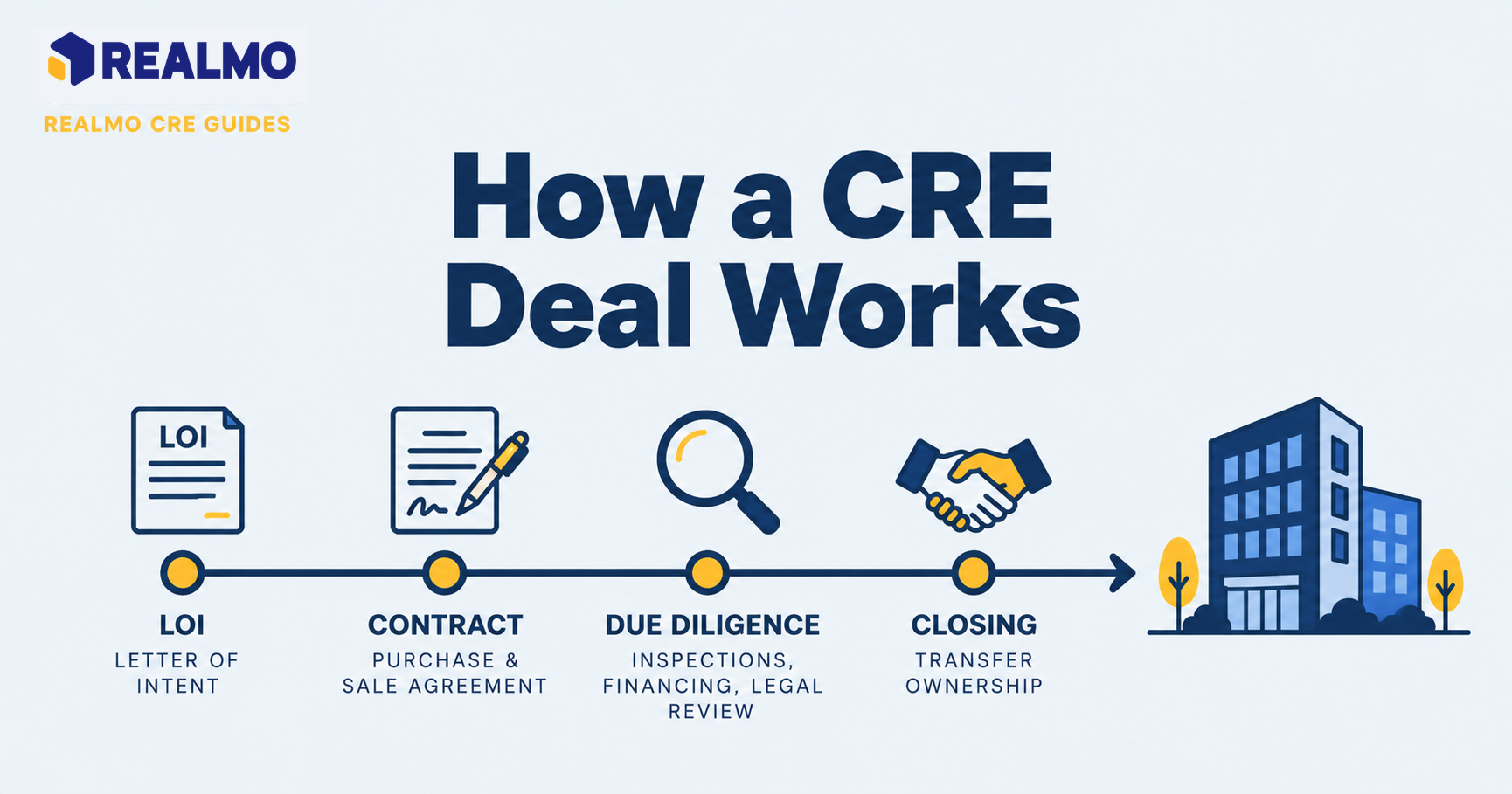
Submit a letter of intent. The letter of intent is a short, non-binding document that sets price, deposit, due diligence period, closing date, and conditions. Negotiating those terms in an LOI costs far less than negotiating them inside a purchase and sale agreement drafted by attorneys.
Sign the PSA and open escrow. The purchase and sale agreement converts the LOI into a binding contract. Your deposit commonly goes hard, meaning it becomes non-refundable, at the end of the due diligence period. That period’s length is one of the most consequential terms you negotiate.
Run due diligence and lender processing in parallel. The lender orders its appraisal and environmental report on its own schedule, and a delay in either can push closing past your contract date.
Close, then take control on day one. Rent collection, insurance binding, utility transfers, and tenant notification all happen at closing, not after.
How Lenders Size the Loan You Can Actually Get
Commercial lenders apply three constraints and lend the lowest amount any of them produces.
Loan-to-value caps the loan at a percentage of appraised value. That’s appraised value, not purchase price, which matters if you bid aggressively. Debt service coverage ratio caps the loan at whatever amount net operating income can service with a cushion. A lender requiring 1.25x will not lend an amount whose annual debt service exceeds NOI divided by 1.25. Debt yield, used mainly by commercial mortgage-backed securities (CMBS) lenders and larger balance sheet lenders, caps the loan at NOI divided by a minimum yield. It removes interest rates from the calculation entirely.
Coverage is where first-time buyers get surprised. Lenders do not use your NOI. They use their own, adjusted downward for a market management fee and replacement reserves, plus tenant improvement and leasing commission reserves in commercial buildings. That adjustment commonly reduces qualifying NOI by five to ten percent, which cuts loan proceeds and raises the equity you must bring.
Recourse is the other surprise. Most small-balance commercial loans are full recourse, meaning you personally guarantee repayment. Non-recourse debt exists but commonly requires larger loan sizes, stabilized assets, and institutional-quality sponsorship. SBA 504 and 7(a) financing can reduce the equity requirement substantially for owner-occupied commercial property, where the buyer’s business occupies a majority of the space. It does not apply to pure investment acquisitions. Eligibility rules, occupancy thresholds, and maximum loan amounts are set by the SBA and change periodically; confirm current terms with an approved lender.
What Due Diligence Covers and Who Pays for It
Due diligence on a commercial building is a paid investigation with a hard deadline, and you spend the money whether or not the deal closes.
Phase I Environmental Site Assessment. A records-and-site review conducted under ASTM E1527, looking for recognized environmental conditions. Nearly every lender requires one. If it flags a former dry cleaner, gas station, or auto shop, the lender will require a Phase II with soil or groundwater sampling. That costs multiples of the Phase I and takes weeks. A Phase I ESA is also the foundation of the innocent landowner defense under CERCLA, the federal Comprehensive Environmental Response, Compensation, and Liability Act.
Property condition assessment. An engineer’s review of roof, structure, mechanical systems, parking, and compliance with the Americans with Disabilities Act (ADA), with an estimate of immediate repairs and a multi-year capital schedule. This becomes your capital budget, and the immediate-repair number is legitimate leverage in a price renegotiation.
Lease abstraction and estoppel certificates. Every lease gets read and summarized: term, rent, escalations, renewal options, expense recovery method, exclusive-use clauses, and termination rights. Each tenant then signs a tenant estoppel certificate confirming those terms independently. Discrepancies between what the seller represented and what the tenant confirms are common and material.
ALTA/NSPS Land Title Survey and title review. Reveals easements, encroachments, and access problems the deed will not.
Zoning and code verification. Confirm the current use is permitted rather than merely tolerated as legal non-conforming, and confirm parking counts satisfy code for the use you intend.
Worked Example: Underwriting a Small Retail Strip
All figures below are illustrative and chosen to show the mechanics, not to represent current market pricing.
The property. A 12,000-square-foot neighborhood retail strip with six tenants, asking $1,400,000. Gross potential rent is $168,000. The broker’s pro forma shows NOI of $121,000 and an 8.6% cap rate.
Step 1: Rebuild income. Apply a 5% vacancy and credit loss factor even though the building is fully leased: $168,000 × 0.95 = $159,600 effective gross income.
Step 2: Rebuild expenses. Trailing twelve-month operating expenses total $47,000, covering taxes, insurance, common area maintenance, and utilities. The pro forma excluded management. Your NOI: $159,600 − $47,000 = $112,600, not $121,000.
Step 3: Recompute the cap rate. $112,600 ÷ $1,400,000 = 8.04%, about 60 basis points below what was marketed. That gap is the entire negotiation.
Step 4: Apply the lender’s adjustments. The lender deducts a 4% market management fee ($6,384) and a $0.25 per square foot replacement reserve ($3,000). Lender-qualifying NOI: $103,216.
Step 5: Size the loan. At 70% LTV, proceeds are $980,000. At an illustrative 6.75% rate on a 25-year amortization, the monthly payment is roughly $6,771 and annual debt service is roughly $81,250. DSCR: $103,216 ÷ $81,250 = 1.27. It clears a 1.25 minimum, but barely.
Step 6: Stress the assumption. If the rate locks 50 basis points higher at 7.25%, annual debt service rises to about $85,000. DSCR falls to 1.21, below the minimum. The lender resizes to the amount supporting 1.25x: $103,216 ÷ 1.25 = $82,573 of annual debt service, which at 7.25% supports roughly $952,000. Proceeds drop about $28,000, and your equity requirement rises by the same amount.
Step 7: Total the equity. At the original $980,000 loan: $420,000 down payment, roughly $42,000 in closing costs and third-party reports, and a $25,000 operating reserve equals $487,000 of equity.
Step 8: Compute cash-on-cash. Cash flow before taxes: $112,600 − $81,250 = $31,350. Divided by $487,000 of equity: 6.4%.
How to read this. The deal returns 6.4% cash-on-cash with coverage that leaves almost no room for a rate move or a vacancy. Losing the two largest tenants at once would push coverage under 1.0. That is a pricing problem rather than a dealbreaker. It argues for a price nearer $1,300,000 or a longer rate lock.
The mistake to avoid. Do not treat the broker’s NOI as a starting point to adjust slightly downward. Rebuild it from operating statements and leases. The $8,400 difference in this example moves loan proceeds, DSCR, and the defensible purchase price all at once.
Five Mistakes That Sink First Commercial Purchases
Underwriting the pro forma instead of the actuals. Pro forma NOI assumes vacant space is leased, below-market rents are raised, and expenses stay flat. Financing as though those things already happened produces a DSCR that fails at the lender’s desk and a purchase price that will not survive appraisal.
Treating the due diligence period as a formality. The deposit commonly goes non-refundable at expiration. Buyers who order reports late discover a roof at end of life or an environmental flag after they have lost the right to terminate. That converts a negotiation into a choice between closing on a bad deal and forfeiting the deposit.
Ignoring lease rollover concentration. A building where four of six leases expire within eighteen months is a leasing project priced as a stabilized asset. Renewal downtime, tenant improvement allowances, and leasing commissions all land in the first two years, exactly when reserves are thinnest.
Skipping estoppel certificates. Sellers occasionally represent lease terms inaccurately, sometimes without intent. Without signed estoppels, you inherit whatever the tenant claims the lease says. That includes verbal side agreements on rent abatement or expansion rights that never made it into the document.
Bringing exactly enough cash to close. Commercial buildings generate immediate expenses: deferred repairs identified in the condition assessment, a re-tenanting cost, an insurance premium above quote. Closing without an operating reserve means funding the first surprise from personal income or a credit line at consumer rates.
Entity structure, tax treatment, and SBA eligibility are regulated areas that vary by state and by your broader holdings. Confirm specifics with a licensed attorney, CPA, or approved lender before you sign.
Related Terms
Cap rate · Net operating income (NOI) · Debt service coverage ratio (DSCR) · Cash-on-cash return · Letter of intent (LOI) · Triple net lease (NNN) · Phase I Environmental Site Assessment · Tenant estoppel certificate
Frequently Asked Questions
How much money do I need to buy my first commercial property?
Plan on the down payment plus roughly 5–8% of purchase price for closing costs, third-party reports, legal fees, and an operating reserve. Equity requirements depend on the lender’s LTV cap and DSCR test, which vary by asset type and market. Owner-occupied purchases financed through SBA programs commonly require less equity than pure investment acquisitions.
Can I buy commercial property with no money down?
Not through conventional acquisition financing. Lenders require meaningful borrower equity as a credit control. Some structures reduce personal cash: seller financing on part of the price, partnership equity, or cross-collateralizing another owned property. They shift where the equity comes from rather than eliminating it. Each adds legal complexity worth reviewing with counsel.
How long does a commercial closing take?
Sixty to ninety days from executed purchase agreement is typical, driven by the longer of due diligence and lender processing. Environmental follow-up, appraisal scheduling, or a title defect can extend it. Build a contract timeline around third-party report turnaround rather than assuming a residential pace.
Should I form an LLC before buying?
Most commercial buyers hold each property in a separate entity for liability separation, and lenders commonly expect a single-purpose entity as borrower. Entity choice carries tax and liability consequences that differ by state. Discuss structure with a licensed attorney and CPA before signing, since changing the buyer entity mid-escrow can require lender re-approval.