How to Pull Good Comps

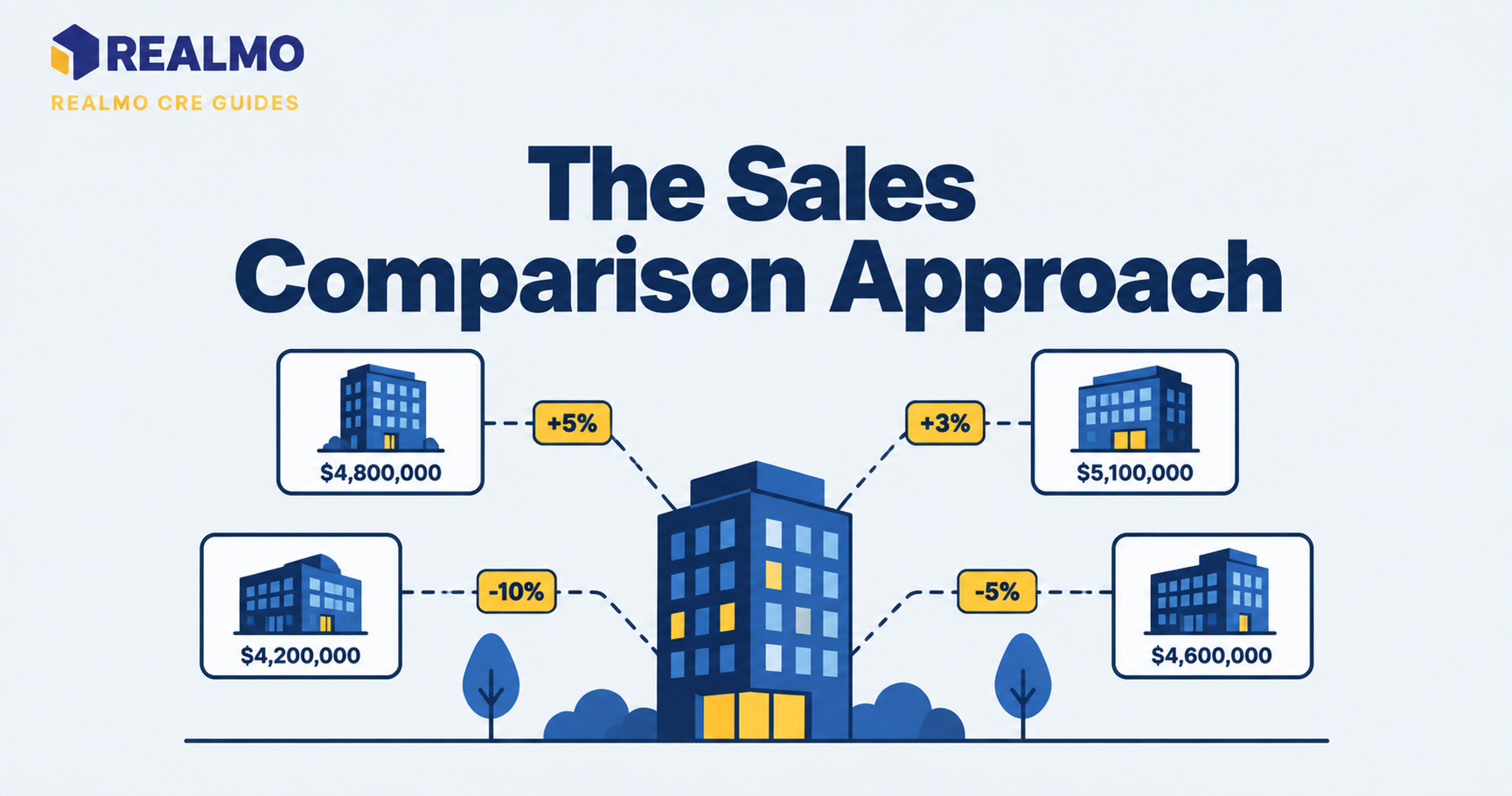
Commercial real estate comps are recent sale or lease transactions involving properties similar to a subject property. Their pricing supports a value or rent conclusion. A comp set works only when the differences between each comparable and the subject can be identified, measured, and adjusted for.
Why Comp Quality Decides Whether Your Number Holds
A broker enters a listing presentation with three same-submarket sales and a defensible-looking price per square foot. The owner’s attorney checks whether any sales involved related parties. Two did: an intra-family transfer and a partnership buyout. The pricing conclusion collapses, along with the broker’s credibility on the pitch.
That failure mode repeats across broker opinions of value, lease negotiations, and litigation support. A comp set is not a list of nearby transactions; it is an argument. Each comparable either survives scrutiny about condition, motivation, timing, and lease structure, or it weakens the whole conclusion. Brokers who screen hard at the front end spend less time defending numbers later. They also price listings closer to where the market clears.
What Makes a Transaction Comparable at All
Comparability runs along four axes, and a transaction has to clear all four rather than score well on one.
Physical similarity covers building size (under ANSI/BOMA Z65), age, construction type, clear height, parking ratio, and site coverage. A 40,000-square-foot warehouse with 32-foot clear height and a 22-foot-clear building of the same size serve different tenants. They also trade at different pricing.
Location means competitive submarket, not radius. Two properties a mile apart can sit across a highway interchange, school district line, or zoning boundary. They may compete for entirely different demand.
Use and income characteristics matter more than the building itself in income-producing assets. A single-tenant net-leased property with twelve years remaining and an investment-grade tenant differs materially from an identical month-to-month building. The address can be the same.
Timing determines whether the transaction still reflects current conditions. Older sales require market-conditions adjustment, and the further back you reach, the more judgment enters the number.
Where to Source Sale and Lease Comps
Public records give you the recorded deed, transfer date, and stated consideration, and they are the only universally available source. County recorder and assessor data varies in quality. Roughly a dozen states are non-disclosure states where sale prices are not recorded. In those markets, public records confirm a transfer, not the price.
Commercial listing and analytics platforms aggregate confirmed sales, lease terms, and property attributes across markets. Coverage is strongest in primary markets and thins in tertiary ones. Realmo’s property analytics cover ownership records, current and suggested use, and valuation data across 9M+ properties. This shortens the screening step before you start confirming individual transactions.
Broker networks remain the best source for lease comps, because leases are rarely recorded. Effective rent (the number that matters) lives in free rent, tenant improvement allowances, and escalation structures that no public database captures.
Appraisals, offering memoranda, and loan documents surface in due diligence and litigation files, and they usually contain confirmed terms. Treat pricing in a marketing package as an asking number until confirmed.
How to Verify a Comp Before You Use It
Verification means confirming the transaction with a party to it or with a document that records its actual terms. Ask three questions of every sale.
First confirm whether the transaction was arm’s-length. Related-party transfers, partnership dissolutions, estate settlements, foreclosure deeds, and portfolio allocations can record prices outside open-market negotiation. Deed type and grantor-grantee name matching catch most of these.
Next confirm what was actually conveyed. A recorded price may include personal property, a business, seller financing below market, or an adjacent parcel. It may exclude an assumed loan. Each item moves the number.
Then assess the parties’ motivations. A 1031 buyer under a deadline, a lender disposing of REO, or a seller behind a defaulted loan faces different pressure. Pricing can differ from an unpressured party’s.
Lease comps need parallel treatment: confirm the term, the escalation schedule, who pays which operating expenses, and what concessions were granted. A gross lease and a triple-net lease quoted at similar face rents describe very different economics.
How to Adjust Comps for Differences From the Subject
Adjustments move each comparable toward the subject, not the other way around. Sequence matters, because some adjustments are applied to the price before others.
Transactional adjustments come first. They cover property rights, financing terms, conditions of sale, immediate post-purchase expenditures, and market conditions between the comp’s contract date and effective date. Apply these in order, each to the running adjusted price.
Physical and locational adjustments follow: location, size, age and condition, quality, and functional utility. These are applied as a set to the adjusted price from the first stage.
Support adjustments with evidence where you can. Paired sales analysis (two transactions differing in one meaningful respect) gives a defensible percentage. Cost data supports condition adjustments. Where no evidence exists, state the adjustment as judgment and keep it modest.
A comp requiring adjustments that total more than roughly 25% gross is telling you it is not comparable. Reach for a better transaction instead of adjusting harder.
Worked Example: Adjusting a Sale Comp
Illustrative figures only.
Subject: 30,000 SF multi-tenant flex building, 20 years old, average condition, secondary submarket.
Comparable: 32,000 SF flex building, sold 14 months ago for $3,840,000, or $120 per SF. Superior location, similar age, recently renovated roof and HVAC.
Step 1, screen. Arm’s-length sale, unrelated parties, no seller financing, no personal property conveyed. Passes.
Step 2, transactional adjustments. Fee simple in both cases, cash-equivalent terms, no post-purchase expenditures. Paired sales in the submarket support a +4% market-conditions adjustment from the comp’s contract date to today. The calculation is $120 × 1.04 = $124.80 per SF.
Step 3, property adjustments applied to $124.80:
- Location: comp superior, −8% → −$9.98
- Condition: comp superior (recent roof and HVAC), −5% → −$6.24
- Size: comp slightly larger, minimal effect, no adjustment
- Age and utility: similar, no adjustment
Adjusted indication: $124.80 − $9.98 − $6.24 = $108.58 per SF, or roughly $3,257,000 for 30,000 SF.
Step 4, interpret. Gross adjustment is 17%, within a defensible range. This is one indication, not a conclusion. Three to five similarly adjusted comps should cluster; the tightness of that cluster tells you how much confidence the value range deserves.
Common error: adjusting the subject toward the comp. If the comp is superior, its indicated value adjusts down. Reversing the direction inflates every conclusion in the set.
How to Present a Comp Set So It Survives Review
Show the grid, not just the conclusion. A reviewer (an appraiser, an underwriter, opposing counsel) wants to see each comparable’s unadjusted price, each adjustment, the reasoning behind it, and the adjusted indication. Conclusions without visible adjustments read as reverse-engineered.
State your verification source for each transaction: buyer, seller, listing broker, closing statement, or public record only. Unverified comps should be labeled as such rather than quietly mixed in.
Give a range, not a point. Adjusted indications that cluster within a narrow band support a tight conclusion; indications scattered widely mean the comp set is weak. Saying so is better than picking a midpoint and hoping.
Explain exclusions. If you looked at eleven sales and used five, note why the other six were rejected. That single paragraph does more for credibility than a longer comp list.
Common Mistakes When Pulling Comps
Using asking prices as comps. Listing prices reflect seller hope, not market clearing. A comp set built on asking numbers overstates value and falls apart when a buyer’s lender orders an appraisal.
Ignoring lease structure in income properties. Two buildings sold at the same price per square foot can represent completely different cap rates once term, credit, and expense responsibility are accounted for. Price per square foot alone misleads on leased assets.
Radius searching instead of submarket screening. A one-mile radius pulls in properties that never compete with the subject and excludes true competitors just outside the circle. Draw the boundary the way tenants and buyers actually shop.
Stacking large adjustments to force a comp to work. Each adjustment adds error. Four adjustments of 10% each do not produce a reliable indication; they produce a number with wide uncertainty presented as precision.
Using the same comp set months later without re-screening. Market conditions adjustments compound, and transactions that were current become historical. Refresh before reuse.
Related Terms
- Broker Opinion of Value (BOV), how comps feed a broker’s formal value opinion
- Sales Comparison Approach, the appraisal method comps support
- Price Per Square Foot, the most-used and most-misused comp metric
- Effective Rent, why face rent misleads in lease comps
- Cap Rate, converting income to value alongside comparable sales
- Arm’s-Length Transaction, the screening standard for every sale comp
- Submarket Analysis, defining the geography a comp set should cover
- Highest and Best Use, why use, not just building type, drives comparability
FAQ
How many comps do you need for a commercial property?
Three to five verified, well-matched transactions support a defensible conclusion. Quality outweighs count: five closely comparable sales beat twelve loosely related ones. If fewer than three exist in the submarket, widen the geography or the time window and disclose that you did.
How old can a comp be and still be usable?
It depends on how much the market has moved, not on a fixed cutoff. Stable periods tolerate older sales; periods of rapid rate or demand change do not. Any sale requiring a large market-conditions adjustment carries proportionally more uncertainty.
Where can I find commercial real estate comps for free?
County recorder and assessor sites provide deed records and transfer dates at no cost, though non-disclosure states omit price. Some commercial platforms publish property-level analytics without a paywall. Confirmed lease terms almost always require broker relationships.
What’s the difference between a comp and an appraisal?
A comp is a single data point; an appraisal is a full valuation assignment performed by a licensed appraiser under USPAP (the Uniform Standards of Professional Appraisal Practice), using multiple approaches. Brokers use comps to form opinions of value, which are not appraisals and are labeled accordingly.
Why do two brokers pull different comps for the same building?
Different submarket definitions, different verification standards, and different judgments about which differences matter. Both sets can be reasonable; the one that discloses its screening criteria and adjustment reasoning is the one a reviewer will trust.
Valuation methodology and licensing requirements vary by state, consult a licensed appraiser or attorney for assignments requiring certified valuation.