Full Service Gross Lease Explained
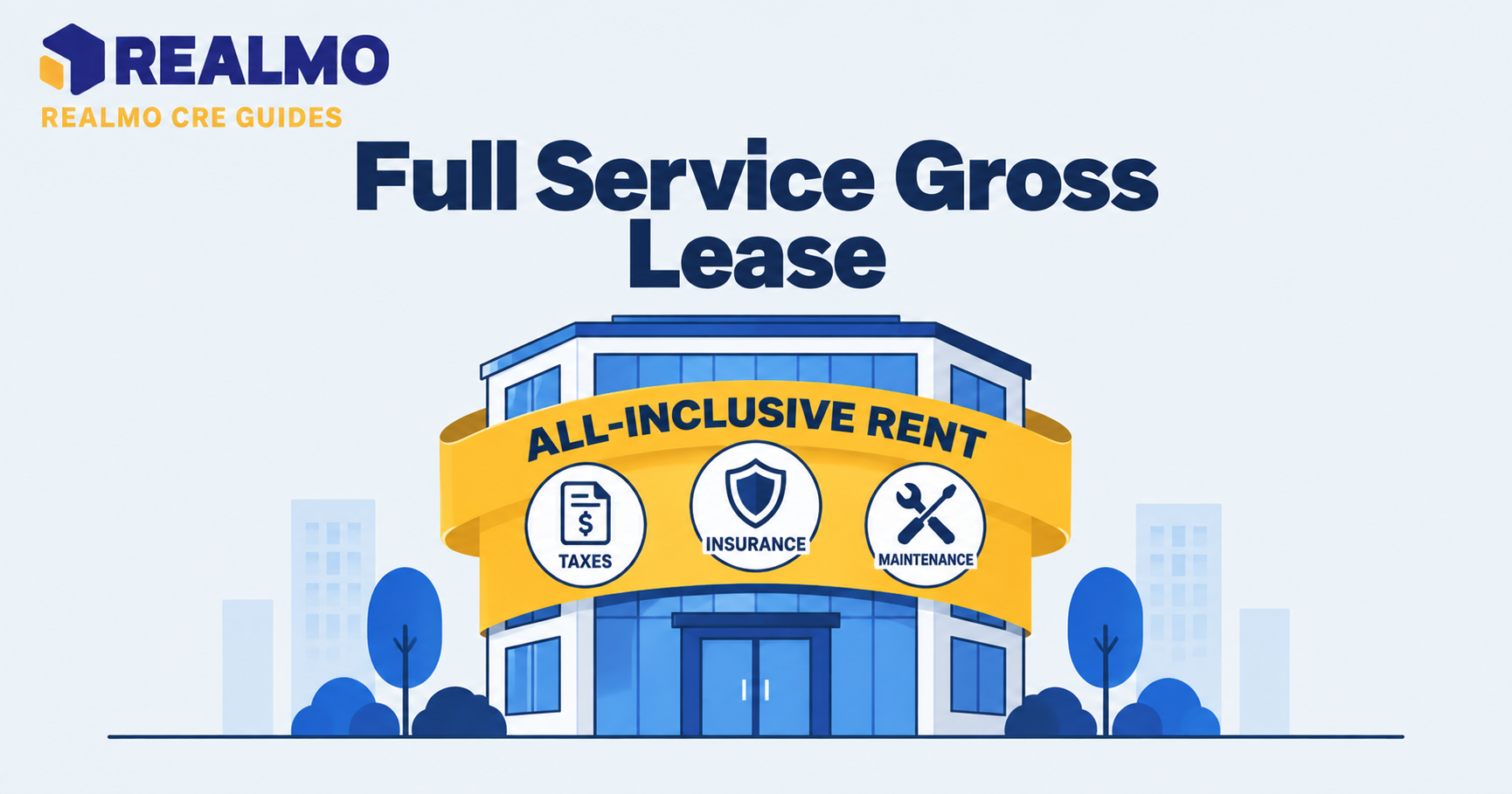
A full service gross lease is an office lease in which the tenant pays one rent figure and the landlord covers operating expenses out of it: property taxes, insurance, common area maintenance, janitorial, and building utilities. Most U.S. versions still bill the tenant for a share of expense increases above a base year.
Why rent still rises under a “full service” deal
A law firm signs 5,000 rentable square feet at $32.00 per square foot, full service (illustrative figure). The firm budgets $160,000 a year and moves on. Fourteen months later an operating expense statement arrives for $6,200.
Nothing was breached. The lease carried a base year set at the calendar year of commencement, and the building’s tax bill and insurance premium both went up after that year closed. The tenant owes its pro rata share of the increase.
That is the structure working as written. Tenants who read “full service” as “fixed” budget the quoted rate and nothing else. The number that decides your real occupancy cost is the quoted rate plus every escalation the lease permits.
What the landlord covers, and what it bills separately
The landlord’s side of a full service building usually includes real estate taxes, property insurance, common area maintenance, security, elevator and life-safety service, landscaping, a management fee, and janitorial for both suites and common areas. Base-building HVAC is included during building standard hours, commonly 8 a.m. to 6 p.m. on weekdays and a half day Saturday.
Outside that list, you pay. Overtime HVAC is billed by the hour at a rate stated in the lease. So is above-standard electrical for a server closet, extra janitorial, suite alterations beyond the improvement allowance, your telecom, and your own liability and contents insurance.
Read the operating expense definitions in your lease before you compare buildings. Two landlords can quote the same rate and include different services.
How the base year sets your costs for the whole term
The base year fixes a spending level. Once actual building expenses exceed it, you reimburse your share of the excess, calculated as your rentable square feet divided by the building’s rentable square feet under the ANSI/BOMA Z65.1 measurement standard for office buildings. Some leases use a fixed dollar expense stop instead, say $10.50 per square foot, with the same mechanics.
Occupancy is where this gets expensive. Janitorial, utilities, and management scale with how full the building is. If the base year lands while the property sits at 65% leased, variable expenses that year understate a stabilized building. Fill the building to 90% and your pass-throughs jump, even with zero inflation.
A gross-up clause fixes this. It restates variable expenses in the base year as if the building were 95% or 100% occupied, applied to variable costs only, never to taxes or insurance. Without it, lease-up risk transfers to you.
One more trap sits at renewal. A renewal or expansion should reset the base year to a current one. Rolling forward an old base year quietly converts a gross lease into something close to net.
Worked example: pass-through on a 5,000 SF suite
All figures illustrative.
The building measures 100,000 rentable square feet. Your suite is 5,000, so your pro rata share is 5%. Base year operating expenses run $1,000,000, or $10.00 per square foot. Base rent is $32.00 per square foot, full service, or $160,000 a year.
In year three, building expenses reach $1,120,000, or $11.20 per square foot. The increase over base year is $120,000. Your 5% share is $6,000, which equals $1.20 per square foot. Effective rent that year: $33.20, and total cash rent $166,000.
How to read it: your exposure equals your share of expense growth, not the whole expense line. A 12% jump in building costs moved your rent 3.75%.
The mistake that shows up in tenant spreadsheets is comparing $32.00 full service to a $24.00 triple net (NNN) rate and calling it an $8.00 saving. Add the NNN building’s $10.00 expense load and the net deal costs $34.00.
Full service gross vs modified gross and NNN
Under a modified gross lease, the expense list gets split by category. A frequent arrangement leaves taxes, insurance, and CAM with the landlord while the tenant pays its own suite electricity and janitorial directly. Under NNN, the tenant pays its share of all three nets from day one, with no base year cushion.
Full service gross moves short-term expense volatility to the landlord, who prices that risk into the quoted rate. You pay for the certainty. In exchange, you get one predictable number for the first year and capped exposure after that, assuming you negotiated the caps.
Quoted rates across listings are not comparable until you normalize them to the same expense structure. Realmo listings show the lease structure alongside the asking rate, which makes that normalization faster when you are screening several buildings at once.
Clauses tenants negotiate in a full service gross lease
Base year selection comes first. If the building sold recently, a property tax reassessment can land in year two and blow past a base year set before it. California’s Proposition 13 triggers reassessment on change of ownership, and similar sale-triggered rules exist in other states.
Then the caps. A common tenant ask is 5% per year, cumulative and compounding, on controllable expenses only, with taxes, insurance, and utilities carved out as uncontrollable. Pair it with an exclusions list: capital expenditures, leasing commissions, improvement costs for other tenants, ground rent, debt service, and the landlord’s income taxes.
Audit rights matter more than tenants expect. Ask for a 90 to 120 day window to review supporting invoices after the annual statement, with the landlord paying audit costs if the overcharge exceeds a stated threshold. Add the 95% gross-up and a management fee capped as a percentage of gross revenue.
Lease provisions carry legal and tax consequences. Have a licensed attorney and a tenant representative review any structure before signing.
Common mistakes tenants make
- Budgeting the quoted rate only. Year-one certainty becomes year-four surprise when pass-throughs compound on top of scheduled rent bumps.
- Skipping the gross-up clause in a partially leased building. You end up funding the landlord’s lease-up costs through inflated escalations.
- Accepting a stale base year at renewal. The gap between an old base year and current expenses is pure additional rent.
- Treating rentable square footage as measured space. A 5,000 RSF suite may contain 4,300 usable feet, and your load factor drives both rent and pro rata share.
- Ignoring overtime HVAC rates. A firm running evenings and weekends can add thousands a year that never appear in the rent comparison.
Related terms
Base year, expense stop, gross-up clause, modified gross lease, triple net lease, common area maintenance (CAM), pro rata share, effective rent.
FAQ
Is a full service gross lease the same as a gross lease?
Not quite. A pure gross lease leaves all operating expenses with the landlord for the full term. Full service gross adds a base year or expense stop, so the tenant reimburses its share of increases above that level. Pure gross structures appear mostly in short-term or single-tenant deals.
What does the tenant actually pay under a full service lease?
Base rent, plus its pro rata share of operating expense increases over the base year, plus anything defined as above-standard service. Overtime HVAC, extra janitorial, and supplemental cooling for server rooms are billed separately. Suite telecom and the tenant’s own insurance sit outside the rent entirely.
Which property types use full service gross leases?
Multi-tenant office buildings, medical office, and some coworking and flex space in the U.S. market. Industrial and single-tenant retail lean toward net structures, because those tenants control their own premises and prefer to manage expenses directly.
How do I compare a full service quote to a net quote?
Add the net building’s estimated operating expenses per square foot to its base rate, then compare against the full service rate. Also match base years. A full service quote with a current base year is worth more than one carrying a base year two cycles old.