Assessed Value vs Market Value: What the Difference Means for CRE Owners
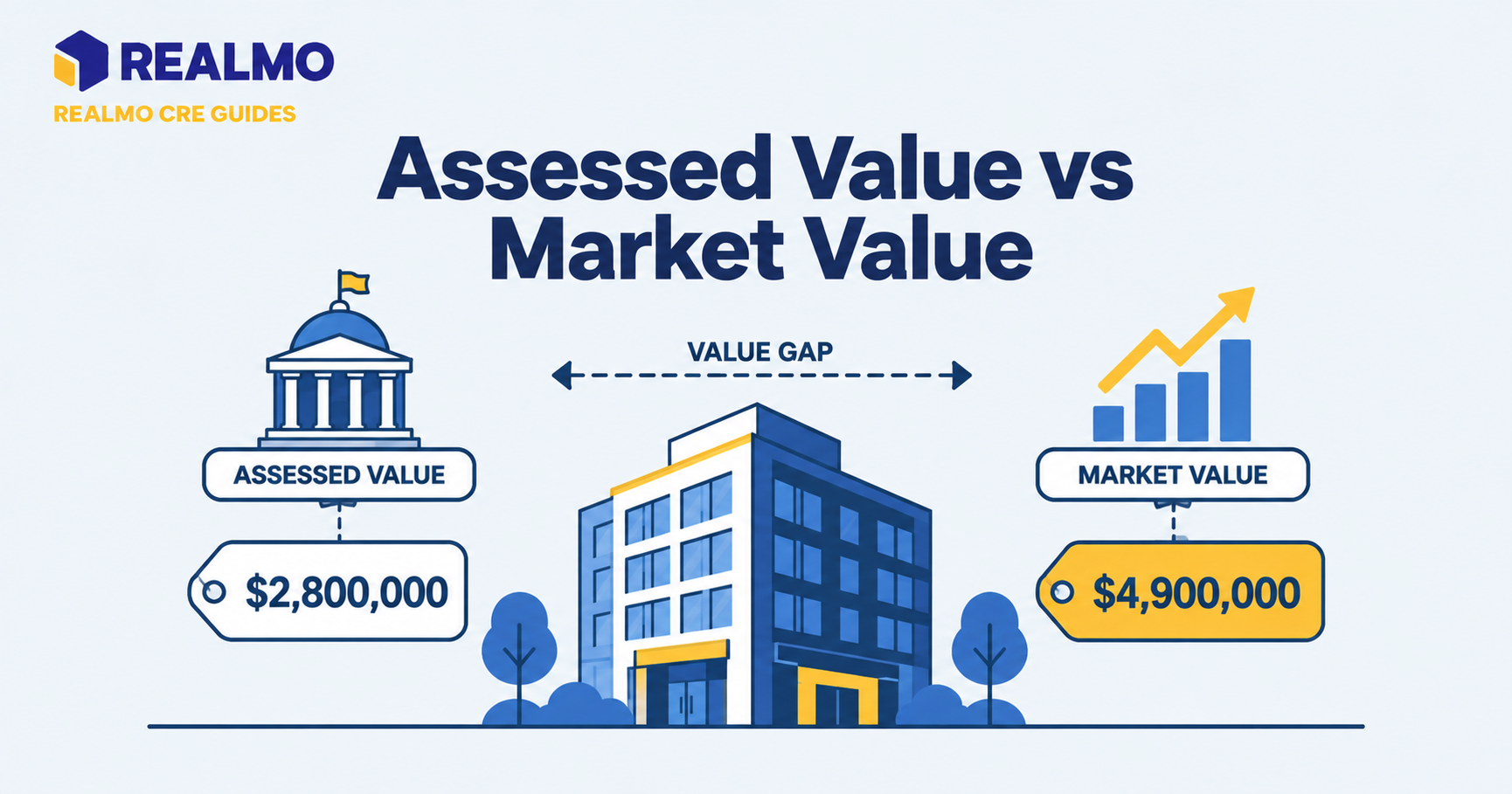
Assessed value is the figure a county or municipal assessor assigns to a property for tax purposes. Market value is the price a property would bring in an arm’s-length sale between a willing buyer and a willing seller. The two rarely match, and the gap between them determines whether an owner is overpaying property tax.
Why the gap costs owners real money every year
A retail strip center owner receives a notice of assessed value in the mail. The number looks close enough to what she paid three years ago, so she files it. What she misses is that two anchor spaces have gone dark since acquisition. The income the property actually produces no longer supports the assessor’s figure. Property tax is usually the second-largest line item on a commercial operating statement after debt service. Unlike insurance or management, it can be contested through a defined administrative process.
The gap runs both directions. An assessment far below market value looks like a win, but it creates repricing risk at the next reassessment. Buyers will normalize taxes to a post-sale basis anyway. Owners who track both numbers see the tax exposure before it lands in an offer negotiation.
How assessors calculate assessed value
Assessors work at scale. A county may carry tens of thousands of parcels. Reassessment cycles can be annual, biennial, or longer depending on state law. That volume forces mass appraisal, conducted under standards published by the IAAO (International Association of Assessing Officers): statistical models applied to groups of similar properties rather than individual inspections.
Most jurisdictions build assessed value from an estimate of market value, then apply an assessment ratio set by statute. If the ratio is 40%, a property the assessor values at $5,000,000 carries an assessed value of $2,000,000. The tax rate applies to that base. Some states assess at full value with a ratio of 100%. Others vary the ratio by property class, taxing commercial property at a higher effective ratio than residential, a structure known as classification.
Assessors use the same three approaches an appraiser would: cost, sales comparison, and income capitalization. For income-producing commercial property, the income approach usually carries the most weight. However, the assessor is applying market-derived rents and expenses to a property class, not the property’s actual rent roll. That distinction is where most appeals begin.
How market value is determined in a commercial sale
Market value assumes a specific set of conditions: both parties are informed, neither is under compulsion, the property has reasonable exposure to the market. Payment terms are typical. It is an opinion of price under hypothetical conditions, not a record of what happened.
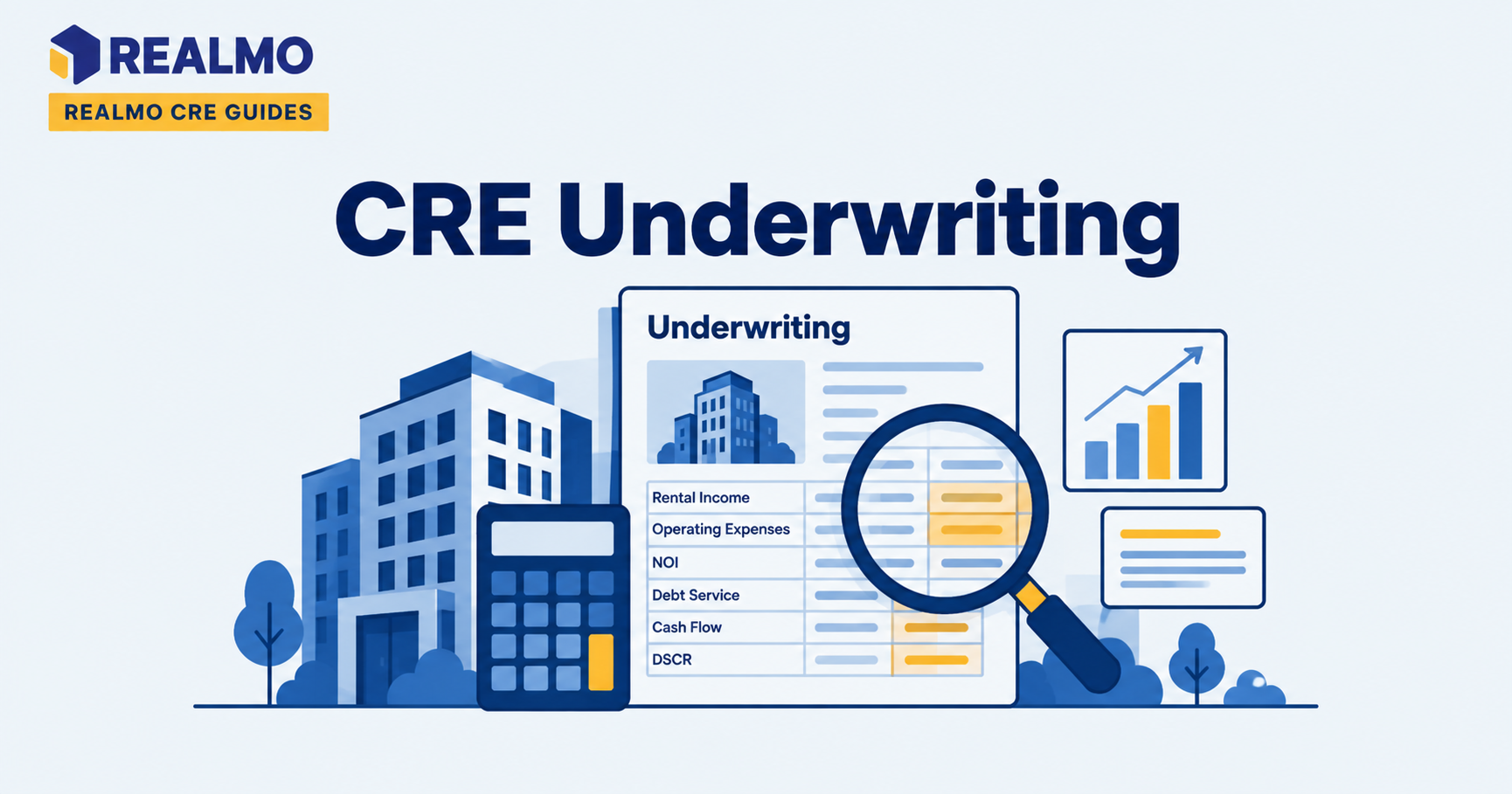
An appraiser reaching market value for a commercial asset weights the income approach heavily. The analysis uses actual and market-supported NOI plus a cap rate drawn from comparable sales. Sales comparison provides a cross-check. The cost approach matters most for new construction and special-purpose buildings where comparables are thin.
The critical difference is specificity. An appraisal accounts for this building’s lease structure, remaining term, tenant credit, deferred maintenance, and any encumbrances. Mass appraisal cannot. See how commercial property valuation works for the mechanics of each approach.
Why assessed value lags the market
Three structural forces keep assessed value out of step with current pricing.
Timing. Assessments reflect a statutory valuation date that may sit twelve to twenty-four months before the tax bill arrives. In a market that has moved sharply in either direction, the assessment is a snapshot of a period that has already passed.
Cycle length. Where reassessment happens every three or four years, the figure drifts further from market with each intervening year, then resets abruptly.
Statutory limits. Several states cap how much an assessment can increase in a single year, or reset assessed value only on transfer of ownership. Under those rules, two identical buildings on the same block can carry very different assessed values purely because one sold recently and one did not.
None of these forces has anything to do with the property’s quality or income. They are artifacts of how the system is administered.
Which value applies to which decision
Assessed value drives the property tax bill and nothing else. It is not the number a lender underwrites or an insurer uses for replacement-cost coverage. It is also not a defensible purchase-price input.
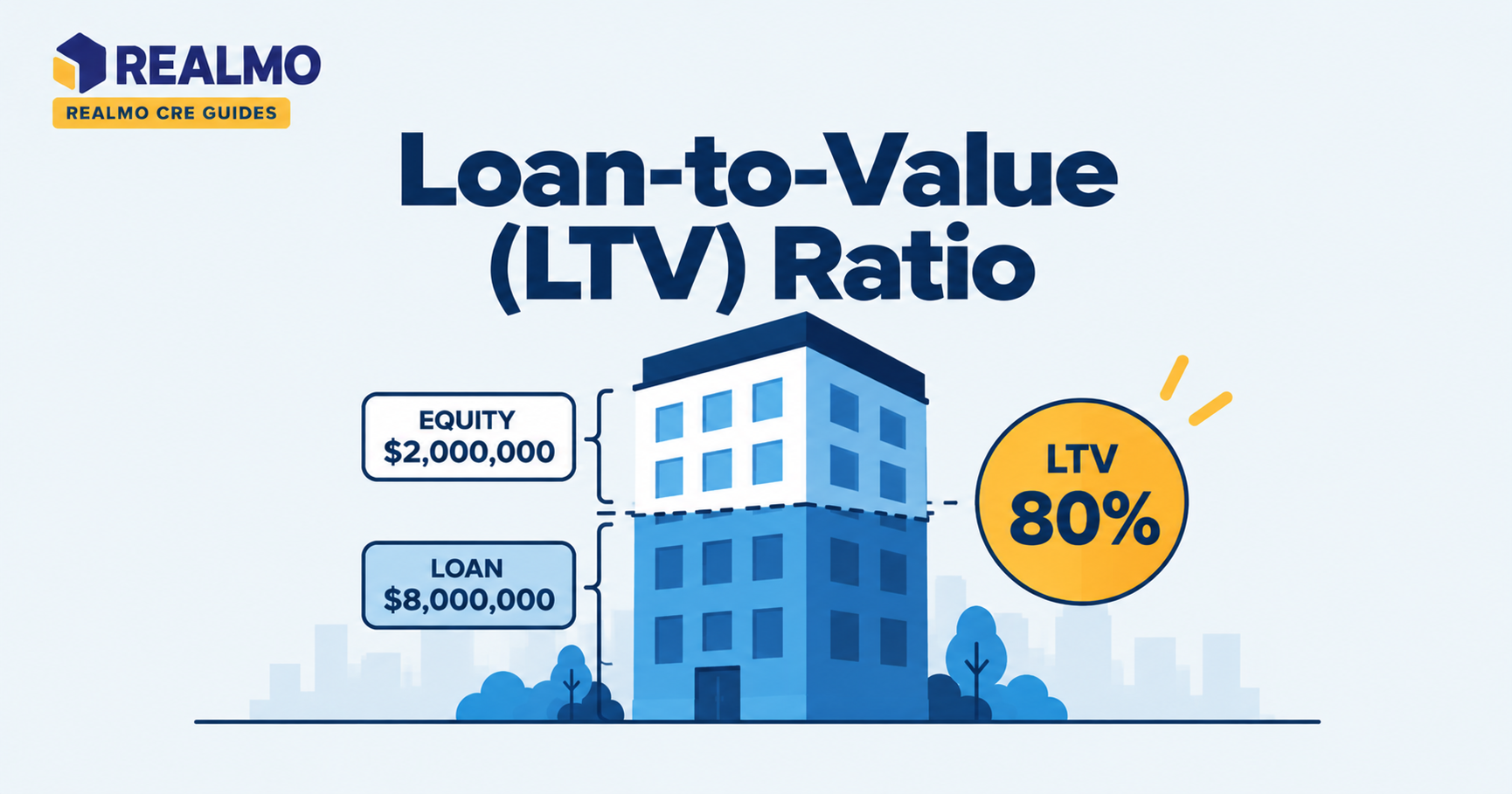
Market value drives acquisition and disposition pricing, loan-to-value calculations, partnership buyouts, estate planning, and casualty settlements. When a buyer asks what a property is worth, assessed value is a data point about tax exposure, not an answer to the question. Owners preparing to sell should understand how cap rates translate income into value before treating any single figure as authoritative.
Insurable value is a third number entirely, based on cost to rebuild. It can sit far above or below both of the others because it excludes land.
Worked example: reading the gap on a small industrial building
The figures below are illustrative and do not reflect any specific market.
An owner holds a single-tenant industrial building. Actual net operating income is $180,000. Comparable sales in the submarket support a capitalization rate of 7.5%.
Market value indication: $180,000 ÷ 0.075 = $2,400,000
The county’s notice shows an assessor’s market value of $3,000,000, an assessment ratio of 50%, and an assessed value of $1,500,000. At an illustrative combined rate of $30 per $1,000 of assessed value, the annual tax is $45,000.
If the owner proves a $2,400,000 market value, assessed value falls to $1,200,000. The annual bill then falls to $36,000, a recurring $9,000 reduction. At the same 7.5% cap rate, removing $9,000 of annual expense adds roughly $120,000 to value. The savings flow directly through NOI.
Interpretation: the appeal is worth pursuing not for the one-year savings but for the effect on the income stream and the resale price. One common error is comparing the owner’s market value estimate to the assessed value on the notice rather than to the assessor’s underlying market value. Comparing $2,400,000 to $1,500,000 makes the assessment look low and kills a valid appeal before it starts. Always normalize for the assessment ratio first.
Property tax appeals involve jurisdiction-specific procedure and deadlines; consult a licensed property tax attorney or consultant before filing.
Common mistakes owners make with these two numbers
Using assessed value to set an asking price. Buyers underwrite income and comparable sales. An asking price anchored to a tax figure either leaves money on the table or draws no offers, and both outcomes waste marketing time.
Ignoring the appeal window. Appeal deadlines are short, fixed, and unforgiving. Missing one means carrying the assessment for a full cycle with no remedy, which on a multi-year cycle can mean several years of overpayment.
Failing to underwrite post-sale reassessment. In jurisdictions where a sale triggers reassessment, a buyer who models the seller’s historical tax expense will miss the actual expense from year one. That error inflates projected NOI and overstates the price the buyer can pay.
Treating a low assessment as validation of a low market value. It works the other way in a dispute. If a lender or partner questions value, an assessment carries little evidentiary weight against a current appraisal.
Appealing without evidence of the property’s actual economics. A rent roll showing vacancy, below-market leases, or a tenant in default is the substance of an appeal. An opinion that the number feels high is not.
Realmo’s property records show assessed values alongside estimated market value and ownership history for over 9 million commercial properties. This makes the gap visible before the tax notice arrives.
Related terms
- Capitalization rate
- Net operating income
- Highest and best use
- Property tax appeal
- Millage rate
- Appraisal approaches to value
- Insurable value
FAQ
Is assessed value the same as market value?
No. Assessed value is a tax figure produced by mass appraisal and reduced by a statutory assessment ratio. Market value is an opinion of the price a property would bring in an open-market sale. In most jurisdictions assessed value is deliberately set below market value.
Can I use my assessed value to price my building for sale?
No. Assessed value reflects a past valuation date, a mass-appraisal model, and a statutory ratio. Commercial buyers price on net operating income and comparable sales. Use an appraisal or broker opinion of value instead.
Why did my assessment go up when my building lost a tenant?
Assessors value property classes, not individual rent rolls, and the valuation date may precede the vacancy. Documenting the income loss is the basis for an appeal, subject to your jurisdiction’s deadlines and procedures.
Does a sale change my assessed value?
In many jurisdictions, yes. A recorded transfer can trigger reassessment to the sale price. Rules vary widely by state, so verify local practice before underwriting tax expense on an acquisition.
Which number does my lender use?
Market value, established by an independent appraisal ordered by the lender. Assessed value appears in the file as a tax data point only.