Commercial Property Appraisals: What to Expect
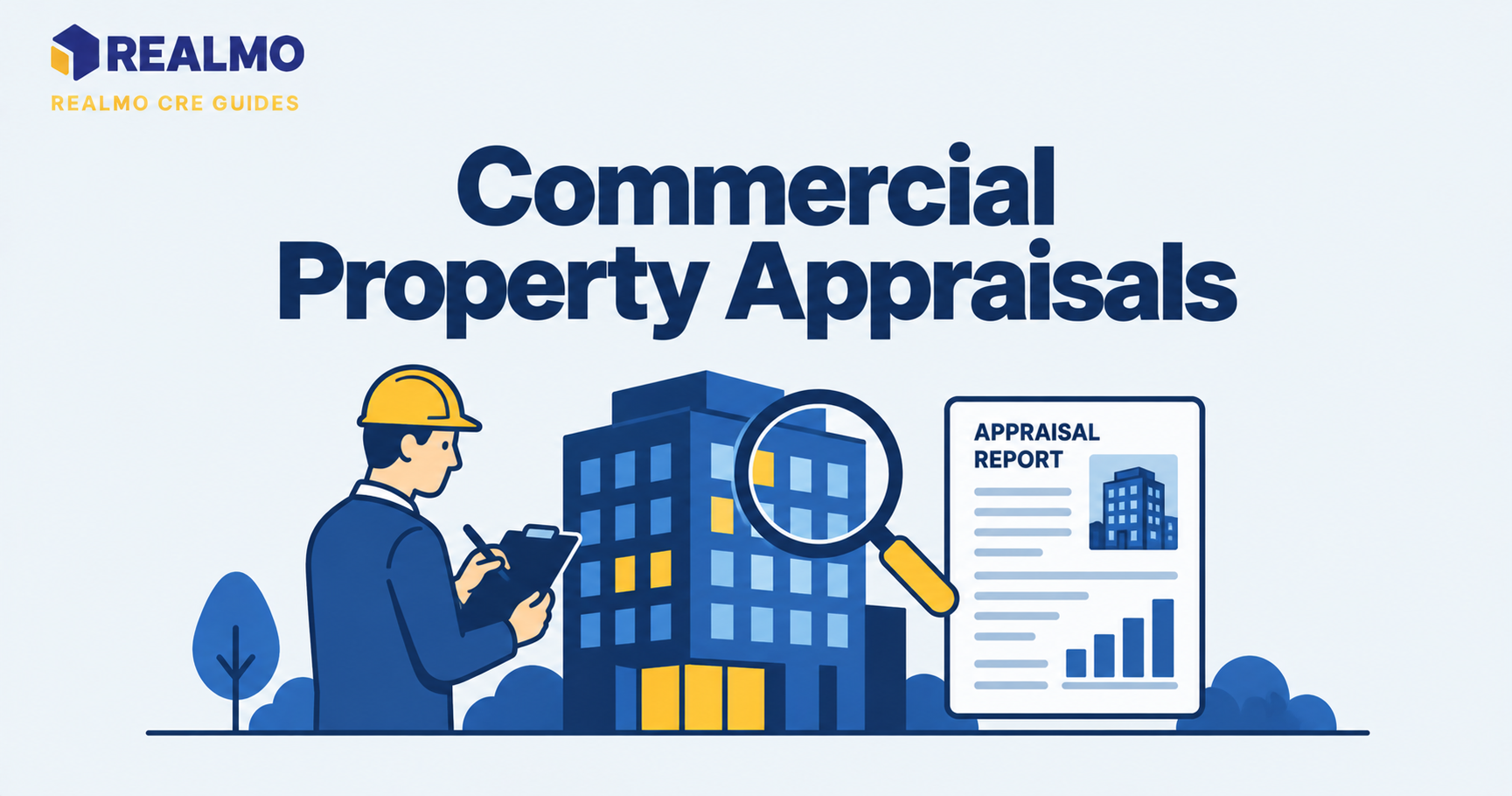
A commercial property appraisal is an independent opinion of value prepared by a state-licensed appraiser under USPAP for an income-producing property. The appraiser inspects the asset and analyzes leases, comparable sales, and market data. The appraiser then reconciles the income, sales, and cost approaches into one dated value conclusion.
Why the appraisal matters to the owner
You have a loan maturing on a 40,000-square-foot flex building you have held for nine years. The lender orders an appraisal before it will size the new debt. The appraised value sets the denominator in the loan-to-value test. If value lands below your assumption, the refinance shrinks. You must bring cash, accept a shorter term, or restart with another lender several weeks behind schedule.
The same report shapes outcomes far outside financing. Appraised value anchors partnership buyouts, estate and gift filings, property tax appeals, insurance replacement cost, and buyer pricing discussions. Owners who treat the appraisal as a box the lender checks lose control of a number that follows the asset for years. Owners who understand the value build can supply better inputs and correct factual errors before the report is finalized. They also know when a conclusion is genuinely defensible.
What a commercial property appraisal report contains
Every credible report identifies five basics: client and users, intended use, property rights, effective date, and value type. Those five items are not boilerplate. A below-market lease can make leased fee value differ from fee simple value. A lender appraisal is also not automatically usable in a divorce proceeding.
The report describes the market area, site, improvements, zoning, and highest and best use. It then presents the valuation approaches and explains their relative weight. Under USPAP, appraisers issue either an Appraisal Report or a Restricted Appraisal Report. The Appraisal Foundation publishes USPAP. The restricted format contains less explanation and is limited to a single named client, which is why lenders rarely accept it.
Read the extraordinary assumptions and hypothetical conditions section closely. It identifies facts the appraiser assumed rather than confirmed. Examples include future lease-up, environmental conditions, and permit issuance. Each assumption is a hinge the value turns on.
Who orders the appraisal and who the client is
In a financing assignment, the lender is the client, not the borrower, even when the borrower pays for the report. Federal rules under Title XI of FIRREA separate appraisal ordering from loan production. The request therefore goes through an appraisal management company or an internal appraisal desk. You cannot call the appraiser and negotiate. You can, and should, provide factual information through the channel the lender designates.
That structure has a practical consequence owners discover too late: a report addressed to Lender A is not transferable to Lender B. Some lenders will accept a transfer letter, many will not, and a second appraisal means a second fee and another two to four weeks.
For non-lending purposes (a buyout, a tax appeal, litigation support, an estate filing) you engage the appraiser directly. Scope of work is negotiable there, but independence is not. An appraiser who agrees to a target number in advance violates USPAP. Opposing counsel or an assessor can discredit that report immediately.
Below a dollar threshold set by the federal banking agencies, a regulated lender may use an evaluation rather than a full appraisal. That threshold has changed more than once. Confirm the current figure with the lender instead of relying on a number from a prior deal.
The three approaches to value and when each leads
The income approach converts property earnings into value. It either divides stabilized NOI by a cap rate or discounts a multi-year cash flow. For stabilized office, retail, industrial, and multifamily assets, the income approach usually drives the conclusion. It mirrors how buyers underwrite these properties.
The sales comparison approach adjusts recent transactions of similar properties for differences in location, size, age, condition, and terms of sale. It carries the most weight where the buyer pool is owner-users rather than investors, small industrial condos, single-tenant buildings under a certain size, land. Sales comparison also checks the income approach for reasonableness. A value implying price per square foot far outside the comparable range needs an explanation.
The cost approach estimates land value and adds the depreciated replacement cost of the improvements. It is most persuasive for new construction, special-purpose assets with thin sale evidence, and insurance-related assignments. Its weakness is depreciation. Estimating physical, functional, and external obsolescence on a 45-year-old building involves judgment that reasonable appraisers apply differently.
Reconciliation is not averaging. A competent appraiser explains which approach the market relies on for this property type and weights accordingly. If the reconciliation section reads as a mechanical blend of three numbers, that is a signal the analysis was thin.
How the appraisal process runs from order to report
The engagement begins with a scope-of-work agreement covering the property, intended use, value type, effective date, and fee. The appraiser then requests information from ownership, schedules an inspection, researches comparable sales and rents, builds the analysis, and delivers a draft or final report. Turnaround on a straightforward stabilized property commonly runs two to four weeks; complex assets, portfolios, partial interests, and properties in thin markets take longer.
The inspection is usually a few hours. The appraiser measures or verifies building dimensions, photographs the exterior, interior, and mechanical systems, notes deferred maintenance, and confirms unit or suite counts. Deferred maintenance you have not disclosed will be found and will show up as a deduction.
What documents owners should hand over
Incomplete information is the single most common cause of both delay and a conservative value. Assemble before the request arrives:
- A current rent roll with tenant names, suite sizes, lease start and expiration dates, base rent, escalations, options, and reimbursement structure
- Full executed leases and amendments, including any side letters
- Two to three years of operating statements plus a current-year budget
- Capital expenditures made during your ownership, with invoices where the work was material
- The survey, site plan, environmental report, title policy, and any zoning correspondence
If the property has recent lease-up, a signed LOI, or a large tenant renewal in progress, disclose it. The appraiser cannot credit market evidence they never see, and a suite the appraiser marks vacant on the effective date will be valued as vacant.
Worked example: income approach on a strip center
Figures below are illustrative and rounded to show the mechanics, not to describe any market.
A 12,000-square-foot neighborhood strip center is fully leased. Contract rent averages $22.00 per square foot.
- Potential gross income: 12,000 × $22.00 = $264,000
- Vacancy and collection loss at a stabilized 7% (not the current physical vacancy, which is zero): $264,000 × 7% = $18,480
- Effective gross income: $264,000 − $18,480 = $245,520
- Operating expenses net of tenant reimbursements: $65,520
- Net operating income: $245,520 − $65,520 = $180,000
- Replacement reserves at $0.25 per square foot: $3,000, producing an after-reserve NOI of $177,000
- Capitalization: $177,000 ÷ 7.0% = $2,528,571, rounded to $2,530,000
Two features of this arithmetic decide most disputes. First, the appraiser applies a stabilized vacancy factor even to a fully occupied building. This is because a buyer prices the risk of rollover rather than the snapshot on inspection day. Reserve treatment also matters. Capitalizing NOI before reserves at the same rate indicates roughly $2,571,000. On a small asset, the difference is about $41,000. Whether reserves are deducted above or below the line must be consistent between the subject and the comparables used to extract the rate.
Sensitivity is the part owners underestimate. Holding NOI at $177,000, a 6.5% rate produces about $2,723,000 and a 7.5% rate produces about $2,360,000. A 100-basis-point spread in rate selection moves value by roughly 14%. That outweighs any argument over a single line item in the expense statement. Focus closely on the appraiser’s cap-rate support. Comparable sales, investor surveys, and band-of-investment analysis usually matter more than minor expense reconstruction.
Common error: capitalizing the owner’s pro forma NOI. Appraisers value stabilized income supported by market rent and market expenses. Above-market rents with two years remaining are not treated as perpetual. The leased fee conclusion may therefore sit closer to market than the rent roll suggests.
How appraisals differ from BOVs and AVMs
A broker opinion of value is a licensed broker’s pricing estimate, usually prepared free or at low cost in connection with a listing pitch. A BOV is faster and can reflect current buyer appetite. It is legally distinct from an appraisal in most states. Federally related transactions cannot rely on it. Its weakness is incentive: the broker who prices the asset may want the listing.
An automated valuation model applies statistical methods to recorded sales, property characteristics, and income data. Automated estimates help screen portfolios, test assessments, and narrow target lists. Realmo publishes valuation, ownership, and use data on millions of properties without a paywall. They cannot read leases, inspect roofs, or price every functional defect. A 14-foot industrial clear height can be obsolete where tenants now require 28 feet.
Use each for what it is built for. Use automated data for screening and broker input for listing prices. Lenders, courts, assessors, and the IRS require appraisals from appropriately licensed Certified General Appraisers.
What to do when the value comes in low
Read the report before you argue with it. Most disagreements come from three sources. One is a factual error. Another is a rebuttable assumption. The third is a defensible methodological choice you dislike.
Factual errors are common and easy to fix. Examples include wrong square footage, stale vacancy, one-time capital expenses, or an outdated zoning classification. Submit corrections in writing with documentation, through the lender’s channel if the lender is the client. Appraisers revise reports when the facts change.
Assumption disputes require better comparables, not better adjectives. If the appraiser used inferior comps, identify stronger transactions. Explain specifically why their location, condition, or other characteristics make them more comparable. “The value is too low” moves nothing.
Methodological disagreements narrow your options. You can accept the conclusion, request a review appraisal, or order a second appraisal when the intended use permits it. Lenders sometimes commission a desk or field review by a second appraiser rather than a full second report. Understand that a review evaluates the quality of the work, not whether the number pleases you.
Appraisal licensing, USPAP rules, and evidentiary standards vary by state and intended use. Confirm the specifics with licensed appraisal, legal, or tax professionals before relying on the report.
Common mistakes owners make with appraisals
Providing a rent roll that does not tie to the operating statements. The appraiser reconciles the two, and when they conflict, the analysis defaults to the more conservative figure. The value absorbs the difference.
Withholding deferred maintenance. A failing roof or expired HVAC system will be photographed and deducted. Hiding it also damages your credibility on every other input you supplied.
Assuming the report transfers between lenders. Compressed financing timelines create problems. A new lender may require a new appraisal, adding weeks and a second fee at the worst time.
Treating the appraised value as the sale price. An appraisal estimates value under a defined set of conditions and exposure time. A motivated buyer with a strategic reason to own the asset can pay more; a compressed marketing period can produce less.
Ignoring the effective date. Value is stated as of a specific day. A six-month-old report may no longer satisfy a lender, assessor, or court. Treating it as current invites a challenge.
Related terms
Cap rate · Net operating income · Highest and best use · Broker opinion of value · Loan-to-value ratio · Discounted cash flow analysis · Property tax assessment appeals · Leased fee vs. fee simple interest
Frequently asked questions
How long does a commercial appraisal take?
Two to four weeks is typical for a stabilized property with complete documentation. Complex assets, partial interests, portfolios, and properties in markets with few comparable sales run longer. The clock usually starts when the appraiser receives the rent roll and financials, not when the order is placed. Slow document delivery is the most controllable delay.
Who pays for the appraisal in a loan transaction?
The borrower almost always pays, even though the lender is the client and the report is addressed to the lender. Fees vary with property type, size, and complexity. Paying the fee does not entitle you to direct the appraiser’s conclusion or to use the report for another purpose without permission.
Can I get a copy of the appraisal my lender ordered?
Ask. Practice differs by lender and loan type, and certain consumer-facing rules that guarantee copies do not extend to most commercial transactions. Where the lender does release the report, you receive it for information only, with reliance limited to the intended users named inside.
What is the difference between market value and investment value?
Market value assumes a typical buyer and seller, adequate exposure time, and no unusual motivation. Investment value reflects what the asset is worth to one specific owner given their tax position, financing, or portfolio strategy. The same property can carry two defensible numbers, which is why the value definition in the report matters.
Does a low appraisal kill a refinance?
Not necessarily. It reduces proceeds at a given loan-to-value ratio, which may require additional equity, a lower loan amount, or different structure. Correcting factual errors in the report, supplying comparables the appraiser missed, or approaching a lender with different underwriting parameters are the practical responses.