Core, Value-Add and Opportunistic Real Estate Explained
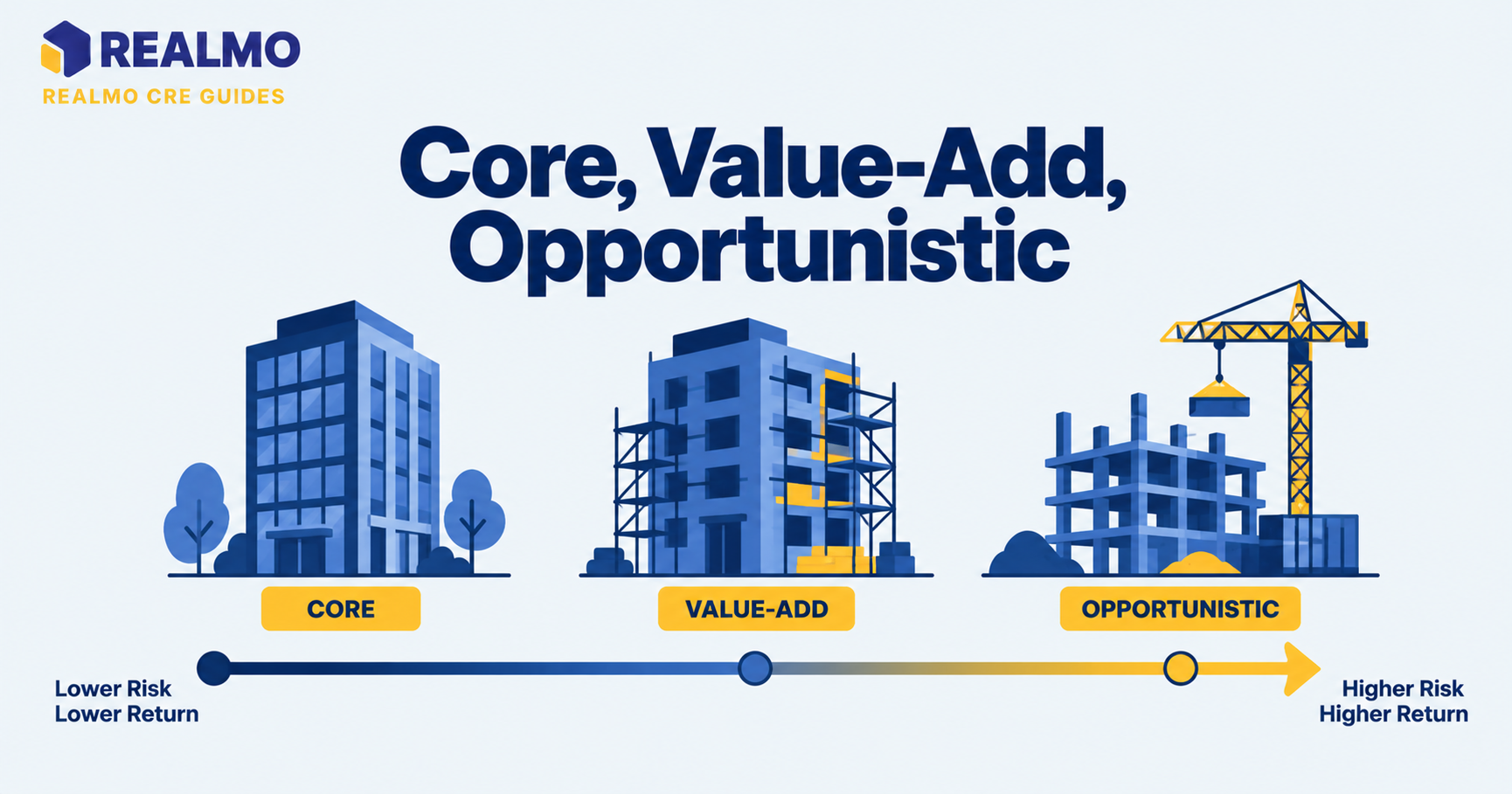
Core, value-add, and opportunistic are the three standard risk labels for commercial real estate equity investments. Core buys stabilized, well-leased assets and earns most of its return from current income. Value-add real estate buys a fixable problem and earns return by raising net operating income. Opportunistic takes development, entitlement, or distress risk with little income at entry.
Why the Label Changes How You Underwrite
An investor comparing two suburban industrial buildings priced at the same going-in yield is not comparing two similar deals. One is 95% leased to three tenants with seven years of weighted average lease term remaining. The other is 55% leased with two leases rolling next year and a roof at the end of its life. The first pays you from day one and asks you to be right about credit and market rent at renewal. The second asks you to fund capital, sign leases, and survive a period with negative cash flow before it produces anything.
The label tells you which mistakes will hurt you. Core deals are wrecked by pricing errors and rate movement. Value-add deals are wrecked by construction budgets and lease-up timing. Opportunistic deals are wrecked by entitlement delays and by running out of capital before the asset produces income. Underwriting, financing structure, and reserve sizing all follow from that distinction.
What the Core-to-Opportunistic Spectrum Measures
The spectrum measures how much of your return depends on future events you have to make happen, versus events that are already contracted. A fully leased asset has most of its next five years of income written into signed leases. A vacant building has none of it.
Three variables move together along the spectrum. The share of return that comes from income versus sale proceeds, the amount of capital you must inject after closing, and the number of decisions between purchase and stabilization. Core sits at one end with contracted income and minimal capital needs. Opportunistic sits at the other, where the asset may generate nothing for years. Everything in between is graded by how much execution stands between the purchase price and the stabilized net operating income.
These labels are conventions, not definitions with legal force. Two sponsors can classify the same deal differently, which is why the fund documents matter more than the marketing category.
What Counts as a Core Asset
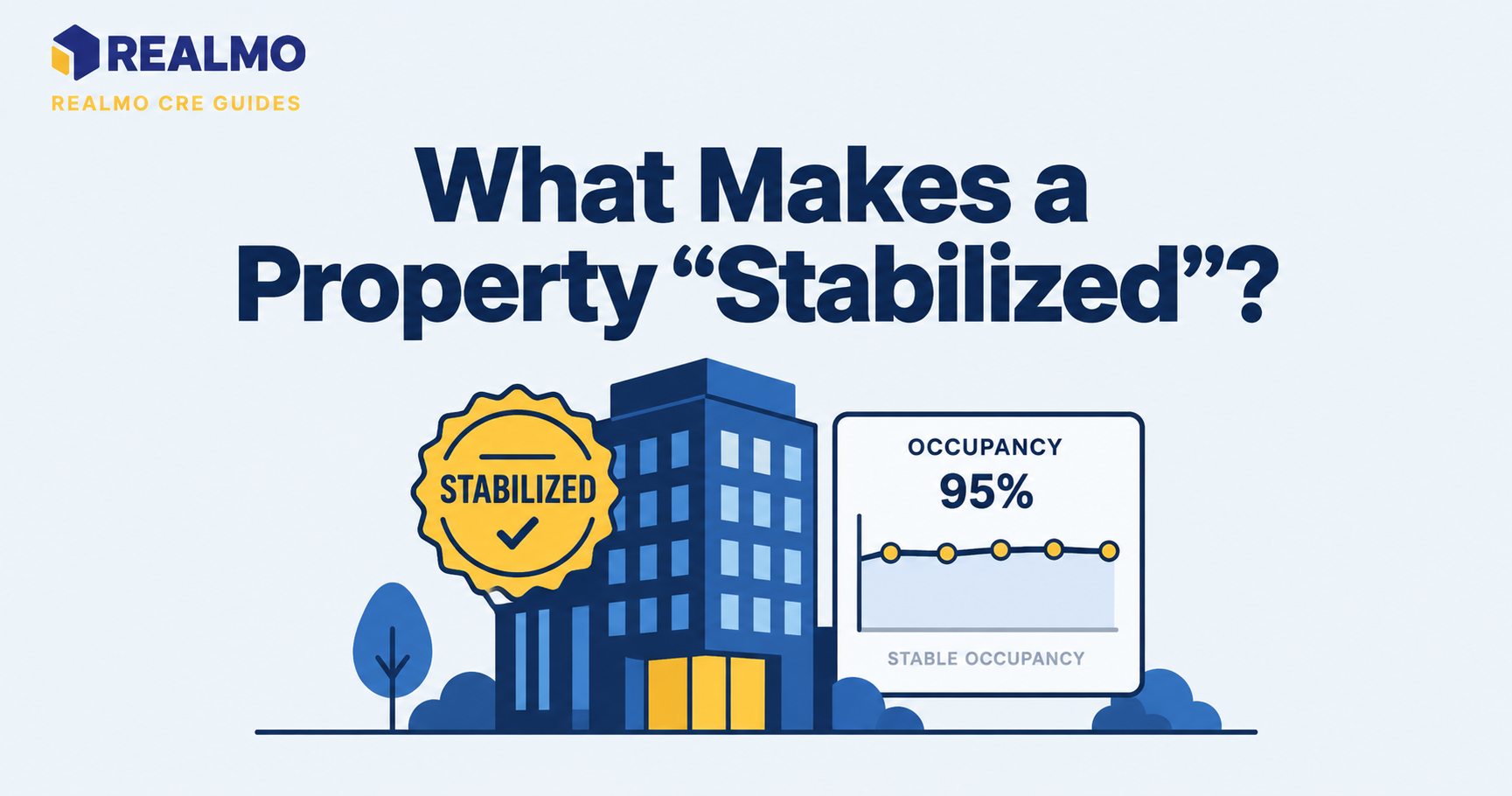
Core assets are stabilized, institutional-quality buildings in established submarkets with high occupancy, creditworthy tenants, and long remaining lease term. Physical condition is current: no deferred roof, structure, or systems work waiting on the buyer.
Return comes mostly from distributed cash flow, and the exit is a normal-course sale rather than a required event. Because the income stream is contracted and predictable, core pricing behaves somewhat like a bond , values are sensitive to interest rate movement and to the credit quality of the rent roll, and the cap rate is the dominant pricing variable. Core buyers use conservative leverage, frequently in the 40% to 55% loan-to-value range typical of institutional practice, because they are not relying on debt to manufacture returns.
The risk that gets underestimated in core is renewal risk. A single-tenant asset with a strong credit, and four years of term remaining is stable until year four, at which point the entire income stream is up for negotiation.
What Value-Add Real Estate Actually Requires
Value-add real estate is the purchase of an asset with an identifiable, fixable gap between current NOI and achievable NOI. The gap has a cause you can name. Below-market rents on legacy leases, vacancy the prior owner did not lease, deferred maintenance suppressing rent. Expense line items running above market, or a use that no longer fits the location.
The strategy only works if the fix is specific and priced. “Rents are below market” is a thesis; “eight of fourteen suites are 15% under market on leases expiring within 30 months, and re-tenanting each costs a broker commission plus a tenant improvement allowance” is an underwriting. The second version can be modeled, funded, and tested.
Value-add deals carry a capital plan, and usually a bridge loan with an interest reserve, since the asset frequently cannot cover debt service during the work. Leverage runs higher than core, commonly 60% to 75% of total cost in standard practice, and the loan matures on a schedule that assumes stabilization happens roughly on time. When leasing runs long, the refinancing date arrives before the income does, which is the most common way these deals fail.
Screening for candidates is a data problem before it is a deal problem. Ownership records, current versus suggested use, and building-level attributes across a market let you build a list of assets where the gap plausibly exists. Realmo’s property analytics cover that first pass across 9M+ properties, before you spend time on tours.
What Makes a Deal Opportunistic
Opportunistic deals start with little or no in-place income and require the investor to create the asset or its usability. Ground-up development, adaptive reuse, land entitlement, recapitalization of a troubled ownership structure, and acquisition of loans on defaulted collateral all sit here.
The distinguishing risk is that failure modes are not gradual. An entitlement can be denied outright. A construction budget can be broken by a single trade. A capital stack with a mezzanine piece can transfer the equity entirely on a default. Returns are concentrated in the exit, so the timing of that exit dominates the internal rate of return, and the promote structure in the equity waterfall is usually built around it.
Opportunistic investors are underwriting a business plan and a sponsor, not a property. The quality of the general contractor, the sponsor’s track record with the specific product type, and the depth of the guarantee behind the loan carry more weight than the going-in yield.
Where Core-Plus and Debt Strategies Sit
Core-plus describes stabilized assets with one identifiable weakness. A shorter weighted average lease term, a secondary location, one tenant below investment grade, or a moderate capital item due. It expects most of its return from income, with a smaller increment from a modest improvement.
Real estate debt strategies are graded on the same spectrum. Senior mortgage lending on a stabilized asset behaves like core; mezzanine debt, and preferred equity behind a value-add business plan behave like value-add, because repayment depends on that plan working. A whole-loan purchase at a discount from a lender exiting a position is closer to opportunistic. What matters is the position in the capital stack and how much execution has to occur before you are repaid.
How Leverage and Hold Period Move the Label
Debt does not change an asset, but it changes the risk of the investment. A stabilized asset financed at 80% loan-to-value with a floating rate, and a short maturity carries a return profile that looks nothing like core. This is because a modest decline in NOI or a covenant test on the debt service coverage ratio can wipe out the equity.
Hold period works the same way. Compressing a value-add business plan into a two-year hold makes execution timing the dominant variable. Extending it to seven allows a leasing setback to be absorbed by later income. When you evaluate an offering, read the leverage, the loan maturity, and the intended hold before you accept the strategy label on the cover.
Worked Example: Pricing a Value-Add Reposition
All figures are illustrative and rounded for demonstration.
An investor buys a 40,000-square-foot flex building for $6,000,000. In-place NOI is $330,000, a 5.5% going-in yield, thin, because the building is 65% occupied, and rents on the legacy leases are below what comparable renovated space achieves.
The capital plan is $900,000 over 24 months: roof and HVAC replacement, a demising wall to split one large vacant suite, plus leasing costs. Total basis becomes $6,900,000. Stabilized NOI, after leasing the vacancy and marking expiring suites to market rent, is projected at $600,000.
Yield on cost is $600,000 ÷ $6,900,000 = 8.70%. If the stabilized asset is valued at a 7.00% cap rate, it is worth $8,571,000. Roughly $1,670,000 above basis before financing costs, closing costs, and taxes.
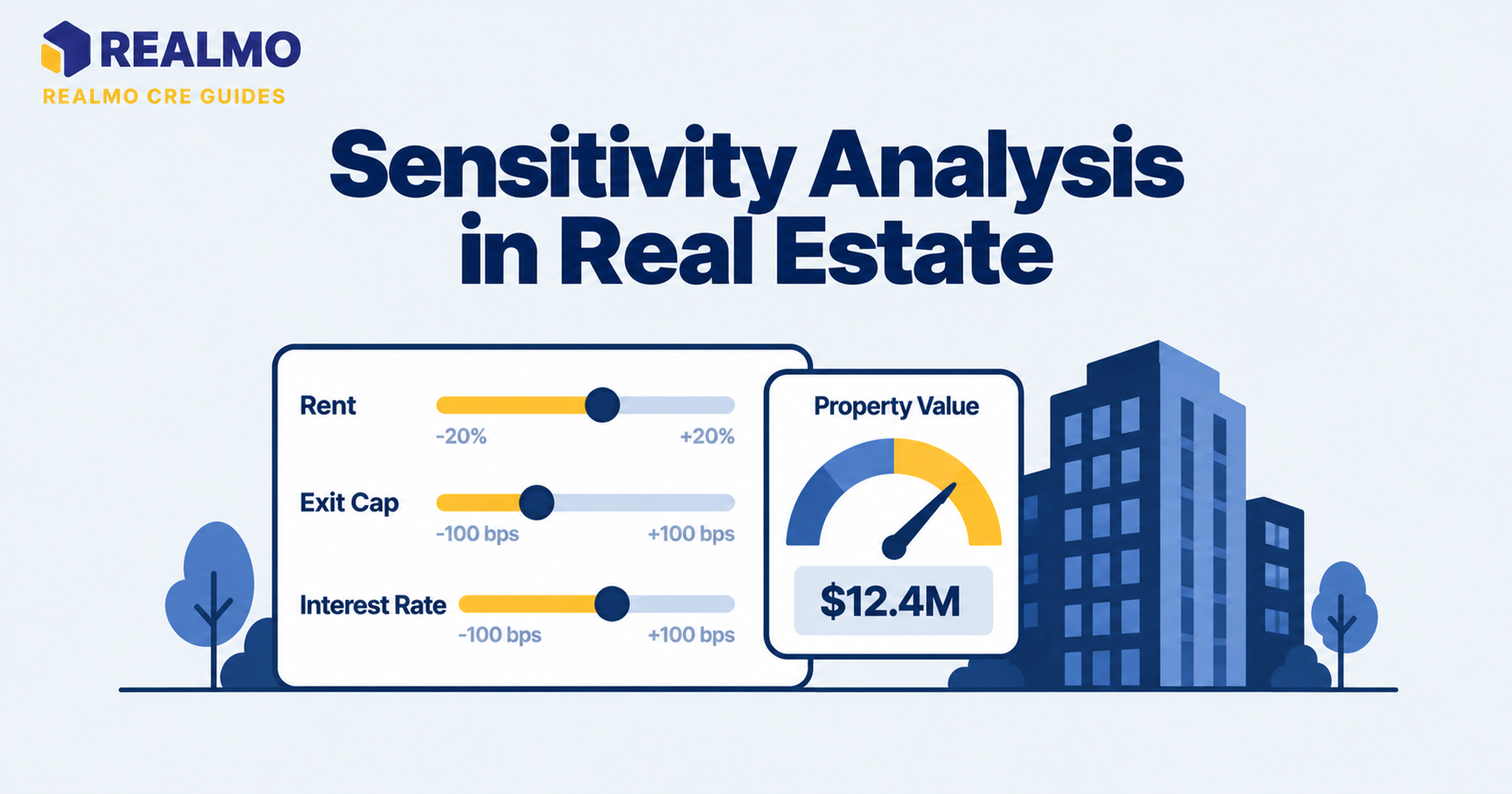
Interpretation: the entire profit sits in the 170-basis-point spread between yield on cost and exit cap rate, not in the current income. If the exit cap rate ends up at 8.70%, the deal returns basis and nothing else. The common error is assuming the exit cap equals the going-in cap. An older building sold with new leases can price tighter, wider, or the same, and that assumption deserves a sensitivity table rather than a single number.
Common Mistakes Investors Make With These Labels
- Treating the sponsor’s label as an underwriting fact. A deal marketed as core-plus with 75% floating-rate leverage and an 18-month lease-up behaves like value-add, and will be priced by lenders that way when you refinance.
- Underwriting the fix without underwriting the downtime. Rent lost between the old tenant leaving and the new one paying is larger than the construction budget, and it lands before the loan matures.
- Using one return target across strategies. Requiring the same yield from a stabilized net-leased asset and a vacant reposition means you will systematically overpay for one and pass on the other.
- Ignoring reserve sizing. Value-add and opportunistic deals fail on liquidity more than on thesis. A capital plan with no contingency turns a normal overrun into a capital call.
- Assuming market rent is achievable rent. Comparable rents come from buildings with specific finishes, loading, and parking ratios. If the subject cannot match them after the capital plan, the entire NOI lift is theoretical.
Related Terms
- Cap rate
- Net operating income (NOI)
- Yield on cost
- IRR vs. equity multiple
- Bridge loan
- Equity waterfall and promote
- Debt service coverage ratio
- Weighted average lease term (WALT)
FAQ
Is value-add real estate riskier than core?
Yes. Value-add returns depend on events that have not happened yet, construction completing on budget, space leasing on schedule, rents reaching underwritten levels. Core returns depend mostly on contracted leases already in place. Value-add also carries higher leverage and shorter loan maturities, which compresses the margin for delay.
What is the difference between value-add and opportunistic?
Value-add starts with an operating asset producing some income and improves it. Opportunistic starts with no income at all, raw land, a vacant building, an entitlement, or a defaulted loan, and must create a functioning asset before income exists. The practical marker is whether the property can service debt at closing.
Can a fully leased building still be a value-add deal?
Yes, if the income is below what the asset could produce. Legacy leases well under market, expenses recoverable, but not being billed, or a rent roll that could support higher rates after a repositioning all create the gap, even at full occupancy.
What returns do these strategies target?
Targets vary with capital costs and market conditions, so no fixed numbers hold over time. The stable relationship is ordering: opportunistic targets the highest return, value-add sits below it, core-plus below that, and core lowest, with the spread between them widening when financing is expensive and execution risk is priced more heavily.
Who decides which label a deal gets?
The sponsor or manager, using industry convention rather than a regulated standard. Read the leverage, loan term, capital plan, and projected hold period in the offering documents. Those determine the actual risk profile regardless of the category on the cover page.