Defining a Stabilized Property
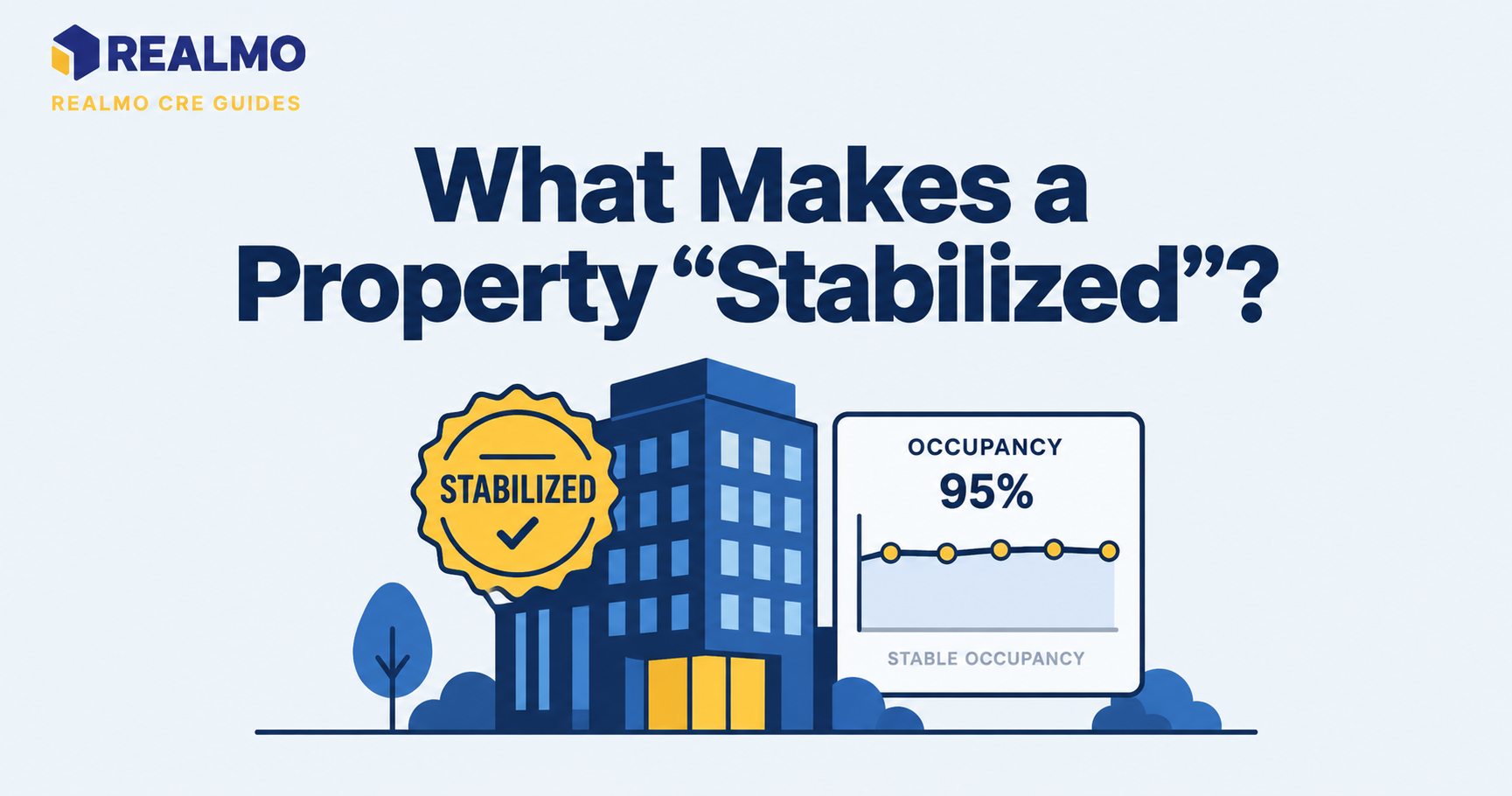
A stabilized property is an income property. It has reached and held the occupancy, rent levels, and expense profile a lender or buyer treats as normal for its type and submarket. An unstabilized property has not (because of vacancy, lease-up, renovation, or below-market rents) so its current income misstates what the asset can produce.
Why the Label Changes Your Whole Underwriting
The distinction decides which income stream you are allowed to price. Say you are looking at two 50,000-square-foot flex buildings a mile apart, both asking the same number. One is fully leased to three tenants on multi-year terms with staggered expirations. The other is 60% leased, with the vacant suites unfinished and no leasing broker engaged.
For the first, in-place net operating income and stabilized NOI are close to the same figure. A cap rate on today’s income is a defensible way to value it. For the second, applying that same cap rate to today’s income produces a number that has nothing to do with what you should pay. You have to underwrite the cost and time to fill the vacancy, then price the income that exists on the other side of that work. Investors who skip this step do not buy a cheap building. They buy a lease-up project without budgeting for it.
What Qualifies as a Stabilized Property
There is no single industry definition, which is the first thing to understand. Stabilization is a threshold set by the party using the term. That party may be a lender, appraiser, or sponsor. Each can set it differently for the same building.
Three tests show up in most versions. Occupancy has reached a level consistent with comparable properties in the submarket. It has stayed there for several consecutive months, not just one snapshot. Rents are at market rather than at concession-driven or legacy levels. Operating expenses reflect steady-state ownership, not the elevated leasing, marketing, and capital spend of a lease-up.
Definitions in loan documents are usually the most explicit, because a debt yield or debt service coverage ratio test attaches to them. Read those definitions rather than assuming a standard.
Why Property Type Moves the Stabilization Bar
Stabilized occupancy is not a fixed percentage across the market. It is whatever the property type and location sustain over a cycle.
Multi-tenant office and small-bay industrial have structural vacancy from normal tenant turnover. Full occupancy is not the benchmark. The benchmark is the submarket level through normal churn. Single-tenant net lease buildings are binary: occupied or not. Self storage and multifamily reach stabilization through unit-by-unit absorption and are measured on both physical and economic occupancy. This is because a heavily concessioned rent roll can look full while producing lease-up income.
Duration matters as much as level. A building that hit target occupancy last month on one large lease is less stabilized. A building holding the same level for a year across five tenants is more stabilized.
Stabilized NOI vs. In-Place NOI
In-place NOI is what the property produces under signed leases today. Stabilized NOI is what it produces once the stabilization assumptions are met. The gap between them is the entire value-add thesis, and it is where underwriting errors concentrate.
Stabilized NOI is a projection, not a fact. It rests on assumed lease-up pace, assumed market rent, assumed tenant improvement and leasing commission costs, and assumed expense recoveries. Each assumption compounds. Sellers of unstabilized assets market on stabilized NOI while pricing at a stabilized cap rate. This asks the buyer to pay today for work the buyer has not yet done and risk the buyer has not yet taken.
The clean way to test the spread is yield on cost: stabilized NOI divided by total capitalized basis, including everything spent to get there.
Worked Example: Pricing a 60% Leased Building
Illustrative figures only, chosen for round math.
Take a 50,000-square-foot multi-tenant industrial building at a $6,000,000 purchase price, 60% leased at $9.00 per square foot on NNN terms. Leased space produces 30,000 × $9.00 = $270,000. The owner absorbs operating costs on the 20,000 vacant square feet at $3.50 per square foot, or $70,000. In-place NOI is $200,000, a 3.3% return on price.
Assume the submarket supports 92% occupancy and the same $9.00 rent. At stabilization, 46,000 × $9.00 = $414,000, less $14,000 of unrecovered expense on the remaining vacancy, gives $400,000 of stabilized NOI. Getting there costs money: 16,000 square feet of new leasing at $25.00 per square foot of TI and commissions is $400,000. Roughly a year of carry on the vacant space adds about $100,000. Total basis becomes $6,500,000, and yield on cost is $400,000 ÷ $6,500,000 = 6.2%.
Interpret it as a spread, not a return. Compare that 6.2% against what a genuinely stabilized building of the same type and quality trades at in the same submarket. If the spread is thin, you are absorbing lease-up risk for free. The common error here is arithmetic honesty about time: pushing stabilization from twelve months to twenty-four does not just delay the income. It adds carry to the basis and drops yield on cost twice over.
How Lenders Treat Unstabilized Collateral
Debt reprices with the label. Permanent lenders size loans from in-place income and coverage tests. Unstabilized buildings fail those tests by definition. Financing therefore shifts to shorter, floating bridge or transitional debt with holdbacks funded as leases sign.
That structure has a second effect. Loan-to-cost replaces loan-to-value as the sizing constraint, and the borrower carries an interest reserve rather than paying debt service from operations. Refinancing into permanent debt usually requires meeting a written stabilization test. Missing that test by a quarter can cost more than missing a rent target. It exposes the loan to the rate environment at maturity.
Before setting a stabilization assumption, check occupancy, ownership, and tenancy across comparable buildings. Realmo’s property analytics cover ownership records and current use for more than nine million properties.
Common Mistakes When Judging Stabilization
- Using a single-month occupancy snapshot. A building at target occupancy for thirty days with three leases expiring next year is not stabilized. A lender’s sustained-occupancy test will show that at refinance.
- Confusing physical and economic occupancy. Free rent, stepped concessions, and unrecovered expenses mean a fully leased building can produce lease-up-level cash flow for another year.
- Ignoring rollover behind the stabilization date. If half the rent roll expires within eighteen months of your target, you have bought a second lease-up you did not underwrite.
- Paying a stabilized cap rate for unstabilized income. This hands the seller the value created by work you still have to fund, and it usually surfaces only when the exit is priced.
- Assuming the market’s stabilized occupancy applies to your building. Ceiling height, column spacing, parking ratio, or suite size can put a specific asset structurally below its submarket average.
FAQ
What occupancy percentage counts as stabilized?
There is no universal figure. Stabilization depends on what comparable properties of the same type sustain in the same submarket. Lenders also require occupancy to hold for several consecutive months. Check the specific definition written into the loan agreement or appraisal rather than applying a rule of thumb.
Is a fully leased building always stabilized?
No. A building can be 100% physically occupied while still in lease-up economically. This applies if tenants are in free-rent periods, rents sit below market, or leasing costs are still being amortized. Stabilization tests income quality and durability, not just whether the space is spoken for.
How is stabilized different from core or value-add?
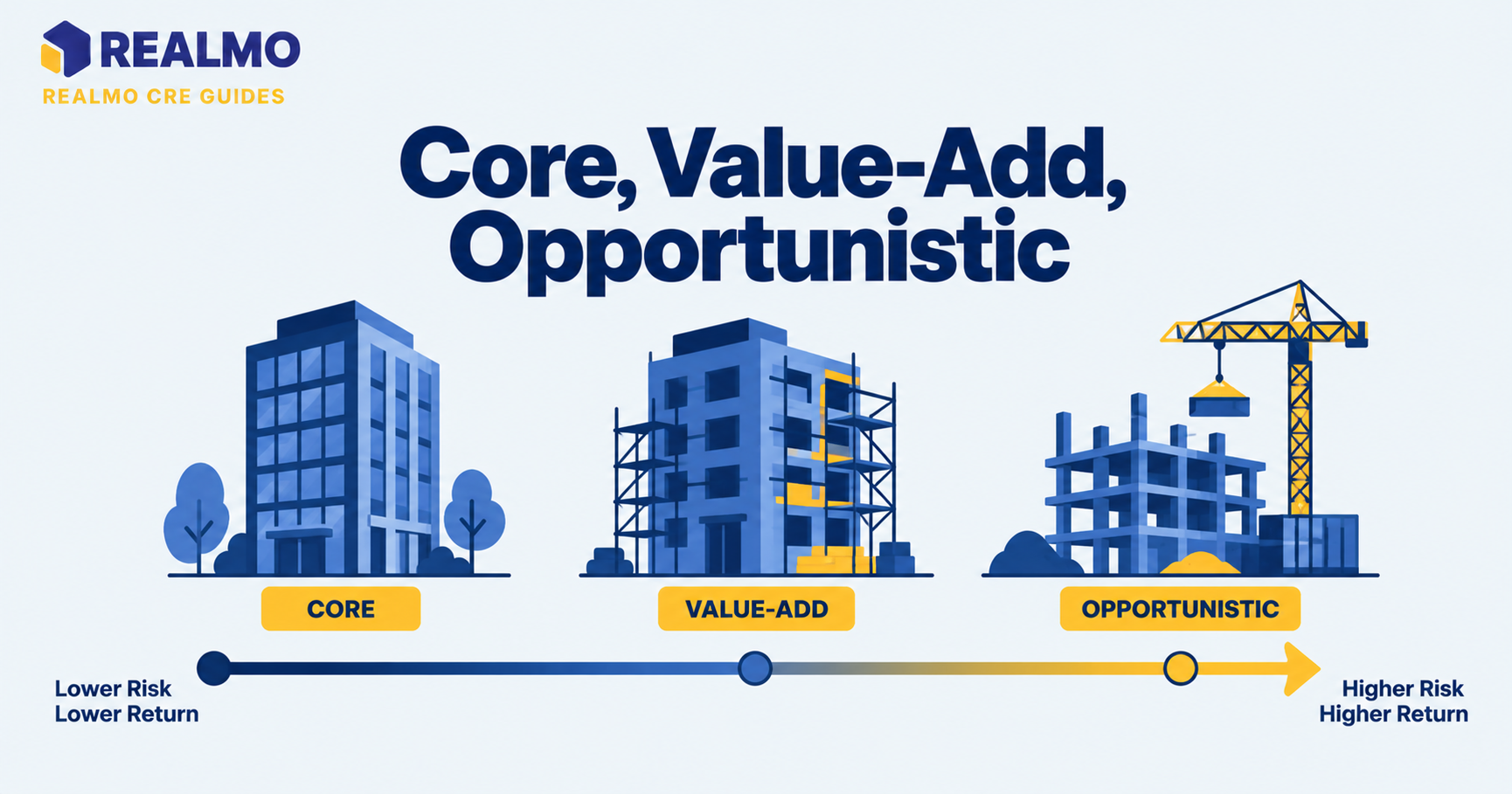
Stabilized describes the property’s operating condition. Core and value-add describe investment strategies. Most core acquisitions are stabilized properties, and most value-add deals start unstabilized. The terms are not interchangeable. A stabilized building with below-market rents can still be a value-add opportunity.
Can a stabilized property become unstabilized?
Yes, and this is a real risk in single-tenant and small multi-tenant assets. A major tenant departure, a casualty event, or a repositioning decision can drop a property back below its stabilization threshold. This can also trip covenants on permanent debt tied to occupancy or coverage tests.
Related Terms
Net operating income · Cap rate · Yield on cost · Economic vs. physical occupancy · Tenant improvement allowance · Bridge loan · Value-add investment strategy