How a Commercial Real Estate Deal Works, Start to Finish
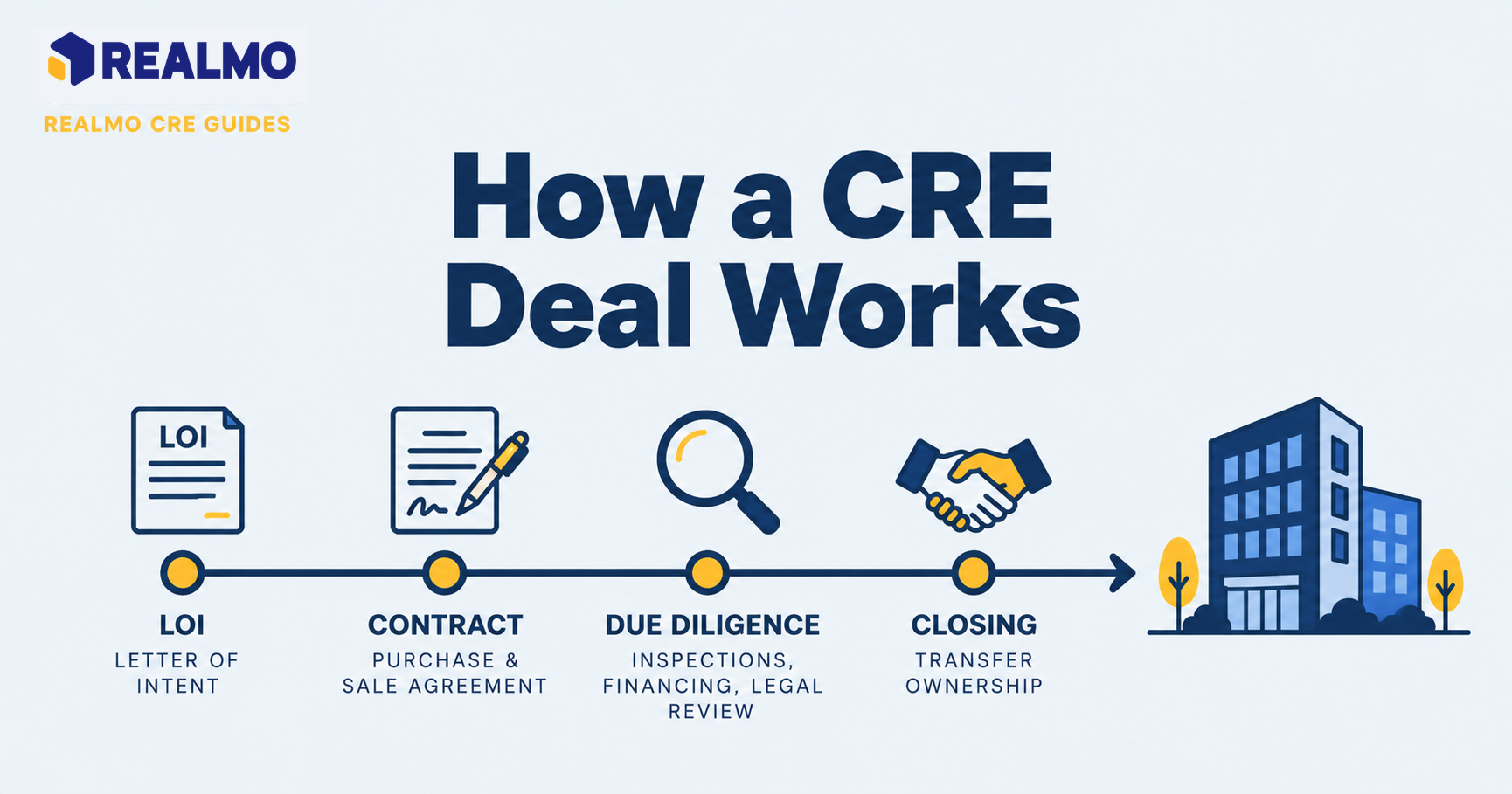
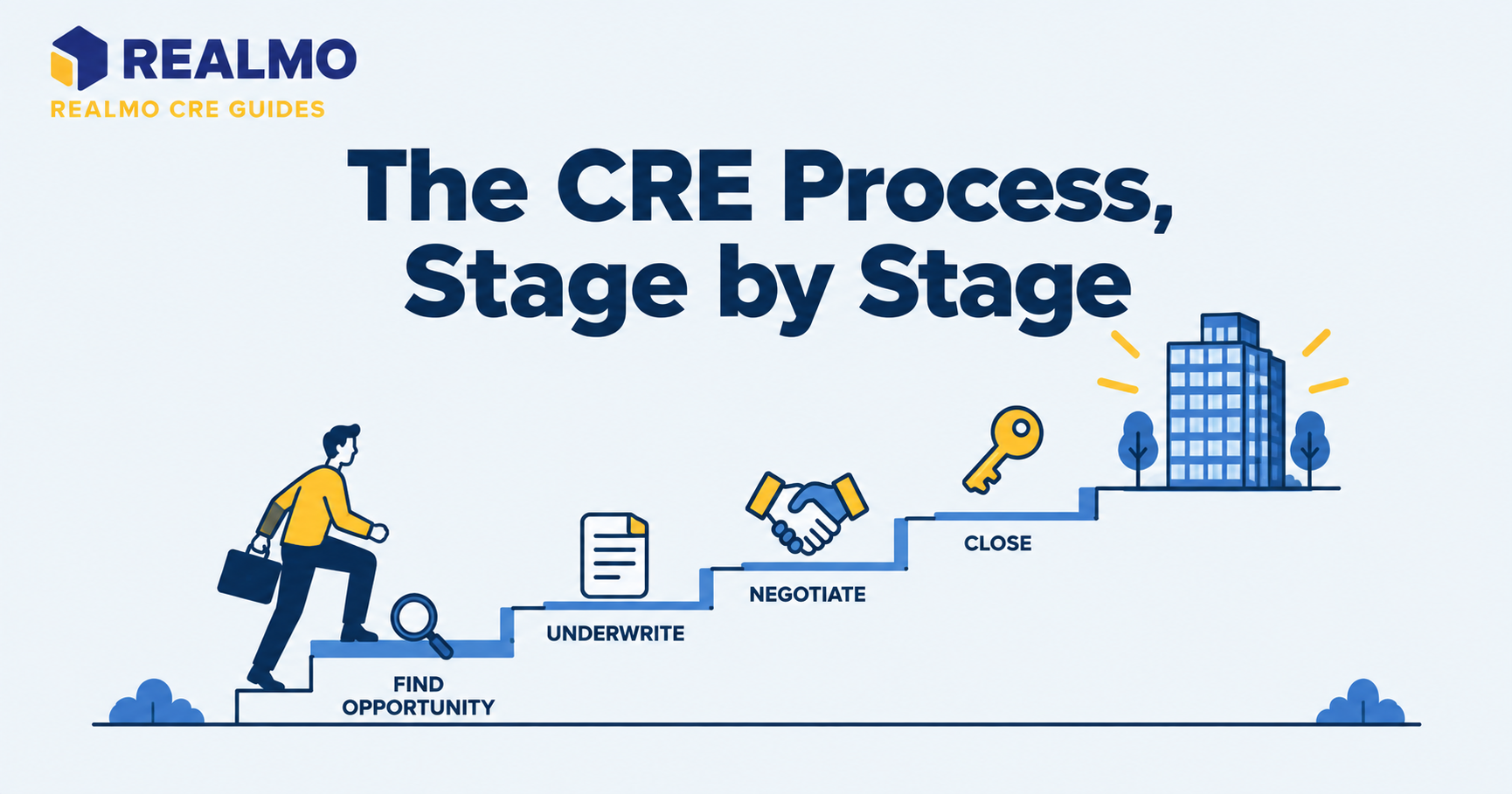
A commercial real estate deal moves through eight stages: sourcing, screening, letter of intent, purchase contract, due diligence, financing, closing, and takeover. The commercial real estate process usually runs 60 to 120 days from signed LOI to funding. The buyer’s negotiating power over price drops sharply once the due diligence period expires.
Why the Order of Steps Protects Your Deposit
Picture a first-time buyer under contract on a 12,000-square-foot multi-tenant retail strip. The seller’s broker pushes for a 21-day due diligence period with the deposit going hard on day one. The buyer agrees, and orders the Phase I environmental site assessment in week two. In week three, the buyer learns that a dry cleaner once operated in the end cap. The report recommends further testing. The deposit is already non-refundable, and the lender will not fund against an open environmental finding. The buyer chooses between forfeiting cash and buying a liability.
Nothing in that sequence was unusual. The failure was ordering the report after the deposit went hard instead of before. Every stage of a CRE deal exists to move one specific risk off the buyer’s balance sheet while the money is still recoverable.
The Commercial Real Estate Process in Eight Stages
The commercial real estate process is a sequence of decision gates, not a checklist. Each gate asks the same question in a different form: do I know enough to spend the next, larger amount of money?
Sourcing. Deals reach you through broker relationships, marketed listings, direct owner outreach, or data-driven targeting. Volume matters here because most opportunities die at screening.
Screening. A first-pass filter on price, income, tenancy, location, and financing feasibility. Should take under an hour per deal.
Letter of intent. A short, mostly non-binding document that fixes price, deposit, timelines, and major conditions before lawyers get involved.
Purchase and sale agreement. The binding contract. This is where the deposit, contingency structure, representations, and default remedies become enforceable.
Due diligence. Physical, financial, and legal verification of everything the seller claimed. The deposit stays refundable during part or all of this window, if the contract says so.
Financing. Runs parallel to due diligence, not after it. The lender orders its own appraisal, property condition assessment, and environmental review.
Closing. Title clears, funds move through escrow, the deed records, and prorations settle.
Takeover. Tenant notification letters, rent redirection, vendor contracts, insurance binding, and the first month of actual operations.
Stages three through seven are where a deal is won or lost. Stages one and two determine how many chances you get.
Who Sits at the Table and What Each Party Does
A single asset purchase pulls in eight to twelve professionals, and the buyer pays most of them.
The listing broker represents the seller and controls the flow of information. Assume every document received from that broker is accurate in what it says and incomplete in what it omits. A buyer’s broker works your side of the table, though in many transactions the buyer is unrepresented and negotiates directly.
The lender is the second underwriter on your deal, and tends to be the more conservative one. Lender approval depends on the borrower’s balance sheet and experience, not only on the property. The appraiser, engaged by the lender rather than by you, produces a valuation governed by USPAP (the Uniform Standards of Professional Appraisal Practice) that constrains loan proceeds regardless of what you agreed to pay.
The title company or escrow agent holds the deposit, researches ownership history, issues the title commitment, and disburses funds at closing. The real estate attorney drafts and negotiates the purchase agreement and reviews leases, easements, and survey exceptions. In some states an attorney is required at closing; in others the title company handles it.
Technical consultants enter during due diligence: a property condition assessment engineer, an environmental consultant for the Phase I, and a surveyor for the ALTA/NSPS survey. Sometimes a zoning consultant or roof specialist joins them too.
The property manager should be selected before closing, not after. Whoever manages the asset needs lease abstracts, tenant contact information, and vendor contracts in hand on day one.
Sourcing and Screening: From Teaser to Signed LOI
Marketed deals arrive as a one-page teaser, followed by an offering memorandum once you sign a confidentiality agreement. The OM is a sales document. Treat the rent roll and trailing twelve-month operating statement inside it as the only pages worth reading closely. Expect the narrative sections to present the most favorable version of the story.
Off-market sourcing works differently. You identify a property type and submarket, build a target list, verify who actually owns the entity on title, and approach owners directly. Ownership research separates a serious inquiry from a mailing campaign. The record owner is commonly an LLC whose principals are not obvious from the deed alone. Realmo’s property analytics cover ownership records, valuation estimates, and current-versus-suggested-use data across 9M+ U.S. properties. That lets you screen a target before spending broker time on it.
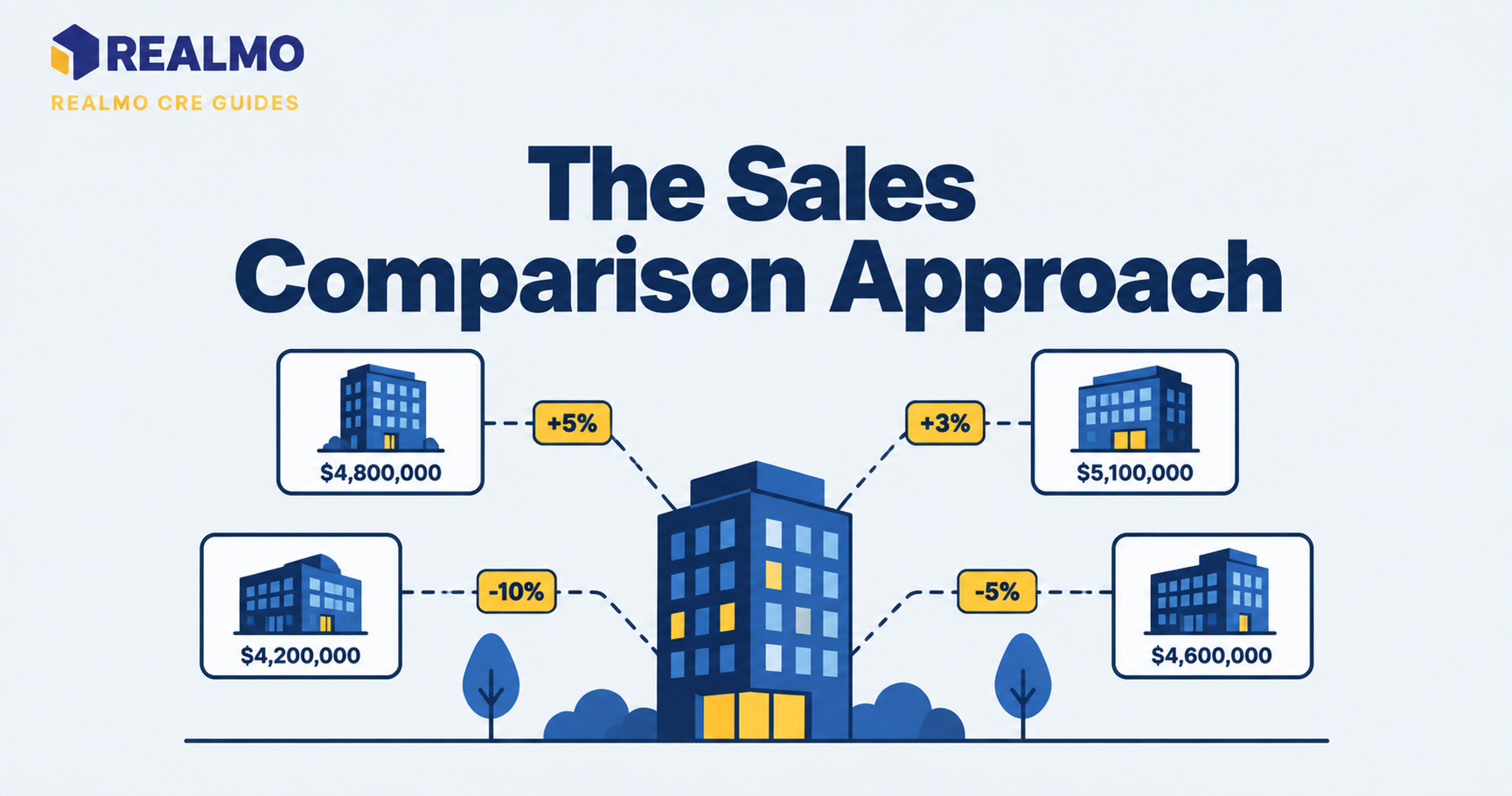
Screening should kill most deals fast. Three questions do the work. The first: does in-place income support the asking price relative to what comparable assets have recently traded for in the same submarket. The second: can a lender size a loan against this income stream. The third: is there a plausible reason this asset is available at this price. Comparable pricing has to come from closed sales of the same property type, vintage, and tenancy nearby. Asset-class averages will mislead you on any individual building. Remaining lease term, tenant credit, and location quality move cap rates more than the property-type label does.
The letter of intent converts interest into terms. A useful LOI fixes purchase price, deposit amount and timing, and the length of the due diligence and closing periods. It also spells out what the seller must deliver and by when, the financing contingency language, and who pays which closing costs. Most LOI provisions are non-binding by design, with confidentiality and exclusivity as the usual exceptions. Read your own LOI for the phrase that makes any provision binding before you sign.
The single most valuable LOI term for a buyer is a due diligence clock that starts when the seller delivers a complete document package. Not when the contract is signed. Sellers deliver late. Without that language, delay eats your inspection window.
Underwriting the Rent Roll, T-12, and Debt Terms
Underwriting reconstructs the property’s income from primary documents rather than accepting the seller’s summary.
Rebuilding NOI from the source documents
Start with the rent roll and check it against the actual leases. Verify base rent, escalations, expiration dates, renewal options, termination rights, and reimbursement structure for every tenant that matters. A rent roll that shows $32 per square foot means little on its own. It means less if the lease shows a free-rent period or a below-market renewal option that the buyer inherits.
Then rebuild operating expenses. Property taxes are the line most commonly understated, because many jurisdictions reassess on transfer and the seller’s historical tax bill reflects an older basis. Insurance is the second, since quoted premiums for a new owner can differ substantially from the seller’s legacy policy. Add a management fee even if the seller self-manages, and add a replacement reserve even if the seller never funded one. The result is a defensible net operating income, which drives both value and loan sizing.
Sizing debt before you commit
Lenders constrain proceeds by two tests and lend the lesser. One is a loan-to-value cap against the appraised value; the other, a debt service coverage ratio floor against underwritten NOI. Which test binds is a function of the spread between the property’s yield and the cost of debt. When debt is cheap relative to the cap rate, LTV caps proceeds. As borrowing costs rise toward the cap rate, coverage binds first, and the loan shrinks even though the price never moved.
The caps and floors themselves vary by lender type and asset class. Banks, life companies, agency lenders, and commercial mortgage-backed securities (CMBS) shops underwrite the same building differently. Every lender applies tighter terms to hospitality and single-purpose assets than to stabilized multi-tenant industrial. Get both numbers in writing at term sheet stage and re-run your model against theirs rather than against a rule of thumb.
Interest rate quotes early in a deal are indications, not commitments. The rate locks at a defined point in the loan process. A rate that moves between term sheet and lock changes both proceeds and cash flow. Model the deal at a rate above the quote and confirm it still clears the DSCR floor.
Going-in cap rate, cash-on-cash return, and debt yield each answer a different question. Cap rate measures price against unlevered income. Cash-on-cash measures annual pre-tax cash flow against equity invested. Debt yield, calculated as NOI divided by loan amount, is the metric a lender uses to test downside.
Due Diligence: Physical, Financial, and Legal
Due diligence is the only period in which the buyer can walk away and recover the deposit, assuming the contract preserves that right. Everything ordered during this window should be ordered in the first week.
Physical inspection
A property condition assessment covers structure, roof, mechanical systems, parking, and accessibility under the Americans with Disabilities Act (ADA). It produces a schedule of immediate repairs and expected capital needs over a defined horizon. Roof, HVAC, and parking lot condition drive most retrade negotiations, because each carries a large, near-term dollar figure.
The Phase I environmental site assessment, conducted under ASTM E1527, reviews historical use, regulatory databases, and site conditions to identify recognized environmental conditions. It is a records-and-observation review, not testing. A finding triggers a Phase II with soil or groundwater sampling, which adds time and cost and can end a deal. Order the Phase I first, since lenders require it and its findings can make everything else irrelevant.
Financial verification
Estoppel certificates are signed statements from tenants confirming their lease terms, rent, deposit held, and the absence of landlord defaults. They matter because a tenant’s version of the lease sometimes differs from the seller’s. Most contracts require the seller to obtain estoppels from major tenants as a closing condition.
Bank statements and deposit records verify that the rent shown on the rent roll was actually collected. A tenant listed as current who has paid partially for six months is a credit problem disclosed nowhere in the OM.
Legal and title review
The title commitment lists exceptions: easements, restrictive covenants, encroachments, liens, and prior agreements that run with the land. The ALTA survey maps those exceptions onto the physical site. Reading them together reveals problems that neither document shows alone. One example: an access easement across the parking area that reduces usable spaces below the zoning minimum.
Zoning verification confirms that the current use is permitted rather than legally nonconforming. A legal nonconforming use may not be rebuildable after a casualty, which affects both insurance and exit value.
Financing: From Term Sheet to Clear to Close
Financing runs alongside due diligence. Waiting for inspections to finish before engaging a lender adds weeks a contract usually does not allow.
The sequence starts with a term sheet or application outlining loan amount, rate structure, amortization, term, recourse, prepayment terms, and required reserves. Signing usually requires a good-faith deposit that funds third-party reports. The lender then orders its own appraisal, property condition report, and environmental review, kept separate from anything the buyer commissioned and controlled by the lender.
Underwriting review covers the property, the borrower, and the guarantors. Expect requests for personal financial statements, schedules of real estate owned, tax returns, and an explanation of your experience with this asset type. Credit committee approval produces a commitment letter, which is the first document that binds the lender.
Loan documents follow, then a closing checklist covering entity formation documents, insurance certificates naming the lender, tenant estoppels, and any lender-required repair escrows. “Clear to close” means every condition is satisfied and funds can be wired.
Two structural terms deserve attention before signing. Recourse determines whether your personal assets stand behind the loan; non-recourse loans still carry carve-outs for fraud, waste, and unauthorized transfers. Prepayment structure determines the cost of an early exit. A yield maintenance penalty (preserving the lender’s promised yield) or defeasance (collateral substitution) can make a sale in year three far more expensive than the headline rate suggests. Compare both against your intended hold period and against the loan-to-value you are targeting.
Closing Mechanics and the First 90 Days
Closing is an escrow event. The title company collects the buyer’s equity wire, the lender’s funding, and the loan documents, then records the deed and disburses. The settlement statement allocates prorated rent, security deposits, property taxes, and expenses between seller and buyer as of the closing date. Security deposits transfer as a credit to the buyer, and unpaid tenant balances are commonly handled through a post-closing collection agreement.
Closing cost allocation is negotiated and varies significantly by state and by custom. Transfer taxes, title premium, and survey cost can each land on either side. Confirm local practice before the LOI, not at settlement.
The first 90 days determine whether underwriting holds. Send tenant notification letters with new payment instructions immediately, since misdirected rent in month one is common and creates collection friction. Bind insurance effective at closing, not the following day. Review every vendor contract for assignment and termination provisions. Service agreements that survive closing can lock the new owner into pricing that was never underwritten. Re-verify the tax assessment after transfer, since a reassessment lands in the following cycle and may exceed the number in your model.
Buyers using a 1031 exchange, permitted under Internal Revenue Code Section 1031, face additional timing constraints that begin at the sale of the relinquished property. The structure must be in place before that sale closes. Exchange mechanics, entity structure, and depreciation treatment carry consequences that require review by a licensed tax advisor and attorney for your specific situation.
Worked Example: A Small Retail Deal, Step by Step
All figures below are illustrative. They are round numbers chosen to show the mechanics and do not reflect any specific market, lender, or transaction.
The asset. A four-tenant retail strip, 12,000 square feet, offered at $4,200,000.
Step 1: rebuild income. Base rent totals $384,000 and expense reimbursements add $72,000, for gross potential income of $456,000. Applying a 5% vacancy and credit loss factor removes $22,800, leaving effective gross income of $433,200. Operating expenses, after adding a 4% management fee and a $0.20-per-square-foot replacement reserve the seller never funded, come to $118,200. NOI is $315,000.
Step 2: test the price. A $315,000 NOI on a $4,200,000 price is a 7.5% going-in cap rate. That number is meaningless in isolation. It becomes information only when set against closed sales of comparable strips in the same submarket with similar tenant credit and remaining lease term. That comparison is what tells you whether the seller is asking a market price or a hopeful one.
Step 3: size the debt. At 60% LTV the loan is $2,520,000. At an illustrative 7.00% fixed rate on a 25-year amortization schedule, annual debt service is roughly $213,700. DSCR is 315,000 ÷ 213,700 = 1.47x. Cash flow before taxes is $101,300. With $1,680,000 of equity plus $145,000 in closing costs and reserves, cash-on-cash is 101,300 ÷ 1,825,000 = 5.6%.
Step 4: due diligence changes the math. The property condition assessment gives the roof a remaining useful life shorter than the hold period, with a replacement estimate of $85,000. The buyer requests a credit. The seller agrees to an $85,000 closing credit rather than a price reduction, which keeps the loan amount intact.
Step 5: interpret the result. The credit reduces required equity to $1,740,000, lifting cash-on-cash to 5.8%. Note which test constrained the loan: at 1.47x the deal cleared coverage with room to spare, so proceeds were capped by LTV. Run the same deal at a materially higher rate and the reverse happens. Coverage binds, and the loan shrinks even though the price has not moved.
The common error. Buyers frequently carry the seller’s property tax line forward unchanged. If the jurisdiction reassesses on sale, a tax increase of $18,000 would drop NOI to $297,000. That would push DSCR to 1.39x and cut cash-on-cash by roughly a full point. The change shows up in the first full year of ownership, not on the settlement statement.
Common Mistakes That Cost Buyers Money
Letting the deposit go hard before third-party reports are complete. Environmental and structural findings arrive late in the window. A hard deposit converts a walk-away right into a forced purchase.
Underwriting the seller’s expense history instead of the buyer’s future expenses. Reassessed taxes, a new insurance quote, and a market management fee routinely add several points of expense that never appeared in the T-12.
Accepting the rent roll without reading the leases. Termination options, co-tenancy clauses, below-market renewal options, and unfunded landlord improvement obligations all transfer with the property. None of them appear on a rent roll summary.
Starting the lender process after due diligence. Lender-ordered reports and credit committee review take weeks. A financing contingency that expires before the commitment letter arrives leaves the deposit exposed.
Ignoring prepayment structure because the hold period looks long. Plans change. Yield maintenance or defeasance on an early sale can consume a meaningful share of the equity gain.
Related Terms
- Net operating income (NOI)
- Capitalization rate
- Debt service coverage ratio (DSCR)
- Letter of intent (LOI)
- Phase I environmental site assessment
- Estoppel certificate
- Title commitment
- 1031 exchange
Questions Buyers Ask About the CRE Process
How long does a commercial real estate deal take?
Most transactions run 60 to 120 days from signed LOI to closing, split between a due diligence period and a closing period. Financing complexity is the main variable. An all-cash purchase can close faster, while a loan requiring lender-ordered appraisal, environmental review, and credit committee approval sets the floor on timing.
What is the difference between an LOI and a purchase agreement?
An LOI outlines commercial terms: price, deposit, timelines, contingencies, and it’s mostly non-binding apart from confidentiality and exclusivity clauses. The purchase and sale agreement is the enforceable contract that governs deposit forfeiture, representations, closing conditions, and remedies if either party defaults.
Can you back out of a commercial real estate contract?
Yes, during the due diligence period, if the contract preserves that right. Terminating within the window returns the deposit. After the deposit goes hard, walking away means forfeiting it, unless a specific contingency (financing, say, or an unmet seller closing condition) remains unsatisfied.
Who pays closing costs in a commercial real estate deal?
Allocation is negotiated and varies by state and local custom. Buyers commonly pay lender-related costs, their own inspections, and loan fees; sellers commonly pay commissions and, in many jurisdictions, transfer taxes. Title premium and survey costs are frequently split or assigned by regional practice.