Commercial Real Estate: How It Works
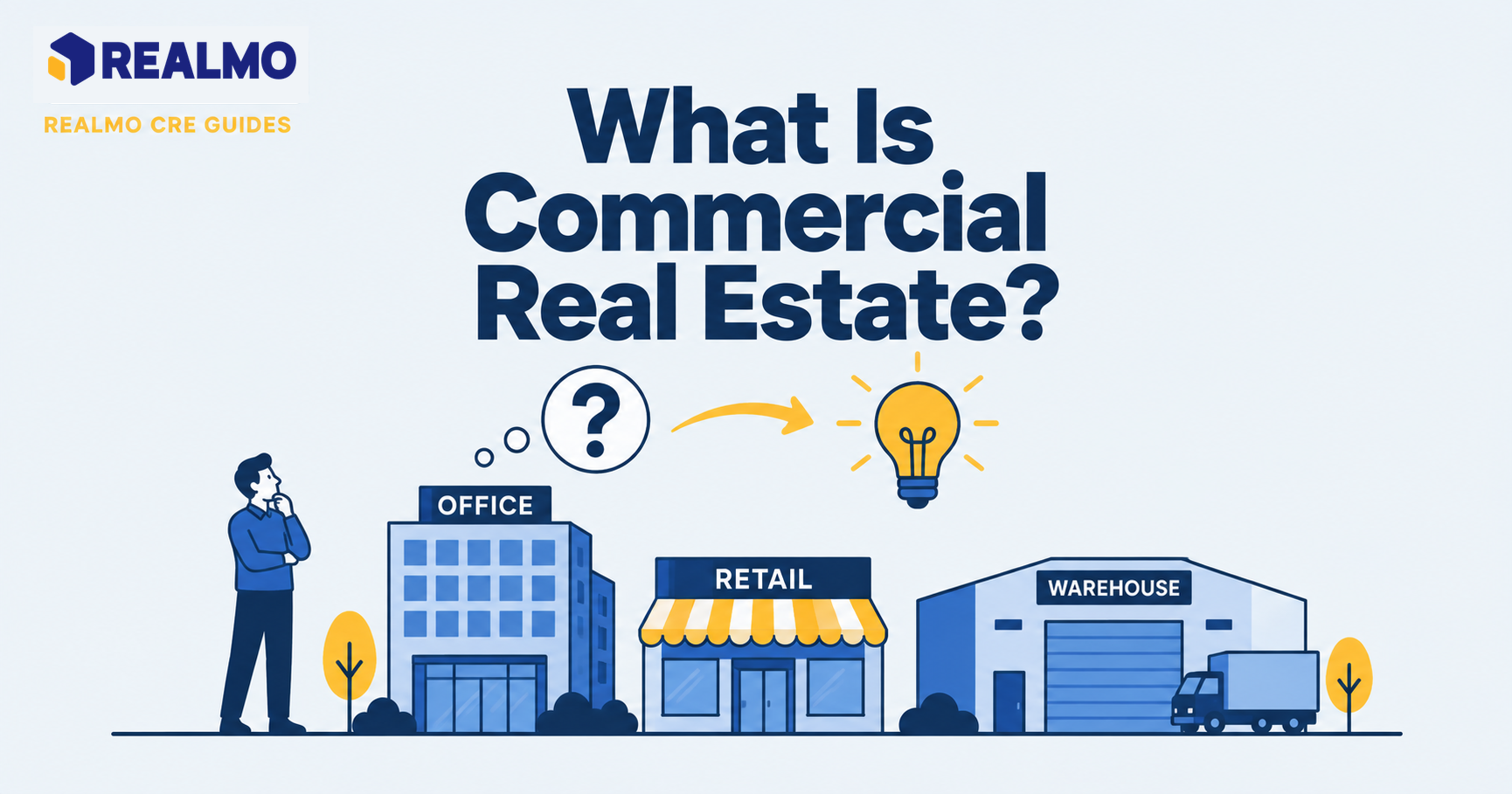
Commercial real estate is property owned to generate income or house business operations, not to shelter its owner. It spans office, industrial, retail, multifamily of five or more units, hotels, and specialty assets. Value follows cash flow. Its worth tracks what the building actually produces, so pricing starts with net operating income rather than with what the neighbors paid.
Why a first CRE deal feels different from stocks
Say you have owned index funds and one rental house, and you are now looking at a six-tenant retail strip. In public markets, the price is handed to you. You either accept it or you don’t. Here you set a price, and the seller sets a different one. The gap closes around a number you both build from a rent roll and twelve months of operating statements.
That number responds to management. A renewal signed above expiring rent, an expense line shifted to the tenants, a dark suite re-leased: each of these raises net operating income. Net operating income divided by the market cap rate is the value. The mechanism runs in reverse when an anchor leaves, when the roof fails, or when a loan matures into a higher-rate market. Ownership is active. The returns follow the work.
How commercial real estate differs from residential
The dividing line is purpose, not size. A duplex bought to rent is residential property held as an investment, while a five-unit apartment building counts as commercial for most lenders and agencies. The classification changes almost everything downstream.
Underwriting changes first. A residential mortgage is sized against your personal income and credit. A commercial mortgage is sized against the property’s cash flow, with your balance sheet and experience as secondary support. Loan terms shorten too: commercial loans amortize over a longer schedule than their actual term. That gap leaves a balloon balance due years before the loan is paid off.
Leases change second. Residential leases run months and follow a state-standard form. Commercial leases run years, are negotiated line by line, and assign operating costs between landlord and tenant in ways that materially change what you net. A building leased on a triple-net basis and an identical building leased on a full-service gross basis look the same on paper. At the same headline rent, the two produce very different owner-level cash flow. That distinction is covered in how commercial lease structures split expenses.
Tax treatment changes third. Nonresidential real property and residential rental property depreciate over different recovery periods under the Modified Accelerated Cost Recovery System (IRS Publication 946). That difference affects after-tax returns even when pre-tax cash flow is identical. Depreciation, entity structure, and holding period interact in ways specific to your situation. Confirm treatment with a licensed CPA or tax attorney before underwriting any tax benefit.
The five core property types and what drives demand
Multifamily. Apartment communities of five units and up. Demand follows household formation, local job growth, and the cost gap between renting and owning. Leases run short, so rents reprice quickly in both directions. The sector also carries the deepest financing market of any property type, backed by Fannie Mae and Freddie Mac, whose multifamily purchases the Federal Housing Finance Agency oversees.
Industrial. Warehouse, distribution, light manufacturing, and flex space. Demand follows goods movement: e-commerce fulfillment, port and rail volumes, trucking access. Buildings are functionally simple. The underwriting question is clear height, dock doors, truck court depth, and power, not finishes.
Retail. From single-tenant net-leased outparcels to grocery-anchored centers and enclosed malls. Demand follows rooftops, traffic counts, and the anchor’s own health. Tenant credit carries more weight here than in any other sector: a fifteen-year lease is only as good as the company signing it.
Office. Central business district and suburban buildings, sold by class. This is the sector where the gap between headline rent and effective rent runs widest. Concessions and tenant improvement allowances are large enough to change deal math entirely.
Hospitality. Hotels, which are operating businesses that happen to own real estate. Revenue reprices nightly, expenses run heavily labor-driven, and performance is measured in occupancy, average daily rate, and RevPAR — calculated as average daily rate multiplied by occupancy — not leases.
Beyond these five sit specialty categories that trade on their own logic: self-storage, medical office, senior housing, data centers, student housing, and land. Each has a distinct demand driver and its own buyer pool. A broker who sells industrial well is not automatically the right broker for a self-storage disposition.
Where returns actually come from in a CRE deal
Four sources, and confusing them is the most common analytical error a new buyer makes.
The first is cash flow: what remains after operating expenses and debt service. It is the only component you can spend while you own the asset, measured against invested equity as cash-on-cash return.
The second is principal amortization. Every debt service payment retires a slice of the loan balance. You do not receive that money until sale or refinance, but it accrues to your equity whether or not the property appreciates.
The third is value change, which has two independent drivers that get blurred together. NOI growth is the one you influence through leasing and expense control. Cap rate movement is the one you do not: it is set by capital markets. A shift in prevailing cap rates moves your value even if the rent roll never changes. Deals underwritten on the assumption that exit cap rates will be tighter than entry cap rates are making a market forecast, not an operating plan.
The fourth is tax treatment: depreciation deductions, cost segregation, interest deductibility, and deferral mechanisms such as a 1031 like-kind exchange, permitted under Internal Revenue Code Section 1031. These affect after-tax outcomes substantially, and they are also the most rule-bound part of the business. Consult a licensed tax professional. The mechanics described here are educational, not advice for your situation.
How NOI and cap rate set a property’s value
Net operating income is gross rental income plus other income, minus vacancy and credit loss, minus operating expenses. Debt service, capital expenditures, depreciation, and income taxes are all excluded. That exclusion is what makes NOI comparable between two buildings with different owners and different loans.
Two line items sit outside industry consensus and get argued in every negotiation. Sellers who self-manage report NOI with no management fee, on the logic that the expense does not exist. Most buyers and every lender add a market fee back, because the next owner will either pay it or absorb the labor. Replacement reserves split the same way: appraisers and lenders deduct them, while brokers’ marketing packages treat them as below-the-line capital. Neither convention is wrong, but the two produce different NOI on identical operations. Establish which one a stated cap rate was built on before comparing it to anything.
The direct capitalization formula is:
Value = NOI ÷ Cap Rate
An illustrative example, using hypothetical figures: a building produces $210,000 of NOI. At a 6.5% cap rate, indicated value is $210,000 ÷ 0.065 = $3,230,769. Hold NOI constant and move the cap rate 50 basis points wider to 7.0%. Value falls to $3,000,000, a $230,769 decline driven entirely by capital markets. Now hold the cap rate at 6.5% and raise NOI by $15,000 through a single renewal, and value rises to $3,461,538. Both levers are real; only one of them is yours.
The formula’s weakness is that it assumes stabilized, sustainable income. A property with near-term rollover, below-market rents, or deferred maintenance will not be priced off a single year’s NOI. That is why buyers move to discounted cash flow and internal rate of return for anything with a business plan attached. Cap rate remains the language of the market; DCF is how the actual bid gets built.
Getting the inputs right is most of the work. Ownership records, estimated value, cap rate context, and current-versus-suggested use are published without a paywall across 9M+ U.S. properties on Realmo. That shortens the first screen before you spend money on third-party reports. Verify anything that reaches your offer against primary documents.
How lenders decide how much they will lend
Three constraints run in parallel, and the loan is sized by whichever binds first.
Loan-to-value caps the loan as a percentage of appraised value. Debt service coverage ratio, calculated as NOI divided by annual debt service, has to clear a cushion the lender sets. Required coverage varies by lender, asset type, and where the cycle sits. Debt yield, NOI divided by loan amount, gives the lender a value-independent view of its position, and has become the binding test in volatile markets.
Term and amortization are separate negotiations. A loan may amortize on a twenty-five- or thirty-year schedule while the term matures far sooner. That gap leaves a balloon payment that must be refinanced or paid off. Refinance risk at that maturity date is the single largest structural risk in a leveraged deal.
Lender type shapes the terms as much as the property does. Banks and credit unions hold loans on balance sheet and require personal recourse on most deals. Life insurance companies favor stabilized, low-leverage assets. Agency lenders serve multifamily. Commercial mortgage-backed securities (CMBS) provide non-recourse debt with rigid servicing. SBA 504 and 7(a) apply only to owner-occupied commercial property, where the borrower’s own business occupies the building it finances. The mechanics of each are covered in how commercial mortgages are structured.
What happens between the LOI and the closing table
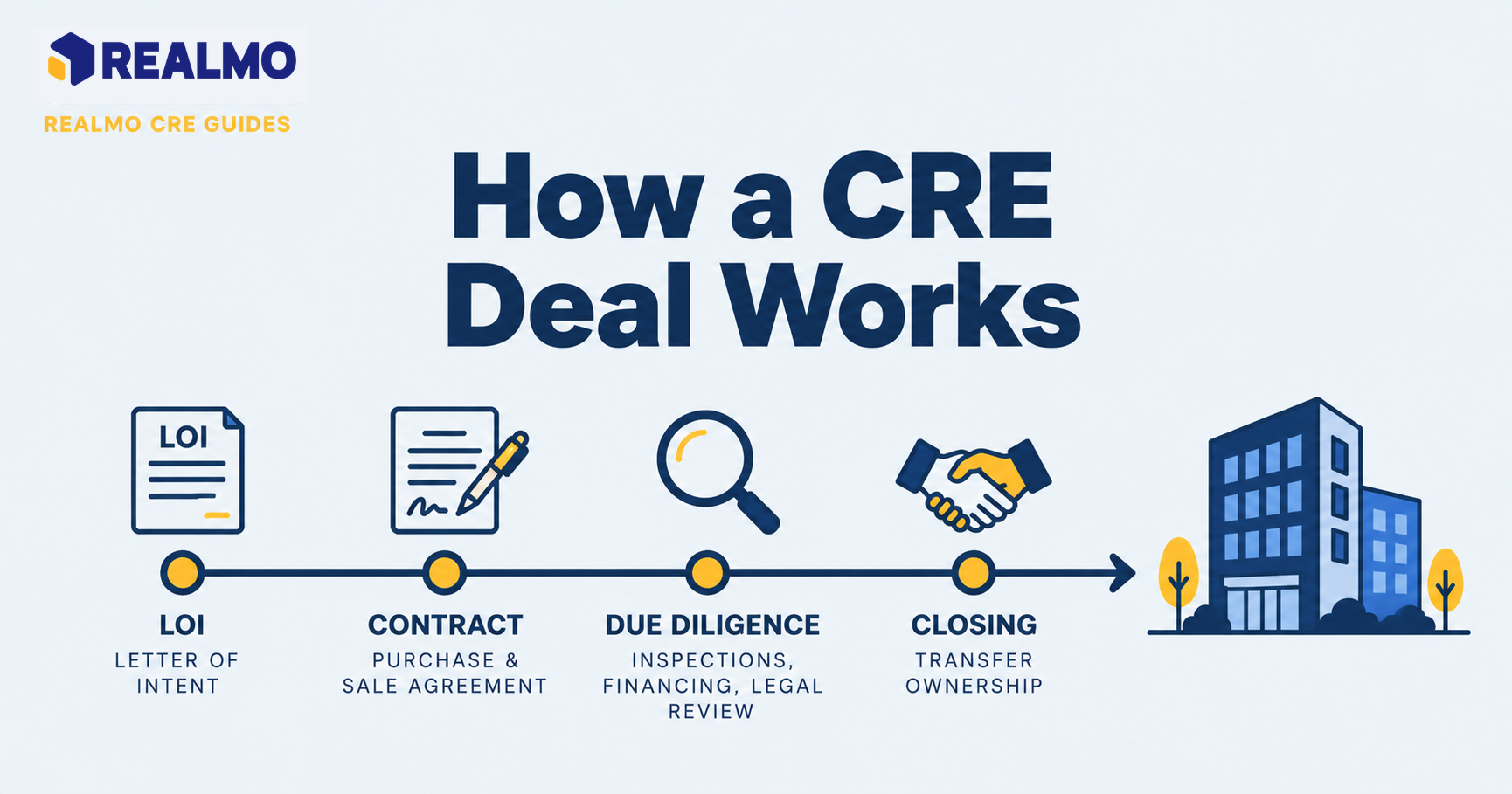
A letter of intent sets price, deposit, diligence period, closing date, and financing terms, and is usually non-binding except for confidentiality and exclusivity. It exists so both sides can find deal-breakers before paying attorneys to draft.
The purchase and sale agreement turns those points into obligations. Earnest money goes into escrow, refundable during the diligence window and hard once that window closes. The date the deposit goes hard is the moment your downside becomes real. Put it on your calendar, not in a file.
Diligence runs on parallel tracks, and each track can kill the deal:
- Financial: rent roll tied to executed leases, trailing twelve-month operating statements tied to bank deposits, tax bills, and insurance quotes at current, not legacy, pricing
- Legal: title commitment, an ALTA/NSPS land title survey, zoning verification, tenant estoppel certificates confirming what the leases actually say, and lender-required subordination agreements
- Physical: property condition assessment, roof and HVAC age, a compliance review under the Americans with Disabilities Act (ADA), a Phase I environmental site assessment (ASTM E1527), escalated to Phase II if flagged
Financing runs alongside diligence. The lender orders its own appraisal and, on most deals, its own environmental and engineering reports. Those reports can change loan sizing after the deposit has gone hard. Sequencing the deposit deadline behind the loan commitment is a negotiating point worth fighting for. The full sequence is laid out in the commercial property due diligence checklist.
Eight building blocks to learn next
Net operating income. Every valuation, loan, and offer traces back to NOI, and the disagreements in a negotiation are almost always about which expenses belong in it. Start with how to calculate net operating income and how a seller’s stated NOI differs from a buyer’s underwritten NOI.
Cap rate. The market’s shorthand for price, risk, and growth expectations rolled into one figure. How to calculate and interpret cap rate covers what it does and does not tell you. Comparing cap rates across property types is usually a mistake.
Cash-on-cash return and IRR. Two metrics that answer different questions: annual cash yield on equity versus time-weighted return across a full hold. Cash-on-cash return versus IRR explains when each one drives the decision and how debt distorts both.
Lease structures. Triple net, modified gross, and full-service leases move the same expenses to different parties. That changes owner cash flow and risk profile at identical headline rents. See triple net versus gross leases before comparing two buildings by rent alone.
Debt and loan sizing. LTV, DSCR, debt yield, amortization, prepayment penalties, and recourse determine your real return and your real risk. How lenders size a commercial loan walks through the constraints and how they interact.
Property classes and submarkets. Class A, B, and C describe building quality and age, not investment quality. The same building can be Class A in one submarket and Class B two miles away. What property class actually means covers how the labels are assigned and misused.
Due diligence. The period where assumptions get tested against documents. Sequencing diligence so the cheap deal-breakers come first keeps expensive reports from landing before you know whether the deal survives.
Tax mechanics. Depreciation schedules, cost segregation, passive activity rules, and 1031 exchanges change after-tax outcomes more than most operating decisions do. 1031 exchange basics for CRE explains the deferral mechanism and its statutory deadlines; individual application requires a licensed professional.
Related terms
- Net operating income (NOI)
- Capitalization rate
- Debt service coverage ratio (DSCR)
- Loan-to-value ratio (LTV)
- Triple net lease (NNN)
- Pro forma
- Letter of intent (LOI)
Questions first-time CRE buyers ask most
What qualifies a property as commercial real estate?
Purpose, not size. Property held to produce income or house business operations is commercial: office, industrial, retail, hotels, specialty assets, and residential buildings of five or more units. A single-family rental stays residential for financing and depreciation purposes even though it produces income.
How much money do you need to start investing in commercial real estate?
It depends on price, lender leverage, and closing costs rather than on a fixed threshold. Equity requirements are set by whichever loan constraint binds first (LTV, DSCR, or debt yield), plus reserves and transaction costs the lender will not finance. Syndications, funds, and real estate investment trusts (REITs) allow participation at much lower amounts, with no operating control.
What is a good cap rate?
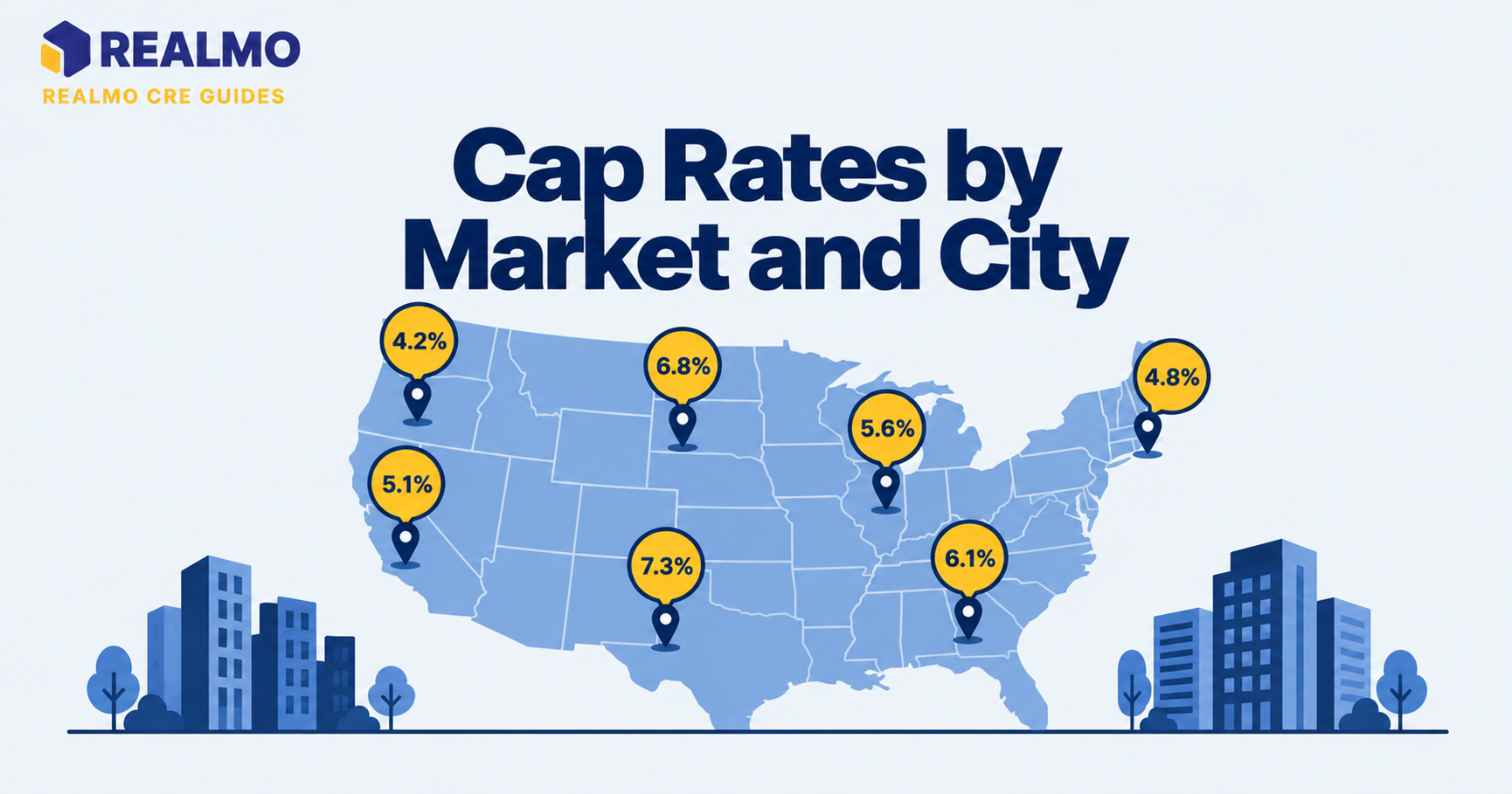
There is no universal answer, and treating a low cap rate as good or bad is the usual error. Cap rates price risk and growth: stabilized assets in deep markets trade tighter than assets with rollover or weak tenant credit. The relevant comparison is against recent sales of similar assets in the same submarket.
How is a commercial mortgage different from a home loan?
Sizing is driven by the property’s cash flow rather than your salary. Terms run shorter than the amortization schedule, so a balloon payment comes due. Prepayment penalties are common and expensive, and many loans carry personal recourse. Rate, term, and structure are negotiated per deal rather than posted.
Who actually makes money in a CRE transaction?
Brokers earn commissions paid at closing, usually by the seller. Lenders earn interest and origination fees. Attorneys, appraisers, environmental consultants, and title companies bill for their reports. The buyer’s return comes only from operations and eventual sale, which is why transaction costs deserve underwriting attention rather than a footnote.