Strip Centers vs Power Centers vs Malls: Types of Shopping Centers Explained
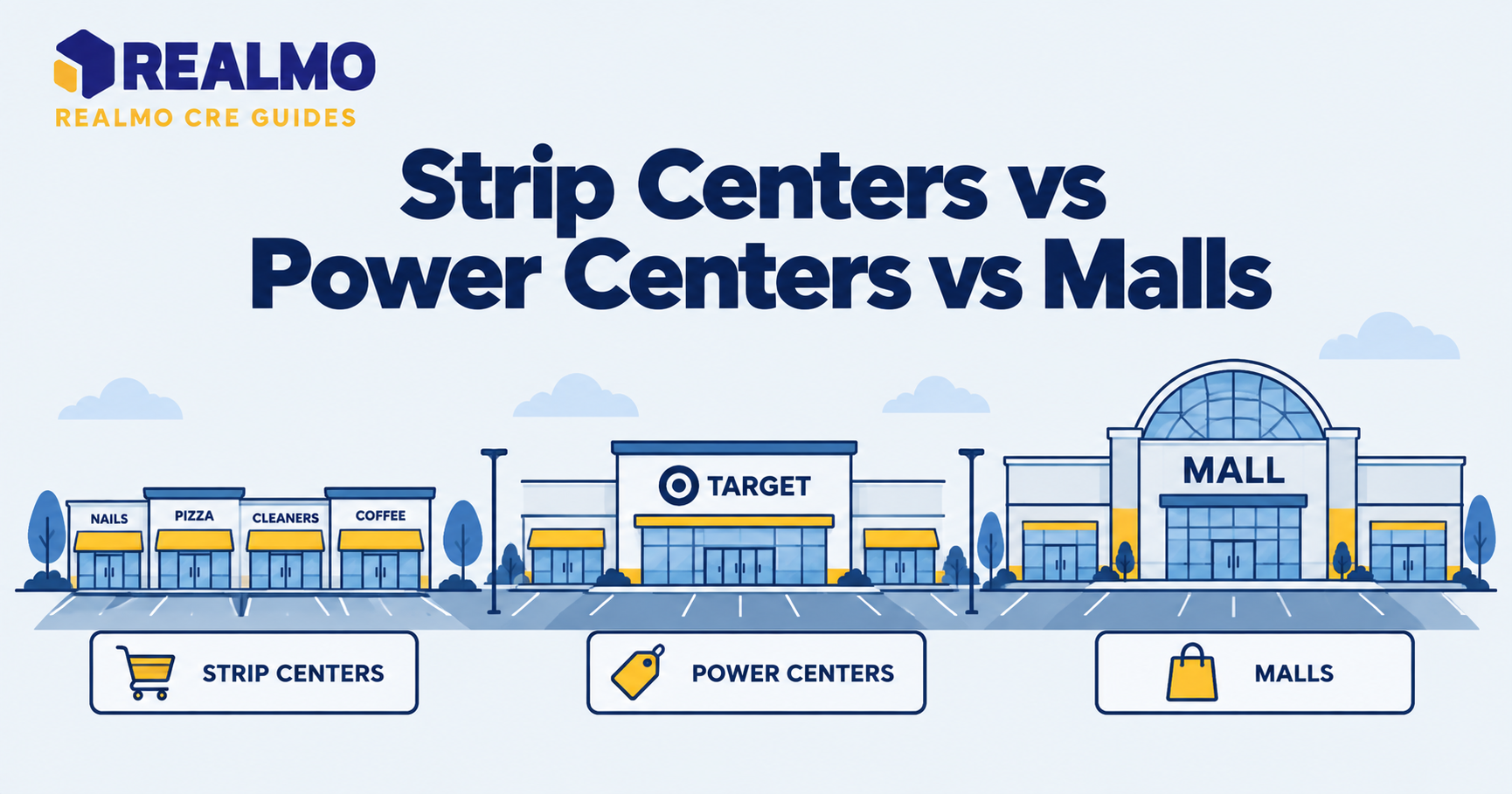
The main types of shopping centers are strip centers, neighborhood and community centers, power centers, lifestyle centers, and malls. They differ by size, anchor tenant, trade area, and lease structure. The differences matter. They drive underwriting far more than the retail label itself.
Why the format matters more than the tenant roster
An investor comparing two retail listings at the same cap rate is usually comparing two different businesses. A 12,000-square-foot strip center anchored by a nail salon, a pizza shop, and an insurance office generates income from small-format tenants. Those tenants sign short leases with personal guarantees. A 300,000-square-foot power center anchored by two big-box retailers generates income from corporate credit on 10- to 20-year leases with options.
The first property has re-leasing risk every few years and pricing power that tracks local demand. The second has almost no near-term rollover. But a single anchor departure can strand hundreds of thousands of square feet and trigger co-tenancy clauses across the rest of the rent roll. Same asset class, opposite failure modes. Underwriting the format tells you which set of questions to ask before you look at a rent roll at all.
How shopping centers are classified by size and anchor
The industry standard classification comes from ICSC (International Council of Shopping Centers). ICSC sorts centers by gross leasable area (GLA), anchor type, and trade area radius rather than by aesthetics. The categories overlap at the edges, and brokers use the labels loosely, so read the actual site plan.
Strip center (convenience center). Under 30,000 square feet, unanchored or anchored by a small convenience tenant. Linear building, parking in front, one or two access points. Trade area measured in blocks, not miles.
Neighborhood center. Roughly 30,000–125,000 square feet, anchored by a supermarket or drugstore. Draws from a few miles. The workhorse format of American retail.
Community center. Roughly 125,000–400,000 square feet, usually with a discount department store or a second grocery anchor plus junior boxes.
Power center. Roughly 250,000–600,000 square feet, dominated by three or more category-killer big boxes (home improvement, off-price apparel, warehouse club, pet supply) with limited small-shop space.
Lifestyle center. Open-air, upscale, restaurant- and apparel-heavy, usually without a traditional anchor. Sells atmosphere as much as merchandise.
Regional and superregional mall. 400,000 square feet and up, enclosed, anchored by full-line department stores, drawing from a wide radius.
What drives income in a strip center
Small-shop retail is a spread business between local demand and local supply. Rents are set per square foot. Terms are short, three to five years is common, with annual escalations and a heavy reliance on the personal credit of owner-operators. Tenants are service-oriented: hair and nails, dental, tax prep, quick-serve food, mobile phone stores, martial arts studios.
The upside is repricing speed. If the trade area’s household income rises, or a competing center is redeveloped, a strip center owner can mark rents to market. That happens within a couple of years. The downside is that vacancy is a permanent operating condition rather than an event. A well-run 10-unit strip center will always have one space in transition. Downtime, tenant improvement dollars, and leasing commissions consume a real share of gross potential rent.
Leases are usually gross or modified gross in older strip product, which pushes expense risk onto the landlord. Confirm the recovery structure line by line. Check whether CAM is capped. Confirm whether the tenant pays a pro rata share of taxes and insurance, and whether the pro rata denominator uses occupied or total GLA. That single denominator choice can move net operating income by several percentage points in a partially leased center.
For a deeper treatment of the mechanics, see how NNN leases allocate expenses and how to read a commercial rent roll.
What drives income in a power center
Power centers trade on credit and duration. The anchors sign long primary terms with multiple five-year options and escalations that are flat or infrequent. Rents run well below what small shops pay per square foot. The economics work because the boxes generate traffic that supports higher-rent outparcels and inline space. The landlord also carries almost no expense risk under true triple-net structures.
Two risks dominate. The first is dark rent: a national tenant that stops operating but keeps paying through the term. The rent check clears while the center’s traffic collapses, and inline tenants either invoke co-tenancy relief or leave at renewal. The second is the option structure. Options belong to the tenant, not the landlord. That means a below-market anchor lease can extend for decades at rents that never catch up. The landlord holds the reletting risk on everything else.
Read co-tenancy clauses first. Then read the offering memorandum’s stabilized pro forma. Many inline leases in power centers allow reduced rent or termination if occupancy falls below a threshold or a named anchor goes dark. A single box vacancy can cascade into a rent roll that looks nothing like the one you underwrote. See how co-tenancy clauses work and why anchor tenants set the value of a retail center.
What changed in the mall business
Enclosed malls split into two populations. A small number of dominant superregional centers in high-income trade areas remain productive, with sales per square foot that support rising rents and heavy reinvestment. The much larger group of secondary and tertiary malls lost the department store anchors that defined the format. Department store reciprocal easement agreements usually gave those anchors control over redevelopment, parking, and site changes. That control usually outlasted the anchors’ own operations.
That control is the core underwriting problem. Anchor parcels in older malls are frequently owned separately from the inline mall. The operating agreement can then require anchor consent for demolition, subdivision, or a change in use. An investor buying a distressed mall is usually buying a redevelopment thesis. That thesis depends on assembling parcels and unwinding agreements written in the 1970s, not on stabilizing an existing income stream.
The productive alternative has been conversion: medical, entertainment, self-storage, fulfillment, education, or ground-up residential on surplus parking. Those are development projects with entitlement timelines and construction risk, priced accordingly. Treat mall acquisitions as land-and-entitlement plays. That holds unless sales productivity clearly supports the existing income.
How cap rates differ across shopping center types
Cap rate spreads between formats follow logic that holds regardless of where the market is in its cycle. Grocery-anchored neighborhood centers price tightest among multi-tenant retail because the anchor is a necessity-based, internet-resistant traffic generator on a long lease. Power centers price wider than grocery-anchored, because fewer buyers can write the check and because box re-leasing is genuinely hard. Unanchored strip centers price wider still, reflecting tenant credit and rollover frequency. Secondary malls don’t really trade on yield. They trade on a residual land basis.
Within any one format, the spread comes from the same variables every time. Those variables are anchor credit and remaining term, percentage of income from investment-grade tenants, and weighted average lease term. They also include rollover concentration in any single year and whether in-place rents sit above or below market. A center with 60% of its GLA rolling in one year is a different asset from an otherwise identical center with rollover spread evenly. The pricing should reflect that. See how to calculate cap rate and what weighted average lease term tells you.
Worked example: comparing two retail centers at the same price
Both figures below are illustrative round numbers, not market data.
Center A is a 40,000-square-foot unanchored strip center. Gross potential rent is $1,000,000. Vacancy and credit loss are underwritten at 10%, giving effective gross income of $900,000. Operating expenses net of recoveries run $250,000, producing NOI of $650,000. Weighted average lease term is 2.5 years.
Center B is a 200,000-square-foot power center. Gross potential rent is $2,600,000. Vacancy and credit loss are underwritten at 5%, giving EGI of $2,470,000. With near-full triple-net recovery, unrecovered expenses run $170,000, producing NOI of $2,300,000. Weighted average lease term is 9 years, but 120,000 square feet sits with a single anchor.
At a $10,000,000 price, Center A yields 6.5%. At a $35,400,000 price, Center B yields 6.5%. The yields match; the risk does not. Center A’s income reprices every few years and requires continuous leasing effort funded from cash flow. Center B’s income is locked but concentrated. Losing the anchor removes roughly half the GLA and may trigger co-tenancy relief on part of the remainder.
Interpretation: run a downside case on each. For Center A, model 15% vacancy plus $30 per square foot of TI and commissions on annual rollover. For Center B, model the anchor going dark at expiration with 18 months of downtime and a re-leasing rent below the in-place rate.
The common mistake is treating the two identical yields as equivalent risk-adjusted returns. They aren’t equivalent. They compensate for different things, and only a downside case reveals which one you are actually being paid to take.
Common mistakes when comparing shopping center types
Underwriting the label instead of the site plan. Brokers call almost anything a “power center” or “lifestyle center.” A center with two boxes and 40% small shop space prices like a community center regardless of the marketing. Consequence: you pay a format premium the asset does not earn.
Ignoring the anchor’s ownership position. In many centers the anchor owns its parcel and participates in an operating agreement that limits what you can do with yours. Consequence: a redevelopment plan that cannot be executed without a consent you were never going to get.
Missing co-tenancy and exclusive use clauses. Exclusives restrict who you can lease to; co-tenancy lets tenants cut rent when occupancy drops. Consequence: your leasing plan is illegal under your own leases, or your stabilized NOI never arrives.
Using occupied GLA as the CAM denominator without checking. Consequence: recoveries in the offering memorandum exceed what the leases actually permit, and NOI falls on the first reconciliation.
Assuming grocery anchors are interchangeable. Sales per square foot, remaining term, and whether the store is the chain’s format of record for that trade area all matter. Consequence: buying a store on a closure list at a pricing that assumes permanence.
Comparing formats across markets is easier when you can see the ownership record, current use, and surrounding trade area for each candidate in one place. Realmo’s property analytics cover both listed and unlisted retail assets nationwide.
Related terms
Anchor tenant · Co-tenancy clause · Gross leasable area (GLA) · Triple net lease (NNN) · Weighted average lease term (WALT) · Percentage rent · Common area maintenance (CAM) · Grocery-anchored retail
FAQ
What is the difference between a strip center and a power center?
A strip center is a small, usually unanchored row of shops under about 30,000 square feet serving a neighborhood trade area. A power center runs 250,000 square feet or more and is dominated by three or more big-box category killers on long leases. It draws from a much wider radius.
Are shopping centers a good investment?
It depends on format. Anchor credit and trade area matter more than the retail category label. Necessity-based centers with strong grocery anchors behave very differently from unanchored strip retail or secondary malls. Evaluate lease terms, rollover schedule, and recovery structure before treating any of them as comparable.
What is the most common type of shopping center in the US?
Neighborhood and community centers lead. They make up the largest share of the shopping center inventory. These are grocery- and drugstore-anchored properties of roughly 30,000 to 400,000 square feet, found in most suburban submarkets.
Why do malls trade at higher cap rates than grocery-anchored centers?
Income is less certain. The buyer pool is smaller too. Department store anchor losses, redevelopment constraints written into reciprocal easement agreements, and high capital requirements all raise perceived risk. Many malls end up priced on redevelopment potential rather than on stabilized yield.
What is a lifestyle center?
A lifestyle center skips the traditional anchor. It’s built around upscale apparel, restaurants, and entertainment in an open-air format. It substitutes design, walkability, and food and beverage traffic for the department store or big box that anchors other center types.