Mixed-Use Development: What It Is and How Investors Underwrite It
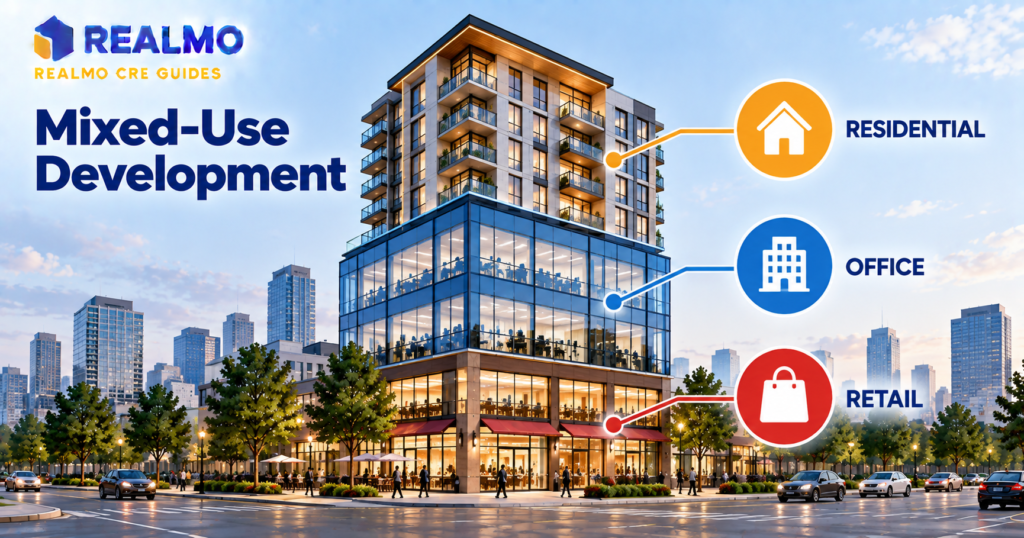
A mixed-use development is a single building or coordinated project that combines two or more income-producing uses under unified ownership and design. Examples include retail, office, multifamily, and hospitality. Each component carries its own lease structure, tenant risk, and buyer pool. A mixed-use development is underwritten as several assets sharing one roof, one parcel, and one capital stack.
Why mixed-use trades differently from single-use
Picture a three-story main street building: 10,000 square feet of ground-floor retail with 20 apartments above. An investor who prices it off residential comparables and calls a multifamily lender will hit three walls in sequence. The agency lender declines because the commercial income share exceeds program limits. The bank quotes wider spreads and a shorter term. The appraiser values the retail on a different cap rate than the apartments, and the number lands below the contract price.
None of that is exotic. It is the ordinary result of buying two asset classes at once. The retail space runs on five-to-ten-year leases with credit exposure to two or three local operators. The apartments turn over annually, with dozens of small tenants absorbing the risk. Those cash flows behave differently in a downturn, they attract different buyers at exit, and underwriting them together will misprice both.
Four formats you’ll actually encounter
Vertical mixed-use stacks uses in one structure, with commercial at grade and residential or office above. That’s the format most people picture. But it carries the most operational friction: shared vertical circulation, fire separation between occupancies, and utility metering that rarely matches the rent roll.
Horizontal mixed-use spreads uses across separate buildings on one master-planned site, commonly with a shared parking field and common-area maintenance regime. Components can usually be financed and sold separately, which is a meaningful advantage.
Main street infill covers the small two-to-four-story buildings that dominate secondary market inventory. Deal sizes fall below institutional thresholds, which is exactly why private buyers find room here.
Adaptive reuse converts obsolete office, industrial, or civic buildings into mixed programs. Structural and code work drives the budget, and eligibility for the federal historic tax credit under IRC Section 47 can move the return math materially.
How lenders underwrite a mixed use development
The first question any lender asks is what share of net rentable area and gross income comes from the commercial component. Agency multifamily programs through Fannie Mae and Freddie Mac permit a limited commercial share. Cross that line, and the deal leaves agency execution entirely, moving to a bank, credit union, life company, or commercial mortgage-backed securities (CMBS) lender. That single threshold commonly separates long-term fixed-rate debt from a five-year bank loan with recourse.
Lenders also size the debt service coverage ratio against blended net operating income. But many haircut the commercial income before running the test, applying higher vacancy assumptions to retail or excluding percentage rent altogether. Ask which convention the lender uses before you build the model. A 15% haircut on the commercial line can change proceeds more than a quarter-point of rate.
Construction and lease-up deals add a further wrinkle: residential absorbs steadily, retail absorbs in lumps tied to a single signature. Lenders write completion and stabilization tests accordingly.
Pricing each component on its own cap rate
Build a separate rent roll, vacancy and credit loss assumption, and reserve line for every use. Retail requires tenant improvement and leasing commission reserves that residential does not; residential requires unit turn costs that retail does not. Allocate operating expenses by submeter where possible and by rentable square footage where not. Document the method: a buyer’s appraiser will test it.
Then value each stream. Retail usually prices at a wider cap rate than apartments in the same submarket. A single tenant departure can erase a large share of that component’s income. Residential vacancy, spread across many small leases, averages out instead. Where the retail is leased long-term to strong credit on a triple net lease, that gap narrows and can invert. Summing component values gives a defensible number. Dividing total net operating income by that value gives the blended cap rate you’ll quote to a lender. Doing it the other way, picking a blended rate first, hides the assumption that actually drives price. Comparing component-level pricing across a submarket is easier when ownership records, valuation, and current versus suggested use sit in one place. That’s what Realmo’s property analytics are built to show.
How the 80% test sets your depreciation schedule
Under IRC §168(e)(2)(A), a building qualifies as residential rental property depreciable over 27.5 years. That status requires at least 80% of gross rental income to come from dwelling units. Fall below that, and the entire building is nonresidential real property on a 39-year schedule. The test runs annually on income, not square footage, so a building can cross the line in either direction as rents reset.
The practical consequence: a modest increase in commercial rent can push the whole structure onto the longer schedule. That cuts annual depreciation for every part of the building, including the apartments. Cost segregation studies are common here because they separate shorter-life components regardless of which schedule the building shell lands on. Confirm treatment with a licensed CPA before relying on it in your model.
Zoning, parking, and condo structure risk
Verify that both uses are permitted by right rather than by variance or conditional use permit. A conditional approval can carry conditions that bind the property, and non-conforming uses may lose protected status if operations lapse. Parking is the recurring failure point: municipalities frequently require separate ratios per use. Shared parking credits recognize that office and restaurant demand peak at different hours, but they must usually be applied for rather than assumed.
Many projects are structured as condominium regimes that legally split the commercial and residential portions, allowing separate financing and separate sale. That flexibility comes with a governing declaration, a shared-cost allocation formula, and a board that can outvote you on capital decisions. Read the declaration and the reciprocal easement agreement during commercial real estate due diligence, not after. Consult a licensed attorney on entitlement and condominium documents in your jurisdiction.
Worked example: valuing a two-component building
All figures below are illustrative and rounded to show method, not market pricing.
| Line | Retail | Residential |
|---|---|---|
| Rentable area / units | 10,000 SF | 20 units |
| Gross scheduled rent | $250,000 | $360,000 |
| Vacancy and credit loss | 10% → $25,000 | 5% → $18,000 |
| Effective gross income | $225,000 | $342,000 |
| Operating expenses and reserves | $45,000 | $150,000 |
| Net operating income | $180,000 | $192,000 |
| Illustrative cap rate | 7.0% | 5.5% |
| Component value | $2,571,000 | $3,491,000 |
Total NOI is $372,000 and total value is $6,062,000, which implies a blended cap rate of roughly 6.1%. Interpret it this way: the blended rate is an output, not an input. If retail rent rolls down at renewal while residential holds, the blend widens even though total NOI barely moves. Value shifts toward the more expensive component. Applying the 5.5% residential rate to the full $372,000 would have produced about $6,760,000, a $700,000 overpayment created by one modeling shortcut. The same arithmetic underlies any cap rate calculation; the discipline is refusing to average inputs that describe different risks.
Common mistakes investors make with mixed-use
- Blending cap rates before valuing components. Overpayment concentrated in the weaker income stream, and an appraisal gap at closing.
- Assuming agency financing based on unit count. Commercial income share disqualifies the deal, and the buyer re-trades on debt terms after the deposit goes hard.
- Underwriting retail vacancy at residential rates. Reserves come up short the first time an anchor space sits empty for a full leasing cycle.
- Ignoring the 80% income test. An unexpected shift to a 39-year schedule reduces depreciation across the entire building.
- Skipping the condominium declaration and parking analysis. Shared-cost obligations and parking shortfalls surface only when refinancing or selling one component.
Related terms
Cap rate · Net operating income · Triple net lease · Debt service coverage ratio · Adaptive reuse · Cost segregation · Highest and best use
FAQ
Is mixed-use commercial or residential property?
It depends on the test being applied. Lenders classify by the share of income and rentable area from commercial space. The IRS applies the 80% gross rental income test to set the depreciation schedule. Zoning classifies by permitted use category. A building can be treated as commercial by one and residential by another.
What cap rate should I use for a mixed-use building?
Use a separate rate for each component, then derive the blended rate from the resulting values. Retail usually prices wider than apartments in the same submarket because tenant concentration is higher. Long-term leases to strong credit narrow that spread considerably.
Can you get agency financing on mixed-use?
Sometimes. Fannie Mae and Freddie Mac multifamily programs allow a limited commercial share of net rentable area and income. Deals above that threshold move to banks, credit unions, life companies, or CMBS, usually with shorter terms and different recourse.
Is mixed-use harder to sell than single-use?
Usually, yes: the buyer pool narrows to those comfortable underwriting both uses. Condominium structures that permit separate sale of components mitigate this. That’s one reason developers create them at the outset, not later.