Cold Storage Warehouses: How Cold Storage Real Estate Works
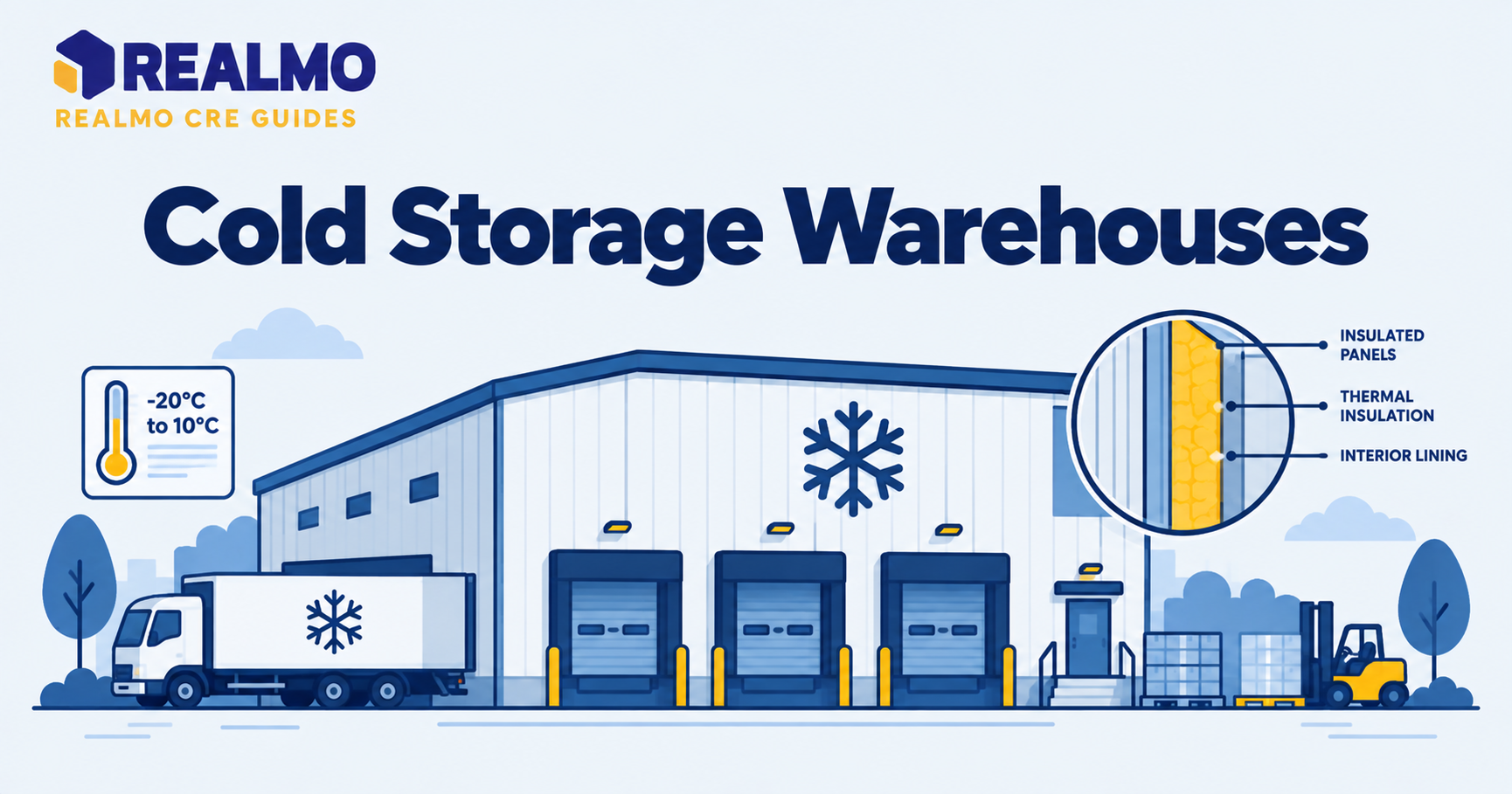
Cold storage real estate is temperature-controlled industrial property built to hold perishable goods within a specified range, from chilled coolers to deep-freeze rooms. Unlike dry warehouse, the building functions as a refrigeration machine inside an insulated envelope. Value depends on mechanical systems and power supply as much as on location and clear height. The difference matters.
Why cold storage looks cheap until you underwrite it
An investor who owns two bulk distribution buildings gets offered a freezer facility. The going-in yield looks visibly wider than anything in the dry industrial pipeline. The spread looks like a mispricing. It usually is not. The wider yield compensates for a shorter mechanical life inside the shell and for a smaller pool of replacement tenants. It also compensates for a power bill the landlord may partially carry. And it compensates for a residual value that collapses if the refrigeration package has to come out. An investor who underwrites the asset like a warehouse with a bigger rent number will overpay. The model omits the reserves, the re-tenanting downtime, and the capital cost of the next compressor replacement. The spread is a risk price. The question is whether the specific building earns it.
How cold storage real estate differs from dry industrial
A dry warehouse is a shell. Its value drivers are location, clear height, dock doors, trailer parking, and column spacing, and almost any distribution tenant can occupy it. A cold building adds an insulated envelope, a refrigeration plant, and refrigerated docks with air locks. It also needs floor systems that resist frost damage, and an electrical service several times larger than a comparable dry box.
That equipment has a useful life measured in years, not decades. The shell lasts far longer. The practical consequence is that a cold asset carries two capital stacks with different clocks. One is a long-lived structure that lasts for decades; the other is a shorter-lived plant that must be reserved for and eventually replaced. Underwriting that ignores the second clock overstates net operating income for the entire hold.
Temperature classes and what each one costs to run
Cold buildings are grouped by range. Controlled ambient space sits above freezing and serves produce, chocolate, and some consumer goods. Cooler space runs just above freezing for dairy, meat, and fresh produce. Freezer space runs below zero Fahrenheit for frozen food and proteins, and blast-freeze rooms go lower still, to pull heat out of product quickly.
Each step down multiplies the cost of everything around it. Insulation thickens, and refrigeration tonnage rises. Vapor barriers become critical, and freezer slabs require under-slab heating or ventilation to prevent frost heave from lifting and cracking the floor. Power draw scales the same way. That is why utility capacity at the site is a hard gate on feasibility, not a detail to solve later. A building that can be converted from cooler to freezer is worth more than one that cannot. That flexibility is designed in, not added later.
Who occupies cold buildings and how the leases are written
Occupiers fall into three groups. Food producers and processors need storage adjacent to production. Grocery and foodservice distributors need it too, alongside third-party logistics operators who run public refrigerated warehouses for many customers at once. Life sciences occupiers are a smaller category subject to Good Distribution Practice (GDP) validation and documentation requirements.
The lease structure follows the occupier. Purpose-built facilities are usually delivered as long-term build-to-suit or triple net lease deals. The tenant specifies the refrigeration design and expects to amortize it over a long term. Public refrigerated warehouse operators run a different model. They charge customers by pallet position per month plus handling fees, an operating business layered on top of the real estate. An investor buying a building leased to such an operator is exposed to that operator’s utilization, not directly to the underlying food companies. Confirming which model applies is the first underwriting step. It determines whether you are pricing lease credit or business risk.
Why converting a dry warehouse usually fails
Conversion is the most common way investors lose money in this asset class. A standard distribution slab is not designed for freezer service, and retrofitting under-slab heat means demolition rather than an overlay. Ceiling insulation reduces usable cube. So a building marketed at high clear height delivers materially less once the envelope goes in. Column spacing set for pallet racking in ambient conditions rarely matches the racking density a cold operator needs to justify the rent premium.
Two other constraints kill deals late: electrical service capacity must be upgraded, and utility timelines sit entirely outside the developer’s control. Systems using anhydrous ammonia above the 10,000-pound threshold trigger OSHA Process Safety Management and EPA Risk Management Program obligations. Those carry design, documentation, and siting consequences. Verify both before the deposit goes hard.
How investors underwrite cold storage cash flow
Cold buildings are measured in pallet positions and cubic feet, not just square feet, because the revenue-generating unit is volume under racking. Rent per square foot on a freezer is not comparable to rent per square foot on a dry box. You have to normalize for usable cube. You also have to adjust for who pays power.
Beyond rent, the diligence list is specific. It covers the refrigeration plant’s age and remaining life, the refrigerant type and its compliance regime, and power capacity and demand charges. It also covers floor condition and evidence of heave, plus envelope integrity and the mechanical reserve schedule. Residual value deserves its own analysis, because a vacating tenant leaves a small, geographically constrained replacement pool. The building cannot be re-let to a general distribution user without stripping cost out of it. Screening submarkets for utility infrastructure, labor, and proximity to processing or population centers is where platform data helps. Realmo’s Location Insights and ownership records let you assemble that picture before site tours.
Worked example: yield on cost for a freezer development
All figures below are illustrative round numbers chosen to show the mechanics, not market quotes.
A developer builds a 150,000-square-foot freezer facility. Total project cost, including land, shell, insulated envelope, refrigeration plant, and soft costs, comes to $45,000,000, or $300 per square foot. The building is leased on a triple net basis at an illustrative $22.00 per square foot.
Gross rent is 150,000 × $22.00 = $3,300,000. Apply a 3% structural vacancy and credit allowance, or $99,000, for effective gross income of $3,201,000. Deduct non-recoverable owner costs (asset management and a reserve for refrigeration capital) at an illustrative $0.45 per square foot, or $67,500. Net operating income is approximately $3,133,500.
Yield on cost is $3,133,500 ÷ $45,000,000 = 6.96%. The development margin comes from the spread between that yield and the cap rate a stabilized buyer would apply. At a spread of 125 basis points, value is $3,133,500 ÷ 5.71% ≈ $54,900,000, a margin near $9.9 million, or about 22% on cost. It’s a spread, not a number. The same yield on cost produces a loss if exit pricing moves against the developer during construction.
The frequent error: omitting the refrigeration reserve. Treating the plant as maintenance-free inflates NOI, and a small NOI overstatement compounds into a large valuation error once it is capitalized.
Common mistakes in cold storage underwriting
- Pricing the rent premium without pricing the cost premium. Cold buildings cost a multiple of dry warehouse to build and more to operate, so a higher rent alone does not produce a higher return.
- Ignoring who pays power. Where the landlord carries any part of the utility load, unhedged demand charges move directly through NOI.
- Assuming re-tenanting timelines from the dry industrial market. The replacement tenant pool is narrow, and downtime assumptions borrowed from bulk distribution understate carry costs.
- Skipping refrigerant compliance diligence. Systems crossing regulatory thresholds carry documentation, training, and siting obligations that transfer with ownership.
- Trusting marketed clear height. Insulation and ceiling systems reduce usable cube, which reduces pallet positions and the rent the building can actually support.
Frequently asked questions
Is cold storage a good asset class for a first industrial acquisition?
It’s specialized. It carries concentrated tenant risk and heavy mechanical capital needs. Most investors build general industrial competence first, because cold underwriting demands judgment about equipment life and re-tenanting that a generalist distribution deal never requires.
Why do cold storage assets trade at wider cap rates than bulk industrial?
Pricing reflects specialized improvements that limit the tenant pool, along with shorter-lived mechanical systems, higher operating intensity, and weaker residual value. The spread over comparable dry industrial in the same market is the market’s price for those risks. It widens with specialization.
Can refrigeration equipment be depreciated faster than the building?
Nonresidential real property is depreciated over 39 years under the Modified Accelerated Cost Recovery System (MACRS), but a cost segregation study may identify components that qualify for shorter recovery periods. Treatment depends on the facts. It also depends on how the equipment is characterized. Consult a licensed tax professional before relying on any depreciation position.
Related terms
Triple net lease (NNN) · Cap rate · Yield on cost · Build-to-suit · Clear height · Sale-leaseback · Cost segregation · Single-tenant net lease