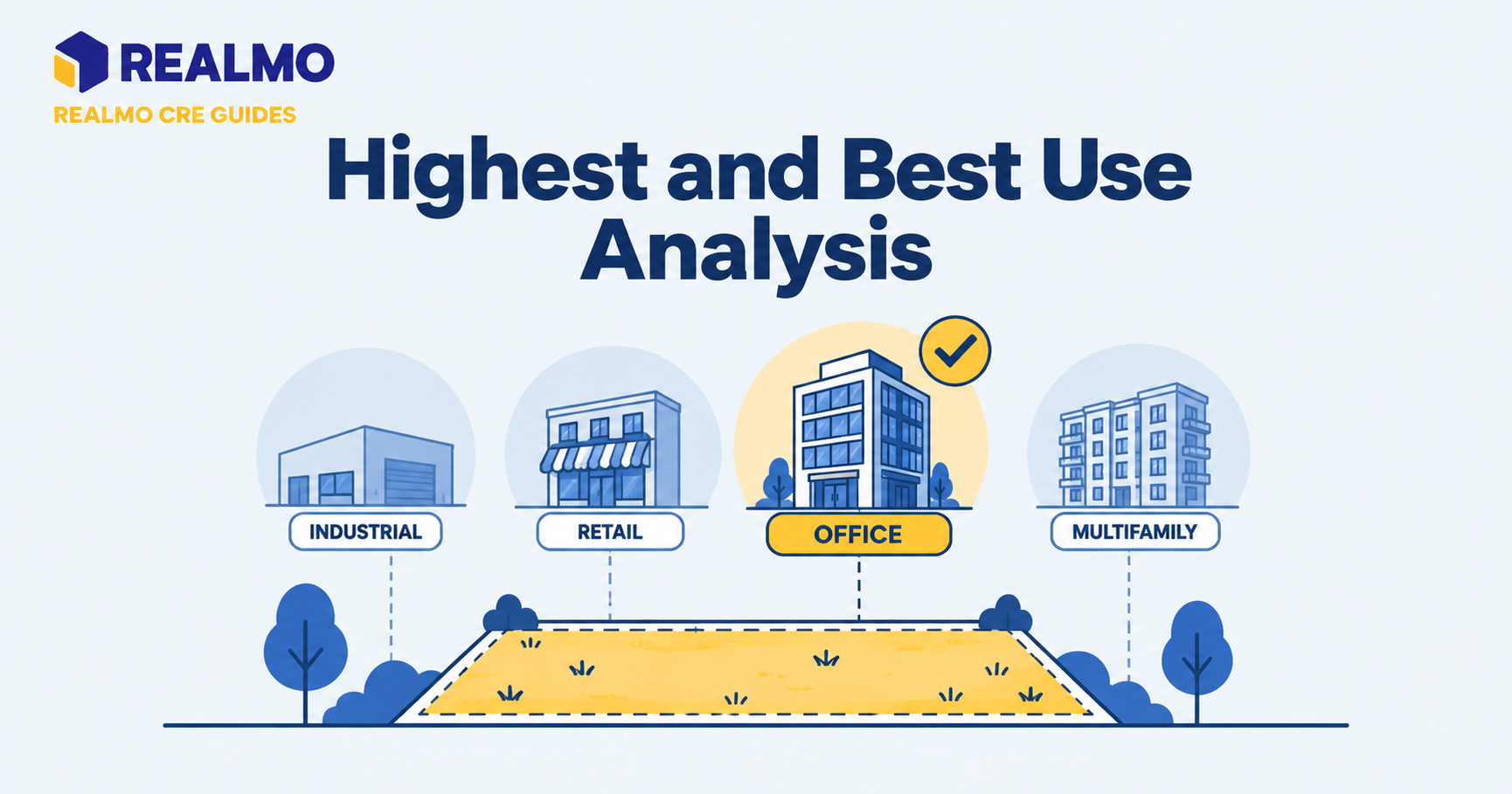
Which Asset Class Fits Which Investor: Finding the Best Commercial Property to Invest In

The best commercial property to invest in is the asset class whose capital requirement, operating workload, and lease structure match the investor’s own constraints. Net lease retail suits passive owners with limited time. Multifamily and flex industrial reward operators who can underwrite and manage. Hospitality is a business, not a lease.
Why Asset Class Fit Decides Your Outcome
An investor has $600,000 of equity, a full-time job, and no local contractor relationships. He buys a four-tenant strip center anyway, because the cap rate beats the single-tenant pharmacy across the street. Eighteen months later, two leases roll. The landlord owes tenant improvement dollars he never reserved for, and he ends up fielding HVAC calls during his own work hours. The yield premium was real. It just paid for labor and capital risk he never priced in.
The same investor in the pharmacy earns less on paper and never touches the building. Neither deal is better in the abstract. The mismatch is what destroys returns. An asset class that assumes time, expertise, or reserve capacity the owner doesn’t have will underperform its pro forma, no matter how the market moves.
There Is No Single Best Commercial Property to Invest In
Asset classes are not ranked on a ladder from worse to better. They are priced against each other. The pricing gaps are mostly explanations. When one property type trades at a higher cap rate than another in the same submarket, the spread pays for something specific. It might be shorter lease term or weaker tenant credit. It could also be more capital expenditure exposure, thinner resale demand, or more hours of owner attention per year.
Industrial cap rates sit below retail cap rates in the same market. Leases run longer than retail leases, tenants invest heavily in their own build-out, and the physical box is cheap to re-tenant. Hospitality trades wide of everything, because revenue reprices nightly. The question isn’t which spread is highest. It is which of those costs you’re actually equipped to absorb.
Four Variables That Decide Which Asset Class Fits
Equity available per deal. Some classes have a practical floor. Institutional-grade industrial and large anchored retail rarely trade small enough for a first-time buyer to control alone, without a partner or a fund. Small multifamily, flex space, and freestanding single-tenant buildings do.
Hours you can give it per month. This is the variable investors misjudge most. A single-tenant building on an absolute net lease takes about ten hours a year. A twelve-unit apartment building takes hours every week, or a management fee that comes straight out of net operating income.
Underwriting edge. If you cannot judge whether a rent roll is above or below market, you are a price taker. Edge is local and specific: knowing which industrial corridor is losing supply to conversions, or which tenant category is expanding. Without it, favor classes where the income is contractual and legible rather than classes where the return depends on your operating skill.
Hold period and exit liquidity. A five-year hold on a single-tenant asset with eight years of term left is straightforward, since the buyer pool stays wide. The same hold on an asset with three years of term left is different. You are selling a lease-up risk to the next buyer, and your buyer pool narrows accordingly.
Passive Capital: Net Lease and Credit-Backed Assets
Single-tenant net lease is the closest thing in commercial real estate to a bond with a building attached. Under triple net (NNN) lease structures, the tenant carries taxes, insurance, and maintenance, and the landlord’s job reduces to collecting rent and monitoring credit. The trade is obvious once you look for it. Yields sit at the low end. Rent growth is fixed by the escalation schedule, not by the market. And 100% of your income depends on one tenant’s ability to pay.
This class fits investors short on time. It also fits investors doing a like-kind exchange under a compressed identification window, since the underwriting is simpler and closings are faster. The primary work is credit analysis and lease reading, not property management. The main risk is concentration: when a single-tenant building goes dark, income does not decline, it stops.
Hands-On Capital: Multifamily, Flex, and Small Mixed-Use
Multi-tenant assets pay owners for absorbing volatility. Vacancy is fractional rather than binary, so one departure reduces income instead of eliminating it. In exchange, the owner runs leasing, capital planning, and collections, and funds tenant improvement and leasing commission costs every time a suite turns.
Small multifamily is the common entry point. Residential leases are short, rents reprice annually, and financing is broadly available. Flex and small-bay industrial suit investors who want less management than apartments, but more upside than net lease, since suites re-tenant cheaply.
Small mixed-use is the deceptive one. A retail ground floor over apartments carries two leasing markets, two tenant types, and two capital plans in one asset. It rewards owners with genuine local knowledge and punishes those buying it as a diversification shortcut.
Operating Businesses in Disguise: Hotels and Storage
Hospitality and self-storage are priced as real estate. They’re run like businesses. Hotels reprice every night, carry payroll and franchise obligations, and swing with national travel demand from one week to the next. Self-storage has short-term contracts, high customer churn, and revenue management that behaves more like software pricing than leasing.
Both can produce strong returns, and both punish absentee ownership faster than any lease-based asset. If your plan is to hire third-party management and check quarterly reports, understand that you are underwriting the operator as much as the property. These belong later in an investor’s path. They fit after the mechanics of underwriting, financing, and reserves become second nature.
How Financing Availability Narrows the Choice
Lender appetite quietly eliminates options. You feel it before you tour a single building. Stabilized multifamily has the deepest financing market in U.S. commercial real estate, including agency programs through Fannie Mae and Freddie Mac. Owner-occupied commercial property can access SBA 504 and 7(a) programs. Hospitality and specialty assets require more equity ( current minimum with your lender), carry shorter loan terms, and face tighter debt service coverage ratio requirements.
Two effects follow. Lower required equity per deal means you reach a diversified portfolio sooner. And the classes lenders favor are the same classes buyers can finance easily at exit, which supports resale liquidity down the road. When you compare asset classes, compare the debt each one attracts, not just the yield each one quotes.
Worked Example: Comparing Two Deals on Yield and Hours
All figures below are illustrative round numbers chosen to show the method, not market quotes.
Two properties are each priced at $2,000,000. Each uses a $1,200,000 loan at 60% LTV, 6.00% interest, and 25-year amortization. Annual debt service is roughly $92,800. Equity in each deal is $800,000.
Deal A: single-tenant net lease. Cap rate 6.5%, so NOI is $130,000. Landlord obligations are minimal. Cash flow after debt service: $130,000 − $92,800 = $37,200. Cash-on-cash return: $37,200 ÷ $800,000 = 4.65%. Estimated owner time: about 10 hours per year.
Deal B: four-tenant flex industrial. Cap rate 8.0%, so NOI is $160,000. NOI already reflects operating expenses and vacancy, but not capital items. Budget $25,000 per year for replacement reserves, tenant improvements, and leasing commissions, amortized across the hold. Cash flow: $160,000 − $92,800 − $25,000 = $42,200. Cash-on-cash: 5.28%. Estimated owner time: about 120 hours per year.
How to read it.
The 150-basis-point cap rate spread narrows to 63 basis points once capital costs are deducted. The remaining $5,000 of annual advantage compensates roughly 110 extra hours of work, or about $45 per hour before any vacancy actually occurs. Deal B still has the better risk profile in one respect: four income streams instead of one. It has the worse profile in another, since a single tenant’s departure triggers real out-of-pocket cost. The exercise does not pick a winner; it converts a yield gap into hours and dollars you can compare against your own situation.
Common error: comparing cap rates directly across asset classes without normalizing for capital reserves and leasing costs. Cap rate sits above the capital expenditure line. Two identical cap rates in different classes are not identical returns.
Common Mistakes When Choosing an Asset Class
Buying the yield instead of the workload. The spread is priced compensation. Take it only if you can supply the labor and reserves it pays for; otherwise the return leaks out through deferred maintenance and slow re-leasing.
Treating one strong tenant as a substitute for reserves. Investment-grade credit reduces the odds of default, but it does nothing for the cost of a dark building sitting empty. Reserve for re-tenanting cost anyway.
Choosing a class lenders avoid. Higher equity requirements mean fewer deals over a decade and a thinner buyer pool at exit, both of which compound.
Diversifying across classes before mastering one. Each class carries its own lease conventions, expense structures, tenant expectations, and diligence checklist, and none of it transfers automatically. Two unfamiliar classes generate two sets of unfamiliar mistakes.
Anchoring on a national narrative. Asset class performance is submarket-specific. Supply pipelines, employment mix, local zoning, and job growth do more to determine outcomes than any sector-wide headline ever will.
Data in one place helps. Realmo publishes valuation estimates, ownership records, and current and suggested use for millions of U.S. commercial properties, without a paywall. That means you can compare a net lease building and a multi-tenant flex asset on the same terms, before you tour either one.
Asset class selection touches tax treatment. It also touches entity structure and financing terms that most investors don’t think through carefully until the closing table itself. Confirm the specifics of any deal with a licensed attorney, CPA, or tax advisor before you commit capital.
Related Terms
Cap rate Net operating income (NOI) Triple net (NNN) lease Debt service coverage ratio (DSCR) Cash-on-cash return Tenant improvements and leasing commissions Replacement reserves
FAQ
What is the best commercial property to invest in for a beginner?
Beginners do best in a class with deep financing, legible income, and forgiving management demands: small multifamily or a single-tenant net lease building. The deciding factor isn’t the property type. It’s whether you can fund reserves, read the lease accurately, and supply the operating time the asset requires.
Which commercial asset class requires the least management?
Single-tenant properties on absolute net leases require the least owner involvement, since the tenant handles taxes, insurance, structure, and maintenance. The tradeoff is binary vacancy risk. If the tenant leaves or defaults, income stops entirely rather than declining, and the landlord funds carrying costs and re-tenanting alone.
Is a higher cap rate always a better investment?
No. A higher cap rate prices identifiable risk: shorter lease term, weaker tenant credit, higher capital expenditure exposure, or a thinner resale market. Cap rate is calculated before capital costs. Two assets with different reserve and leasing requirements can show the same cap rate and still deliver very different cash returns.
Can I invest in more than one asset class at once?
Yes, but each class carries its own lease conventions, expense structures, and diligence requirements you have to learn from scratch. Most investors start with one class. They build competence there, reach several assets, then expand into an adjacent class with overlapping mechanics. A common path moves from small multifamily into small mixed-use, rather than straight into hospitality.
How much equity do I need for commercial real estate?
It depends on the class and lender. Stabilized multifamily and owner-occupied properties allow the highest leverage, since agency programs and SBA programs both back them at closing. Specialty and hospitality assets require more equity and shorter loan terms. Ask about current requirements for your target class before you set a budget.