Pro Forma vs Actuals: Spotting Inflated Numbers
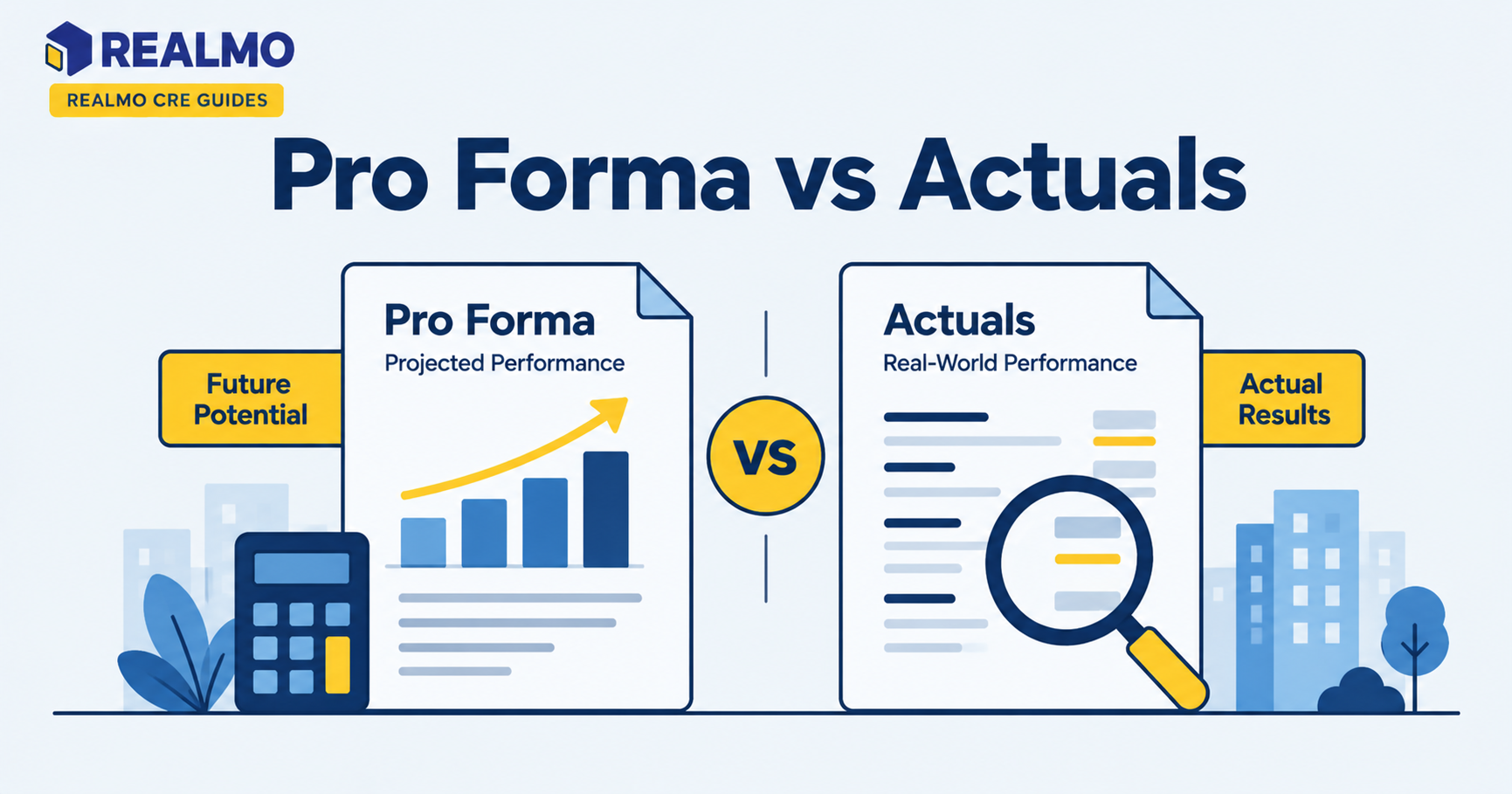
A pro forma real estate statement projects what a property could earn under stated assumptions, while actuals report what it has already earned. The gap between them is where value is either created or invented. Reading that gap correctly is the difference between buying a business plan and buying a story.
Why the pro forma gap decides your entry price
You tour a 40-unit apartment building. The offering memorandum shows a stabilized net operating income and a going-in cap rate that looks acceptable for the submarket. Underneath, the seller has assumed full occupancy, rents at the top of the current lease range. A management fee below what any third-party firm would sign, and no replacement reserves.
Every one of those assumptions is defensible in isolation. Stacked together, they can lift projected NOI by fifteen to twenty percent over the trailing period , and because value in income property is NOI divided by a cap rate, a twenty percent NOI overstatement is roughly a twenty percent price overstatement. Your lender will size the loan on actuals, not on the seller’s projection, so an inflated pro forma does not just cost you yield. It quietly increases the equity you have to bring to close.
What a pro forma real estate statement shows
A pro forma is a forward-looking operating statement. It starts with gross potential rent, subtracts vacancy and credit loss, adds other income, and deducts operating expenses to arrive at projected net operating income. Everything below the NOI line, debt service, capital reserves, partnership fees, may or may not appear, depending on who built the model and why.
Sellers build pro formas to justify a price. Buyers build them to test a plan. Lenders build them to size debt and stress the debt service coverage ratio. The same property produces three different statements, and none of them is dishonest by definition. The label “pro forma” only tells you the numbers are projections. It tells you nothing about whether the projections are reasonable.
Two versions circulate. A stabilized pro forma shows the property at the end of a business plan, after renovation or lease-up. A year-one pro forma shows the first twelve months of ownership, including disruption. Sellers prefer the first. Underwriters need the second.
Which documents count as actuals
Actuals live in source documents, not in the marketing package. The core set is the trailing twelve-month operating statement, the current rent roll. The last two or three years of tax returns or audited financials, and the tenant leases themselves.
The T-12 statement is the anchor because it captures a full seasonal cycle of utilities, turnover, and collections. A trailing three-month figure annualized will flatter a property in its strong season and punish it in its weak one. Ask for both, then compare the annualized T-3 to the T-12 to see which direction the property is actually moving.
Leases matter more than any summary. A rent roll shows what tenants are supposed to pay. Leases show free rent periods, expense caps, early termination rights, and escalations. Where the rent roll and the leases disagree, the leases win.
Five Line Items Sellers Commonly Inflate
Market rent. The pro forma applies a rent that only the two most recently renovated units achieved, then spreads it across all forty. The honest version separates in-place rent from the loss to lease and shows what capital and time are required to close it.
Vacancy. Physical vacancy alone understates the drag. Economic vacancy adds concessions, bad debt, non-revenue units, and downtime between leases. A pro forma using a vacancy rate below the property’s own trailing collections history needs an explanation, not an assumption.
Management fee. Owner-operated properties frequently show no management fee, or a below-market one. Underwrite the fee a third-party manager would actually charge for that asset class and unit count, whether or not you plan to self-manage.
Repairs versus capital. Reclassifying routine repairs as capital improvements moves cost off the operating statement and inflates NOI without changing a dollar of cash flow. Read the general ledger detail, not the summary line, and apply a consistent standard for capital expenditures versus repairs.
Property taxes. Many jurisdictions reassess on transfer. A pro forma carrying the seller’s historical tax bill through the first year of your ownership can understate expenses materially. Model the reassessment mechanism in the specific county, and confirm it with a licensed tax professional before you rely on it.
How to rebuild a seller’s pro forma from the T-12
Start from actuals and add back only what you can document. Take T-12 revenue, adjust for units that have signed new leases since, and stop there , signed leases are evidence, projected leases are not. Then take T-12 expenses and adjust upward for known changes: reassessment, insurance renewal, a management fee at market, and replacement reserves on a per-unit or per-square-foot basis.
Keep the two adjustments separate. Revenue upside is a business-plan item that you control through execution. Expense increases are largely outside your control and should be treated as certain. Blending them into one “stabilized” number hides which half of the value creation you are actually underwriting.
Verify ownership and history independently. Sale dates, prior transfers, and current use are matters of record, and Realmo’s property records and Location Insights let you check them against the offering memorandum before you spend money on third-party reports. Discrepancies in basic facts usually predict discrepancies in financial ones.
Finally, run the operating expense ratio on both statements. Expense ratios cluster within a recognizable band by asset class and vintage. A pro forma whose ratio falls well below the property’s own trailing ratio. Without a specific operational change to explain it, is the fastest tell available.
Worked example: pro forma versus actual NOI
All figures below are illustrative and rounded for clarity. They are not market data.
| Line | Seller pro forma | Trailing 12 months |
|---|---|---|
| Gross potential rent | $720,000 | $720,000 |
| Vacancy and credit loss | ($21,600) | ($65,000) |
| Other income | $12,000 | $9,000 |
| Effective gross income | $710,400 | $664,000 |
| Operating expenses | ($245,000) | ($291,000) |
| Net operating income | $465,400 | $373,000 |
The gap is $92,400, and it splits almost evenly: about $46,400 of revenue optimism and $46,000 of expense omission. On the revenue side, the pro forma assumes a 3% vacancy factor against a trailing economic vacancy of roughly 9%. On the expense side, it drops the management fee and reserves.
Rebuild it. Suppose eight units have signed new leases at $75 more per month, documented in the lease file: that supports $7,200 of annual revenue upside. Suppose the county reassesses on sale, adding $18,000 to taxes, and a third-party manager charges 4% of effective gross income, roughly $26,600. Underwritten NOI lands near $335,600, below the trailing figure, not above it.
Interpretation: at an illustrative 5.5% cap rate, the difference between the seller’s $465,400 and an underwritten $335,600 is about $2.36 million of value on the same physical building. Nothing about the property changed. Only the assumptions did.
The common error here is subtler than accepting the pro forma outright. Buyers frequently apply the market’s going-in cap rate , which is derived from actual, in-place income across comparable trades , to a stabilized pro forma NOI. That double-counts the upside once in the numerator and again in the denominator.
When an aggressive pro forma is still defensible
Not every optimistic projection is a red flag, and the industry does not agree on where the line sits. One camp underwrites strictly to in-place income and treats all upside as free option value; this is common among debt funds and conservative private buyers. Another camp argues that value-add investing is precisely the business of buying mispriced operations, and that refusing to pay anything for documented upside means never winning a deal.
Both positions are coherent. What separates them from wishful thinking is evidence and timing. A pro forma is defensible when the assumption is supported by something outside the model. Signed leases, executed contracts, a completed renovation on comparable units, a filed tax appeal, and when the timeline to realize it is stated and funded. It is not defensible when the support is a general claim about the submarket.
Common mistakes investors make reading pro formas
- Comparing pro forma NOI to actual comps. You end up paying a stabilized price for an unstabilized asset and carry the execution risk for free.
- Accepting a T-3 annualization. Seasonal properties look best in one quarter; annualizing that quarter can overstate NOI enough to break your loan sizing at closing.
- Ignoring below-the-line items. Reserves, tenant improvements, and leasing commissions do not appear in NOI but consume real cash, and omitting them makes cash-on-cash returns look better than they will be.
- Trusting the rent roll over the leases. Concessions and expense caps buried in lease documents can erase months of projected income you already paid for.
- Modeling one scenario. A single case gives you no sense of how much of your equity depends on the softest assumption in the file.
Related terms
- Net operating income
- Cap rate · T-12 statement
- Loss to lease
- Operating expense ratio
- Debt service coverage ratio
- Capital expenditures vs repairs
Frequently asked questions
No. A value-add pro forma is reasonable when each assumption ties to evidence outside the model, signed leases, completed comparable renovations, executed service contracts. And when the cost and timeline to reach stabilization are explicitly funded. Unsupported market-wide rent growth claims are the unreliable part, not the format itself.
Use actual, in-place NOI for the going-in cap rate, because market cap rates are derived from in-place income on comparable sales. Calculate a separate stabilized yield-on-cost using pro forma NOI and total capitalized basis. Mixing the two overstates value by counting the same upside twice.
Compare each line to the trailing twelve months and require documentation for every improvement. The recurring tells are a vacancy factor below the property’s own collections history. A missing or below-market management fee, no replacement reserves, historical property taxes carried through a reassessment, and repairs reclassified as capital.