NOI vs Cash Flow: Why They Differ

NOI vs cash flow is a question of where the accounting stops. Net operating income measures what a property earns after operating expenses but before debt service, capital expenditures, leasing costs, and income taxes. Cash flow subtracts those items and shows what actually lands in the owner’s account.
Why the gap between NOI and cash flow costs investors money
An investor reviewing a small industrial building sees a $500,000 NOI on the offering memorandum and a cap rate that clears their hurdle. They model the acquisition, sign, close, and then meet the second set of numbers. A mortgage payment, a roof approaching replacement, and tenant improvement dollars promised to a renewing tenant. The property still produces $500,000 of NOI. The bank account tells a different story.
That gap is not a pricing error or a broker’s exaggeration. NOI is designed to strip out everything specific to a particular owner , their loan terms, their tax situation, their capital plan , so that two buildings can be compared on the merits of the real estate alone. Cash flow reintroduces all of it. Buyers who underwrite one number and live on the other are the ones surprised in year one.
NOI vs Cash Flow Calculator
See exactly how Net Operating Income turns into actual property-level cash flow after debt service, capital expenditures, and leasing costs.
Property & Financing
Year 1 Capital & Leasing Costs
Stabilized Year
NOI vs Cash Flow
| Metric | NOI | After Debt Service | Year 1 | Stabilized |
|---|---|---|---|---|
| Cash Amount | — | — | — | — |
| Cash-on-Cash | — | — | — | — |
| Difference vs NOI | 0% | — | — | — |
Disclaimer: This calculator is provided for informational and educational purposes only. The results are estimates based on the assumptions and inputs provided and should not be considered financial, investment, tax, legal, or real estate advice. Actual returns may vary due to changes in property income, financing terms, operating expenses, capital expenditures, taxes, market conditions, transaction costs, and sale proceeds. Users should independently verify all assumptions and consult qualified financial, tax, legal, and real estate professionals before making investment decisions.
What NOI includes and what it leaves out
Net operating income starts with effective gross income, scheduled base rent plus reimbursements and other income, minus vacancy and credit loss, and subtracts operating expenses. Operating expenses are the costs of running the building for the current year. Property taxes, insurance, utilities not billed back, repairs and maintenance, management fees, payroll, and turnover cleaning.
Four categories are excluded by convention, and each exclusion has a reason. Debt service is excluded because financing belongs to the buyer, not the building. Capital expenditures are excluded because they replace an asset rather than operate it. Depreciation is excluded because it is a non-cash tax construct set by the Modified Accelerated Cost Recovery System (MACRS). Income taxes are excluded because they depend on the owner’s entity and other holdings.
Practitioners argue about the middle ground. Replacement reserves, leasing commissions, and tenant improvements sit between operating and capital. Lenders frequently underwrite NOI with a reserve deducted; sellers rarely present it that way. Neither treatment is wrong, but the two produce different numbers for the same building, so ask which convention a given figure follows before comparing it to anything.
How cash flow is built from NOI, line by line
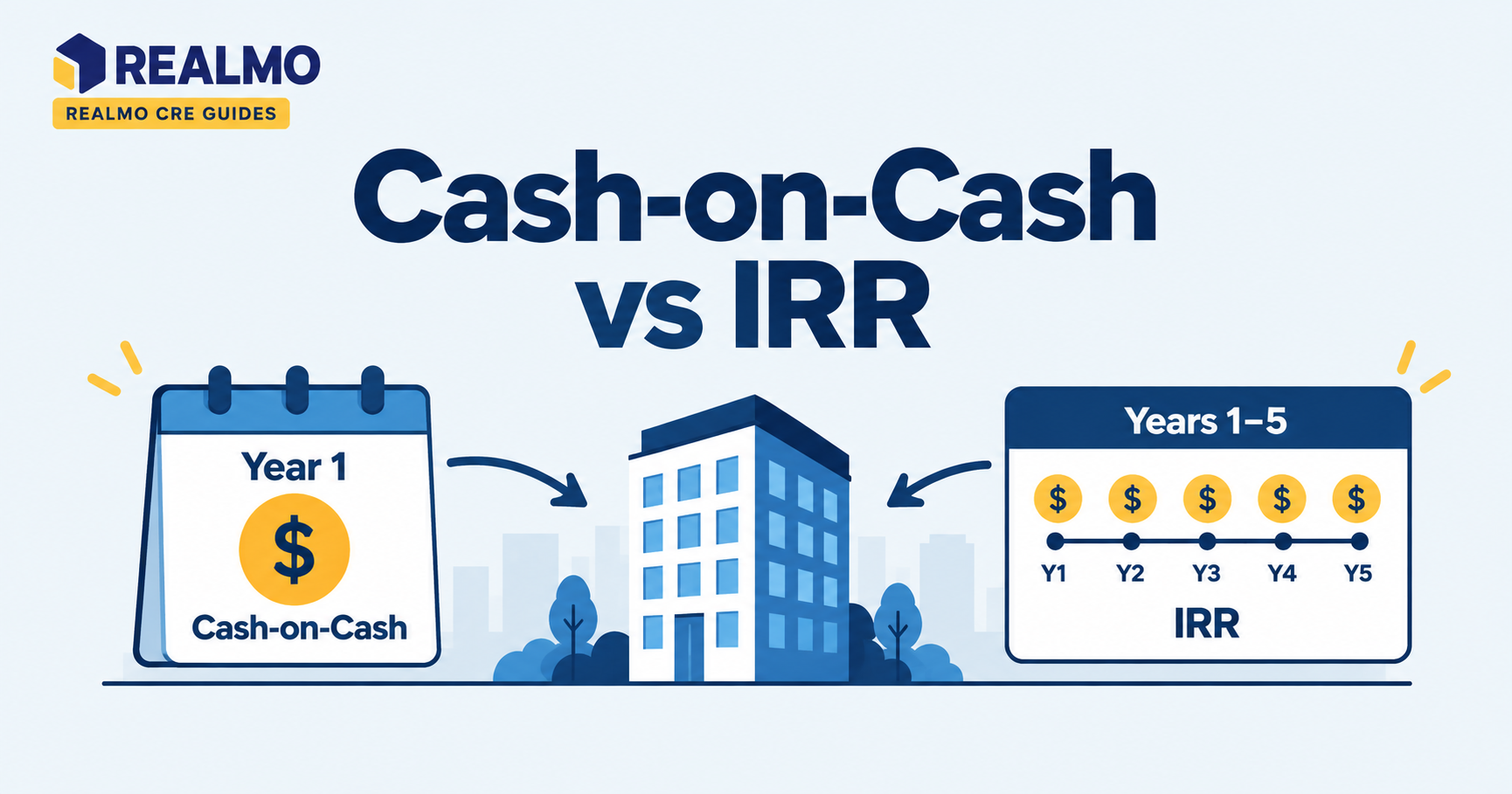
Cash flow after debt service starts at NOI and subtracts principal and interest. The result is called levered cash flow or before-tax cash flow, and it is the number that drives cash-on-cash return.
Next come the capital items. Capital expenditures, roofs, parking lots, HVAC units, elevator modernization, are lumpy and rarely spread evenly across a hold period. Leasing costs follow the rent roll rather than the calendar. A year with three expirations carries commissions and buildout allowances that the prior year did not. Owners who fund a replacement reserve smooth this volatility on paper without changing when the money leaves.
Income taxes come last, and they move in the opposite direction from intuition. Depreciation is a deduction with no cash cost, so taxable income is usually lower than cash flow, and a property can distribute cash while reporting a paper loss. The mirror case also exists: principal payments are cash out but not deductible, which is why highly amortizing loans can generate tax bills that exceed distributions. Tax outcomes depend on entity structure and personal circumstances, so confirm treatment with a licensed CPA.
NOI vs cash flow: which number lenders rely on
Lenders size loans on NOI because they are underwriting the asset’s ability to carry debt, not the borrower’s preferences. Debt service coverage ratio divides NOI by annual debt service. This means a lender’s NOI adjustments, deducting a management fee the owner performs themselves. Applying market vacancy to a fully leased building, adding a per-square-foot reserve, flow directly into loan proceeds.
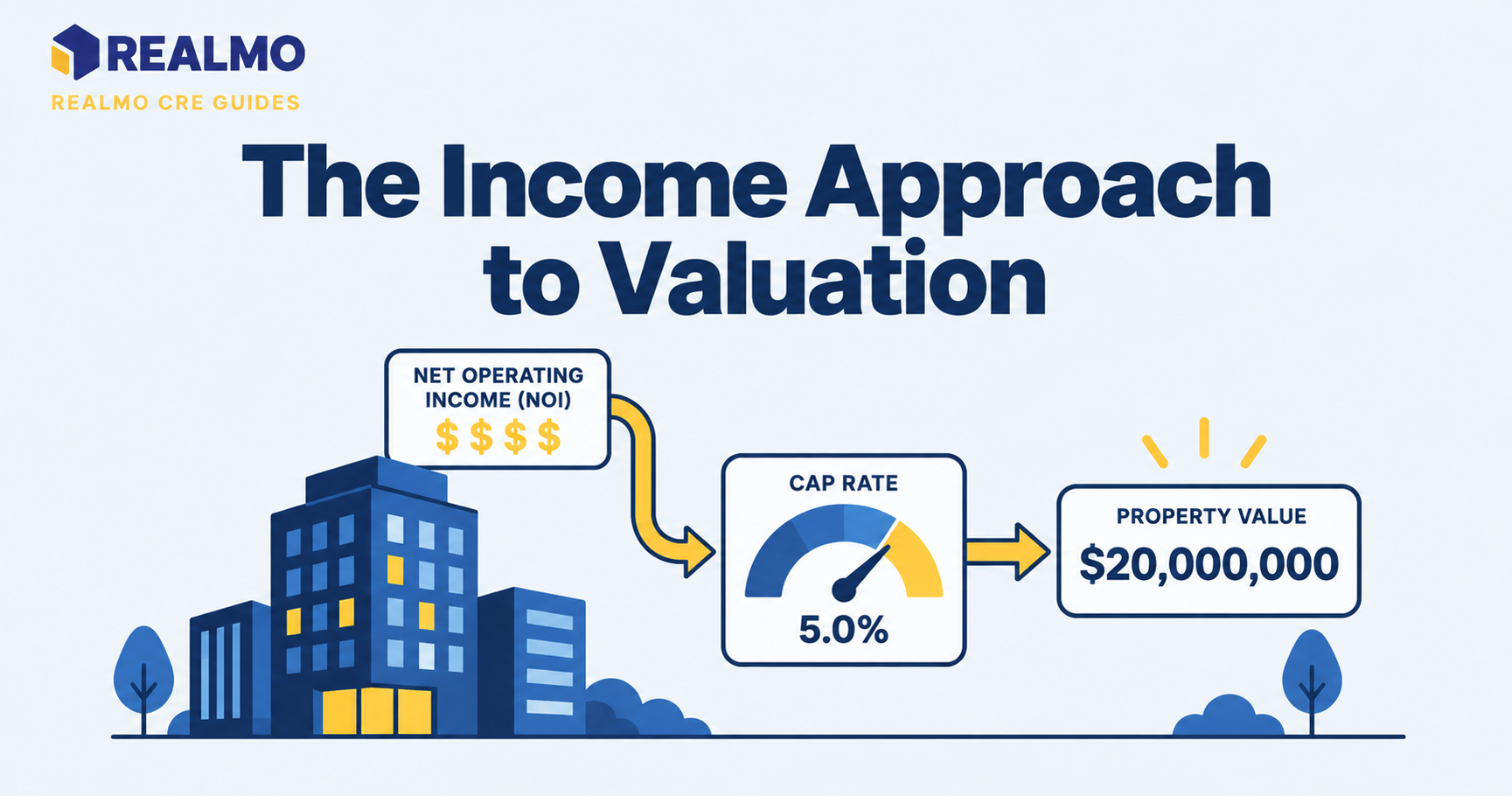
Appraisers and buyers use NOI for the same reason. Cap rate is NOI divided by value, so the metric only functions if the numerator ignores financing. Two bidders with different leverage would otherwise derive different values for identical real estate.
Cash flow governs everything after the loan closes: distributions to partners, reserve funding, whether a capital call becomes necessary, and how a refinance or sale is timed. Trailing statements are where the difference shows up, which is why underwriting a listing means rebuilding NOI from the rent roll and operating statements rather than accepting the summary line , a step made easier when ownership records and prior expense history are visible before an LOI, as they are in Realmo’s property analytics.
Worked example: one property, two very different numbers
The figures below are illustrative and chosen for round arithmetic, not drawn from current market conditions.
A 50,000-square-foot flex building produces $500,000 of NOI. The buyer pays $6,250,000 and finances 65% of the price , a $4,062,500 loan at 6.5% with a 25-year amortization schedule , leaving $2,187,500 of equity before closing costs. Annual debt service on that loan runs approximately $329,000, so cash flow after debt service is $171,000.
Year one carries two capital items. A tenant renews 12,000 square feet and receives $60,000 in improvement allowance and commissions, and the roof reaches the end of its life for $85,000. Cash flow drops to $26,000, a cash-on-cash return of roughly 1.2%.
In a stabilized year with no roof project and $25,000 budgeted for leasing costs, the same building produces $146,000 of cash flow, or about 6.7% on the same equity. NOI was $500,000 in both years and did not move.
Interpretation: the swing between 1.2% and 6.7% came entirely from items NOI excludes by design. A five-year hold that averages those years looks reasonable; a buyer who planned distributions off the first year does not. The frequent error is treating year-one cash flow as the run rate in either direction. Extrapolating the good year into a pro forma, or abandoning a sound asset because of a capital event that will not repeat.
Common mistakes when comparing the two numbers
- Comparing a seller’s NOI to a lender’s NOI. The seller’s version usually omits a management fee and a reserve. The consequence is a loan sized several hundred thousand dollars below the model, discovered after the deposit goes hard.
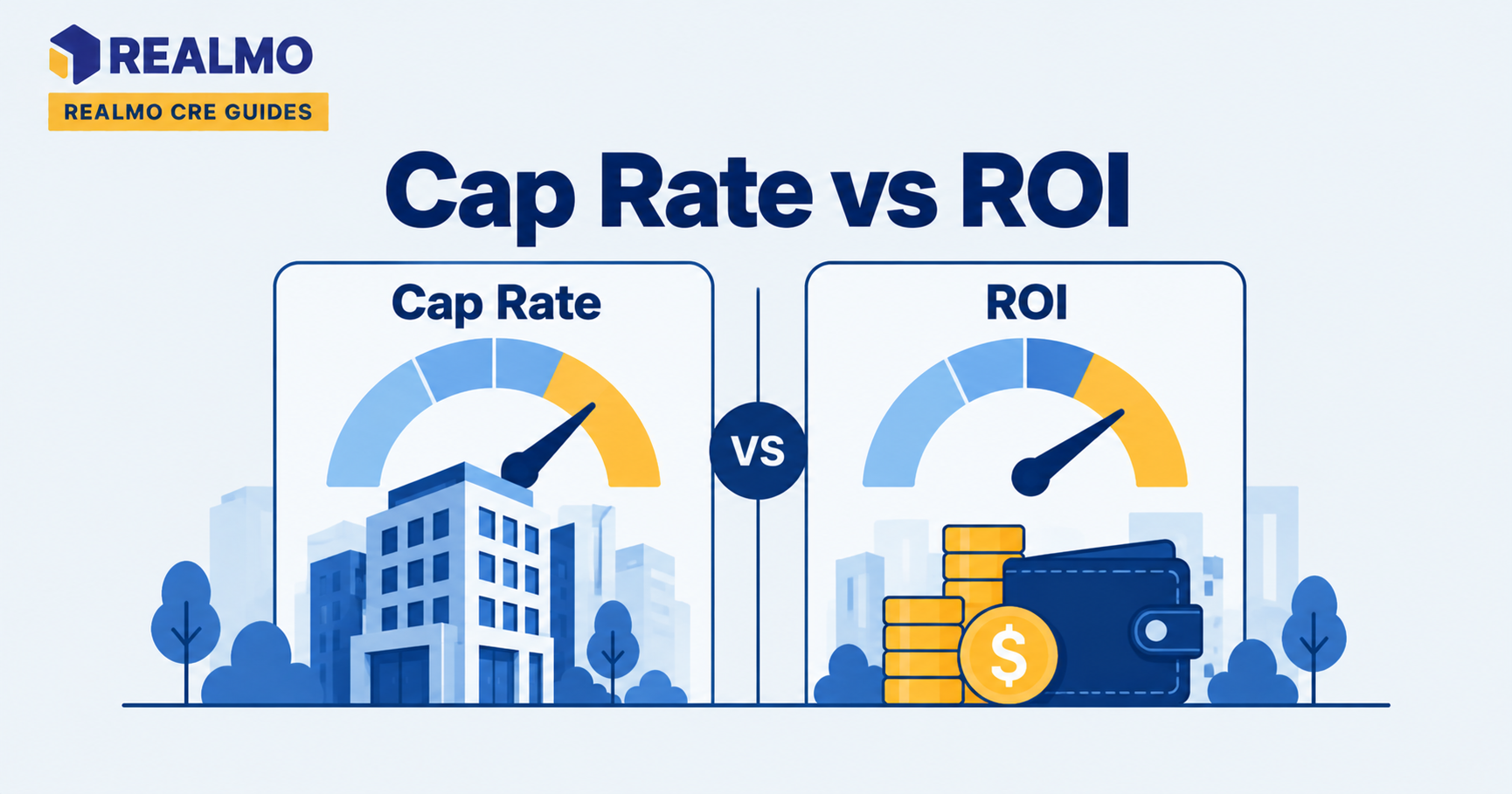
- Treating cap rate as a return. Cap rate is NOI over price, a valuation ratio that assumes no debt. Investors who read it as a yield are surprised when leveraged cash flow lands below the cap rate at high borrowing costs.
- Averaging capital expenditures into operating expenses. This depresses NOI and, through the cap rate math, the valuation, while still failing to time the actual outflow correctly.
- Ignoring rent roll timing. A building with staggered expirations and a building with three simultaneous expirations can share an NOI and have completely different cash flow profiles for two years running.
- Forgetting that principal is not deductible. Owners assume distributions and taxable income move together, then face a tax liability larger than the cash they received.
Related terms
- Net Operating Income (NOI)
- Cap Rate
- Cash-on-Cash Return
- Debt Service Coverage Ratio (DSCR)
- Operating Expense Ratio
- Capital Expenditures in CRE
- Effective Gross Income
FAQ
Is NOI the same as profit?
Does NOI include mortgage payments?
No, and this is intentional. Excluding debt service lets buyers compare properties independently of how each is financed, which is what makes cap rate a usable valuation tool. Once the loan is in place, principal and interest are subtracted from NOI to reach cash flow after debt service.
Does NOI include mortgage payments?
No, and this is intentional. Excluding debt service lets buyers compare properties independently of how each is financed, which is what makes cap rate a usable valuation tool. Once the loan is in place, principal and interest are subtracted from NOI to reach cash flow after debt service.
Why is my cash flow lower than my cap rate suggests?
Cap rate is an unlevered measure. When the loan constant, annual debt service divided by loan amount, exceeds the cap rate, leverage reduces the return on equity rather than increasing it. Capital expenditures and leasing costs, both excluded from NOI, pull actual cash flow lower still.
Should capital expenditures be deducted from NOI?
Practice splits here. Sellers and appraisers exclude them, while lenders usually deduct a per-square-foot replacement reserve when sizing a loan. Both conventions are defensible. The problem is comparing figures built on different conventions, so identify the treatment before using any NOI in a valuation.