Subleasing Commercial Space: How a Commercial Sublease Works
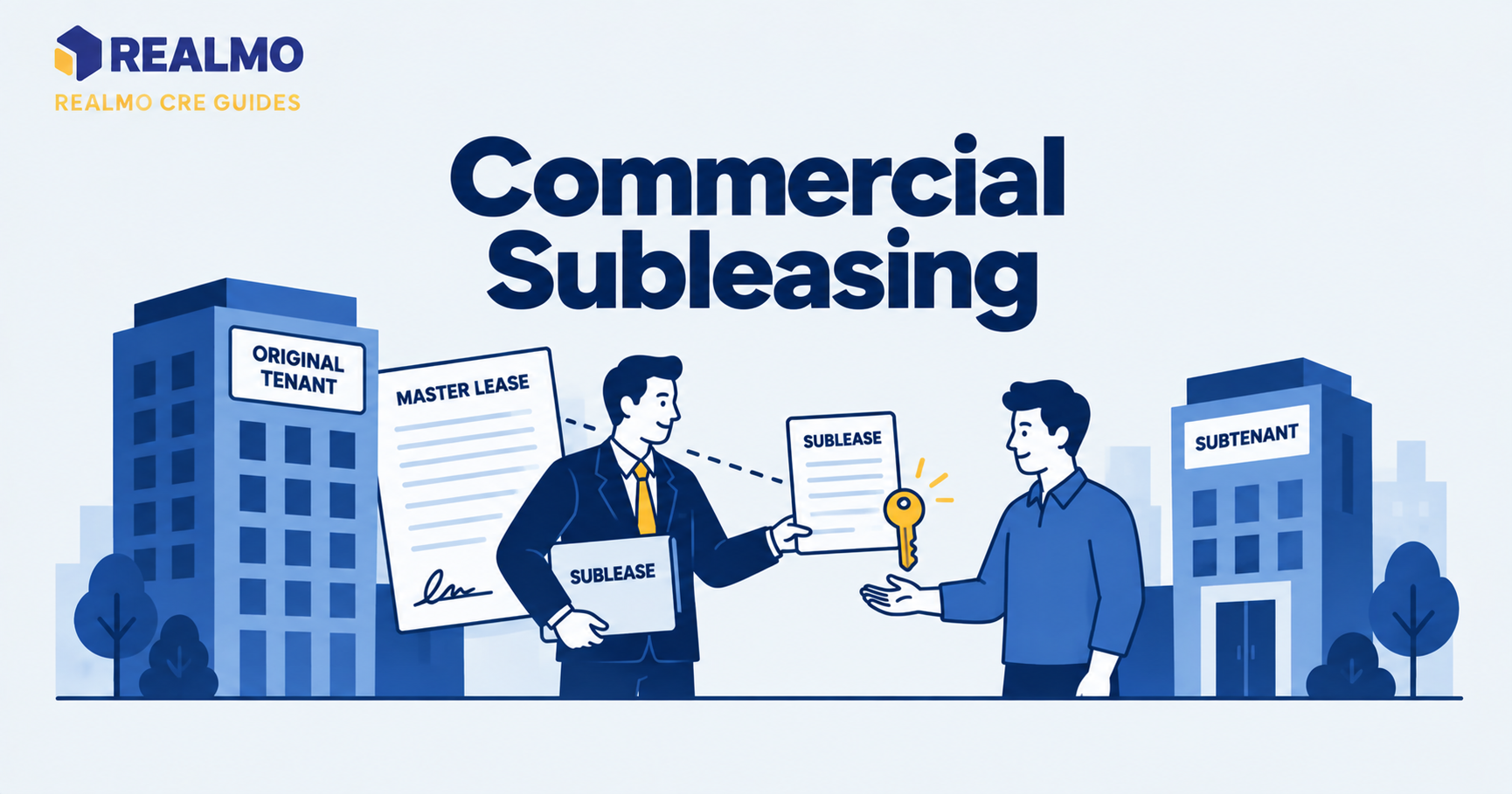
A commercial sublease is a contract in which an existing tenant rents its leased space, in whole or in part, to a third party for less than the remaining term. The original tenant stays fully liable to the landlord under the master lease. The subtenant pays the sublandlord, not the owner.
The situation that pushes a tenant to sublease
Take an illustrative case. A services firm signs a seven-year lease on 12,000 square feet. By year four, headcount has shifted to hybrid work and half the floor sits dark. Rent is still due on the first of every month, and walking away triggers a default with an acceleration clause and a drawn-down letter of credit.
Subleasing is the exit that does not require the landlord to tear up the contract. It converts dead space into partial rent recovery while the tenant keeps its lease, its address, and its renewal rights. The trade is real money and real risk. The tenant becomes a landlord to someone it did not underwrite, on space it cannot afford to have vacant twice.
What a commercial sublease is and who stays liable
Two contracts run in parallel. The master lease binds the landlord and the original tenant. The sublease binds that same tenant, now acting as sublandlord, and the subtenant.
The landlord and the subtenant have no direct contract between them. A subtenant cannot enforce lease rights against the owner without a separate recognition agreement, and its occupancy ends the day the master lease ends. If the sublandlord defaults on rent in month eight, the sublease can be terminated with it.
Liability does not move. The sublandlord owes full rent whether or not the subtenant pays, and most master leases extend the tenant’s responsibility to damage, code violations, and holdover caused by anyone occupying under it.
Sublease vs. assignment: what actually transfers
A sublease keeps a reversion. The tenant gives up occupancy for a period shorter than the remaining term, then gets the space back, even if only for one day. An assignment of lease transfers the entire remaining interest, and the assignee deals with the landlord directly.
That one day carries legal weight. Courts in several states treat a transfer of the full remaining term as an assignment regardless of the document’s title. Drafters routinely end the sublease term at least one day before the master lease expires.
Assignment does not release the original tenant on its own. Release requires a written novation signed by the landlord, and landlords rarely grant it without a substitute of equal or better credit.
How landlord consent clauses control the deal
Almost every US commercial lease conditions subletting on landlord consent. The standard written into the clause decides how much leverage the tenant has. “Sole and absolute discretion” gives the landlord a veto with no explanation. “Not to be unreasonably withheld” limits the landlord to defensible grounds, usually subtenant credit, proposed use, and building compatibility.
Three provisions matter more than the consent standard itself.
A recapture right lets the landlord respond to a sublease request by taking the space back and terminating that portion of the lease. Profit-sharing splits any excess of sublease rent over master rent, commonly at 50 percent to the landlord after the tenant recovers its transaction costs. A response deadline, often 15 to 30 days from a complete submission, keeps the request from stalling a signed subtenant.
Submit the package in one piece: the proposed sublease, the subtenant’s financial statements, a description of use, and the intended alterations. Partial submissions restart the clock.
Why sublease space prices below direct space
Sublease space competes at a discount because it offers less. The term is whatever is left on the master lease, so a tenant needing five years cannot sign. There is usually no renewal option, no expansion right, and no tenant improvement allowance, since the sublandlord is spending its own cash rather than the landlord’s.
Condition is the second factor. Sublease space is delivered as-is, often furnished with the sublandlord’s cubicles and cabling, which suits a company that wants to move in quickly and penalizes one that needs a different layout.
The third factor is counterparty risk. The subtenant’s occupancy depends on a company that just decided it no longer wants the space. Pricing a sublease means comparing it against direct availabilities in the same submarket, on the same rent measurement basis; Realmo’s listing and analytics data covers both sides of that comparison.
Worked example: the cost of subleasing at a loss
Illustrative figures, round numbers.
A tenant holds 10,000 square feet with 36 months remaining. Master base rent is $30.00 per square foot, triple net, so $300,000 per year and $900,000 over the remaining term. The best sublease offer comes in at $22.00 per square foot with two months of free rent.
Steps:
Sublease rent at $22.00 per square foot is $220,000 per year, or $18,333 per month. Over 36 months that is $660,000. Two months free reduces collections to $623,333. A 4 percent brokerage commission on the sublease rent costs $26,400. Demising the space and repainting costs $50,000. Net recovery is $546,933.
Result: the tenant’s remaining exposure falls from $900,000 to $353,067.
How to read it: the comparison is $353,067 against $900,000, not against zero. A sublease priced below master rent still recovers roughly 61 percent of the obligation in this example. Operating expenses pass through to the subtenant under a net structure, but any vacancy period leaves them with the sublandlord.
The common error is calling the $8.00 per square foot gap “the loss” and stopping there. The gap is $240,000. Actual cost is $353,067 once free rent, commission, and demising work are included.
What a subtenant must read in the master lease
Ask for the full master lease with all amendments before signing a letter of intent. The sublease will incorporate most of it by reference, which means the subtenant inherits obligations it never negotiated.
Check the operating expense escalation method and the base year, because a base year set years ago can produce pass-throughs far above what a direct lease would carry today. Confirm the use clause covers the intended business. Read the surrender and restoration provisions, since the obligation to remove alterations can land on whoever built them.
Then verify that the sublandlord is current. An estoppel certificate signed by the landlord confirms no default exists and states the rent actually payable. A recognition or non-disturbance agreement is the only reliable protection: it lets the subtenant stay if the master lease terminates early.
Sublease documents raise contract and tax questions specific to each state and each lease. Have a licensed attorney and a tenant-side broker review the package before signing.
Common mistakes in commercial sublease deals
- Marketing before reading the consent clause. A recapture right can take the space back once the tenant shows its hand, killing a deal already at LOI.
- Ignoring the profit-share. In rising markets, a sublandlord can sign above master rent and hand most of the upside to the landlord because nobody read that paragraph.
- Skipping the recognition agreement. The subtenant builds out, then loses everything when the master lease is terminated for a default it never caused.
- Underwriting the subtenant loosely. The sublandlord owes rent regardless, so a weak subtenant converts one problem into two.
- Matching the sublease term to the master lease expiration date. That risks recharacterization as an assignment, with different consequences under the lease and under state law.
Related terms
Assignment of lease · Estoppel certificate · Holdover tenancy · Operating expense escalations · Tenant improvement allowance · Triple net lease · Letter of intent
FAQ
Do I need landlord approval to sublease commercial space?
In almost all US commercial leases, yes. The lease states whether consent may be withheld at the landlord’s sole discretion or only on reasonable grounds. Submitting a complete package, including the proposed sublease and the subtenant’s financials, starts the response period written into the clause, commonly 15 to 30 days.
Can I make a profit on a commercial sublease?
Sometimes, but the lease usually limits it. Profit-sharing clauses give the landlord a share of any excess over master rent, frequently 50 percent after the tenant recovers commissions and improvement costs. Read the exact deduction language before pricing the space, since definitions of recoverable costs vary between leases.
Am I still responsible if my subtenant stops paying?
Yes. The sublease does not change the master lease, and the sublandlord owes the landlord full rent on schedule. Remedies against the subtenant run through the sublease itself, which is why security deposits and personal or corporate guaranties matter on this side of the deal.
What happens to a sublease if the master lease is terminated?
The sublease normally terminates with it, since it depends on the tenant’s underlying interest. A recognition or non-disturbance agreement signed by the landlord changes this by converting the subtenant into a direct tenant on stated terms. Without one, a subtenant can lose occupancy and its build-out.
How long can a commercial sublease run?
Up to the remaining master lease term, minus at least one day. Transferring the full remaining term can be treated as an assignment rather than a sublease, which changes the parties’ rights. Renewal options in the master lease belong to the original tenant unless the sublease expressly passes them through.