Absolute vs Standard NNN: What an Absolute NNN Lease Covers
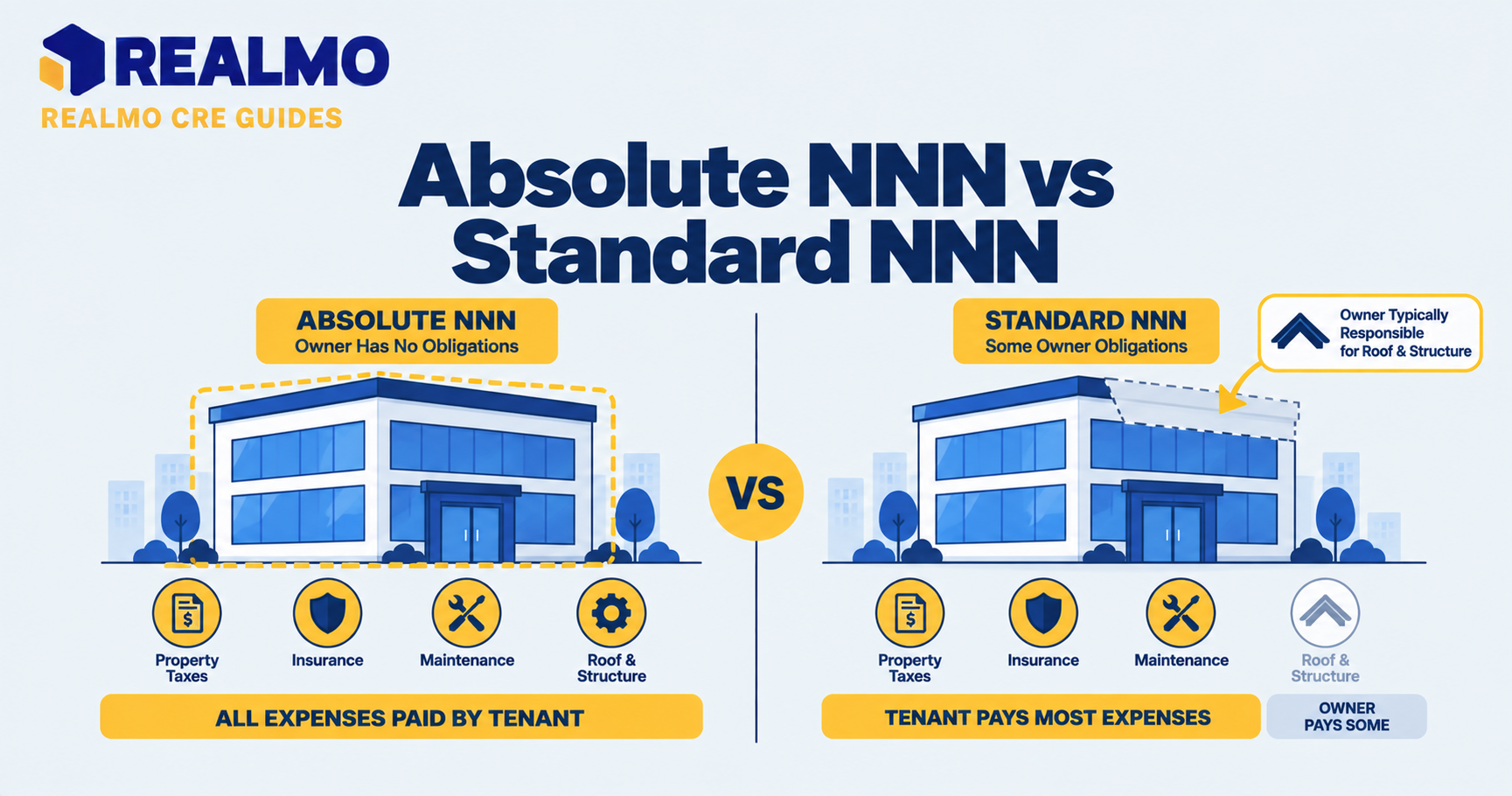
An absolute NNN lease shifts every property cost and risk to the tenant, including roof, structure, casualty restoration, and condemnation. A standard NNN lease passes taxes, insurance, and maintenance to the tenant but keeps roof and structure with the landlord. The listing label rarely settles which one you actually bought.
Where the roof lands after closing
You close on a single-tenant pharmacy with 11 years left on the term. The offering memo says absolute NNN. In year three, a hailstorm ends the life of a 14-year-old TPO membrane.
Now you read the lease. The maintenance clause hands the tenant everything “excluding roof, foundation, and structural components.” That exclusion is the whole deal. The replacement is a landlord cost, the insurance deductible is a landlord cost, and neither shows up in the net operating income you underwrote.
Rent never stopped. That is what “net” protected. It did not protect the capital account, and the difference between the two lease structures shows up exactly once, in the year something expensive breaks.
What an absolute NNN lease obligates the tenant to do
An absolute NNN lease, also called a bondable lease or a hell-or-high-water lease, leaves the landlord with no operating or capital duties. The tenant pays real estate taxes, insurance premiums, common area costs, and all repairs. Roof, foundation, exterior walls, parking lot, and HVAC replacement sit on the tenant’s side.
The obligations go past expenses. After a fire, the tenant keeps paying full rent, applies the insurance proceeds, and rebuilds. There is no rent abatement and no termination right. In a partial condemnation, the tenant continues performing and the award allocation follows the lease, not a default rule.
That structure looks like a ground lease with a building attached. Your only real exposure is credit. If the tenant fails, every obligation you sold off comes back at once, at a building you have never maintained.
What a standard NNN lease leaves with the landlord
Standard NNN keeps the pass-throughs and returns the structural items. The usual carve-outs are roof, foundation, load-bearing walls, and the parking lot. Utility lines outside the building shell are a frequent addition.
Caps do the quieter damage. A clause limiting tenant HVAC spending to $500 per unit per year, with anything above that on the landlord, converts a mechanical failure into your expense. End-of-term surrender standards matter for the same reason.
Plenty of listings marketed as triple net are closer to a double net lease, where the tenant covers taxes and insurance while the owner carries structure and roof. The marketing label is not a lease term. The document is.
The four clauses that decide which lease you have
Start with the repair and maintenance section, then read whatever “landlord obligations” paragraph the lease contains. If that paragraph lists anything beyond quiet enjoyment and title, the lease is not absolute.
The casualty clause is second. Look for abatement language, restoration duties, and a tenant termination right triggered by damage above a stated percentage during the final years of the term. Third, the condemnation clause: check who receives the award for the building versus the leasehold, since state law and the award-allocation language drive the split.
Fourth, the guaranty. An absolute lease signed by a 14-unit franchisee entity is not the same instrument as one backed by the corporate parent, even with identical text. Confirm the signing entity, the guarantor, and whether the guaranty survives assignment. Have counsel read the actual document before you sign anything.
Worked example: pricing roof and structure risk
Illustrative figures, round numbers, not market data.
A 5,000 sf freestanding retail building is offered at $2,000,000 with $120,000 of base rent, a 6.00% cap rate. Version A is absolute NNN. Version B has the same rent and term, with roof, structure, and parking retained by the landlord.
For Version B, price the retained items across a 15-year hold. Roof replacement at $75,000 in roughly year eight. Parking lot resurfacing at $40,000. A structural contingency of $25,000. That totals $140,000, or about $9,300 per year annualized.
Effective NOI drops to roughly $110,700. At the $2,000,000 asking price, the buyer’s real going-in yield is about 5.54%. To hold a 6.00% net yield, the price has to be near $1,845,000.
Interpretation: the roof and structure carve-out is worth roughly $155,000 on this illustrative deal, or about 8% of price. That is the number to negotiate over, not a vague “structural risk” comment.
One common error: treating the $9,300 as a smooth annual line. The roof lands in a single year, hits cash flow, and can compress debt service coverage right when a loan covenant is tested. Underwrite the replacement reserve and the timing separately.
Common mistakes with absolute NNN deals
- Accepting the term “absolute NNN” from a broker summary without reading the repair and casualty clauses. The carve-out is usually one line inside a longer paragraph.
- Assuming an absolute lease removes lender reserve requirements. Many lenders still escrow for roof and structure based on the property condition assessment, which lowers distributable cash regardless of what the lease says.
- Underwriting a franchisee-signed lease at corporate-credit pricing. When the operator files, the absolute obligations are worth what the estate is worth.
- Ignoring the last five years of term. A tenant with 24 months left has little reason to fund a $75,000 roof, whatever the lease requires, and enforcement takes longer than the remaining term.
- Skipping roof age and warranty transferability in diligence. A 15-year warranty that voids on transfer is not an asset.
Before you accept a listing’s lease label, pull the building’s ownership and use history on Realmo, then request the full lease and every amendment rather than the abstract.
Related terms
Triple net lease · Double net lease · Single-tenant net lease investing · Cap rate · Replacement reserves · Ground lease · Lease guaranty
FAQ
Is an absolute NNN lease the same as a bondable lease?
In practice, yes. Both describe a lease where the tenant carries all costs and keeps paying rent through casualty and condemnation, with no abatement or termination right. “Bondable” is the older financing term, used because the income stream behaves like a corporate bond obligation. Confirm the actual clauses, since neither label is legally defined.
Who pays for the roof under a standard NNN lease?
The landlord, in most standard NNN forms, along with foundation, structural walls, and frequently the parking lot. Some leases split the cost by amortizing a roof replacement over its useful life and billing the tenant for the portion falling inside the remaining term. Check the repair clause and any amortization language before assuming either outcome.
Why do absolute NNN properties sell at lower cap rates?
Because the buyer’s stated NOI is closer to actual cash flow. With no landlord capital duties, there is nothing to reserve against, so the going-in yield and the net yield converge. Roof-and-structure deals require an annual reserve, which lowers effective yield at the same price and shows up as a wider cap rate.
Does an absolute NNN lease protect me if the tenant goes bankrupt?
No. Every obligation depends on the tenant’s ability to perform. Under Section 365 of the Bankruptcy Code, the lease can be rejected, and deferred maintenance you never monitored becomes your problem immediately. Underwrite the guarantor, the unit-level rent coverage, and the building’s re-tenanting prospects as if the lease did not exist.