How Vacancy Affects Property Value
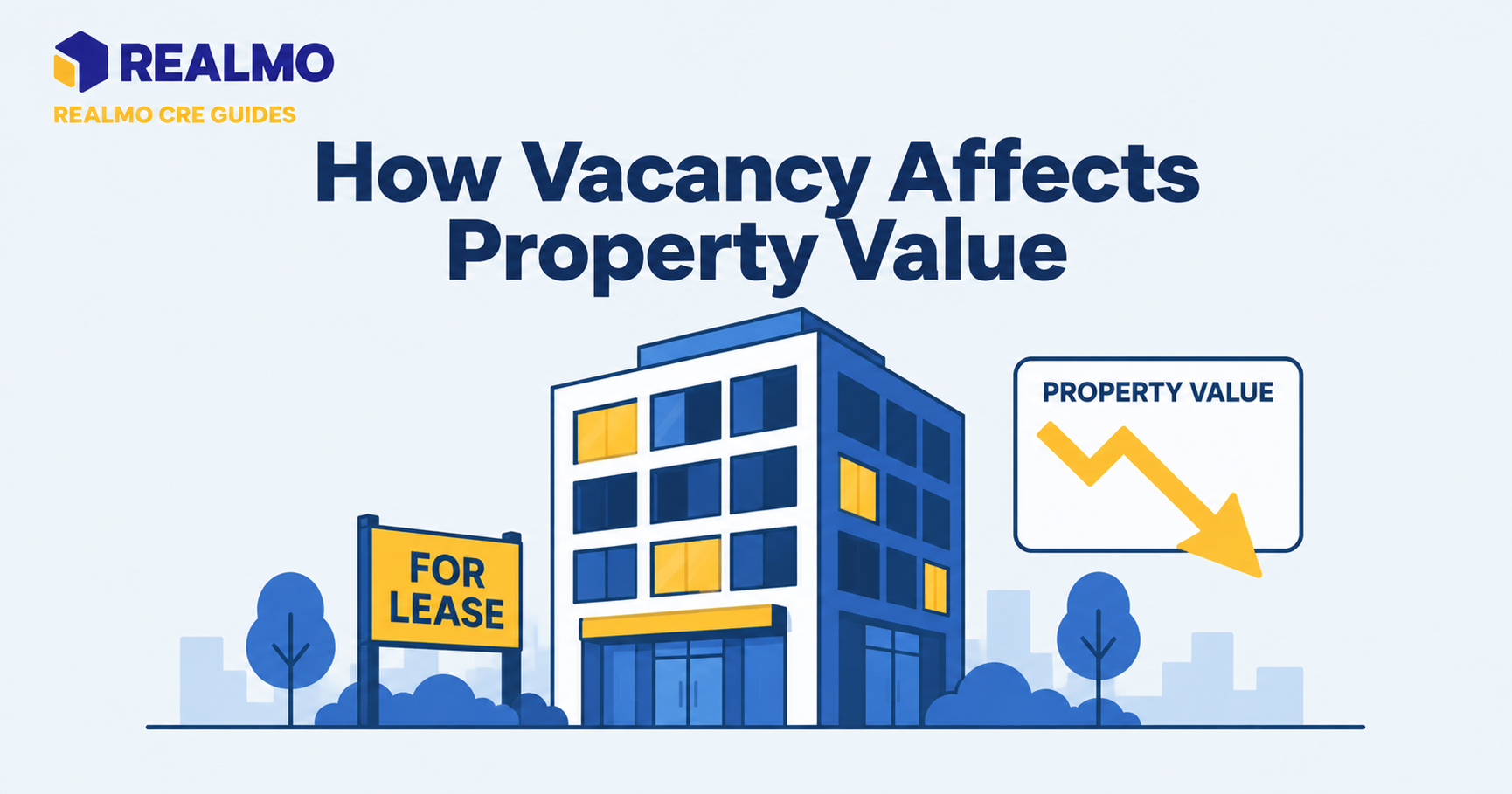
Vacancy reduces property value by cutting net operating income and raising the risk premium a buyer applies to that income. Empty space stops collecting rent while most operating costs continue, and the cost to re-lease it is subtracted from what a buyer will pay. The vacancy impact on value depends on how fast the space re-leases and at what rent.
Why one empty suite changes your whole number
An owner with a five-unit retail strip loses a tenant at lease expiration and assumes the hit is temporary. 20% of the space is dark, so the building is worth roughly 20% less until it fills. Then the offers arrive, and they are worse than that.
Buyers do not simply prorate. Buyers rebuild the rent roll from scratch and apply their own view of market rent. They subtract TI, leasing commissions, and carrying costs. They may also use a higher cap rate because the asset is no longer proven. A vacancy that reads as a short-term inconvenience on your operating statement reads as unpriced execution risk on theirs. Understanding how that translation works is the difference between listing at a defensible number and sitting on the market for three quarters.
Vacancy impact on value: the NOI-to-cap-rate chain
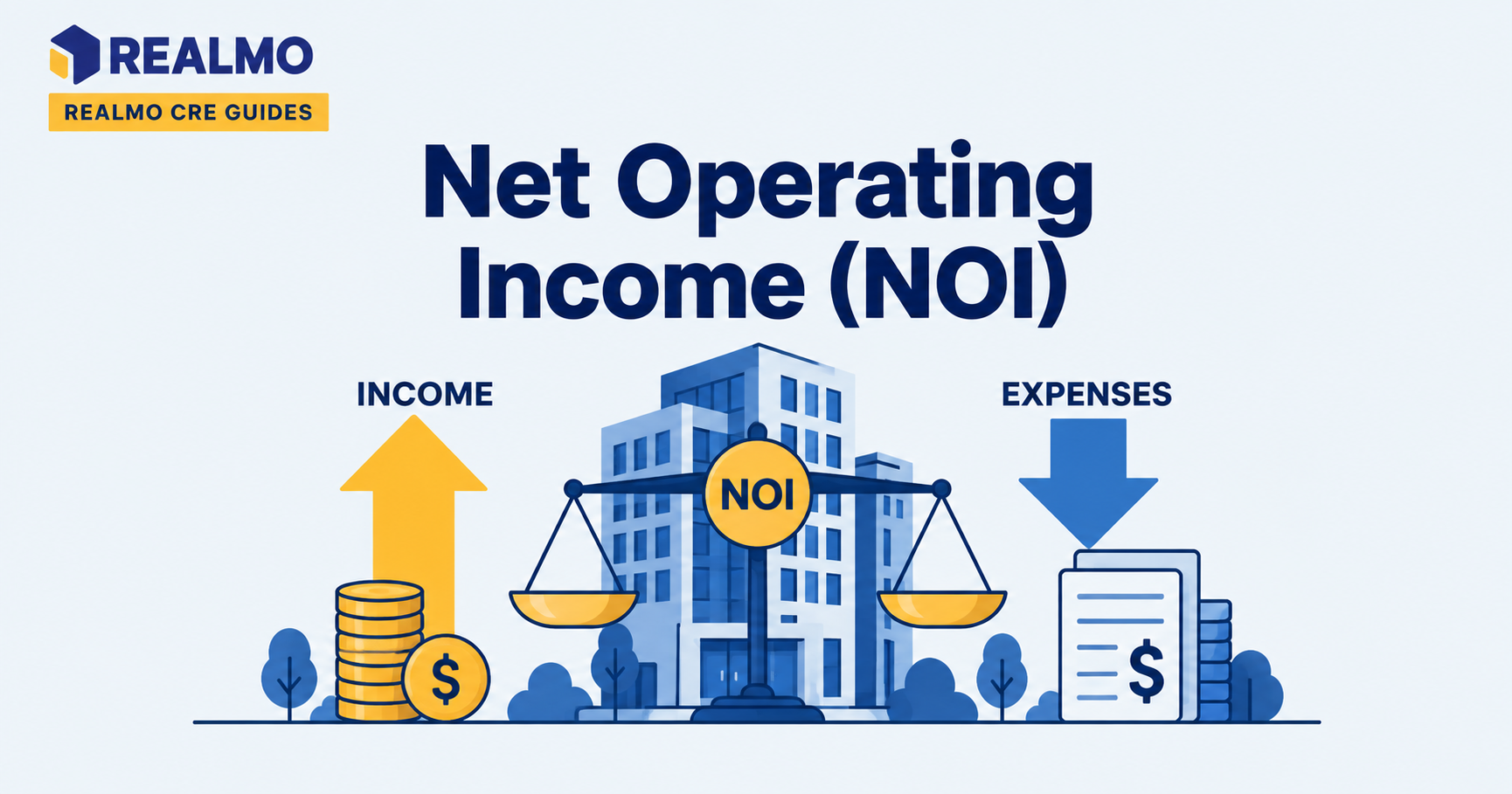
Value in the income approach is net operating income divided by a cap rate. Vacancy attacks both halves of that fraction at the same time, which is why the damage compounds.
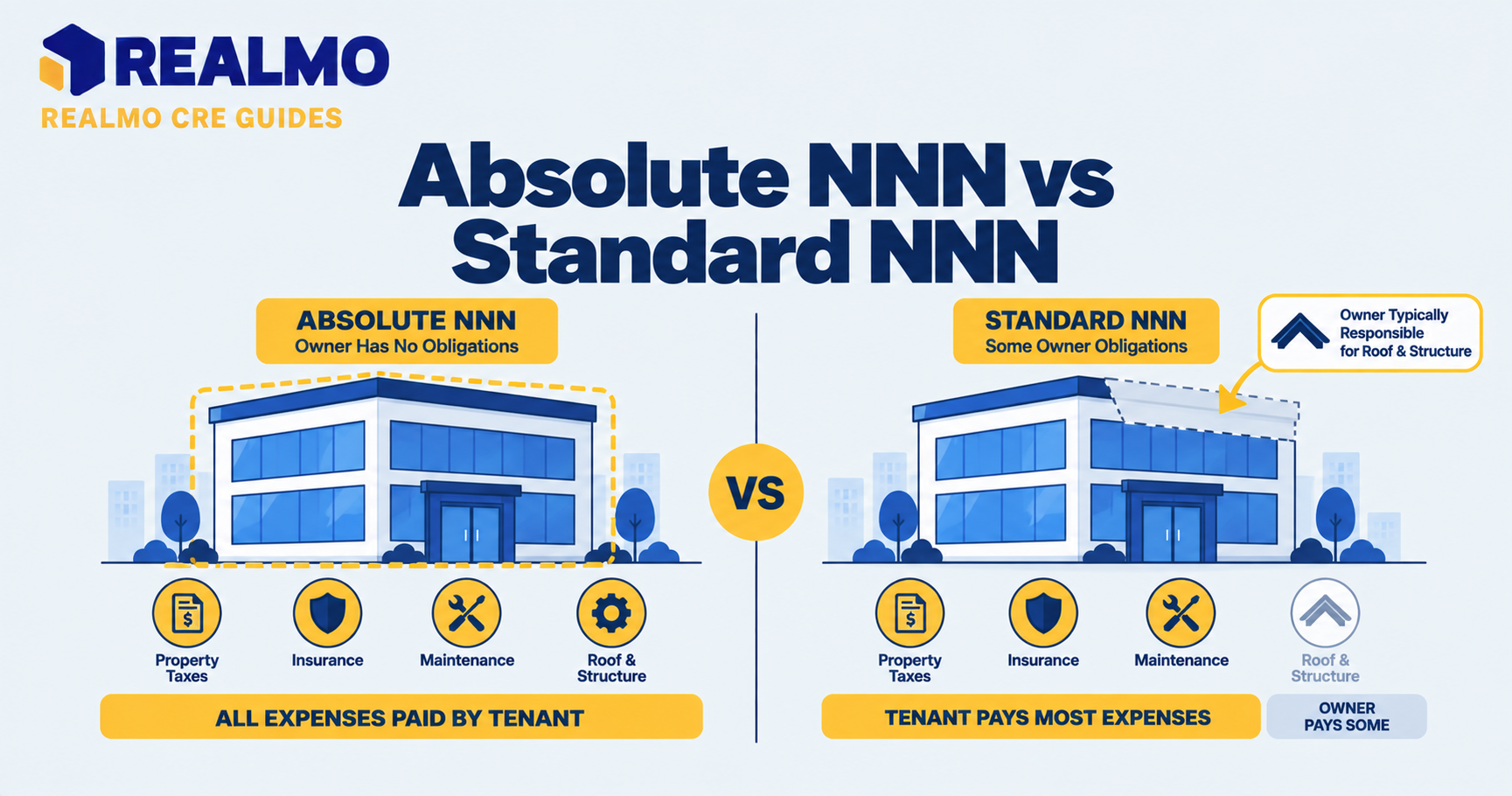
On the income side, lost rent flows straight to the bottom line while property taxes, insurance, base management, and reserves keep running. In a net-lease building, the owner also absorbs the vacant unit’s share of common area maintenance, so the loss exceeds the face rent.
On the cap rate side, buyers price uncertainty. A stabilized building with staggered expirations and paying tenants earns a lower cap rate than an identical building with dark space. The difference is the missing signed replacement. Even a modest upward adjustment in the cap rate applied can cost more value than the missing rent itself.
Physical vacancy, economic vacancy, and credit loss
Physical vacancy measures empty square feet. Economic vacancy measures uncollected income, and it is almost always the larger number. A building can be 100% physically occupied and still lose value through free rent, tenant defaults, and below-market renewals. It can also lose value when an occupying tenant stops paying.
Sophisticated buyers underwrite economic vacancy plus a separate credit loss allowance, because a lease is only worth the tenant behind it. Owners who market on physical occupancy alone invite repricing during due diligence. Bank statements then replace the rent roll as the source of truth.
Why buyers price stabilized income, not today’s rent roll
Appraisers and acquisition teams rarely capitalize the current month’s income. Buyers project a stabilized year and apply vacancy and collection loss assumptions from comparable properties in the same submarket and asset class. They then deduct the cost of reaching stabilization.
This matters because it cuts both ways. A temporarily empty building is not worth current depressed NOI divided by a market cap rate. That math is far too punitive. However, it is also not worth stabilized NOI at a stabilized cap rate because someone must fund the lease-up. The correct answer sits between those poles, where most seller-buyer disputes live.
Lease-up costs a buyer subtracts from your asking price
A buyer converts vacancy into several deductions. These include downtime, non-recoverable carrying costs, TI allowances, leasing commissions, free rent, and capital work needed to compete.
The larger and more specialized the space, the longer the assumed downtime and the higher the TI package. Second-generation office and flex space carry the heaviest improvement costs; small shop retail and warehouse tend to re-lease faster with lighter build-outs. Compare your building’s condition and asking rent against nearby availabilities on Realmo before you go to market. That comparison shows which deductions a buyer can defend.
Worked example: one empty suite in a five-unit strip
Illustrative figures only, rounded for clarity.
A 10,000-square-foot strip center has five equal units. Market rent is $24 per square foot, total operating expenses run $80,000 per year, and one 2,000-square-foot unit is vacant. Stabilized gross potential rent is $240,000, so stabilized NOI is $160,000. At an illustrative 7.0% cap rate, the stabilized value is roughly $2.29 million.
Capitalizing today’s income gives a different figure. $192,000 collected minus $80,000 of expenses equals $112,000 of NOI. At 7.0%, that implies about $1.60 million. That understates value by nearly $700,000, far more than the space could ever cost to fill.
A buyer’s actual math lands in between. Assume nine months of downtime, equal to $36,000 of lost rent, plus $9,000 of non-recoverable carry. Add a $30-per-foot TI allowance, or $60,000. A 5% five-year leasing commission adds $12,000, and three months of free rent add $12,000. Total deductions come to about $129,000. Because the asset is not yet proven, the buyer applies 7.25% instead of 7.0%. That produces $2.21 million, less $129,000, or roughly $2.08 million.
Interpretation: the single vacant unit costs about $210,000 of value, not the $685,000 implied by capitalizing current income. Roughly 40% of that loss comes from the cap rate adjustment alone, not from the missing rent. The common error is assuming full asking rent with no free rent. That quietly lowers the lease-up deduction and moves price toward the seller by six figures.
Valuation assumptions vary by market and property type; a licensed appraiser or broker should review any figure you rely on for a real transaction.
Why vacancy hurts single-tenant buildings hardest
In a multi-tenant building, one departure removes a slice of income. In a single-tenant building, it removes all of it, and the property converts from an income asset into a speculative one overnight.
That binary risk is why single-tenant net lease assets trade so heavily on tenant credit and remaining lease term. As the expiration date approaches without a renewal, the market begins pricing rollover risk well before the space is actually empty. The same logic applies in reverse to buildings with laddered expirations: staggered rollover is a value feature. Clustering multiple expirations in one year is a value problem even while occupancy reads 100%.
Common mistakes owners make when pricing vacant space
- Marketing stabilized value without deducting lease-up cost. Buyers deduct lease-up cost anyway. Marketing stabilized value without it only lengthens the marketing period and weakens the seller’s position after low first-round offers.
- Using asking rent instead of achieved rent. If recent leases in the building were signed with concessions, the vacant unit will be too, and due diligence will surface the difference.
- Ignoring non-recoverable expenses on empty space. In a net-lease property, the owner picks up the vacant unit’s CAM, taxes, and insurance share, which makes economic vacancy worse than physical vacancy suggests.
- Treating a renewal-risk building as fully occupied. A lease expiring within twelve months is priced as partial vacancy by any competent buyer.
- Chasing occupancy with a bad lease. A long-term tenant at below-market rent with weak credit can reduce value more than the vacancy it replaced. The below-market income is locked in.
Related terms
Net operating income · Cap rate · Effective gross income · Tenant improvement allowance · Lease-up period · Weighted average lease term (WALT) · Income approach to valuation
Frequently asked questions
Does 10% vacancy mean my property is worth 10% less?
No. The value loss is usually smaller than the vacancy percentage when the space re-leases quickly at market rent. It can be larger when downtime is long, tenant improvements are heavy, or the vacancy signals a demand problem. Buyers price the cost of stabilization, not the raw occupancy figure.
How does vacancy affect an appraisal?
An appraiser capitalizes stabilized income using a market-derived vacancy and collection loss assumption, then deducts lease-up costs and lost rent as a separate adjustment. Current occupancy influences both the stabilization timeline and the risk rating applied to the income stream.
Should I lower rent to fill space before selling?
That depends on lease term and tenant quality. A below-market lease signed to boost occupancy locks in reduced income for the full term and can lower value more than the vacancy did. A short-term lease at a defensible rent preserves more optionality for a buyer.
Why do lenders care about vacancy more than owners expect?
Vacancy affects the debt service coverage ratio, which lenders test against current income rather than stabilized projections. A vacancy that looks manageable to an owner can reduce loan proceeds or trigger a cash management provision under an existing loan.