Rent Escalation Clause: How Rent Bumps Work in CRE Leases
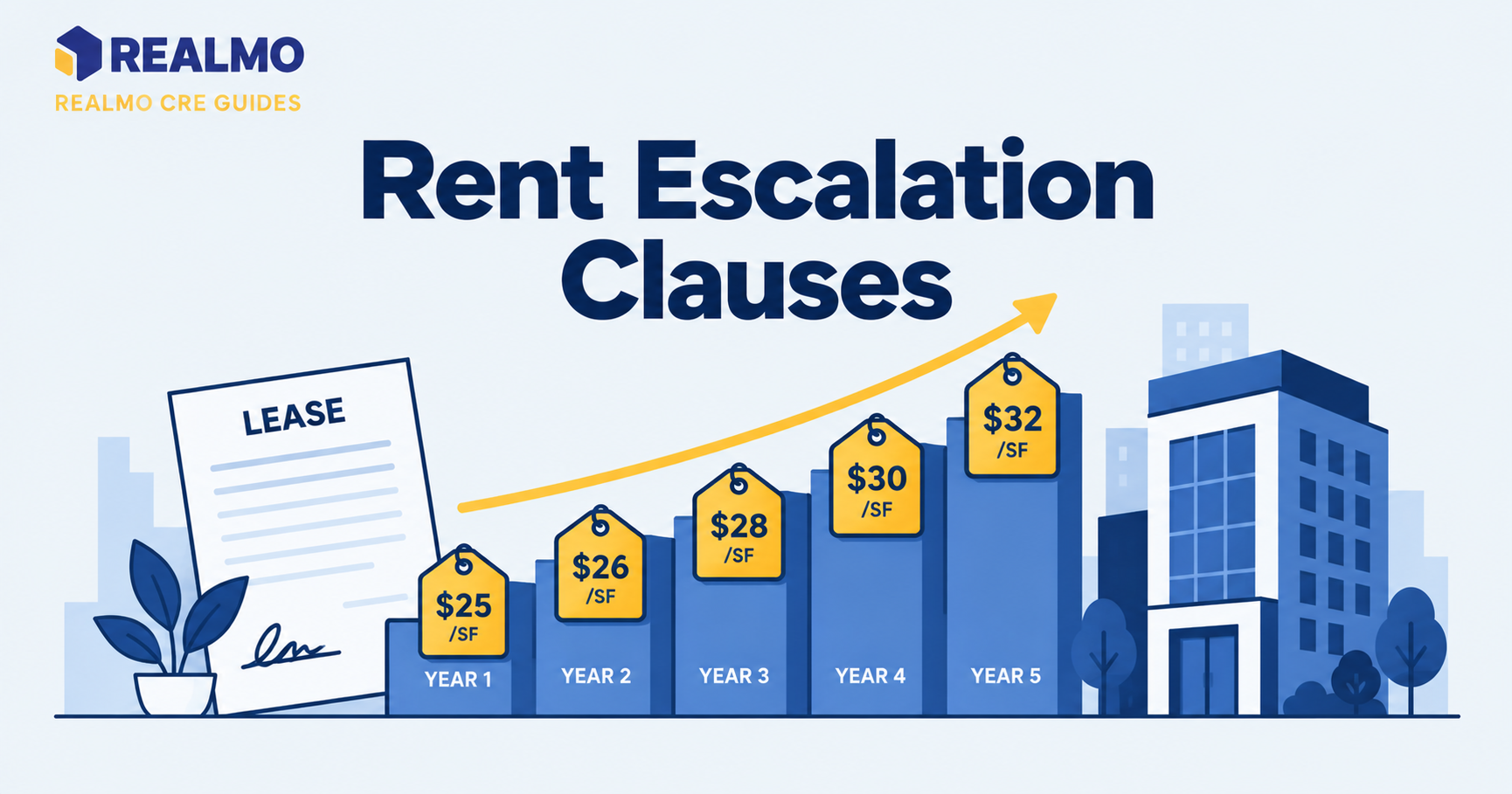
A rent escalation clause is the lease provision that raises base rent on a set schedule during the term. It sets the method as well as the amount: a flat percentage, a stated dollar step, an index like CPI, or a reset to market. Every other rent component sits on top of it.
What weak escalations cost you at refinance
A tenant asks for flat rent through year three of a ten-year deal. You agree. Rent still reaches the same headline number in year ten, so the concession reads as cheap.
It isn’t. Lenders size loans on in-place net operating income, and buyers capitalize the NOI at closing, not the peak rent printed on the schedule. Three flat years pull down every figure after them, because each bump compounds off a smaller base. Refinance in year five and the appraiser reads the rent roll as of that date. A concession granted at signing follows the asset for the rest of the term, through every valuation in between.
How a rent escalation clause is written
Three elements do the work: the base the increase applies to, the rate or index, and the date it takes effect.
Base comes first. In a triple net lease, the escalation applies to base rent only, while taxes, insurance, and CAM charges move separately. In a gross lease, one bump has to absorb the landlord’s insurance renewals and payroll costs too.
Effective date is the second lever. An anniversary bump runs from the rent commencement date. A calendar bump lands every January 1, whenever the tenant took possession. On a lease starting in October, that choice moves the first increase by nine months.
Then compounding. Language reading “3% per year over the prior year’s rent” compounds. Language reading “3% of the initial base rent per year” is simple interest, and by year ten it pays a good deal less.
Fixed steps, CPI indexing, and market resets
Fixed-percentage steps dominate national-tenant retail and modern industrial deals. The number is known at signing, so appraisers and lenders underwrite it without a discount. Retail bumps cluster in the 2% to 3% range per year. Long single-tenant and build-to-suit terms run higher, since the owner carries pricing risk for fifteen or twenty years.
Fixed dollar steps do the same job in plainer language, such as $1.00 per square foot each year, or a set monthly increase. Small-bay and flex tenants price rent by the month, and this is the format they read.
CPI escalations tie the bump to the Consumer Price Index published by the U.S. Bureau of Labor Statistics. Rent tracks inflation instead of a guess made at signing. The tradeoff is uncertainty: neither party knows the year-seven rent, and appraisers underwrite the floor, not the hope.
Market resets appear in ground leases and long option periods. Rent readjusts to fair market rent on a stated date, usually through an appraisal process with arbitration if the parties disagree.
Caps, floors, and the CPI index you name
Name the series exactly. “CPI” alone invites a dispute; CPI-U, U.S. city average, all items, not seasonally adjusted, does not. State the base month, the comparison month, and the publication lag you’ll use. Add fallback language for rebasing or discontinuation of the series, because BLS has revised index construction before.
A cap protects the tenant. A floor protects you. A cap with no floor is a one-way trade, and it still gets signed by owners who skim the clause.
Standard practice pairs a floor near 1% to 2% with a cap near 4% to 5%. The common construction reads “the greater of CPI or 2%, not to exceed 5%.” Underwrite the floor as your real escalation, since that’s the number a buyer will credit.
Escalations versus operating expense pass-throughs
An escalation raises rent. A pass-through recovers a cost you already paid. Office leases blur the two, because both hit the tenant’s monthly invoice as an “escalation” line.
In a base year lease, the tenant pays its share of operating expenses above the base year expense stop. That recovery is separate from the annual base rent bump, and both can appear in the same lease. Owners who treat them as one line either double-charge the tenant or under-recover expenses. Both errors surface during a lease audit, and the second one is unrecoverable for closed years.
Worked example: 2% versus 3% over a ten-year term
Illustrative figures, rounded for clarity. A 10,000 SF suite leases at $20.00 per square foot NNN, so year-one base rent is $200,000. The term runs ten years with annual bumps compounding on the prior year’s rent.
At 2%, year-ten rent is $239,018, and total base rent collected over the term is $2,189,942. At 3%, year-ten rent is $260,955, and the ten-year total is $2,292,776.
The collected-rent gap is roughly $102,800. The number that moves the asset is the year-ten figure: $21,937 of additional NOI. Capitalize that at an illustrative 7.0% exit cap rate and the one-point difference is worth about $313,000 of value on a single suite.
Interpretation: escalations are a valuation input, not a collections detail. The frequent error is comparing two offers on starting rent alone. A tenant paying $21.00 with 1.5% bumps loses to a tenant paying $20.00 with 3% bumps by year six, and loses badly at sale. Run both paths before you counter. Comparable lease terms and ownership records across 9M+ properties are searchable on Realmo without a paywall, which is enough to sanity-check what your submarket is actually signing.
Drafting mistakes that shrink your escalations
- Simple instead of compounding. One missing phrase costs six figures on a long term.
- No floor on a CPI clause. In a low-inflation stretch, rent barely moves while your insurance renewal does not.
- Escalating a gross rent at net-lease rates. A 2.5% bump on a gross number has to cover expense growth as well as rent growth, so your real rent increase is smaller than the clause implies.
- Option periods that carry no bumps. Tenants exercise renewal options at frozen rent, and a five-year extension quietly resets your basis. Price the renewal option rent when you draft it, not when it’s exercised.
- Silence on partial years. Leases that commence mid-month need proration language, or the first increase becomes a billing argument.
Escalation language is enforceable contract text and state law differs on notice, arbitration, and index substitution. Have a licensed attorney review the clause before signing.
Related terms: net operating income, triple net lease, CAM charges, base year expense stop, percentage rent, renewal option, cap rate, rent roll.
Frequently asked questions about rent bumps
What is a typical rent escalation clause in a commercial lease?
Most U.S. commercial leases use a fixed annual percentage applied to the prior year’s base rent, in the 2% to 3% band for retail and higher on long industrial terms. Alternatives include fixed dollar steps per square foot, CPI indexing with a floor and cap, and fair market rent resets in ground leases and option periods.
Do rent escalations compound?
Only if the clause says so. “3% over the rent payable in the immediately preceding year” compounds. “3% of the initial base rent” does not, and the difference grows every year of the term. On a ten-year lease the compounding version pays meaningfully more, which is why the phrasing gets negotiated line by line.
Can a tenant negotiate a cap on CPI escalations?
Yes, and most do. The usual trade is a cap in exchange for a floor, so the owner keeps a minimum increase in flat-inflation years. Owners should underwrite the floor as the real escalation, because lenders and appraisers credit the guaranteed number rather than the indexed upside.
What’s the difference between a rent escalation and a rent bump?
None in substance. “Rent bump” is the deal-desk shorthand brokers use for the scheduled increase; “escalation clause” is the lease language that creates it. In office leases, “escalations” can also refer to operating expense pass-throughs above a base year, so confirm which meaning the document intends.