Lease Types Compared: Gross, Net and Modified Gross
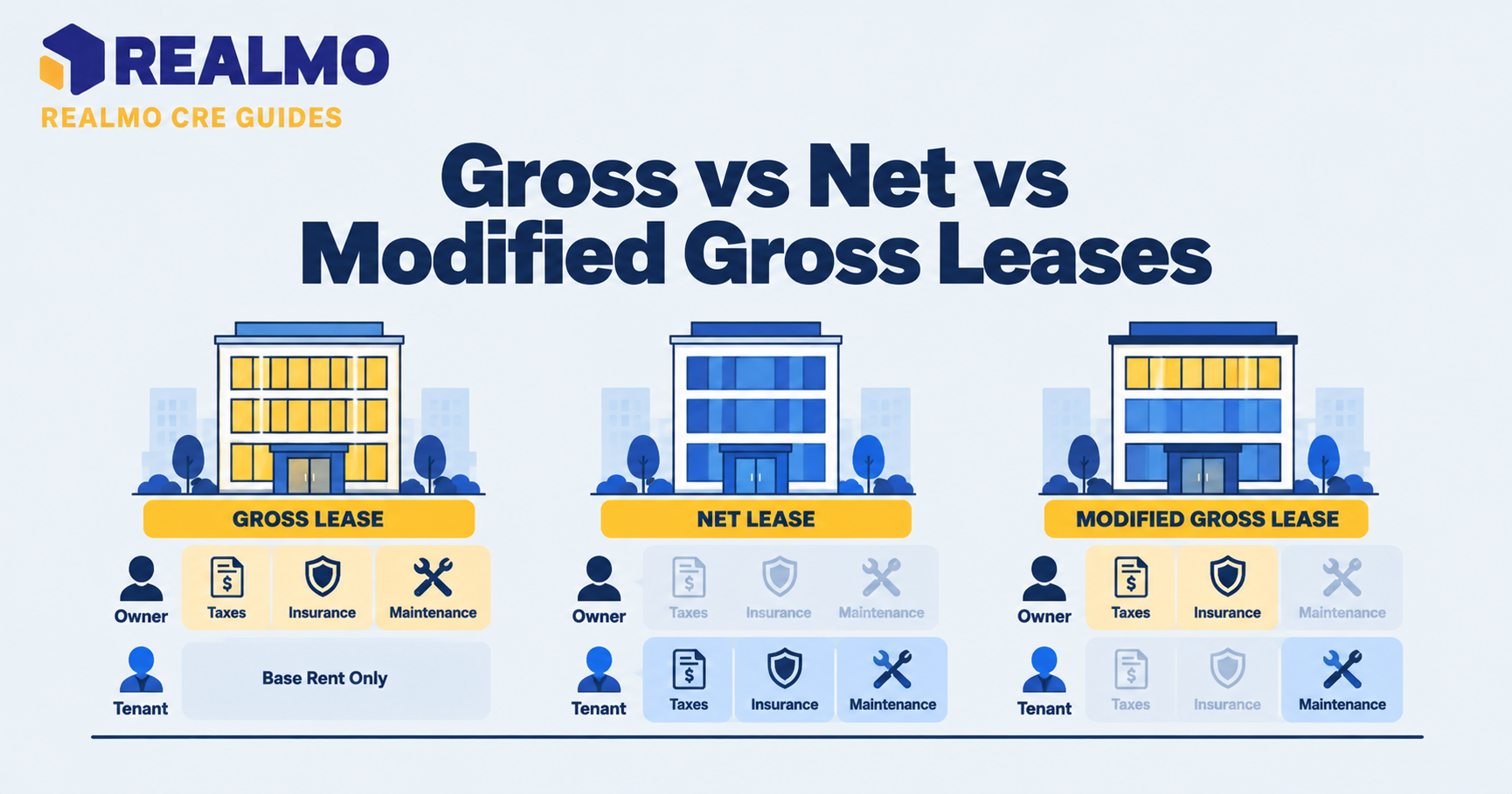
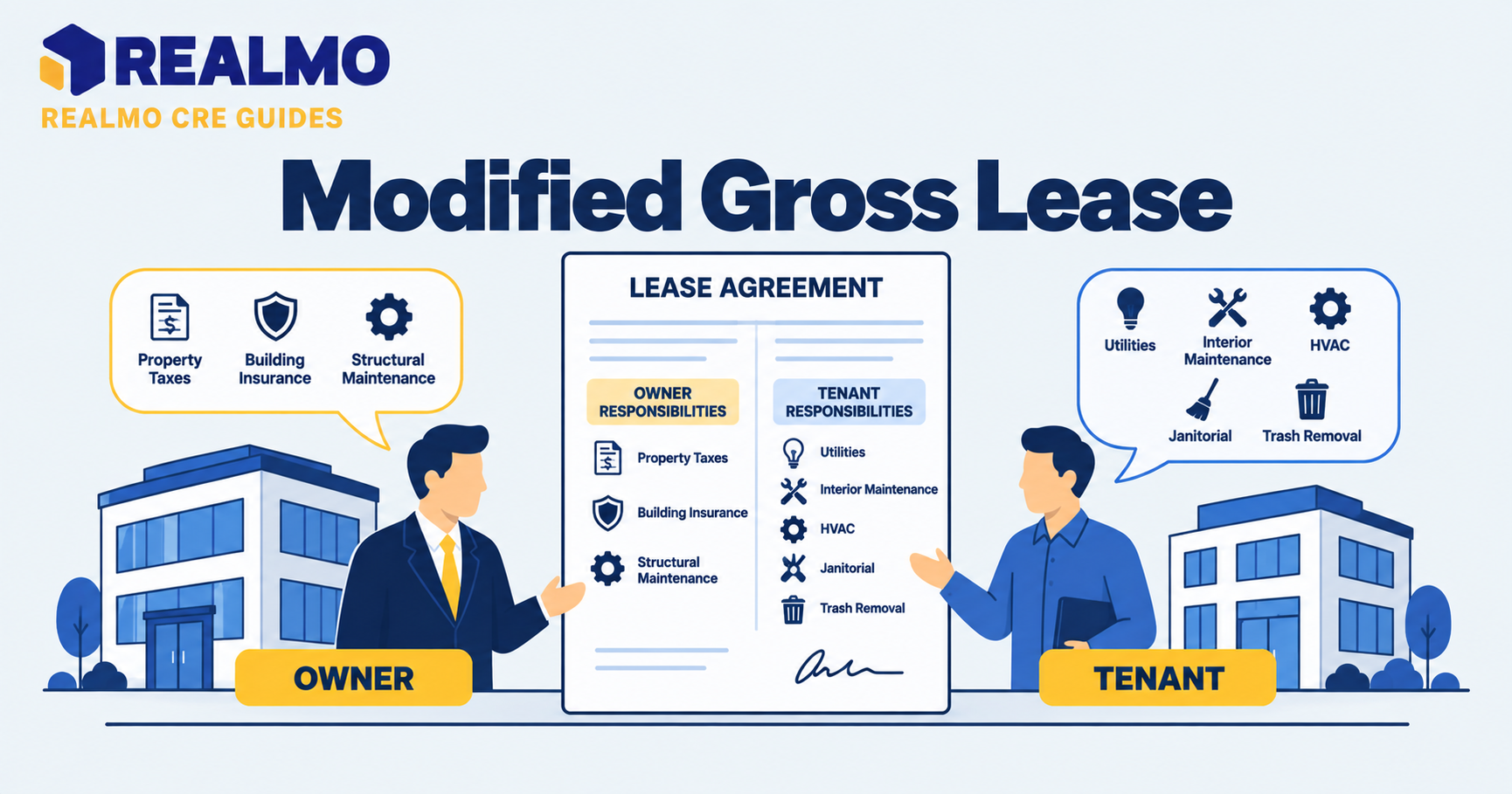
The three main types of commercial leases are gross, net, and modified gross. They differ on one question: who pays the building’s operating expenses. A gross lease bundles those costs into one rent number. A net lease bills them to you on top of base rent. Modified gross splits them between the two of you.
Why lease type changes your real occupancy cost
A $34.00 gross quote and a $22.00 triple net quote can land within a dollar of each other. If the building runs $11.50 per square foot in taxes, insurance, and common area maintenance, the net deal costs $33.50 all in. The headline spread of $12.00 was noise.
What the two structures do not share is risk. Under the gross lease, a mid-term property tax reassessment is the landlord’s problem for the rest of your term. Under triple net, it lands on your February reconciliation statement.
That single difference is worth more than most tenants realize on a 7-year term. Pricing the structure, not the asking rate, is the whole job of comparing quotes.
Gross leases: one number, landlord pays operating costs
In a full service gross lease, the landlord pays property taxes, building insurance, common area maintenance, janitorial, and building utilities. You pay rent. Rent escalates on a fixed schedule, commonly 2.5% to 3.5% per year in current drafting practice.
The structure survives in multi-tenant office, medical office, and small suites under roughly 5,000 square feet. Landlords price a cushion into a flat gross rate, because they absorb every increase for the term. You are buying budget certainty and paying a premium for it.
Read the exclusions before you treat gross as truly flat. Many “full service” leases carve out after-hours HVAC, separately metered suite power, and tenant-specific security. Those come back to you as extras.
A true flat gross lease, with no expense sharing at all, shows up on short terms and sublease space. Most office deals marketed as full service are base year deals, which belong in the modified gross family.
Net leases: single, double and triple net explained
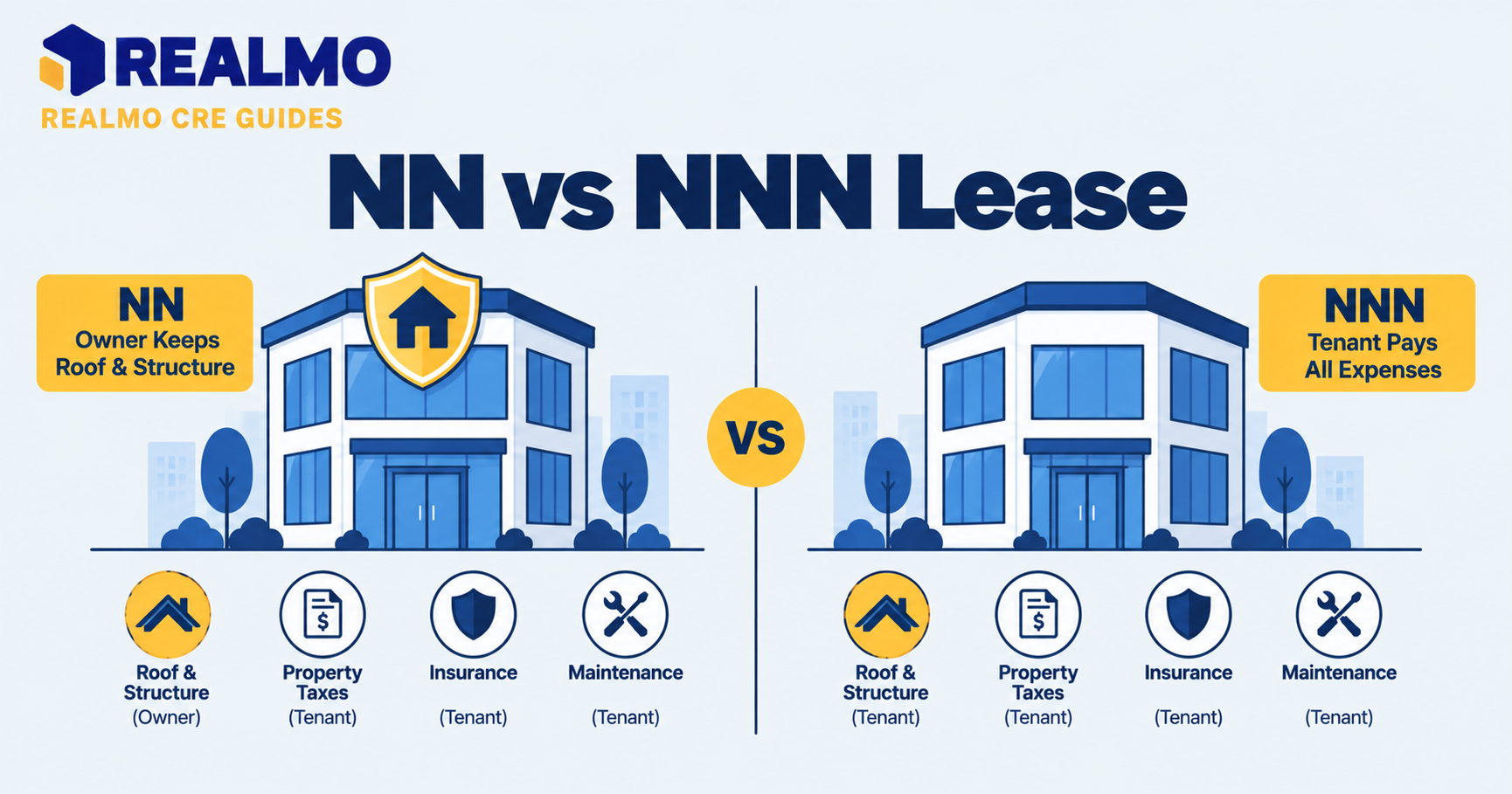
Net leases stack expense categories on top of base rent. A single net (N) lease adds property taxes. A double net (NN) lease adds taxes and building insurance. A triple net (NNN) lease adds taxes, insurance, and common area maintenance charges.
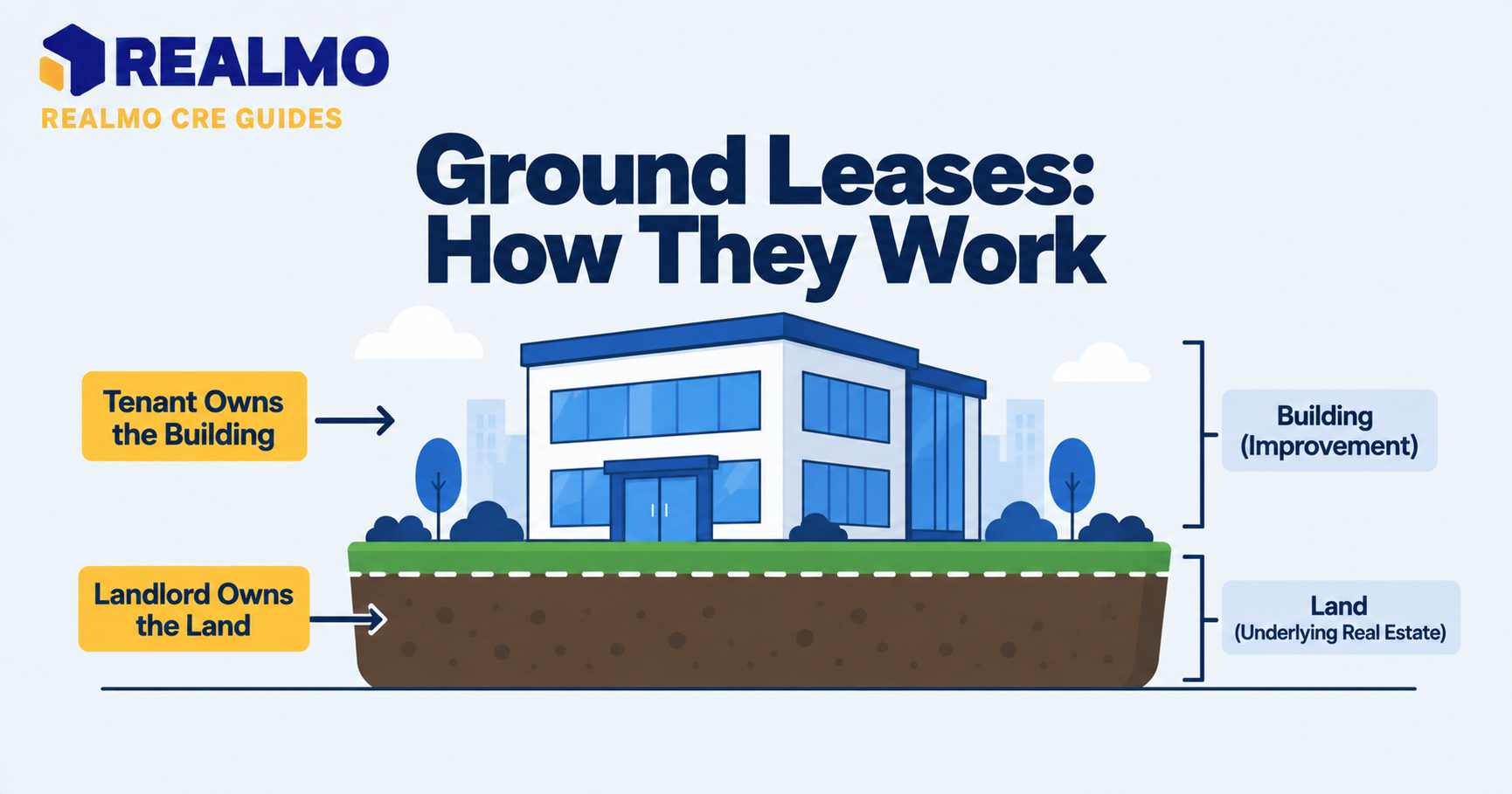
Absolute net goes further. The tenant funds roof, structure, and capital replacements, with no landlord obligations left. That structure dominates single-tenant freestanding retail: drugstores, quick service restaurants, bank branches, dollar stores. It is also standard on a ground lease, where you occupy land and own the improvements.
In multi-tenant retail and industrial, NNN charges are billed monthly as an estimate. The landlord reconciles actual costs after year end, usually within 90 to 120 days under the lease terms. You then get a true-up invoice or a credit.
Your share is set by pro rata formula: your rentable square feet divided by the building’s rentable square feet. Check the denominator. If the lease uses occupied square feet rather than total, you absorb the vacant space’s share of fixed costs.
One term to fix in the document. “Triple net” has no statutory definition in any U.S. state. Roof and structure land wherever the maintenance clause puts them, not wherever the label implies.
Modified gross leases and the base year mechanism
Modified gross covers everything between the two poles. The most common version in U.S. office space is the base year lease. Your first calendar year sets the base year expense stop. After that, you pay your pro rata share of increases over that baseline.
Industrial gross is the warehouse equivalent. The landlord keeps taxes, insurance, and roof; you take interior maintenance, your own utilities, and often the HVAC service contract.
Base years fail in three specific ways.
The first is a building that sat 60% occupied during your base year. Variable costs like janitorial and utilities were artificially low, so your increases start compounding from a false floor. The fix is a gross-up clause, which restates variable expenses as if the building were 95% occupied.
The second is a pending tax appeal that lowers the base year assessment after the fact. The third is a sale. In California, a change of ownership triggers reassessment under Proposition 13, and the jump flows straight into your escalations if the base year predates the transfer.
How the three types of commercial leases compare
| Cost item | Gross | Modified gross (base year) | Triple net |
|---|---|---|---|
| Property taxes | Landlord | Landlord to base, tenant pays increases | Tenant |
| Building insurance | Landlord | Landlord to base, tenant pays increases | Tenant |
| CAM and janitorial | Landlord | Landlord to base, tenant pays increases | Tenant |
| Suite utilities | Varies by clause | Tenant, usually metered | Tenant |
| Roof and structure | Landlord | Landlord | Depends on the maintenance clause |
| Budget predictability | High | Medium | Low without a cap |
Comparison only works on a gross-equivalent basis. Convert every quote to total annual cost per rentable square foot, then run it across the full term including escalations. Add the load factor before you do, because a 12% difference between rentable and usable square feet moves the number more than a dollar of asking rent.
Before signing, pull the building’s ownership record and last sale date on Realmo. A transfer within the past 12 months signals a reassessment that has not hit the expense statements yet.
Worked example: gross vs. NNN on the same suite
All figures below are illustrative and rounded for clarity.
A tenant needs 4,000 rentable square feet for five years. Two quotes:
Option A. $30.00 per square foot, full service gross, 3% annual increases.
Option B. $19.00 per square foot NNN, plus $9.50 per square foot estimated operating expenses, 3% annual increases on base rent, expenses growing 4% per year.
Year one, Option A costs $120,000. Option B costs $76,000 in base rent plus $38,000 in expenses, so $114,000.
Across five years, Option A totals $159.27 per square foot, or $637,096. Option B totals $100.87 in base rent plus $51.46 in expenses, so $152.33 per square foot, or $609,315. Option B saves about $27,800.
Now stress it. Assume the building sells in year two and expenses jump 20% in year three, then resume 4% growth. Option B’s expense total rises to $55.73 per square foot, and the five-year cost reaches $626,425. Option B still wins, but the margin drops to roughly $10,700.
That is the interpretation. The NNN quote is cheaper here, and the gross premium of about $28,000 is what the landlord charges to absorb a reassessment you cannot forecast. If your business can survive a $17,000 swing in a single year, take the savings. If it cannot, you now know the price of the insurance.
The common error at this step is comparing $30.00 to $19.00 and reporting a 37% saving to your CFO. The real gap is 4.4%.
Clauses that cap your operating expense exposure
Six provisions do the actual work in a net or base year lease:
- Gross-up to 95%. Restates variable expenses at near-full occupancy, protecting your base year in a half-empty building.
- Cap on controllable expenses. A 5% annual cap is standard drafting. Insist on non-cumulative, because cumulative caps let unused headroom carry forward and compound.
- Exclusions list. Capital expenditures, leasing commissions, the landlord’s income taxes, costs reimbursed by insurance, and ground rent should all be named and excluded.
- Capital amortization. If a capital item passes through, it should amortize over its useful life at a stated interest rate, not hit in one year.
- Audit right. A 90 to 120 day window after the reconciliation statement, with the landlord paying audit costs if the overstatement exceeds 3% to 5%.
- Administrative fee. Landlords add 3% to 5% of CAM. Negotiate it off the tax and insurance line items at minimum.
Taxes, insurance, and roof structure sit outside most controllable caps by design. Ask for the last three years of reconciliation statements before you accept any estimate. A landlord who will not produce them is telling you something.
A commercial lease is a binding contract with state-specific rules. Have a licensed attorney in the property’s state review the final document, and a CPA review the expense and ASC 842 lease accounting provisions.
Common mistakes tenants make when comparing quotes
Comparing headline rents across structures. A $19.00 NNN quote and a $30.00 gross quote are not 37% apart. Converting to gross-equivalent cost is the first step, not the last.
Accepting a base year without checking occupancy. A base year set during a lease-up period locks in a low baseline for variable costs. Every year after, you pay increases measured from a number that never reflected a full building.
Ignoring the load factor. Two quotes at the same rate are not the same deal if one building carries a 12% common area load and the other carries 18%. Measure under the BOMA Office Standard and ask which version was used.
Signing NNN with a silent structural clause. If the maintenance section does not assign roof, foundation, and structural walls to the landlord, a $40,000 roof replacement can be argued into your CAM.
Skipping the audit right. Without one, a reconciliation error compounds for the full term, and you have no contractual path to the supporting invoices.
Related terms
- Triple net (NNN) lease
- Common area maintenance (CAM) charges
- Base year and expense stop
- Operating expense gross-up clause
- Rentable vs. usable square feet
- Tenant improvement allowance
- Letter of intent for a commercial lease
- Effective rent
FAQ
Is a triple net lease cheaper than a gross lease?
Not by the numbers alone. NNN base rent is lower because you pay taxes, insurance, and CAM separately. Add those to base rent and the two structures land close. The real difference is who absorbs increases during the term. Compare total cost per rentable square foot across the full lease, including escalations.
What does full service gross actually include?
Property taxes, building insurance, common area maintenance, janitorial, and building utilities during standard hours. Most full service leases still bill after-hours HVAC, separately metered suite power, and tenant-specific services as extras. Many are also base year deals, meaning you pay your share of expense increases after year one.
Who pays for a new roof under a triple net lease?
It depends on the maintenance clause, not the label. In a multi-tenant NNN lease, roof and structure usually stay with the landlord. In an absolute net or single-tenant lease, the tenant funds them. If the lease is silent, expect a dispute. Name roof, foundation, and structural walls explicitly.
What is a base year in a modified gross lease?
The first year of the term, whose actual operating expenses set your baseline. From year two on, you pay your pro rata share of any increase over that figure. Ask for a gross-up clause set at 95% occupancy so a partially leased building does not deflate your baseline.
How do I compare a gross quote to a NNN quote?
Convert both to total annual cost per rentable square foot. Add estimated operating expenses to NNN base rent, apply each deal’s escalation schedule across the full term, then adjust for load factor, free rent, and tenant improvement allowance. Compare the five-year or ten-year totals, not year one.