How Interest Rates Move Commercial Real Estate Values
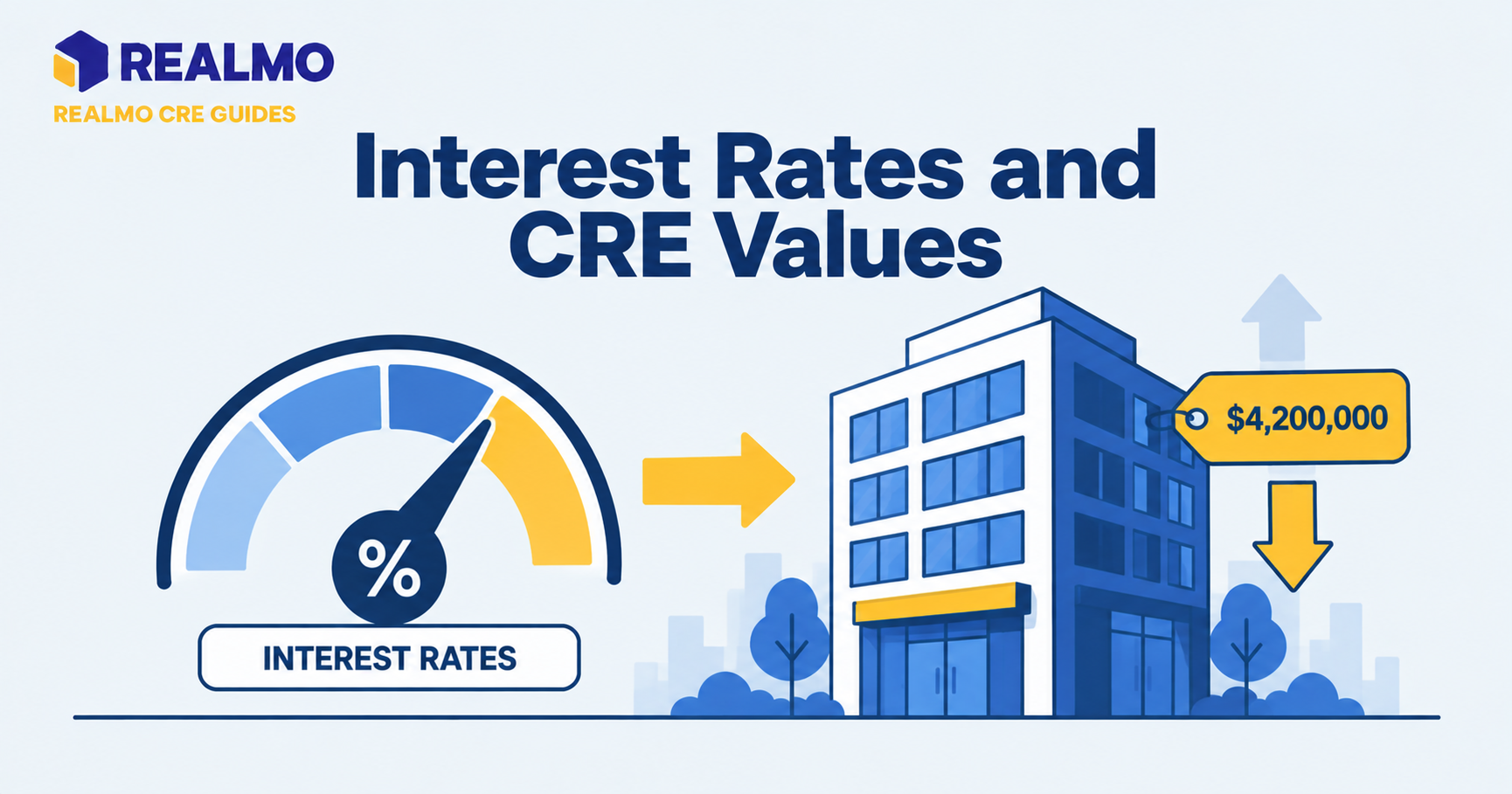
Interest rates move commercial real estate values through three channels. Those channels are the discount rate on future income, debt capacity and cost, and returns on competing assets such as Treasuries. When rates rise, cap rates usually widen and values fall unless income growth offsets the repricing.
Why This Determines What You Can Pay Today
An investor under contract on a suburban medical office building gets a loan repricing. The lender raises the rate 75 basis points between application and rate lock. Nothing about the building changed. The tenants, the rent roll, and the roof are identical. However, the loan now sizes smaller, the equity check grows, and the levered return falls below the investor’s threshold. The choices narrow to three: bring more equity, renegotiate price, or walk.
That sequence repeats across every deal in the market at the same time, which is why rate moves eventually show up as price moves. Understanding the mechanics lets you underwrite a purchase against a rate environment rather than against a comparable sale that closed under different financing conditions. It also tells you which assumptions in your model are doing the heavy lifting.
Why Interest Rates Move Commercial Real Estate Values
Start with the valuation identity most of the industry uses. Value equals net operating income divided by the capitalization rate. NOI reflects the property. The cap rate reflects everything else: the cost of capital, the perceived risk of the income, and expected growth.
A cap rate can be decomposed as the risk-free rate plus a risk premium, minus expected NOI growth. The risk-free rate is proxied by the 10-year Treasury yield. When that yield rises and neither the risk premium nor growth expectations change, the cap rate rises with it and value falls mechanically.
The second channel runs through debt. Most commercial acquisitions use leverage, and lenders size loans against income, not against price. Higher borrowing costs mean less loan proceeds per dollar of NOI. This forces buyers to fund more of the price with equity that demands a higher return.
The third channel is substitution. Real estate competes with bonds for the same capital. If a Treasury pays more, the spread real estate must offer to stay attractive is measured from a higher starting point. Pricing adjusts until the spread is restored.
How Cap Rates Track the 10-Year Treasury
Cap rates and Treasury yields move together over long periods, but not in lockstep. The spread between them drives much of the market’s behavior.
When rates rise quickly, spreads compress first. Sellers hold their price expectations, buyers push back, and transaction volume falls before recorded prices do. Spread compression means values decline less than a one-for-one pass-through would imply, at least initially. When rates fall, the reverse happens: spreads can widen if lenders and investors simultaneously grow more cautious about the income itself.
The practical takeaway is that a rate move does not translate into a value move at a fixed ratio. A 100 basis point rise in the 10-year does not reliably produce a 100 basis point rise in cap rates. Underwriting that assumes a fixed relationship will be wrong in both directions.
Growth expectations complicate this further. Rates can rise while the economy expands and rent growth accelerates. In that case, higher growth partly offsets the higher discount rate. If rates rise while demand weakens, both terms move against value at once. That second case is the one that damages equity.
Why Higher Rates Shrink Loan Proceeds
Lenders size loans by the lower of two constraints: a loan-to-value limit and a debt service coverage ratio minimum. In a rising rate environment the DSCR test almost always binds first.
The math depends on the mortgage constant, which is annual debt service divided by the loan balance. Raise the interest rate and the constant rises, so each dollar of NOI supports less principal. The amortization schedule matters too, which is why interest-only periods and longer amortization are the first levers borrowers reach for when proceeds fall short.
When the mortgage constant exceeds the cap rate, the deal has negative leverage: borrowing reduces the cash-on-cash return rather than enhancing it. Investors still accept negative leverage when they expect NOI growth to close the gap, but it converts a current-income deal into a growth bet. It should be underwritten as one.
Worked Example: Repricing a Deal After a Rate Move
All figures below are illustrative and rounded to show the mechanics, not to represent current market conditions.
A stabilized industrial building generates $600,000 of NOI. At a 6.00% cap rate it is worth $10,000,000. Rates rise, and buyers now require a 6.50% cap rate on the same income.
New value: $600,000 ÷ 0.065 = $9,230,769. The value falls 7.7% on a 50 basis point move.
To hold the $10,000,000 value at the new cap rate, NOI would have to rise to $650,000, an 8.3% increase. That is the hurdle rent growth must clear just to offset the repricing.
Now the debt. Assume a 1.25x DSCR minimum and 30-year amortization. At a 6.00% loan rate the mortgage constant is roughly 7.19%; at 7.00% it is roughly 7.98%.
Maximum annual debt service is $600,000 ÷ 1.25 = $480,000 in both cases. At the lower rate the loan sizes to $480,000 ÷ 0.0719 ≈ $6,670,000. At the higher rate it sizes to $480,000 ÷ 0.0798 ≈ $6,015,000. Proceeds fall about $655,000, near 10%, from a one-point move in the loan rate.
Interpretation: the equity requirement rose by more than the value fell. On the repriced $9,230,769 purchase, equity is roughly $3,216,000 with the smaller loan. At the original price and larger loan, equity is roughly $3,330,000. The levered cash flow is thinner because debt service consumes a larger share of the same NOI. A price cut that looks generous can still leave the returns worse than before.
The common error here is repricing the asset and forgetting to reprice the loan. Buyers who apply a new cap rate but carry forward the old financing assumptions produce a model that no lender will fund.
Which Property Types Absorb Rate Moves Best
Lease duration decides how much of a rate move an asset can absorb. Property types with short lease terms reset rents frequently, so NOI can respond to inflation and demand within a year or two. Multifamily, self-storage, and hotels sit at that end of the spectrum, with hotels repricing nightly.
Long-term net lease assets sit at the other end. A single-tenant property with fifteen years remaining and fixed 1.5% annual escalations behaves much like a corporate bond. Its income cannot respond to a higher rate environment, so its price must. That is why long-duration net lease pricing is the most rate-sensitive segment of the market.
Credit quality cuts the other way. Stronger tenant credit narrows the risk premium, which lowers the cap rate but does nothing to reduce duration risk. Two assets with identical cap rates can react differently to the same rate move. The outcome depends on how much value comes from contractual versus future market rent.
Why Reported Values Lag the Rate Change
Appraisals and index values rely on closed comparable sales, and those comps reflect terms negotiated months earlier. Debt markets reprice in days. The result is a visible gap between what the bond market says a property is worth and what the last recorded sale says.
Owners who are not transacting feel this as denial and buyers feel it as a bid-ask spread. It resolves when someone is forced to transact, usually at a loan maturity. Refinancing risk is the mechanism that converts a paper valuation change into a realized one. This is why maturity schedules matter more than sentiment for predicting when pricing actually moves. A discounted cash flow analysis should stress the exit cap rate and refinance rate together. Testing only one misses the interaction.
If you are testing a specific asset, Realmo’s property analytics show ownership records and estimated value alongside comparable data. This makes it easier to see whether an owner’s basis and likely loan vintage line up with the price they are asking.
Financing, valuation, and tax outcomes depend on facts specific to a property and a borrower. Confirm treatment with a licensed appraiser, lender, or advisor before acting.
Common Mistakes When Underwriting Rate Sensitivity
- Holding the exit cap rate at the entry cap rate. This assumes you sell in the same rate environment you bought in. Consequence: the model shows a return that exists only if rates cooperate, and the sensitivity table hides the single largest driver of the outcome.
- Assuming rate moves pass through to cap rates one-for-one. Spreads compress and widen. Consequence: you either walk away from correctly priced deals or reject a seller’s realistic number as unserious.
- Repricing the asset without repricing the debt. Consequence: the equity requirement in the model is understated, and the deal fails at loan sizing after you have spent money on due diligence.
- Treating a long lease as pure safety. Duration is a risk, not only a protection. Consequence: an asset bought for its stability delivers the deepest value decline when rates rise.
- Ignoring the maturity date relative to the business plan. Consequence: a five-year hold with a three-year loan carries a refinancing event the model never tested. That event, not operations, determines whether the equity survives.
Related Terms
Capitalization rate · Net operating income · Debt service coverage ratio · Loan-to-value ratio · Mortgage constant · Discounted cash flow · Exit cap rate · Refinancing risk
FAQs
Do commercial property values always fall when interest rates rise?
No. Values fall when the cap rate rises faster than NOI grows. If rates rise during strong demand and rents are climbing, higher income can offset a wider cap rate. The assets that suffer most are those with fixed long-term income that cannot respond to the new environment.
What is the relationship between cap rates and the 10-year Treasury?
Cap rates trade at a spread above the 10-year Treasury yield, tracked in the Federal Reserve’s FRED database, since real estate carries illiquidity, management, and credit risk that Treasuries do not. The two move together directionally, but the spread widens and compresses, so cap rates rarely track Treasury moves point for point.
How much does a 1% rate increase reduce property value?
There is no fixed answer, because loan rates and cap rates are different variables. As arithmetic, if the cap rate itself rises from 6.00% to 7.00% with NOI unchanged, value falls about 14.3%. Lower starting cap rates produce larger percentage declines from the same move.
Why do lower cap rates mean greater interest rate sensitivity?
Value is inversely proportional to the cap rate. A fixed basis point change is a larger proportional change when the starting cap rate is small. A 50-basis-point move from a 4.00% cap rate cuts value about 11.1%. The same move from 8.00% cuts value about 5.9%.
Should I use fixed or floating rate debt when rates are moving?
That depends on hold period, business plan, and prepayment terms rather than a rate forecast. Fixed-rate debt locks the mortgage constant and protects debt service; floating-rate debt preserves flexibility to exit or refinance without penalty. Discuss the tradeoff with a licensed lender or advisor for your specific situation.