Net Operating Income: What It Is and How to Use It
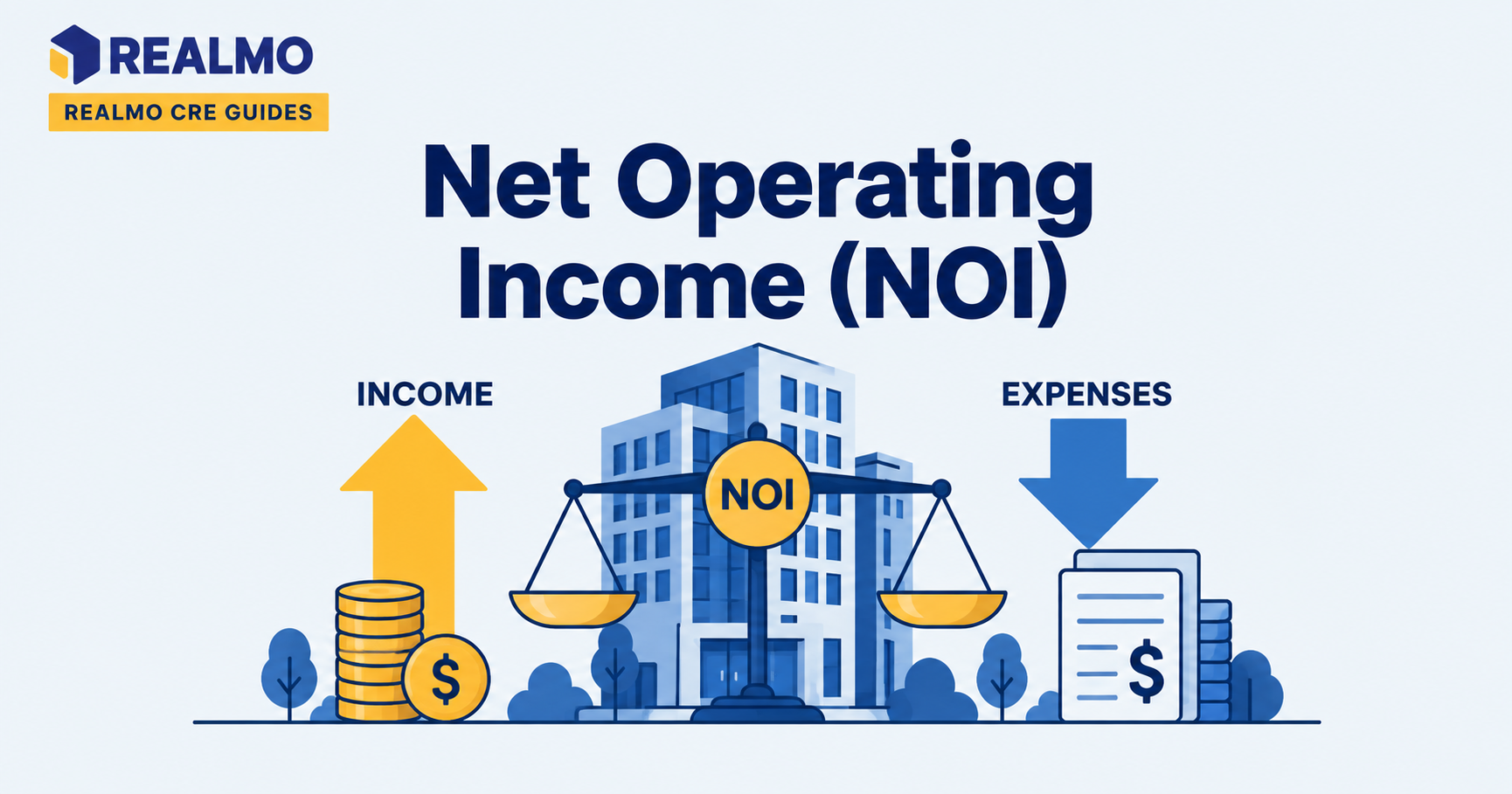
Net operating income (NOI) is a property’s annual income after operating expenses but before debt service, income taxes, depreciation, and capital expenditures. It measures what the real estate itself earns, independent of how a buyer finances or depreciates it. That neutrality is why NOI sits at the center of commercial valuation and loan sizing.
Why investors get judged on their NOI math
An investor tours a six-tenant retail strip and gets a one-page offering memo showing NOI of $500,000. The broker applies a market cap rate and arrives at an asking price. If the investor accepts that NOI without rebuilding it, every downstream number inherits the error. The offer price, the loan amount the lender will fund, the equity check, and the return projection.
Three line items can explain the gap between seller NOI and buyer NOI. The property is self-managed, so no management fee appears. Taxes can reflect the seller’s assessed value instead of a post-sale reassessment. A $28,000 roof repair can also be classified as capital. Rebuilding those items can move NOI by five to eight percent. At a 7% cap rate, each $10,000 of NOI equals roughly $143,000 of value.
What NOI includes and what it deliberately leaves out
NOI = Effective Gross Income − Operating Expenses
What makes NOI useful is the list of things it excludes. Debt service is out, because two buyers looking at the same building will finance it differently, and the building’s earning power does not change based on who borrows what. Income taxes are out, because a REIT, a family LLC, and a foreign pension fund all face different tax positions on identical cash flow. Depreciation is out, because it is a tax convention rather than a cash cost , nonresidential real property is depreciated over 39 years under the Modified Accelerated Cost Recovery System (MACRS) (see IRS Publication 946), a schedule that has nothing to do with how the roof actually ages. Tax treatment varies by entity and jurisdiction; confirm your own position with a licensed CPA or tax attorney.
Capital expenditures are also excluded, along with tenant improvements and leasing commissions. Those costs are real and can recur. A 1970s office building with aging HVAC and rolling leases can show healthy NOI. It can still produce negative cash flow for three years.
By stripping out financing and tax effects, NOI becomes comparable across buildings, markets, and owners. That comparability is the entire point, and it is also why the metric must be built the same way every time.
How to build the income side: from GPR to EGI
Start with gross potential rent. This is every leasable square foot at contract or market rent, assuming full occupancy and full collection. The number is theoretical.
Subtract vacancy and credit loss. Physical vacancy is space with no tenant. Economic vacancy is broader: free rent periods, rent abatement in a renewal deal, a tenant paying reduced rent under a workout, and tenants who stop paying entirely. A building can be 100% leased and still lose meaningful income to economic vacancy. Underwriters who use only physical vacancy consistently overstate income on properties with recent lease-up activity.
Add expense reimbursements. In triple net and modified gross structures, tenants pay back some or all of operating costs through CAM, tax, and insurance recoveries. These are income to the landlord and belong in effective gross income. Two traps show up here. First, recoveries must be matched to the expenses that generate them, booking full recoveries against partially escrowed expenses inflates income. Second, at partial occupancy, fixed costs are still incurred but only occupied tenants reimburse them, so the recovery line falls faster than the expense line. Some leases allow a gross-up provision that calculates recoveries as if the building were 95% occupied. Whether that provision exists is a lease question, not an assumption.
Add other income last: parking, storage, signage and rooftop antenna rent, percentage rent from retail tenants above a sales breakpoint, and late fees. Percentage rent deserves scrutiny because it moves with tenant sales and can vanish in a soft year. Many underwriters exclude it from stabilized NOI or haircut it substantially. The sum of these lines is effective gross income, the real starting point for the expense deduction. Related reading: how effective gross income is calculated.
Which expenses count as operating expenses
Operating expenses are recurring costs that keep the building open and functional. Real estate taxes and property insurance are usually the largest. Other lines include utilities, repairs, maintenance, janitorial, landscaping, security, payroll, administration, and professional fees.
Property management belongs in operating expenses even when the owner does the work. Market fees are quoted as a percentage of effective gross income. The percentage changes by asset type and property size. Smaller, management-heavy properties can carry higher fees.
Replacement reserves are a gray area in market practice. Appraisers deduct them under, while many brokers present NOI without reserves. Compare like with like. A no-reserve seller NOI is not comparable with a reserve-deducted appraiser NOI.
The clean test for any questionable cost: would this expense recur every year under normal operations for a typical owner? Repainting a suite between tenants is a leasing cost. Replacing a compressor is capital. Servicing the HVAC quarterly is operating. One-time items, a casualty loss, litigation, an environmental remediation, are normalized out, but the normalization should be disclosed rather than buried.
How net operating income drives value and loan size
Direct capitalization converts NOI into value in one step:
Value = NOI ÷ Cap Rate
The relationship is mechanical, and it is why NOI receives so much scrutiny. At a lower cap rate, each dollar of NOI carries more value, so the same underwriting error costs more. Cap rates themselves are market-determined and move with interest rates, capital availability, and perceived risk. This is exactly why the durable skill is understanding the relationship rather than memorizing a rate. See how to calculate and interpret cap rates for the other half of the equation.
Lenders use NOI in two separate tests, and both must clear. Debt service coverage ratio divides NOI by annual debt service. A lender requiring a minimum DSCR is asking how much cushion exists between the property’s earnings and the mortgage payment. Debt yield divides NOI by the loan amount and asks a different question. If the lender foreclosed tomorrow and owned the asset free and clear, what unlevered return would the loan balance earn? Debt yield is deliberately insensitive to interest rates and amortization, which is why it became the constraining test after 2008. On a low-rate loan, DSCR can look comfortable while debt yield says the loan is too large. Details on both: DSCR requirements in CRE lending and how lenders use debt yield.
Because NOI is unlevered, it also anchors returns analysis. Cash flow after debt service drives cash-on-cash return, and NOI growth across the hold period drives the exit value. In an IRR model, NOI is the line that everything else reacts to.
Worked example: NOI for a multi-tenant retail strip
All figures below are illustrative and chosen to make the arithmetic clear. They are not market quotes.
A 20,000 SF neighborhood retail center, six tenants, NNN leases.
| Line item | Amount |
|---|---|
| Gross potential rent | $600,000 |
| Less vacancy and credit loss (5%) | ($30,000) |
| Plus expense reimbursements | $120,000 |
| Plus other income (signage, percentage rent) | $10,000 |
| Effective gross income | $700,000 |
| Real estate taxes | ($95,000) |
| Insurance | ($25,000) |
| CAM, repairs and maintenance | ($40,000) |
| Utilities (common area) | ($20,000) |
| Management fee (4% of EGI) | ($28,000) |
| General and administrative | ($12,000) |
| Total operating expenses | ($220,000) |
| Net operating income | $480,000 |
At an illustrative 7.0% cap rate, direct capitalization gives $480,000 ÷ 0.07 = $6,857,000, rounded.
The operating expense ratio here is 31% of EGI ($220,000 ÷ $700,000). Use it as a cross-check against the property type and lease structure. A large deviation from the relevant market band can signal a missing expense or overstated recovery.
Suppose the seller omits the management fee. NOI rises to $508,000. At a 7.0% cap rate, value becomes $7,257,000. One omitted line therefore overstates value by $400,000.
Trailing, in-place, and pro forma NOI are not the same
The same building produces several defensible NOI figures depending on the period and the assumptions, and mixing them is a frequent source of mispricing.
Trailing twelve-month NOI (T-12) reflects what actually happened over the last year. It is the most verifiable version and the one lenders start with, but it is backward-looking and includes any anomalies the year contained. T-3 annualized takes the most recent three months and multiplies by four. This captures recent lease-up but also amplifies seasonality, a self-storage property annualized off summer months will overstate the year.
In-place NOI applies the current rent roll forward: every signed lease at its contract rent, annualized. This picks up a tenant who took occupancy in month eleven and contributed almost nothing to T-12. Pro forma or stabilized NOI adds assumptions, leasing vacant space, marking below-market leases up at renewal, cutting expenses under new management. Pro forma is a legitimate analytical tool and an equally legitimate place to hide optimism. Sellers price on pro forma; buyers should price on in-place and treat the delta as the business plan they must execute and fund.
Two adjustments deserve separate attention. Property taxes can reassess after sale under local rules. Estimate taxes at the expected purchase price where that rule applies. Do not copy the seller’s T-12 tax line.
Verifying an owner’s operating numbers against independent data is the slow part of this work. Realmo’s property analytics cover ownership records, estimated value, and cap rate data across 9M+ properties. This gives you a second reference point before you accept a rent roll at face value.
Where NOI stops working as a comparison metric
NOI assumes a property whose income comes from leases with meaningful term. When that assumption breaks, the metric loses descriptive power.
Hotels are the clearest case. Revenue turns over nightly, and a large share of costs are departmental and variable rather than fixed. The industry uses EBITDA and departmental profit under the Uniform System of Accounts for the Lodging Industry instead. This is because a hotel is an operating business housed in real estate. Senior housing, parking assets, and marinas sit on a similar spectrum.
Assets facing large near-term capital needs also resist NOI-only comparison. Two buildings with identical NOI are not identically valuable if one needs a full roof and parking lot replacement within three years. NOI excludes exactly that cost, so the analysis has to move to cash flow after capital, or the cap rate has to absorb the difference. The same applies to properties with concentrated lease rollover: a single-tenant building at 18 months to expiration and a multi-tenant building with staggered terms can post the same NOI and carry very different risk. Structure matters here too , a ground lease, a percentage-rent-heavy retail lease, and a full-service gross office lease all produce NOI, but the durability of that NOI differs. See how triple net leases shift expense risk and why lease rollover schedules affect pricing.
Value-add and lease-up deals present a related problem: a property at 40% occupancy may show minimal or negative NOI, which makes direct capitalization meaningless. Discounted cash flow, which models the lease-up period explicitly, is the appropriate tool.
Common mistakes that inflate or distort NOI
- Omitting the management fee on owner-managed properties. The buyer will pay a manager, so the expense exists. Consequence: NOI and value are overstated by the full fee amount divided by the cap rate, as the worked example shows.
- Using the seller’s tax bill instead of a reassessed estimate. In jurisdictions that reassess on transfer, the tax line jumps at closing. Consequence: the buyer closes on an NOI that starts declining on day one, which can push DSCR below the lender’s covenant.
- Deducting debt service, depreciation, or income taxes. These belong below the NOI line. Consequence: the resulting figure is not comparable to any market cap rate, so the valuation is wrong in an unpredictable direction.
- Treating recurring capital as operating expense, or the reverse. A roof coded as maintenance depresses NOI; a genuine repair coded as capital inflates it. Consequence: inconsistent treatment across a portfolio makes properties look better or worse than peers for accounting reasons rather than economic ones.
- Booking full expense reimbursements at partial occupancy. Vacant space generates no recovery, but the building still incurs the cost. Consequence: EGI is overstated, and the error grows as occupancy falls, precisely when the analysis matters most.
Related terms
- Capitalization rate
- Effective gross income
- Debt service coverage ratio
- Debt yield
- Operating expense ratio
- Cash-on-cash return
- Triple net lease
- Pro forma analysis in CRE
FAQs
Does NOI include mortgage payments?
No. NOI is calculated before debt service. Principal and interest are excluded so the metric describes the property’s earning power rather than the buyer’s financing terms. Two investors purchasing the same asset with different loans produce the same NOI and different cash flow. Lenders then compare NOI against debt service to compute DSCR.
Is NOI the same as cash flow?
No. NOI excludes debt service, capital expenditures, tenant improvements, leasing commissions, and income taxes. A property can post strong NOI and negative cash flow in a year with heavy leasing activity or a major capital project. Cash flow after debt service and capital is the figure that reaches an investor’s account.
Should capital expenditures be deducted from NOI?
Not from NOI itself. Appraisers and lenders can deduct an annual replacement reserve above the NOI line. Brokers can present NOI without reserves. Both treatments appear in U.S. CRE. Identify the convention before comparing one property with another.
What is a good NOI?
NOI is an absolute dollar figure, so it has no universal benchmark. A larger building can produce more NOI without being a better investment. Compare NOI with price through cap rate and with loan amount through debt yield. Also compare it with effective gross income through the operating expense ratio.
How do I verify a seller’s NOI?
Rebuild it from source documents rather than accepting the summary. Tie rents to the rent roll and executed leases, expenses to the T-12 general ledger and vendor invoices. And taxes to the assessor’s record with a reassessment estimate. Then add back any omitted management fee and reserve.