The Cost Approach Appraisal: What It Is and When It Applies
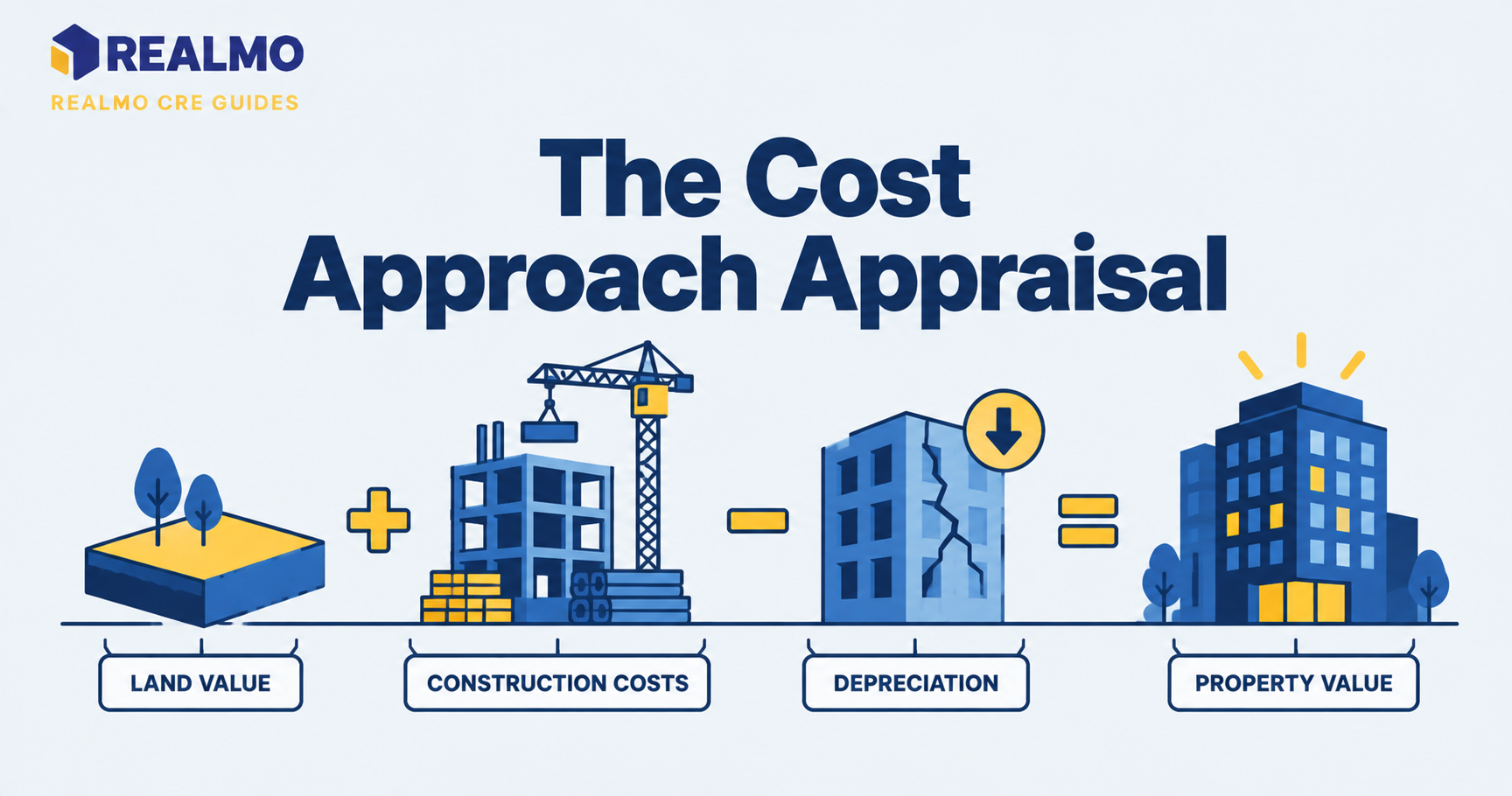
The cost approach values land plus replacement cost less accrued depreciation. It assumes the land is vacant and the improvements are built new. The method estimates what a rational buyer would pay to build a substitute instead of buying the existing property.
Why the cost approach shows up in investor decisions
You are underwriting a 20,000-square-foot flex building in a submarket with almost no recent sales of comparable product. The seller’s broker prices it off a cap rate borrowed from a metro-wide report. Your lender’s appraiser runs all three approaches, and the cost approach lands materially below the asking price. That gap is not noise, it tells you a buyer could assemble land and build the same box for less. This caps what any informed buyer should pay.
The reverse case matters just as much. When the cost approach comes in well above the income approach, the property is worth less than the sum of its parts. The reason is usually external: weak rents, oversupply, a failing corridor. Investors who read only the income number miss the diagnosis. The two approaches together tell you whether you are buying a discount or a problem.
What the cost approach measures
The method rests on the principle of substitution: no one pays more for an existing asset than the cost of acquiring an equally desirable substitute. Appraisers formalize that logic as land value plus depreciated improvement cost.
This is one of the three recognized approaches to value under USPAP, alongside the income approach to commercial property value and the sales comparison approach. An appraiser must consider all three and explain why any one was excluded or given limited weight. Exclusion is common, but it has to be reasoned, not silent.
The three inputs behind a cost approach value
Land value as if vacant. The site is valued at its highest and best use, ignoring the building standing on it. Land sales comparables are the preferred method. When direct land comps are unavailable, appraisers use extraction or allocation. Extraction subtracts depreciated improvements from sale price. Allocation applies land-to-total ratios from similar markets.
Cost new of the improvements. This covers direct costs (labor, materials), indirect costs (permits, architecture, financing during construction, legal). Entrepreneurial incentive, the profit a developer would require to take on the project. Investors routinely forget the last two categories, which is why their own back-of-envelope “cost to build” runs low.
Accrued depreciation. Every dollar of value the improvements have lost since they were new, from any cause. This is where the credibility of the whole exercise lives.
Replacement cost vs. reproduction cost
Reproduction cost is what it would take to build an exact replica, including obsolete design and materials. Replacement cost is what it would take to build a structure of equal utility using current methods and materials.
Most commercial work uses replacement cost, because a buyer wants the utility, not the plaster cornices. Reproduction cost appears in historic properties, insurance disputes, and litigation where the specific structure matters. The distinction is not academic: replacement cost automatically absorbs some functional obsolescence that a reproduction estimate would have to deduct separately.
Cost figures come from published cost services such as Marshall & Swift/CoreLogic or RSMeans, or from local contractor bids, adjusted for the specific market. Any cost source must be adjusted for current local labor and material prices. A cost approach more than a year or two old can be stale.
The three types of depreciation appraisers deduct
Physical deterioration is wear on the physical asset, roof, HVAC, parking surface, structure. It is measured item by item for curable deferred maintenance or through the age-life method: effective age divided by total economic life. Effective age reflects condition, not the calendar. A 1985 building with a new roof, new systems, and a renovated interior can carry an effective age of 12 years.
Functional obsolescence is a defect in the improvements. Examples include low clear height, unusable floor depth, too few loading docks, or an unwanted office-to-warehouse ratio. It can be curable (worth fixing) or incurable (the cure costs more than the value it adds).
External obsolescence originates outside the property line, a declining trade area, a new highway that rerouted traffic, chronic oversupply, a shuttered anchor employer. It is almost always incurable, and it is the hardest to quantify. Appraisers isolate it through paired sales or by capitalizing the rent loss attributable to the location.
Note that this is appraisal depreciation, not tax depreciation. The 39-year and 27.5-year recovery periods under the Modified Accelerated Cost Recovery System (MACRS) are statutory schedules unrelated to any observed loss in value. See depreciation in commercial real estate for the tax side.
When a cost approach appraisal carries real weight
The method is strongest where market evidence is thin or where the building is genuinely new. New or nearly new construction is the clearest case, since accrued depreciation is minimal and the estimate is mostly arithmetic rather than judgment.
Special-purpose and single-tenant assets can lack both comparable sales and meaningful rent comps. Examples include unusual self-storage, cold storage, institutional buildings, and process-specific plants. Cost can then be the only defensible approach.
The approach also informs development feasibility, insurance underwriting, and tax appeals. It supplies the land-versus-improvement split accountants use to establish depreciable basis. Ground-up developers use it in reverse: if projected stabilized value does not exceed total development cost plus a profit margin, the deal does not pencil.
When the cost approach misleads investors
For stabilized, income-producing assets with an active sales market (multi-tenant retail, apartments, standard office and industrial) the cost approach is the weakest of the three. Buyers price those assets off cash flow, and lenders size loans off cash flow.
Reliability also collapses as buildings age. Estimating accrued depreciation on a 45-year-old structure requires many judgment calls. The output can become a wide range presented as a point value. Add a site where land comps are scarce, and two competent appraisers can land far apart. Treat a cost approach on an older asset as a sanity check, not a valuation.
Worked example: cost approach on a small warehouse
All figures below are illustrative and rounded for clarity; they are not market data.
Start with a 20,000-square-foot warehouse on a two-acre site. Land comps support $600,000 for the site as if vacant. After local adjustment, a cost service indicates $140 per square foot, or $2,800,000. Add $150,000 of site improvements and $300,000 of entrepreneurial incentive. Total cost new is $3,250,000.
The building is 20 years old but was re-roofed and re-graded recently. The appraiser assigns an effective age of 10 years against a 40-year total economic life. That is 25% physical deterioration, or $812,500. Clear height of 18 feet limits the tenant pool against newer product at 28 feet; paired rent analysis supports $200,000 of incurable functional obsolescence. The submarket is stable, so external obsolescence is zero.
Depreciated improvements: $3,250,000 − $812,500 − $200,000 = $2,237,500. Add land: $2,837,500, rounded to $2.84 million.
If the income approach gives a materially lower value, the gap signals rent or occupancy weakness. The cost approach cannot see that weakness directly. The income figure should govern. If the income approach comes in higher, ask whether a buyer would simply build new instead. The common error is depreciating from actual age instead of effective age. Here, that would deduct 50% instead of 25% and understate value by roughly $500,000.
Common mistakes with the cost approach
- Using assessed land value as land value. Assessment ratios and reassessment cycles vary by jurisdiction, and the number has no relationship to market land value. The result is a value conclusion built on a tax administrator’s shortcut.
- Omitting indirect costs and entrepreneurial incentive. Skipping permits, financing during construction, and developer profit can understate cost new by a wide margin and make an overpriced building look like a bargain.
- Confusing insurance replacement cost with the cost approach. Insurance figures exclude land and exclude excavation and foundations, since those survive most losses. Reading an insurance schedule as a market value indication produces a number that is wrong in both directions.
- Treating the cost approach as a floor. Where external obsolescence is severe, market value falls below depreciated cost and stays there. Cost sets a ceiling under substitution logic, not a floor.
- Double-counting obsolescence. Deducting for low clear height in the functional category and again through a shortened economic life penalizes the same defect twice.
Related terms
Highest and best use · Effective age and economic life · Functional obsolescence · Sales comparison approach · Income approach to value · Land residual method · Reconciliation in appraisal
When you are testing a seller’s price against build cost, the land side is usually the hard part. Realmo’s property-level data covers land parcels and ownership records alongside valuation estimates, which shortens the search for usable land comps in thin submarkets.
An appraisal that supports a loan, a tax appeal, or a tax filing must be prepared by a state-certified general appraiser. Confirm any valuation, tax, or basis-allocation question with a licensed appraiser and your own tax advisor.
FAQ
When is the cost approach the most reliable method?
On new or nearly new construction and on special-purpose properties with no comparable sales or rents. In both cases accrued depreciation is small or market evidence is absent, so cost carries the analysis. On stabilized income property with active sales activity, it should be a cross-check rather than the primary indicator.
Does the cost approach include land?
Yes. Land is valued separately at its highest and best use as if vacant, then added to the depreciated cost of the improvements. This is a key difference from insurance replacement cost, which excludes land entirely and excludes foundations and excavation as well.
Why does the cost approach come in higher than the income approach?
Usually external obsolescence. Weak rents, oversupply, or a declining trade area reduce what the property earns without changing what it would cost to rebuild. A persistent gap in that direction signals a market problem, not a bargain, and the income indication deserves more weight.
Is appraisal depreciation the same as tax depreciation?
No. Appraisal depreciation measures actual observed loss in value from physical, functional, and external causes. Tax depreciation follows statutory recovery periods: 39 years for nonresidential real property and 27.5 for residential rental. These periods ignore the building’s actual condition or market position.
Can the cost approach be used on a 50-year-old building?
It can be performed, but reliability drops sharply. Estimating accrued depreciation over that span requires enough judgment calls that reasonable appraisers reach different conclusions. Use it as a boundary check on the income and sales comparison indications rather than as the basis for a purchase price.