Core & Core-Plus Real Estate Investing Explained
A projected 20% IRR is easier to turn into a headline than a strategy built around steady rent collections and limited downside. This helps explain why conservative CRE approaches might receive less attention in investment discussions, even though they serve a clear purpose for income-focused investors.
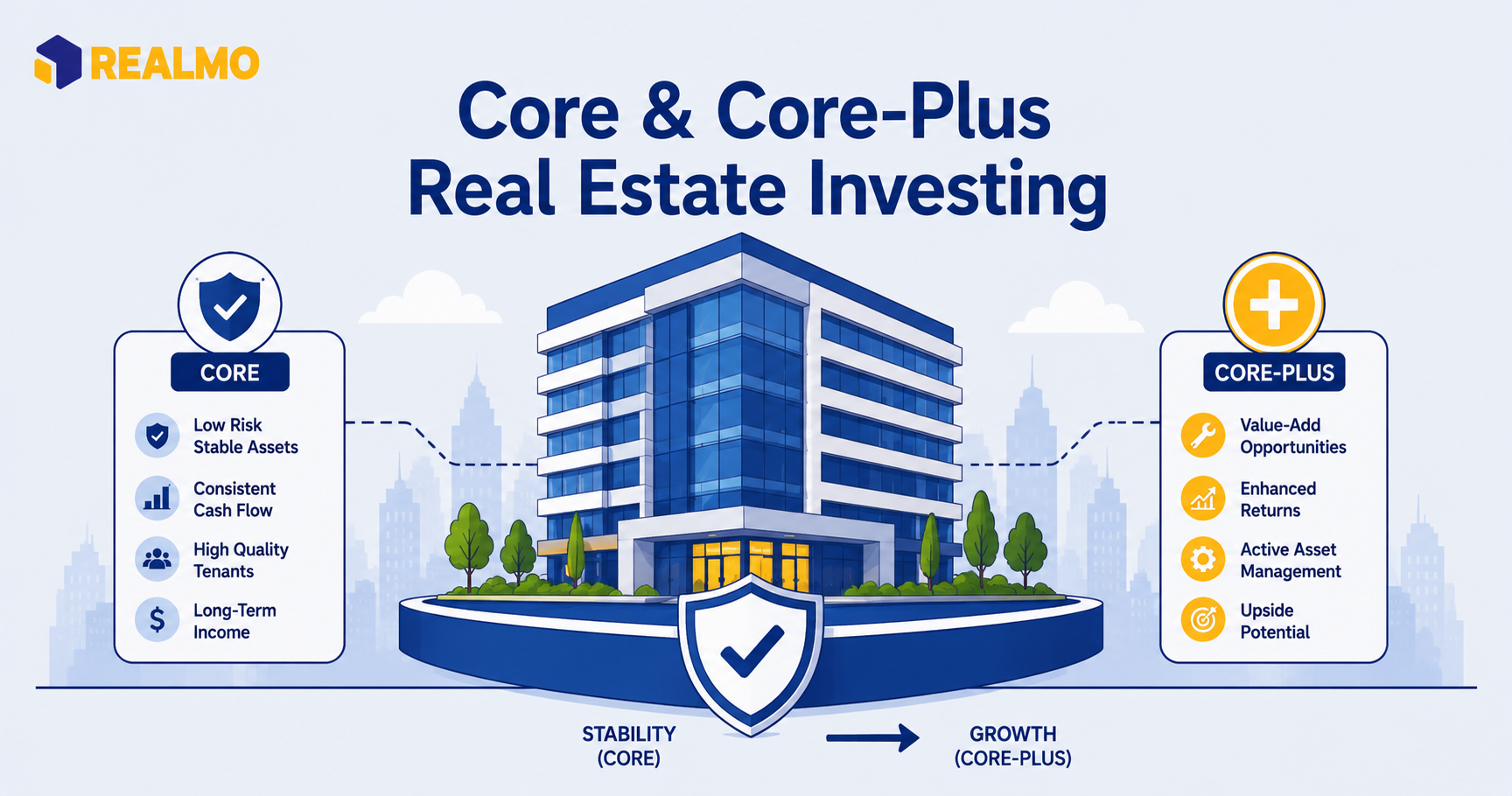
Core and Core-Plus real estate sit at the lower-risk, income-first end of the CRE spectrum. Both prioritize stabilized properties, durable occupancy, and existing cash flow, but Core-Plus accepts modest execution risk in exchange for higher return potential. This guide explains how each strategy works, how they differ, and who they may suit.
What Is Core Real Estate Investing?
Core is the most conservative private real estate strategy in terms of application. It centers on stabilized assets whose value is supported by:
- Occupancy
- Contractual rent
- Proven operations
This makes the return profile closer to fixed income than to speculative property investment.
Defining characteristics of core assets
A Core asset is usually a high-quality, institutional-quality asset in a prime location or a strong secondary market with durable employment, population, and tenant demand:
- Occupancy is already stabilized
- Major systems are in good condition
- The property should need little more than routine capital spending
Long leases and creditworthy tenants reduce near-term rollover risk and make future NOI easier to estimate.
Picture a modern distribution center near a major logistics corridor, fully leased to established tenants, or a grocery-anchored retail property with long remaining lease terms. A fully leased Class A office may also qualify, although only where local fundamentals, tenant credit, lease duration, and future leasing costs support that label. “Core” describes the investment plan as much as the building: the buyer is acquiring existing cash flow, not relying on construction, heavy lease-up, or a market rescue to create it. The underwriting case should work from day one.
Return profile, leverage, and cash flow
Core returns generally come from NOI and recurring distributions, with appreciation playing a supporting role. A common deal-level leverage range is roughly 40% to 45% loan-to-value, although financing can rise when lease credit and debt-service coverage are unusually strong. At fund level, standards may be stricter: NCREIF’s current NFI-ODCE criteria limit qualifying diversified Core funds to 35% Tier 1 leverage against gross assets.
Investors often underwrite Core to a high-single-digit gross return, sometimes approaching 10%, but no range is guaranteed across interest-rate cycles, property types, or hold periods. NCREIF’s 47-year NFI-ODCE record through 2024 produced an 8.00% annualized gross total return, with most of it coming from income. This history is a benchmark and shouldn’t be seen as a forecast. The question is whether in-place rent, tenant quality, operating expenses, and capital reserves can support the projected risk-adjusted return without aggressive rent growth or a favorable exit cap rate at all times.
What Is Core-Plus Real Estate Investing?
Core-Plus moves one step higher on the risk-and-return curve. The property still has a stable operating base, but core-plus investment strategies add a defined improvement plan intended to strengthen:
- Income
- Occupancy
- Long-term value during the planned ownership period
How core-plus differs from core
Core Plus Real Estate begins with many Core qualities:
- Good location
- Meaningful occupancy
- An income-producing asset
However, it accepts a manageable problem or opportunity. This may be:
- Moderate vacancy
- Deferred maintenance
- Below-market rents
- An expiring tenant
- Outdated interiors
The business plan might involve light renovation, targeted tenant improvement work, a new leasing program, or operational improvement rather than a structural overhaul.
This extra work makes cash flow less predictable and asset management more hands-on. Leverage commonly falls around 45% to 60%, although the figure must be checked against the sponsor’s actual debt, preferred equity, and off-balance-sheet obligations. A property upgrade can become asset repositioning when its cost, execution risk, or dependence on new demand grows.
Basically, the category depends on degree:
- Replacing finishes and tightening management can remain Core-Plus
- Gut renovation, major entitlement work, or extensive vacancy usually pushes the deal toward Value-Add, with materially greater downside if delayed
A typical core-plus scenario
Consider a 1990s multifamily property that’s 92% occupied. The roofs have five useful years remaining, common areas look dated, and half the units have original kitchens. Current rents sit modestly below renovated communities, while tenant turnover is manageable today.
The sponsor budgets a phased capital improvement program: replace roofs before failure, refresh the lobby and outdoor space, and upgrade units as residents move out. Existing rental income continues during the work, limiting carrying risk. Renovated units may support higher rents, and stronger presentation can create a lease-up opportunity for the remaining vacancy. This is Core-Plus only if the plan works without emptying buildings, obtaining new entitlements, or assuming exceptional rent growth. The same logic applies to a well-occupied industrial asset needing roofs, lighting, loading improvements, or selective suite upgrades.
Core vs. Core-Plus at a Glance
Core and Core-Plus share an income-first foundation, so the boundary isn’t fixed. A secondary-market property with excellent occupancy and conservative debt can be Core, while a prime-market asset may be Core-Plus if it carries substantial vacancy or planned capital work.
| Factor | Core | Core-Plus |
| Typical leverage | About 40%–45% at deal level; institutional funds may run lower | About 45%–60% |
| Illustrative gross return target | High single digits to roughly 10% | Roughly 9%–13% |
| Tenant and lease profile | Strong credit, stable occupancy, longer leases | Solid base with some rollover, vacancy, or leasing opportunity |
| Capital spending | Routine reserves and limited repairs | Selective renovation, tenant improvements, or deferred maintenance |
| Return driver | Existing cash flow and NOI | Cash flow plus operational gains and modest appreciation |
| Asset management | Primarily oversight and lease administration | Active execution of a defined improvement plan |
Remember that the label can change during underwriting. Higher leverage, a larger renovation budget, weaker tenancy, or a more ambitious rent-growth assumption can move an apparently Core income-producing real estate deal into Core-Plus. This shift is worth keeping in mind because investors accept execution risk even when the property stays unchanged. Return ranges are illustrative conventions and not standardized promises. Gary Lubarsky, CEO of Realmo
How Core and Core-Plus Compare to Value-Add and Opportunistic Strategies
- Value-Add sits beyond Core-Plus because the income base is weaker and the work is more consequential. Value-Add strategies involve greater leasing, renovation, or repositioning risk than Core-Plus and generally use more leverage. INREV’s fund classification places Value-Added strategies above 40% and up to 60% maximum LTV, although individual deals may use more or less debt. Return targets vary by manager, market, and business plan, so a universal low-teens range would be misleading.
- Opportunistic strategies move further toward capital appreciation. They can include ground-up development, converting an office to another use, buying a largely vacant building, assembling land, or restructuring distressed ownership. Financing varies widely by project and capital structure, and sponsors sometimes target returns above 20%. Early cash flow may be limited or absent, while outcomes depend on construction, entitlements, financing, leasing, and the exit market.
Core and Core-Plus give up part of that upside to reduce the number of things that must go right. They may still lose value when tenants fail, rates rise, expenses jump, or local demand weakens. After all, conservative doesn’t mean risk-free. Their advantage is a larger share of return supported by operating income already in place. Across a diversified portfolio, investors can use these strategies as the steadier allocation while reserving smaller amounts for higher-risk projects where capital appreciation carries more of the return. This kind of balance can improve resilience without eliminating exposure to property growth.
Who Should Consider Core and Core-Plus Investments?
Institutional investors such as pension plans, insurers, and endowments often use institutional real estate to seek current income, diversification from public securities, or long-duration exposure to physical assets.
- Core fits liabilities that reward steadier rental income and capital preservation.
- Core-Plus may suit institutions willing to add controlled execution risk for a higher potential risk-adjusted return.
CalPERS, for example, assigns current-income, diversification, and inflation-protection objectives to its Real Assets portfolio.
Individual investors may use Core or Core-Plus alongside equities, bonds, and more aggressive property holdings. Access can come through:
- Publicly traded REITs
- Non-traded REITs
- Interval funds
- Private real estate funds
- Syndications
- Direct ownership
These vehicles don’t offer the same fees, control, reporting, or liquidity. The property strategy and the investment wrapper must therefore be evaluated separately. A stable building inside a highly leveraged, expensive, or redemption-limited vehicle is not automatically a conservative investment.
Private real estate also appears less volatile than equities partly because properties are valued periodically rather than traded continuously. NCREIF requires quarterly valuations for its open-end fund indexes, while SEC filings warn that appraised values may lag rapidly changing conditions and differ from realizable sale prices.
Investors shouldn’t confuse smoother reporting with guaranteed downside protection. Be prepared for limited liquidity, especially in private placements and non-traded REITs, and before committing, verify:
- Redemption limits
- Distribution sources
- Fees
- Debt maturity
- Tenant concentration
- Capital-call obligations
If you can accept these constraints, rental income and diversification can make Core or Core-Plus a useful stabilizing allocation. It should be sized around the investor’s cash needs and risk tolerance.
Conclusion
Core and Core-Plus sit at the income-first, lower-risk end of CRE investing. They’re a good match for investors who value stability, rental income, and a passive hold over chasing the highest return.
Before accepting either label, examine the real estate investment strategy behind it. Check leverage, lease expirations, tenant credit, occupancy, capital reserves, and planned property investment during the hold. Run a simple test by asking what the sponsor must change, spend, lease, or refinance for the projected return to work. The longer that list, the less “Core” the deal probably is.