Price Per Square Foot: How to Compare Properties
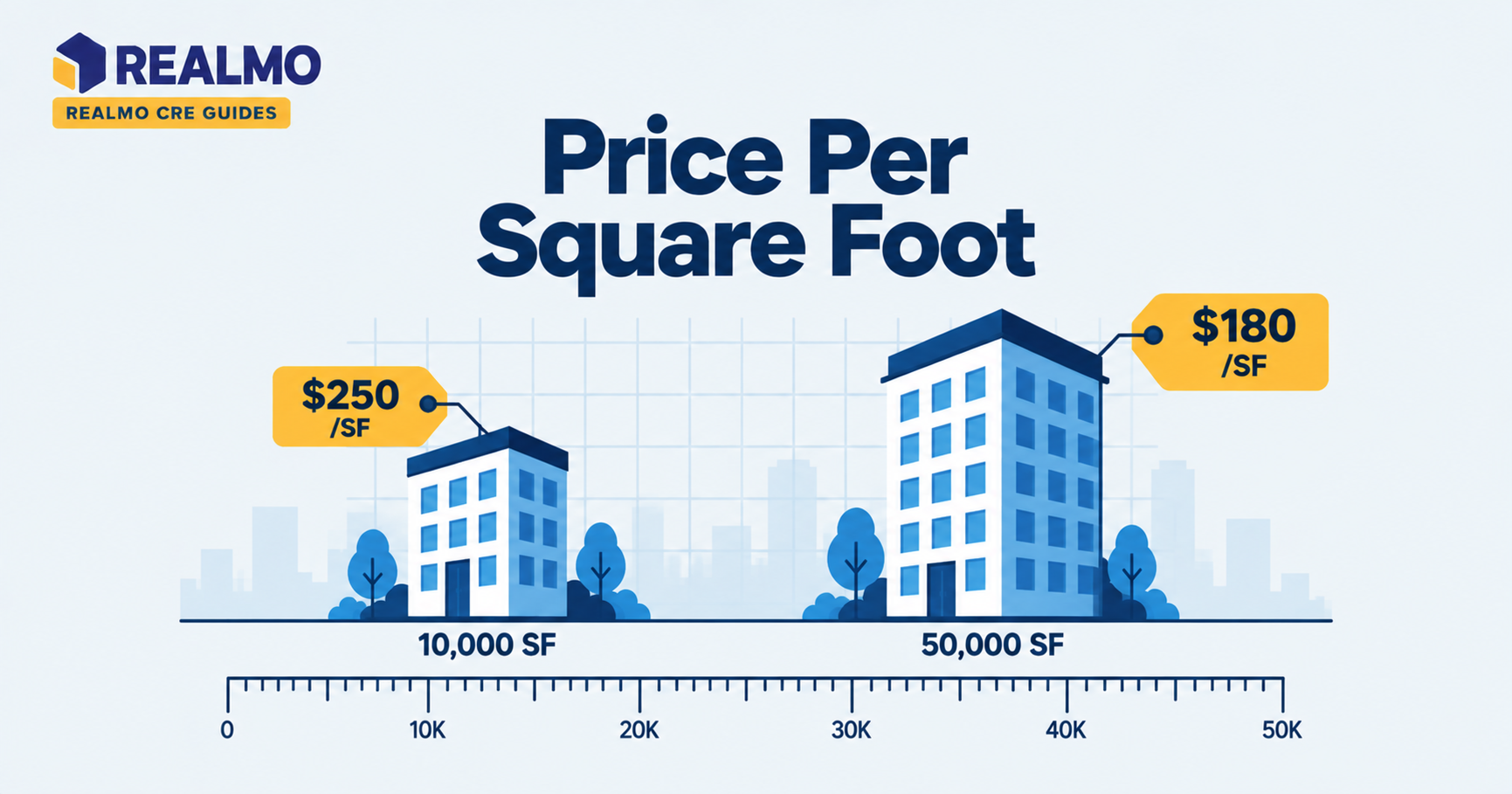
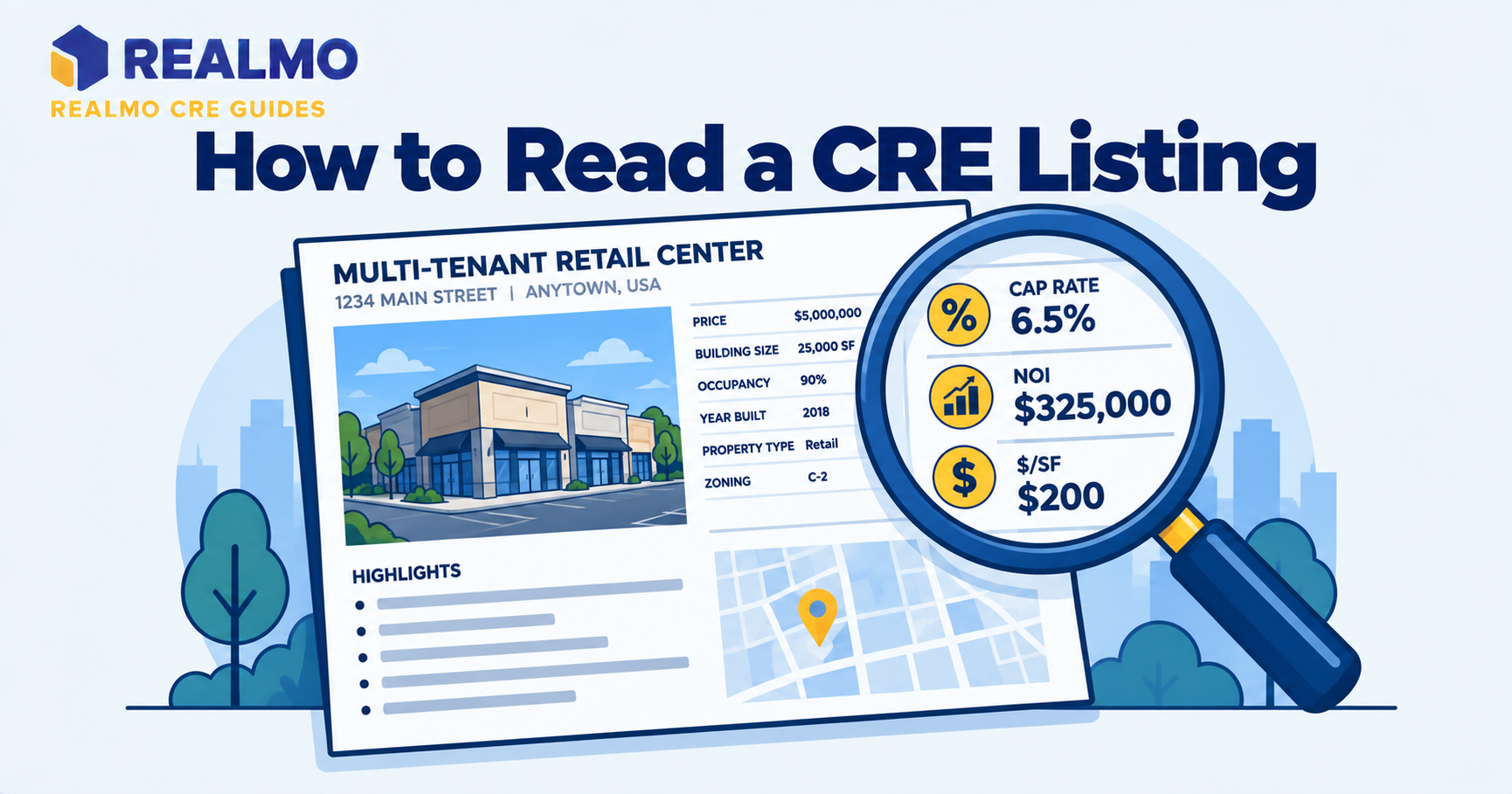
Price per square foot (PSF) is a property’s sale price divided by its building area. In commercial real estate, price per square foot puts deals of different sizes on one scale, so a small strip center and a large one can sit in the same comp set. It measures what space costs, not what it earns.
Where PSF wins and loses a listing pitch
A broker taking on a 40,000-square-foot flex building has to decide within the first week which metric leads the offering memorandum. If the likely buyer is a local contractor or distributor who will occupy the space, that buyer is not underwriting net operating income , they are comparing your building against two other buildings they toured and against a quote to build new. Cost per square foot is the only number in that conversation.
Lead with a cap rate instead and you sound like you are selling an investment to someone who wants a warehouse. Reverse the situation , a fully leased single-tenant asset marketed to a 1031 exchange buyer , and PSF is nearly irrelevant, because that buyer is pricing the income stream and the tenant’s credit. Picking the wrong lead metric tells the market you have not identified your buyer pool.
Which square footage goes in the denominator
The denominator does more damage than the numerator. Sale price is a fact recorded in the deed; square footage is a choice among several defensible measurements.
Gross building area counts everything inside the exterior walls, including mechanical rooms and unleasable space. Rentable square feet adds a tenant’s share of common areas through a load factor, so a multi-tenant office building always reports more rentable feet than usable feet. Gross leasable area in retail in prevailing market practice excludes mall common area. Industrial buildings introduce their own ambiguity: mezzanines, office build-out, and canopies get included by some brokers and excluded by others.
BOMA and ANSI publish the ANSI/BOMA Z65 series , separate standards for office, industrial, and retail , that resolve most of this, and appraisers will name the standard they used. Brokers frequently do not. State the area basis on the flyer, “$/SF on gross building area, mezzanine excluded”, and your PSF becomes defensible. Leave it unstated and every counterparty recalculates it their own way.
How to calculate commercial price per square foot
Price PSF = Sale Price ÷ Building Area.
Rent PSF works the same way but has two extra traps. First, the period: office and industrial usually quote annual rent per square foot, while retail in some West Coast markets quotes monthly. A quoted rent of $2.50 means very different things under those two conventions. Second, the expense structure, a triple net lease rate excludes taxes, insurance, and common area maintenance, while a full-service gross rate includes them. Comparing a net quote to a gross quote overstates the spread by the entire operating expense load.
What makes two PSF figures non-comparable
Two buildings can trade at identical PSF and represent completely different pricing. The variables that break comparability are physical, contractual, and locational.
Physical: clear height, column spacing, loading configuration, office finish percentage, land-to-building ratio, and parking ratio. A 14-foot-clear building with 60% office finish is not competing for the same tenant as a 32-foot-clear cross-dock, and their PSF figures should not be averaged together.
Contractual: a building sold vacant prices the real estate. A building sold with a long-term lease in place prices the real estate plus the income stream, and the PSF absorbs whether that rent sits above or below market. Below-market rent with years of term remaining depresses PSF for reasons that have nothing to do with the bricks.
Condition and location: deferred roof and paving work, environmental history, and submarket boundaries that cut across a single ZIP code all move PSF. When you assemble a comp set, screen on these attributes before you average anything , comparable sales analysis is a filtering exercise first and an arithmetic exercise second. Realmo’s property records let you pull ownership and sale history across 9M+ properties, which shortens the work of confirming whether a comp was arm’s length and what condition it traded in.
Land, building, and buildable PSF are different
Land is quoted per square foot or per acre, and the conversion is fixed: one acre is 43,560 square feet. A price of $10 per land square foot equals $435,600 per acre.
Development sites trade on price per buildable square foot instead. This divides the land price by the square footage that zoning and floor area ratio actually permit. Two adjacent parcels at the same land PSF can differ by half on a buildable basis if one carries denser entitlements. Quoting land PSF to a developer who thinks in buildable feet produces a fast disconnect.
When PSF beats cap rate as a comparison tool
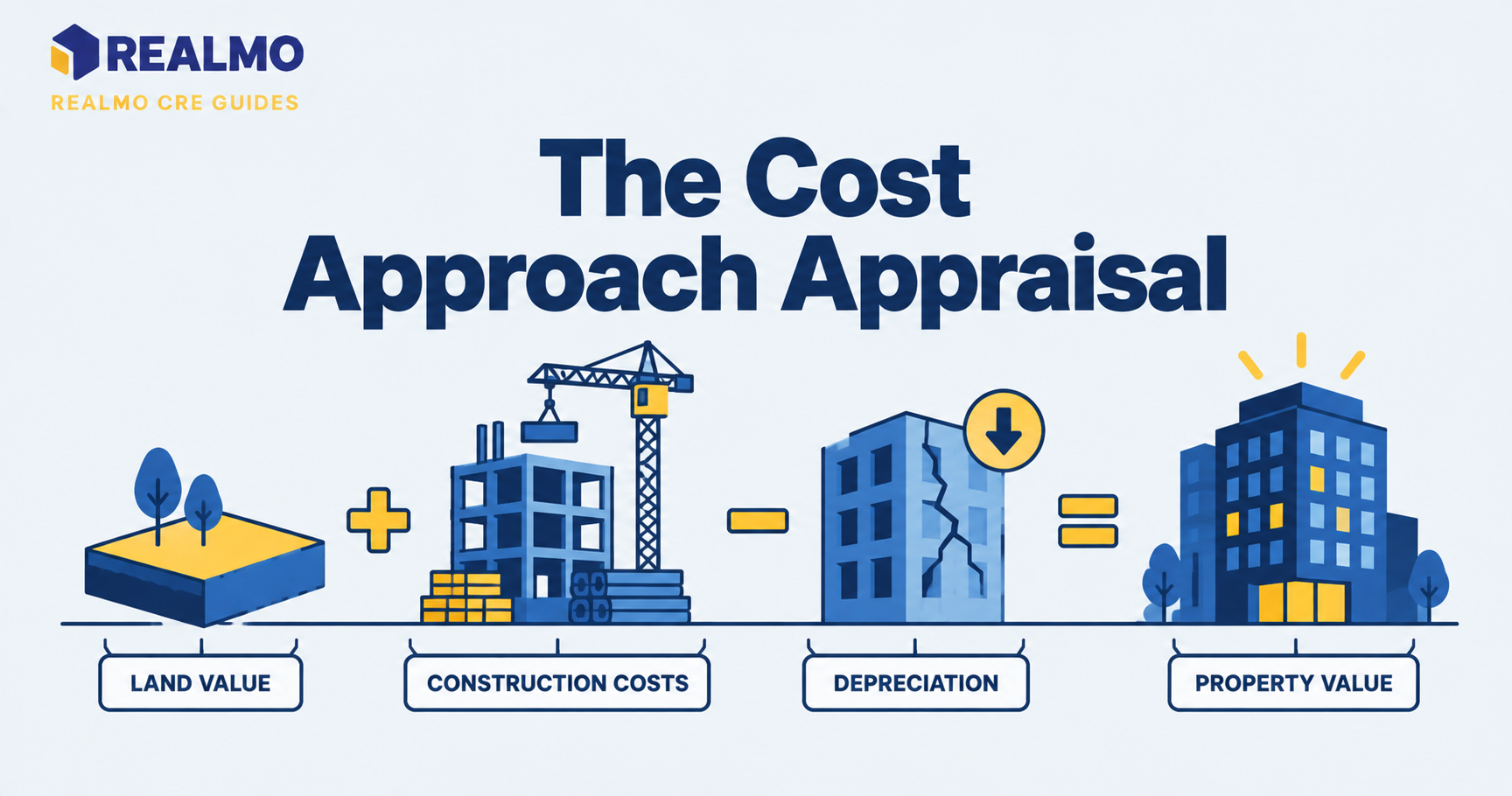
PSF earns its place when income is absent, unreliable, or about to change: vacant buildings, owner-user sales, value-add repositioning, and ground-up comparisons. It also functions as a sanity check against replacement cost. If a building trades meaningfully above what a comparable one costs to build today, the premium needs an explanation such as entitlement scarcity or location.
Cap rate takes over once income is stabilized and durable. Experienced brokers run both and treat a wide divergence as a signal that something in the story needs attention.
Worked example: three flex buildings, one comp set
Illustrative figures, rounded for clarity.
Building A sells for $4,200,000 with 28,000 square feet of gross building area, vacant, 10% office finish. That is $150 per square foot.
Building B sells for $3,300,000. The listing reports 20,000 square feet, which includes a 2,000-square-foot mezzanine, producing $165 per square foot. Restated on ground-floor gross building area of 18,000 square feet, the basis used for A, it is $183 per square foot.
Building C sells for $5,600,000 across 40,000 square feet, or $140 per square foot, but it carries 60% office finish and 14-foot clear height.
Ranked as marketed, C looks cheapest and A mid-range. Restated on a consistent area basis and screened for building type, B is the most expensive of the three by a wide margin, and C is not a comp at all for a warehouse user , its office-heavy configuration serves a different tenant. The common error is treating the mezzanine adjustment as a rounding detail. Here it moved the figure by roughly 11%, which is larger than most negotiating gaps.
Common mistakes that distort PSF comparisons
- Averaging PSF across mixed building types. A blended figure covering office-heavy and warehouse-heavy comps describes no property in the set, and a buyer’s appraiser will discard it.
- Mixing area bases within one comp set. Rentable feet in one row and gross building area in the next creates a spread that looks like market variance but is measurement noise.
- Ignoring the lease in place. Presenting an encumbered sale as a real estate comp imports the seller’s rent roll into your pricing conclusion without saying so.
- Using PSF to price a stabilized investment. Income-driven buyers reverse-engineer the cap rate anyway, and a PSF-led ask that implies an off-market yield invites a lowball counter.
- Failing to name the source of the square footage. County assessor records, architectural plans, and BOMA measurements disagree; unattributed footage collapses under diligence.
Related terms
Cap rate · Net operating income · Rentable vs. usable square feet · Comparable sales analysis · Replacement cost · Floor area ratio · Triple net lease · Price per unit
FAQ
Is price per square foot calculated on rentable or gross square feet?
Both are used, and neither is universally correct. Office comps run on rentable square feet, industrial on gross building area, and retail on gross leasable area. What matters is disclosing the basis and applying it consistently across every property in the comp set.
Why do two similar buildings have very different price per square foot?
Clear height, office finish percentage, land-to-building ratio, parking, building age, deferred maintenance, and whether the sale was vacant or leased all move the figure. Submarket boundaries matter as well, two properties a mile apart can sit in different rent tiers.
Should I use price per square foot or cap rate?
Use PSF when income is absent or unstable: vacant buildings, owner-user sales, and development comparisons. Use cap rate for stabilized leased assets. Running both and investigating any divergence is standard practice among brokers pricing an unfamiliar asset.
How do I convert price per acre to price per square foot?
Divide the per-acre price by 43,560, the number of square feet in an acre. For development sites, also calculate price per buildable square foot using the zoning-permitted floor area, since entitlements matter more than raw land area.