Retail Leads, Land Beats Office: What CRE Buyers Are Asking AI, a Realmo Report
Queries to Rey, the AI assistant on the commercial real estate marketplace Realmo, show where buyers get stuck. Spoiler: finding the property is only the beginning.
Commercial real estate search usually starts with filters, but buyers often need more help once a property appears. Inside the CRE marketplace Realmo, these questions go to Rey, an AI assistant that helps users browse, analyze, and compare listings across the platform’s extensive inventory. Since Rey sits within the marketplace and can see the listing a user has open, the conversation can move straight from search criteria to price, income, risk, and next steps.
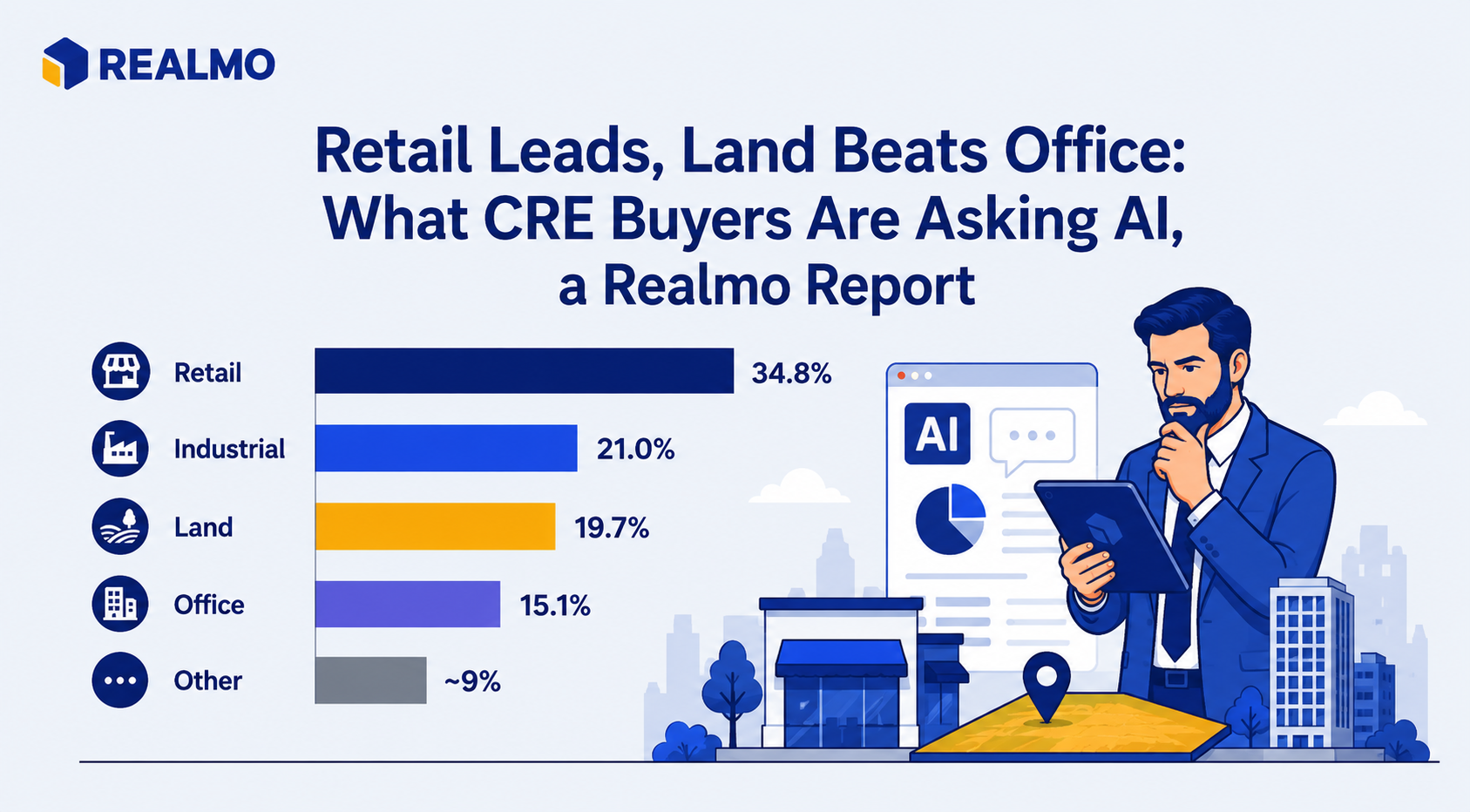
Retail accounted for 34.8% of qualifying Rey queries that explicitly named a property type, followed by industrial or warehouse at 21.0%, land at 19.7%, and office at 15.1%. The figures reflect user activity within a single U.S. commercial real estate marketplace and should not be interpreted as representative of AI use across the broader CRE industry.
The asset mix is the surprising result. Even more surprising, though, is what happens after a property enters the conversation and uncertainty becomes specific in practice. Buyers ask whether the price makes sense, how to interpret net operating income, what risks deserve attention, and what to ask the broker. In other words, AI is entering the commercial real estate decision process.
What Assets People Are Looking for on Realmo with Rey
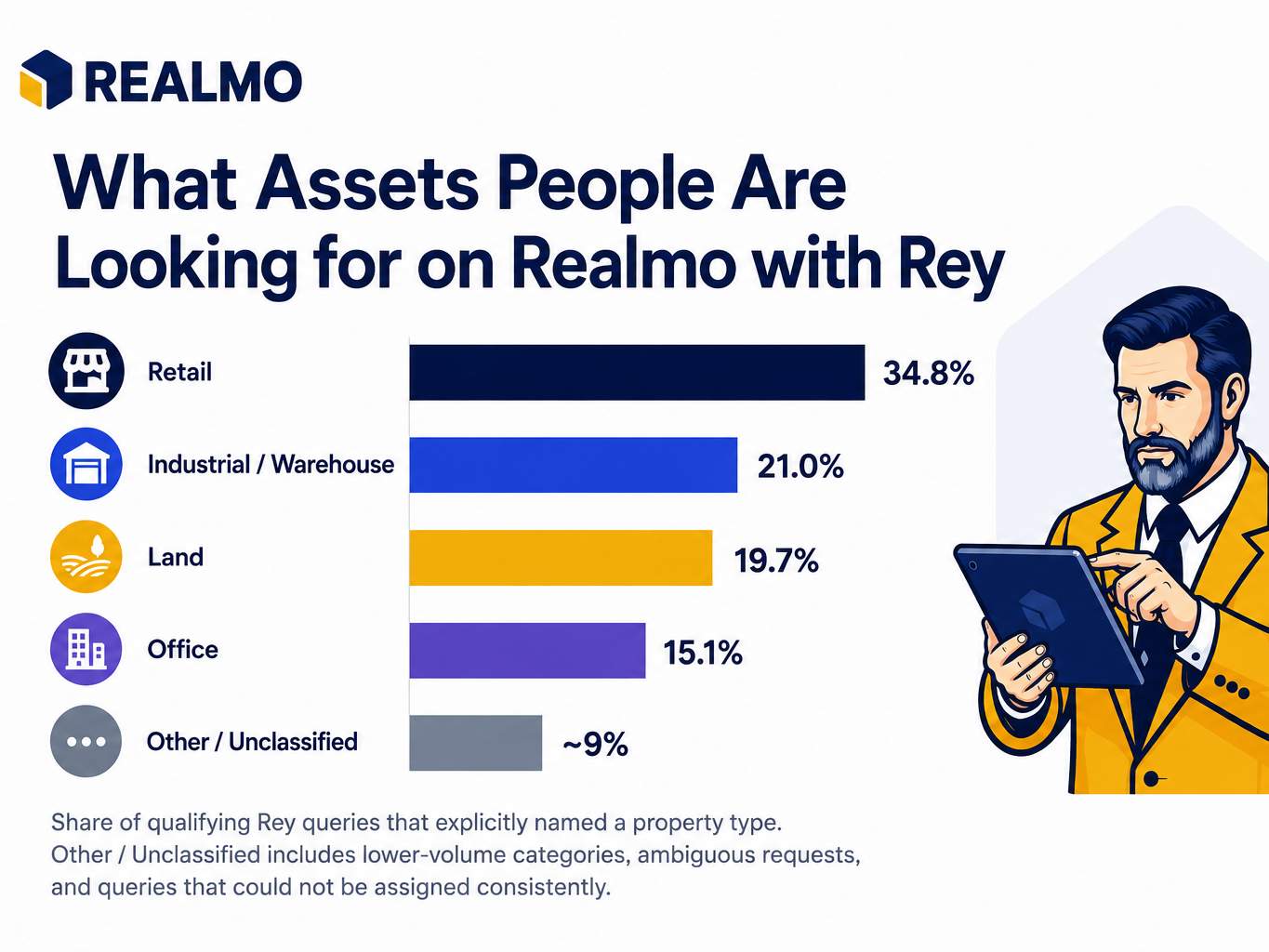
Among queries that explicitly named a property type, retail led at 34.8%. Industrial and warehouse followed at 21.0%, land at 19.7%, and office at 15.1%. Other or unclassified property types represented about 9%. The denominator is key here: these shares exclude requests that didn’t identify an asset class, so they shouldn’t be read as total marketplace demand.
Retail is a logical entry point for private buyers. Many assets have prices and income streams that can be understood without the operating complexity of a hotel or large office tower. Retail also spans a wide range of formats, from single-tenant buildings to small strips and mixed-use storefronts. CBRE’s 2026 investor survey likewise found renewed interest in retail, although institutional preferences differ from the users represented here.
Industrial queries were more technical. Users specified clear height, loading, power, access, and operating requirements, reflecting how quickly a seemingly suitable warehouse can fail an occupier’s needs.
“Land nearly caught industrial – not because it is easy to evaluate, but because it isn’t. One likely explanation is that AI becomes most valuable where the market is least standardized. Land forces buyers to reason through zoning, access, utilities, entitlements, and possible uses before income even exists.”
Iar Argunov, Head of Analytics at Realmo and creator of Rey
Land reached 19.7%, despite having thinner public information and lower liquidity than the major income-producing classes. The result does not prove why users turned to Rey, but it is consistent with the idea that less standardized segments generate more demand for early-stage assistance. Office drew a smaller share, but the dataset should not be treated as a verdict on overall office demand. It captures only the property types named in these marketplace conversations.
What Users Ask Realmo’s AI Assistant to Do: From Search to Analysis and Reassessment
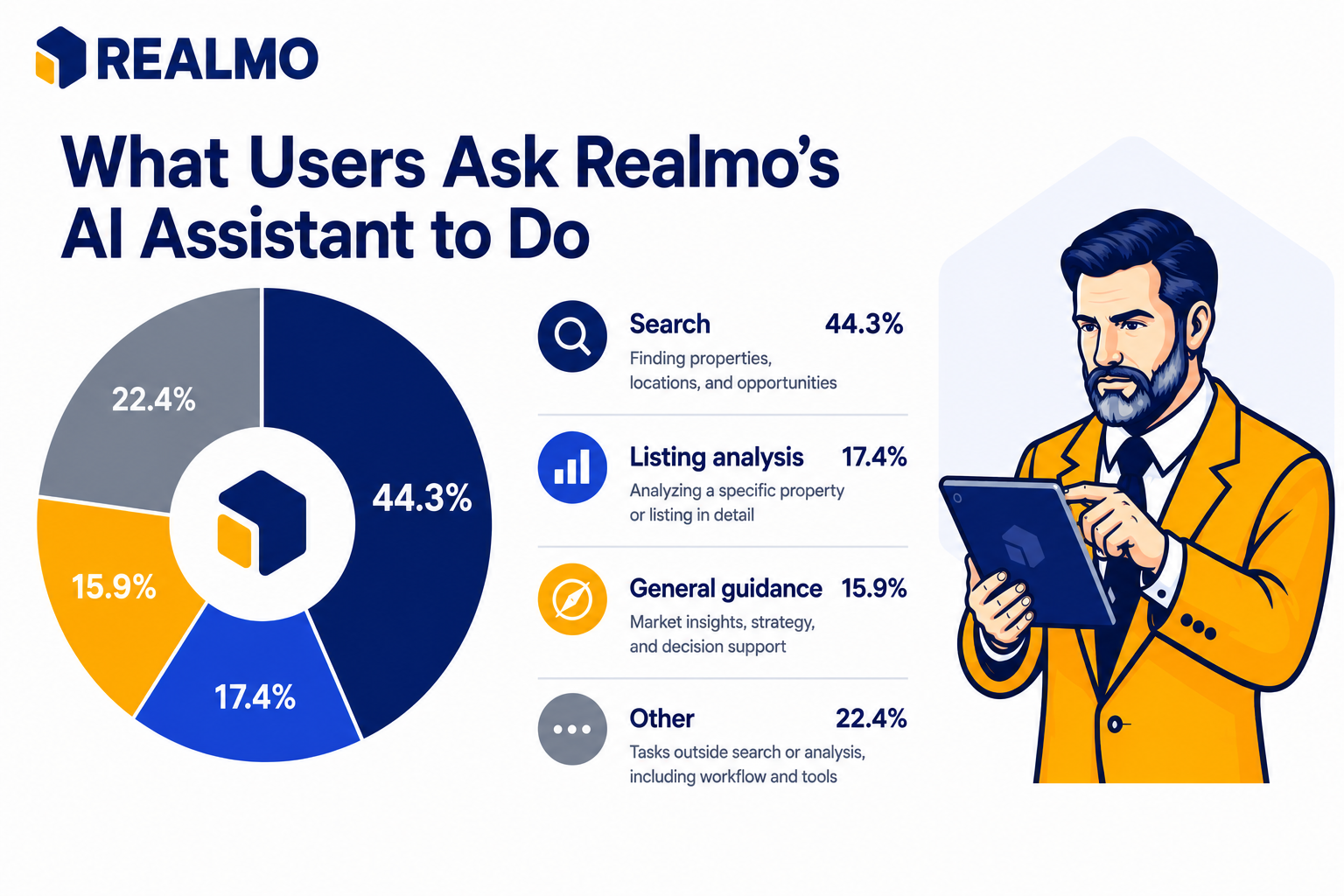
Property search produced 44.3% of classified queries. That’s expected and, by itself, not especially revealing. Search remains the largest use case because buyers still need a simple way to express location, budget, size, use, and asset preferences together.
Listing analysis accounted for 17.4%. Here, the user has stopped scanning the market and is reading one asset. The assistant can see the listing the user has open, so both sides of the exchange share the same property context. This is peak intent: the buyer is no longer asking what exists but whether one candidate deserves more time. Queries about price, size, net operating income, capitalization rate, risk, and possible use all sit in this stage.
General commercial real estate guidance represented another 15.9%. These questions concern:
- Market logic
- Deal mechanics
- Process
- Decision criteria without attaching the request to a specific asset
They expose what users don’t yet know or don’t want to calculate alone. At this point, a CRE AI assistant becomes a record of where knowledge gaps appear during an active search, not only a new interface for commercial property search AI.
The remaining 22.4% covered other classified behaviors and requests that didn’t fit those three leading categories. It’s clear that the leading scenarios don’t describe every use case.
The Top 10 Questions Behind a CRE Decision
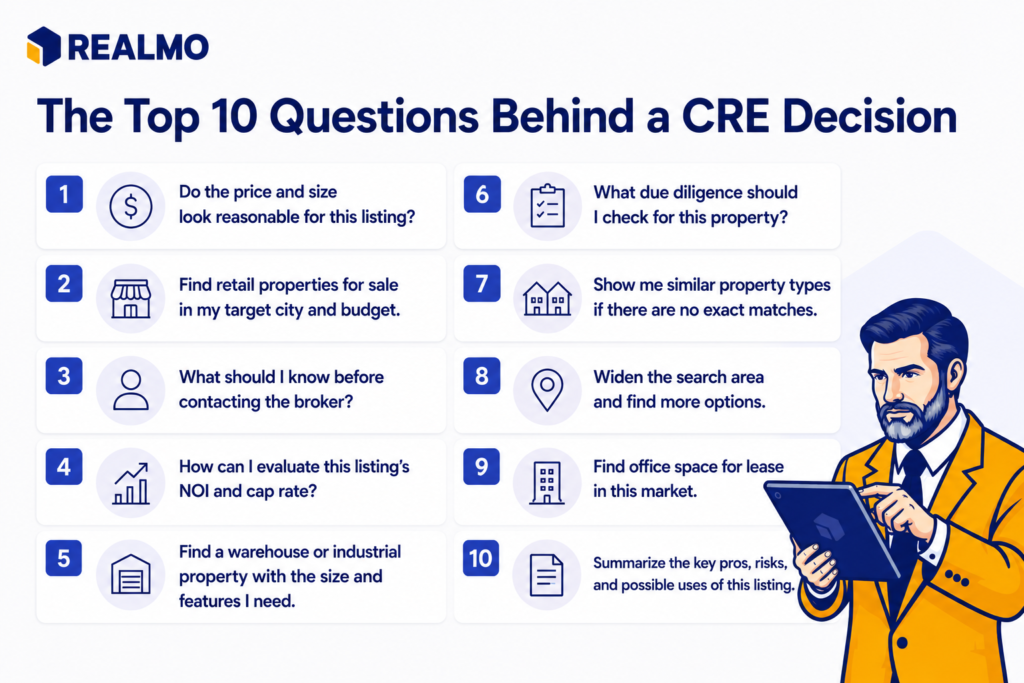
- Do the price and size look reasonable for this listing?
This is an early sanity check, usually made before a buyer spends time building a model or requesting documents. The wording suggests skepticism rather than enthusiasm. The user wants a fast reason to walk away if the asking price, building size, or implied unit value looks detached from comparable opportunities. It’s basically the first attempt to establish whether the listing deserves serious attention.
- Find retail properties for sale in my target city and budget.
This is conventional search behavior expressed as one sentence, effectively replacing several filter selections. The user supplies two constraints at once: geography and capital. Budget comes before building size, which suggests the search begins with financial capacity and lets the available inventory define what format or square footage is realistic. The request fits buyers browsing retail properties for sale.
- What should I know before contacting the broker?
At this stage, the property has passed the first screen, but the user isn’t ready to make contact. You might look at this as a rehearsal for a broker call. The query reflects a fear of missing an obvious issue or sounding unprepared when asking for rent rolls, operating statements, lease details, condition reports, or access. The buyer is moving toward action while trying to reduce an information and confidence gap.
- How can I evaluate this listing’s NOI and cap rate?
This common question to Rey marks the shift from browsing to underwriting. Net operating income, or NOI, and capitalization rate turn the listing from an interesting property into a possible investment case. The user is now testing income, expenses, and price together. It’s also a sign that a property has become a candidate, while other search results are less lucrative. A fuller NOI and cap rate guide can support this review.
- Find a warehouse or industrial property with the size and features I need.
Industrial search is driven by operating fit, so this query is a solid analytical step. Square footage is naturally key, but it doesn’t rescue a property with inadequate loading, clear height, power, yard area, access, column spacing, or zoning. That’s why the user is searching by attribute rather than category alone. This usually places the buyer or tenant closer to a real requirement, with fewer acceptable substitutes than a broad office or retail search allows. Relevant inventory appears under industrial properties.
- What due diligence should I check for this property?
This is a request for process, not simply another data point. The user knows the property may warrant investigation but needs help structuring what comes next. This can include:
- Title
- Leases
- Zoning
- Environmental conditions
- Physical inspections
- Taxes
- Insurance
- Utilities
- Capital needs
The question also suggests that part of the audience is not made up of full-cycle acquisition professionals.
- Show me similar property types if there are no exact matches.
This is a recovery query. In a conventional filter interface, zero results often ends the session. In a conversation, it becomes the next turn. The user is willing to relax the property-type definition while preserving the underlying need. And since Rey only searches the marketplace’s inventory, the request also reflects possible coverage gaps, not only genuine flexibility in the buyer’s criteria.
- Widen the search area and find more options.
This is the second recovery pattern, and it shows which constraint moves first. Users often expand geography before raising the budget. This suggests location has some flexibility, while capital limits remain firmer and more important. The buyer is still active and hasn’t rejected the requirement. The conversation lets the search continue without forcing a full reset of the original size, use, price, or property-type context.
9. Find office space for lease in this market.
This is the only strongly lease-side request in the ten. It contrasts with the sale and investment questions around it, which focus on pricing, income, risk, and due diligence. The user is likely looking for space to run a business rather than to buy as an investment. The next questions would probably concern:
- Term
- Buildout
- Operating expenses
- Parking
- Access
- Permitted use
Current office space for lease provides the relevant inventory.
- Summarize the key pros, risks, and possible uses of this listing.
The user wants a second opinion before choosing a direction. “Possible uses” is the important phrase in this request. It implies that some buyers begin with an asset and then consider the strategy instead of arriving with one fixed business plan. They may be comparing:
- Occupancy
- Redevelopment
- Conversion
- Investment angles
This isn’t pure search or pure underwriting. It looks more like structured judgment under uncertainty.
The Pattern Behind the Questions: Decision-Making Is Early and Specific
- Four questions refer to “this listing” or “this property” directly.
- Two more assume an active search whose constraints are already known.
As you can see, six of the ten questions only make sense when the user is already viewing a listing or continuing an active search.
This distinction separates embedded AI commercial real estate search from a general chatbot. The key pattern is that users ask these questions while viewing a specific asset.
The ten questions also divide into three jobs:
- Find covers questions 2, 5, 7, 8, and 9;
- Judge covers 1, 4, and 10;
- Act covers 3 and 6.
Search creates the most volume, but five questions concern underwriting or next steps.
How Buyers Negotiate Their Own Criteria
What’s interesting is that a typical dialogue with Rey AI doesn’t begin with every constraint stated perfectly. Users mention a city, then add a budget. They specify size, describe the intended use, or introduce a feature after seeing the first results. If the search is too narrow, they widen the radius or consider another property type. Each response changes what the buyer asks next. For example:
- A visible price may reset size expectations
- Weak inventory may reveal that location is less important than access or use
The inputs arrive as a sequence because buyers often reassess their priorities while reviewing the market. A filter form, on the other hand, would assume they know the full specification before the first result appears.
Questions 7 and 8 form a behavior class of their own: recovery. Traditional interfaces treat an empty or weak result set as an endpoint. Conversation, however, is a prompt to renegotiate the request. The user can preserve the original goal while relaxing one condition. In this dataset, geography and asset classification appear more flexible than budget. Buyers move outward or sideways before they move upward in price.
“At Realmo, we see this pattern as a tell-tale sign that commercial property search AI is most useful when it can carry context from one query to the next. Correctly parsing the first sentence is important, sure, but it’s not the hardest task. Retaining the budget, location, size, use, and rejected options by the fifth turn is key. A user shouldn’t need to rebuild the search whenever one constraint changes. So context retention may matter more than the novelty of natural-language input.”
Gary Lubarsky, CEO of Realmo
From Listing to Conviction
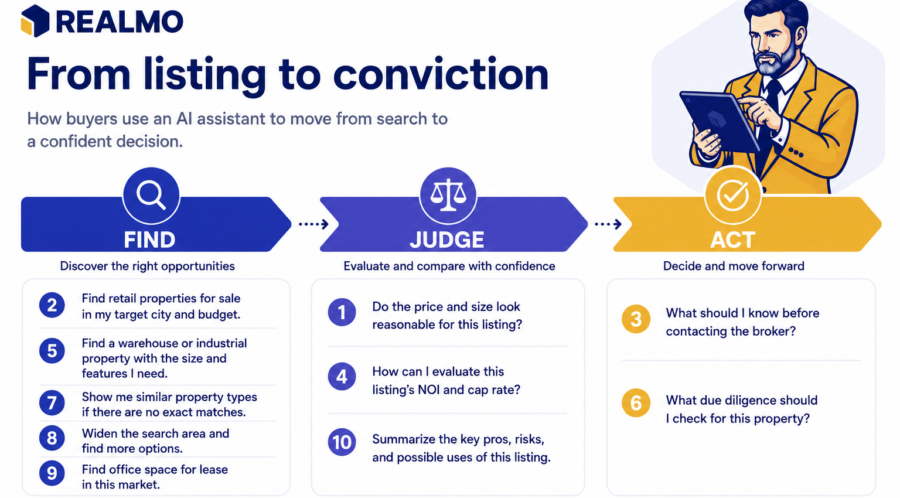
Once a property is found, the same chain repeats: price, income, capitalization rate, risk, due diligence, and broker questions. This is a compressed underwriting cycle. The steps aren’t eliminated, and the final judgment still belongs to the buyer and advisers. They are pulled forward into the browsing session, before a formal model, site visit, or document request. This makes the listing page the beginning of underwriting.
Start by checking how the listing calculates net operating income. Confirm which expenses are included, whether vacancy reflects actual performance, whether a management fee is missing, and how much income depends on projected rent. Then compare the adjusted NOI with the asking price to assess the cap rate. Treat that figure as one input, not a full risk assessment, since it doesn’t capture lease rollover, deferred maintenance, tenant concentration, or financing terms.
Before contacting the broker, turn these gaps into specific questions. Ask for the rent roll, operating statements, lease details, recent capital work, and any assumptions behind projected income. AI assistants like Rey can help organize that list so the first conversation starts with the key issues already identified.
Buyer Questions Expose Where CRE Platforms Fall Short
- Questions 7 and 8 show that weak results don’t always end a search. Buyers are often willing to widen the search area, consider a related property type, or relax one requirement. Marketplaces should make these adjustments easy and keep the original budget, size, and use criteria in place, so the user can refine the search without starting over.
- Listing pages also need to support the first stages of underwriting. With 17.4% of classified queries focused on a property already open, buyers are clearly looking beyond price, square footage, and photos. Pages should make it easier to assess income assumptions, major risks, likely due diligence needs, and the questions worth raising with the broker.
- The query data can also guide product and listing improvements. Repeated questions point to missing fields, unclear terminology, and moments when buyers hesitate. Marketplaces can use those patterns to decide which data to add, which explanations to surface, and where a clearer next step could keep a viable deal moving.
Conclusion
Search was never the only job that needed solving with AI. Inventory can put a property in front of a buyer, but it cannot create conviction on its own. The questions in this dataset show users moving through a broader process:
- Finding an option
- Testing its economics
- Identifying risk
- Preparing to act
That’s likely a more important measure of AI in CRE. The next competitive metric for CRE marketplaces may be how many property decisions they help carry from an initial request to a defensible next step.
Bring a real property question to Rey on Realmo and see where the conversation leads.
Methodology
This analysis covers all qualifying user queries submitted to Rey from its launch in May 2026 through July 2026. Internal, employee, automated, and test activity was excluded. Queries were classified by primary use case and, where explicitly stated, by property type. Property-type shares use only queries that named an asset class. “Other/unclassified” includes lower-volume categories, ambiguous requests, and queries that could not be assigned consistently. These queries were submitted within a single U.S. commercial real estate marketplace and should not be interpreted as representative of AI use across the broader commercial real estate industry. The dataset was prepared, cleaned, classified, and analyzed by Iar Argunov, Head of Analytics at Realmo, who also created and leads the development of Rey.