How Commercial Property Is Valued
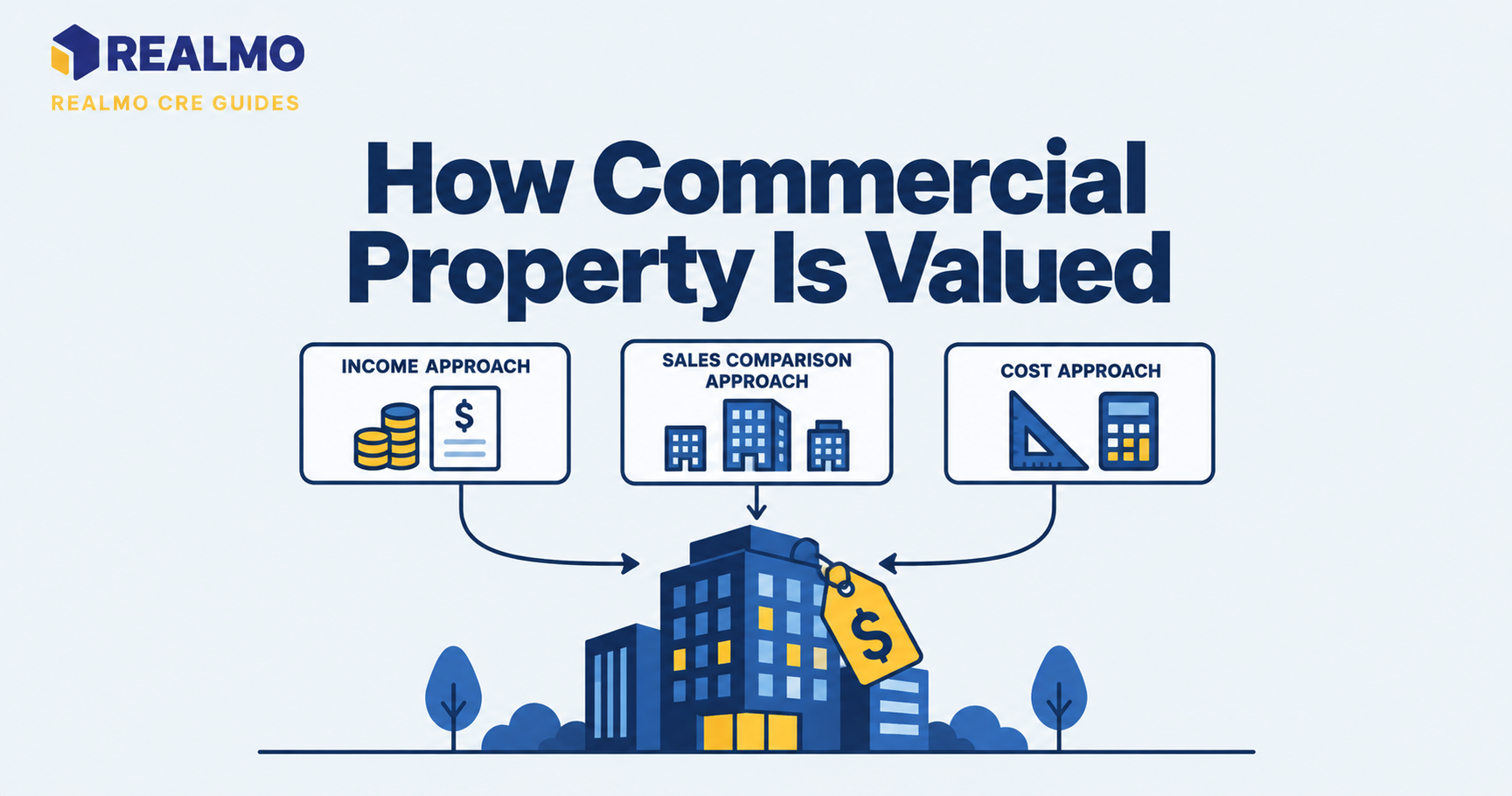
Commercial property valuation estimates what an income-producing asset is worth. It measures property income, comparable sale prices, and replacement cost. Appraisers weigh these three approaches differently by property type, and for leased assets the income approach usually governs.
Why Valuation Decides Whether Your Deal Works
An investor under contract on a multi-tenant retail strip has two numbers in front of him. One is the seller’s asking price. The other is the lender appraiser’s value in three weeks. If the appraisal lands below contract, the loan shrinks, because lenders size debt against appraised value, not purchase price. The gap becomes equity the buyer has to fund or a price he has to renegotiate.
That gap almost never comes from a mysterious appraisal formula. The gap comes from disagreements the buyer could have anticipated. The seller might capitalize month-to-month income, count one-time percentage rent, or ignore a six-figure roof item. Valuation is where every assumption in the deal gets tested at once. Understanding how the number is built is how you predict it before you sign.
Value = Stabilized NOI ÷ Cap Rate
Value = Subject Property Area × Adjusted Comparable Price per SF
Value = Land Value + Replacement Building Cost − Depreciation
Indicated Value = (Income Value × Income Weight) + (Sales Value × Sales Weight) + (Cost Value × Cost Weight)
The Three Approaches Every Valuation Starts From
Every credible commercial real estate valuation uses three lenses. Professional standards expect an appraiser to consider all three, even when one drives the conclusion.
The income approach converts property earnings into value. It divides stabilized NOI by a cap rate or discounts a multi-year cash flow forecast to present value. The method shows what an investor can pay today for a projected income stream.
The sales comparison approach studies similar transactions. It adjusts their prices for location, size, age, condition, tenancy, and deal terms. The method shows what buyers currently pay for comparable properties in that market.
The cost approach estimates current land and replacement-building cost, then subtracts depreciation for the existing structure's age and shortcomings. The method tests whether building a substitute is cheaper than buying the subject property.
The three approaches rarely produce the same number, and they are not supposed to. A reconciliation step assigns weight based on which method has the most reliable inputs for that asset. For a net-leased pharmacy with fifteen years of term remaining, the income approach carries nearly all the weight. The building itself is almost incidental to the value of the lease. For a rural church converted to a community center, rental income and local sales can be absent. The cost approach can then be the only defensible method. For a small owner-user warehouse in a market with steady turnover, comps may lead.
Understanding which approach dominates a given asset tells you where to concentrate your diligence. When income leads, you audit leases. When comps lead, you audit the comp set. When cost leads, you audit the contractor's numbers.
How the Income Approach Sets Most CRE Prices
Most institutional and private commercial transactions are priced off income, and the arithmetic is simple enough to fit on a napkin. The subtlety lives entirely in the inputs.
Start with net operating income, which is effective gross revenue minus operating expenses, before debt service, income taxes, depreciation, and capital expenditures. Identical collections can produce different NOI because expense treatment differs. Market-rate management fees, replacement reserves, and one-time legal settlements can change the result.
Direct capitalization applies a single rate to one year of stabilized income:
Value = NOI ÷ Cap Rate
An illustrative example: a small industrial building produces stabilized NOI of $600,000. At an illustrative capitalization rate of 6.00%, the indicated value is $10,000,000. At 6.25%, the value falls to $9,600,000. A quarter-point change in one assumption moves the price by four percent. These figures are illustrative only and are not quotes of current market rates.
That sensitivity is the whole reason cap rate selection is contested in every appraisal review. Rates are extracted from comparable sales, cross-checked against investor surveys, and adjusted for lease term, tenant credit, and the physical quality of the asset. An appraiser can import distorted pricing by using the wrong sale. Examples include a below-market assumable loan or a 1031 buyer racing a deadline.
Discounted cash flow is the alternative when income is not stable. A DCF projects annual revenue and expenses across the hold. It subtracts leasing and capital costs, calculates reversion from a terminal cap rate, then discounts all cash flows for risk. DCF is the honest method for an office building with a lease roll concentrated in year three, or a value-add multifamily property mid-renovation. This is because it can show the trough before the recovery.
Both methods share one failure mode: they reward optimism. Every extra dollar of assumed rent growth and every month shaved off assumed downtime flows straight to value. Disciplined underwriters first run market-level assumptions. They then layer the business plan as a separate case. This shows how much price depends on work not yet completed.
Reading Sales Comps Without Fooling Yourself
The sales comparison approach looks the most intuitive and is the easiest to abuse. Its logic is straightforward: find recent transactions of similar properties, adjust for the ways they differ from the subject, and derive an indicated value.
The unit of comparison matters. Industrial and office comps use price per square foot. Multifamily uses price per unit and square foot. Self-storage uses price per rentable foot. Land uses price per acre or buildable foot. Reducing dissimilar properties to a common metric makes comparison possible, but it also hides the differences that drive value. Two office buildings at the same price per square foot can be different investments. One may have a long credit lease; the other may be half empty.
Adjustments fall into two families. Transactional adjustments correct for deal-specific terms. Examples include seller financing, strategic overpayment, arbitrary portfolio allocations, or older sales from different market conditions. Property adjustments correct for physical and locational differences. Examples include clear height in a warehouse, parking ratio in an office, frontage and traffic count in retail, unit mix and vintage in multifamily.
The failure mode here is comp selection bias. Given a hundred sales in a submarket, an advocate can assemble a set that supports almost any conclusion. Appraisal reviewers examine excluded sales as closely as included ones. Buyers should also request the full submarket transaction list, not only three sales supporting the ask.
Comps also lag. A sale that closed months ago reflects underwriting done before that, under credit conditions that may no longer exist. In fast-moving markets, the comp set describes the past while the buyer is pricing the future. This is why income-based methods usually take the lead when the two diverge.
When Replacement Cost Drives the Answer
The cost approach estimates land value separately, adds the cost to construct a replacement building, and subtracts accrued depreciation. The cost approach is standard for special-purpose assets with little rental or comparable-sale evidence. Examples include schools, houses of worship, municipal buildings, and some plants.
Two distinctions matter. Reproduction cost is the cost to build an exact replica, including obsolete features. Replacement cost is the cost to build a structure of equal utility using current materials and methods. Appraisers use replacement cost, because nobody would rebuild a 1960s office with its original systems.
Depreciation in the cost approach has nothing to do with tax depreciation schedules. It is an appraisal concept with three components. Physical deterioration is the wear you can see and touch. Functional obsolescence is a design flaw that limits utility. Examples include twelve-foot warehouse clear height or floor plates with columns every eighteen feet. External obsolescence is value lost to forces outside the property line. A highway realignment or an industry decline can create it. External obsolescence is the largest of the three and the hardest to quantify.
The cost approach also sets a useful ceiling in any market. When an existing building costs more than new construction, development becomes the cheaper path. New supply then arrives and competes. When acquisition prices sit well below replacement cost, construction stalls. Investors watch that relationship because it explains the supply pipeline better than any forecast. This also explains why insurable value and market value can diverge. An insurer focuses on the structure, not the lease or land.
What Moves a Commercial Property Valuation Most
A short list of variables explains most value differences between otherwise similar commercial properties. Those variables become clearer once the valuation mechanics are understood.
Lease structure and remaining term. A triple-net lease shifts operating costs to the tenant. It produces a cleaner income stream than a gross lease where the owner absorbs expense growth. Longer remaining term reduces re-leasing risk, which reduces the required return, which raises value. This is why lease structure matters more than square footage.
Tenant credit. Income from an investment-grade national tenant is priced closer to bond income than income from a local operator with no financial disclosure. The difference shows up directly in the capitalization rate applied.
Location within the submarket. Access, visibility, labor availability, and adjacency to demand drivers behave differently by property type. A logistics building lives and dies by highway access and drive-time to population; a medical office building by proximity to a hospital campus.
Physical functionality. Clear height, column spacing, loading, floor plate depth, parking ratio, elevator count, power capacity. These determine which tenants can use the space at all, which sets the depth of the demand pool.
Deferred capital needs. Aging roofs, failing HVAC, or near-term parking replacement create liabilities. Sophisticated buyers deduct those costs from price, close to dollar for dollar.
Cost and availability of debt. Most commercial real estate is bought with debt. The price a buyer can pay therefore depends partly on lender proceeds and borrowing cost. When borrowing costs rise relative to property yields, buyers need higher going-in returns. Cap rates follow with a lag because sellers resist repricing.
Entitlement and current versus highest and best use. Value is measured at the property's highest and best use, meaning the legally permissible, physically possible, and financially feasible use that produces the highest value. A retail building zoned for mixed-use density can be worth more as a redevelopment site. In that case, value is land value less demolition, not capitalized income.
Appraisal, BOV, and AVM: Which One You're Reading
Three different documents get called "the value," and confusing them causes real problems.
A formal appraisal is prepared by a licensed or certified appraiser under the Uniform Standards of Professional Appraisal Practice. It follows a defined scope of work, discloses assumptions and limiting conditions, and is the document lenders rely on for federally related transactions. It costs the most and takes the longest, and it is the only one of the three with professional liability behind it.
A broker opinion of value, sometimes called a broker price opinion, is prepared by a licensed broker, usually free or at low cost. Reflects what that broker believes the asset would sell for in current conditions. It is fast and grounded in live market knowledge, including deals that have not closed and never show up in public records. It also carries an inherent tension: the broker producing it frequently wants the listing. State law limits when a BOV may be used in place of an appraisal, and those limits vary.
An automated valuation model applies statistical methods to property characteristics, recorded sales, and available income data to produce an estimate instantly and at scale. AVMs are strongest on homogeneous property types with dense transaction data and weakest on unique assets, thin markets. Anything whose value depends on lease terms the model cannot see. Their proper use is screening (sorting a thousand properties into a shortlist) not final pricing.
Choosing the right instrument is a question of purpose. Financing needs an appraisal. Deciding whether to tour a building needs an AVM. Setting an asking price benefits from a BOV plus your own underwriting.
How to Pressure-Test a Value Before You Bid
Whatever number lands on your desk, a short sequence of checks will surface most errors.
Rebuild NOI from the leases rather than accepting the seller's operating statement. Confirm each tenant's base rent, escalations, expense recoveries, remaining term, and options against the executed documents and the estoppels. Strip out non-recurring income and add back expenses the seller conveniently omitted, including a market-rate management fee and a realistic reserve.
Test the cap rate by working backward from comparable sales. Use each sale's actual in-place NOI at closing, not pro forma income. Then calculate the rate paid. Wide dispersion means the comp set is not comparable.
Run the value against the cost approach as a sanity check. If price per square foot exceeds nearby replacement cost, you need a defensible reason. Examples include an irreplaceable location, entitlement scarcity, or above-market in-place income. Test whether that reason survives the hold.
Finally, check the physical plant against the model. A capital plan that assumes no roof replacement on a building with a twenty-five-year-old roof is not a valuation, it is a wish.
Ownership records, sales, use data, and estimated values for millions of U.S. commercial properties are available on Realmo without a paywall. That data speeds independent comp screening in unfamiliar submarkets and reduces parcel-by-parcel county-record work.
Valuation intersects with tax, accounting, and lending rules that vary by state and by transaction. Confirm anything with financial or legal consequence with a licensed appraiser, attorney, or tax professional before acting.
Where to Go Next in Valuation & Pricing
Cap rate. The single most-quoted metric in commercial real estate and the most frequently misused. It covers rate extraction from sales, differences between going-in and exit rates, and what cap rates reveal about risk. It also explains why lease structure matters across property types.
Net operating income. The denominator of nearly every valuation metric. It covers NOI inclusions, expense recoveries, capital reserves, and inconsistent industry treatment. It also shows how to normalize a seller's statement for capitalization.
Discounted cash flow analysis. The method for assets whose income is not stable. It covers projection periods, terminal value, discount rate selection, the difference between levered and unlevered returns, and where DCF models most mislead.
Sales comparison and adjustment grids. How appraisers move from raw transactions to an indicated value. It covers unit-of-comparison selection, transactional versus property adjustments, paired sales analysis, and how to audit a comp set for selection bias.
Replacement cost versus market value. Why the two diverge and what each is used for. It covers reproduction versus replacement cost, the three forms of appraisal depreciation, insurable value, and how price relates to construction cost.
Highest and best use. The concept that determines what you are actually valuing. It covers the four tests, as-vacant versus as-improved analysis, and how zoning and entitlement change the answer.
The commercial appraisal process. What happens between engagement and report delivery. It covers scope of work, appraiser designations, licensing tiers, USPAP requirements, review appraisals, and responses to a below-contract appraisal.
Broker opinion of value. It explains when a BOV is appropriate, what it should contain, and how to read one. It also covers state restrictions on broker opinions.
Automated valuation models in CRE. It explains how AVMs work, where they perform well, and which data gaps matter. It also shows how to use estimates for screening, not underwriting.
Related Terms
Cap rate · Net operating income · Discounted cash flow · Highest and best use · Effective gross income · Terminal capitalization rate · Price per square foot · Gross rent multiplier
FAQs
How do you value a commercial property?
Estimate stabilized net operating income, then either divide it by a market capitalization rate or discount a multi-year cash flow projection. Cross-check the result against recent sales of similar properties on a per-square-foot or per-unit basis, and against what it would cost to build a substitute. Reconcile the three indications based on which has the strongest inputs.
What is the difference between market value and appraised value?
Market value is the price a property should bring in a competitive open market under typical conditions. Appraised value is one appraiser's supported opinion of that market value as of a specific date. The two should be close, but an appraisal reflects one professional's judgment and a defined scope of work, not a guaranteed sale price.
Why did my appraisal come in lower than my purchase price?
Common causes include optimistic seller income, excluded comps, deferred-maintenance deductions, or a higher cap rate than the contract implies. Review the report's assumptions and comp selection; a reconsideration of value with new supporting sales is sometimes possible.
Does a commercial property's value depend on the tenant?
Substantially. A financially strong tenant on a long triple-net lease supports a lower required return. The same rent from a short-term, undisclosed-credit tenant is priced higher. Remaining lease term, escalation structure, renewal options, and expense responsibility all feed directly into the capitalization rate applied.
Can I use an online estimate instead of an appraisal?
For screening, yes. For lending, no. Automated estimates help screen properties and test asking prices against recorded data. They cannot read leases, inspect condition, or satisfy appraisal rules for federally related transactions.