Investing in Raw and Development Land
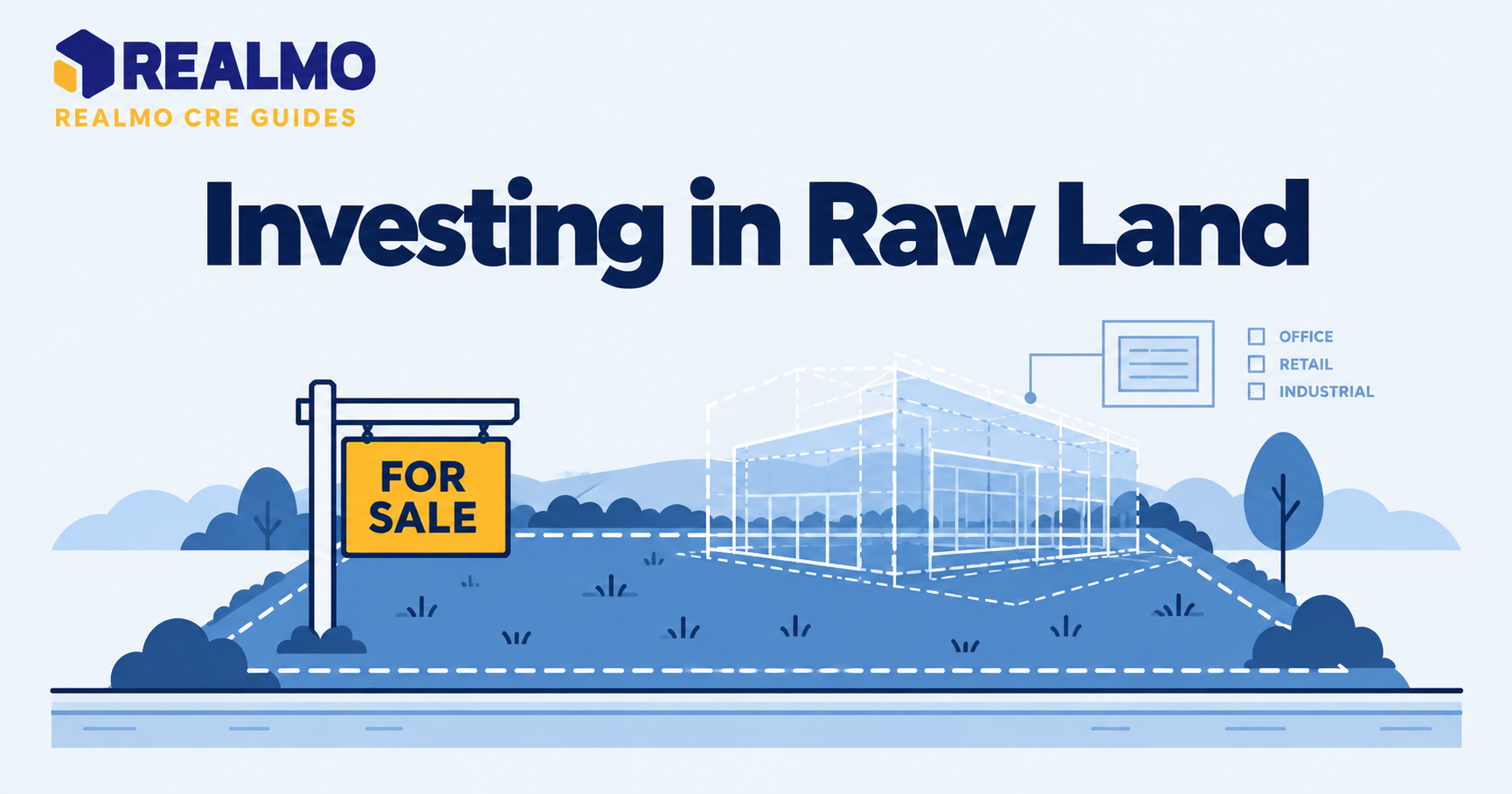
Commercial land investment is the purchase of unimproved or partially improved parcels held for appreciation, entitlement, or future construction. Raw land generates no rent. Unlike income-producing property, returns depend entirely on resale value, entitlement progress, or the developer’s exit, while carrying costs accrue from day one.
Why land behaves differently from every other asset class
An investor moving from a stabilized retail strip into land investment commercial deals usually discovers the underwriting model no longer applies. There is no rent roll to stress, no operating expense ratio, no debt service coverage to calculate. A stabilized asset pays you to wait. Land charges you to wait.
Consider an investor who buys 40 acres on the fringe of a growing metro because the price per acre looks cheap against nearby developed parcels. Property taxes, liability insurance, mowing and fencing, and interest on any acquisition loan all run against the position every year. If the parcel takes seven years to reach a buyer instead of three, the total carry can consume a large share of the gain. Land rewards investors who can specify, before closing, what event makes the parcel more valuable and roughly when that event occurs. Investors who cannot name that event are speculating on the metro. Not on the site.
The four categories of land and how each one is priced
Raw land has no entitlements, no utilities at the boundary, and commonly no legal access beyond an easement. That’s the ground floor. It trades at the largest discount and carries the longest hold, because pricing anchors to agricultural or recreational use rather than development potential.
Entitled land has zoning approval and usually a recorded plat for a specific use and density. The entitlement itself is the value creation. A parcel approved for 200 multifamily units is worth materially more than the identical dirt without approval, because the buyer inherits certainty and time savings.
Improved or finished land has entitlements plus horizontal infrastructure: graded pads, streets, sewer and water stubbed to the lot line, stormwater detention built. Homebuilders and commercial developers buy finished lots. They can start vertical construction immediately.
Infill land sits inside an already-developed area. Supply is fixed. Comparable sales are plentiful, and the risk shifts from “will demand ever arrive” to “what does demolition, remediation, and a difficult approval process cost.”
How to underwrite a parcel with no income
Land underwriting runs backward. It starts from the finished product’s value and works back from there, using residual land value analysis, the standard method professional buyers use.
Start with the finished value. This is what the completed project is worth, or what it would sell for. Subtract every cost required to get there: hard construction costs, soft costs, entitlement and permit fees, impact fees, infrastructure, and financing costs during construction. Then subtract sales or leasing costs, and the developer’s required profit. What remains is the maximum a rational buyer can pay for the dirt.
Profit is a cost, not a residual. That’s the critical discipline. If the numbers only work by shrinking the profit margin below what a rational developer would accept, the land is overpriced, not the project underfunded.
For a hold-and-flip strategy without development, underwriting is simpler. It’s also less forgiving. Your return is the resale price minus purchase price, minus every year of carry, taxes, and interest. Model the carry over a hold period longer than you expect, because land is illiquid and buyer demand is lumpy.
Worked example: residual land value on a small retail pad
All figures below are illustrative round numbers chosen to show the mechanics, not market data.
An investor evaluates a 1.5-acre pad site zoned for a 10,000-square-foot multi-tenant retail building.
Step 1: Value the finished asset. Assume stabilized net operating income of $250,000 and an exit capitalization rate of 7.0%. Completed value = $250,000 ÷ 0.07 = $3,571,000. Round to $3,570,000.
Step 2: Subtract hard costs. Building shell, sitework, parking, and landscaping at $250 per square foot on 10,000 square feet = $2,500,000.
Step 3: Subtract soft costs. Architecture, engineering, permits, impact fees, legal, and construction-period interest at 20% of hard costs = $500,000.
Step 4: Subtract tenant costs. Tenant improvement allowances and leasing commissions = $200,000.
Step 5: Subtract required developer profit. At 15% of total project cost excluding land ($3,200,000) = $480,000.
Step 6: Solve for land. $3,570,000 − $2,500,000 − $500,000 − $200,000 − $480,000 = −$110,000.
The residual is negative. At these assumptions the site cannot support the project, and no land price makes it work.
How to interpret this. A negative or thin residual is information, not failure. It tells you the deal needs a higher-rent tenant, a cheaper build, a lower exit cap rate assumption, or a different use entirely. Run the residual again with a single-tenant net lease build-to-suit and the answer may flip.
The common error. Investors back into the land price they already agreed to pay by trimming the profit line or stretching the exit cap rate. The residual calculation only protects you if you set profit and exit assumptions first and let the land number fall where it falls. Learning to read a capitalization rate correctly is what keeps step 1 honest.
Entitlement risk is the real variable, not price per acre
Entitlement is legal permission to build. It covers a specific project at a specific density: rezoning, conditional use permits, subdivision approval, site plan approval, and environmental clearances. It is where most of land’s value creation and most of its risk live.
Entitlement risk has three dimensions. Duration risk is that approval takes years longer than budgeted while carry accrues. Outcome risk is that approval never comes, or comes with density so reduced the project no longer pencils. Condition risk is that approval arrives loaded with exactions. These can include required road improvements, dedicated open space, affordable housing set-asides, or utility upgrades that were never in the pro forma.
Sophisticated buyers manage this differently. They use option agreements or long due diligence periods to pursue entitlements before the purchase closes. Doing so means paying non-refundable extension fees rather than the full price. The seller gets paid to wait; the buyer converts a binary risk into a metered one. Municipal politics, staff turnover, and neighborhood opposition all sit inside this risk, and none of them appear in a title report.
What due diligence on land actually covers
Land diligence investigates whether a project is physically and legally possible.
Title and survey work confirms legal access. It also identifies easements that may bisect a buildable area. And it reveals mineral rights that may have been severed from the surface, a common surprise in energy-producing states. Zoning and land use verification checks current classification, permitted uses, setbacks, height limits, and parking ratios against the intended project. A Phase I Environmental Site Assessment reviews historical use for contamination indicators; findings can trigger a Phase II with subsurface sampling.
Geotechnical borings determine soil bearing capacity. They also flag whether the site needs undercutting, deep foundations, or extensive fill. Wetlands delineation and floodplain mapping establish how much of the acreage is actually buildable. Utility capacity letters from providers confirm that sewer, water, and power exist with available capacity, not merely that lines run nearby.
Investors screening parcels across markets commonly start with ownership records and current-versus-suggested-use data on Realmo, narrowing the list before they spend money on formal diligence. Diligence follows, not screening. A title order and a geotech report on the wrong parcel is money that buys nothing. Understanding how zoning classifications constrain use before making an offer prevents most of these dead ends.
How land is financed and why lenders treat it as high risk
Land loans sit at the risky end. Collateral produces no income and liquidates slowly, so lenders price accordingly. Banks usually require larger down payments than for income property, and offer shorter terms. Loans for raw land are harder to obtain than loans for entitled land, which are harder than loans for finished lots.
Seller financing is common in land transactions, particularly for legacy owners who want to defer gain and have no debt on the parcel. Terms stay negotiable. They’re commonly more flexible than institutional debt.
Construction changes the financing. Once a project moves to that stage, financing usually converts to a construction loan. That loan funds in draws against verified completion, with the land contributed as equity. An acquisition and development loan can fund both the purchase and horizontal infrastructure for larger projects. Investors evaluating structure should also understand loan-to-cost versus loan-to-value, since land lenders commonly size to the lower of the two.
Tax mechanics that separate land from buildings
Land is not depreciable. Only improvements carry a depreciable life. Nonresidential real property depreciates over 39 years, and residential rental property over 27.5 years, under the Modified Accelerated Cost Recovery System (see IRS Publication 946). This makes purchase price allocation between land and improvements consequential on any acquisition that includes both.
Property tax treatment varies by jurisdiction. Many states offer agricultural or open-space use assessments that dramatically reduce taxes on undeveloped land, but converting to development use commonly triggers rollback taxes. Rollback recaptures several prior years of the deferred amount. Investors who miss this line item are surprised at exactly the wrong moment.
Land held for investment can usually qualify as like-kind property in a 1031 exchange, subject to the statutory 45-day identification and 180-day completion deadlines. Land held primarily for resale as inventory does not qualify. That’s the dealer classification. The distinction turns on facts and intent rather than a bright-line test. Consult a licensed tax professional before structuring any land transaction around these rules.
Common mistakes in land investment
Buying on price per acre instead of price per buildable unit. A cheap 50-acre parcel with 30 acres of wetlands is more expensive per developable acre than a smaller clean site. The consequence is real. The project never reaches the density the pro forma assumed.
Underestimating the hold period. Investors model three years and hold nine. Carry costs compound quietly, and the eventual gain ends up funding years of taxes and interest rather than the return an investor originally modeled.
Assuming utilities nearby means utilities available. A sewer main at the property line with no remaining treatment capacity is not usable infrastructure. The consequence is an unbudgeted lift station or treatment plant contribution that can exceed the purchase price of the land.
Treating entitlement timelines as administrative. Approval is a political process. Organized neighborhood opposition can extend a schedule indefinitely or kill a project outright, and no amount of technical compliance overrides that.
Ignoring access. A parcel reachable only by a prescriptive easement or an unrecorded farm road may be legally landlocked. Lenders will not finance it, and buyers will not close on it, no matter how promising the site looks otherwise.
Related terms
Cap Rate · Entitlement · Zoning · Highest and Best Use · Phase I Environmental Site Assessment · Construction Loan · 1031 Exchange · Ground Lease
Frequently asked questions
Is raw land a good investment for a first commercial deal?
Raw land demands the longest hold. It produces no income and requires the most specialized diligence of any commercial asset type. Investors usually build capital and market knowledge in income-producing property first, because land offers no cash flow to absorb a mistake in timing.
How much can you borrow against raw land?
Less than against income property. Lenders require larger equity contributions on land because there is no cash flow to service debt and liquidation is slow. Entitled and finished lots command better terms than raw acreage, and seller financing is common where bank debt is unavailable.
What is the difference between raw land and entitled land?
Raw land has no development approvals. Entitled land carries legal permission to build a defined use at a defined density. That approval is the value. It removes the largest uncertainty a buyer faces and shortens the path to construction, which is why entitled parcels trade at substantial premiums.
Can you do a 1031 exchange with vacant land?
Land held for investment or productive use in a trade or business can usually qualify, subject to the 45-day identification and 180-day closing deadlines. Land held as dealer inventory for resale does not. The classification depends on facts and intent. Confirm treatment with a licensed tax advisor.
What does entitlement actually cost?
Costs fall into three buckets. Professional fees for engineers, planners, and land use attorneys count as the first, and municipal application and impact fees as the second. The third is carry on the parcel during the approval period. The carry is usually the largest and most underestimated of the three, because it scales with duration.