DCF Real Estate Analysis: Discounted Cash Flow for CRE
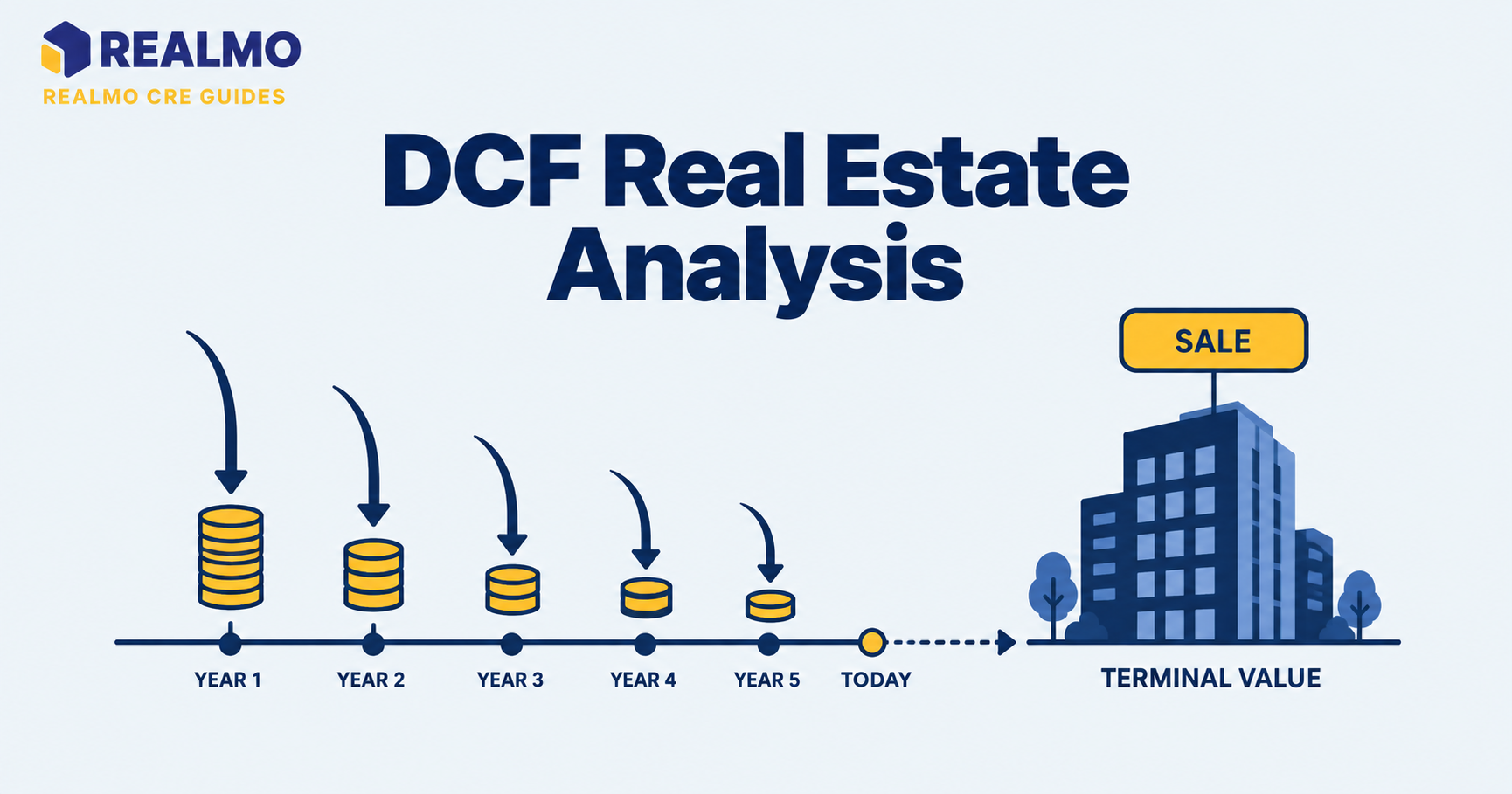
A discounted cash flow (DCF) analysis values a commercial property by projecting its cash flows across a defined hold period. Adding a sale price at the end, and discounting every dollar back to today at a required rate of return. DCF real estate models answer one question: what is a future income stream worth now?
Why Investors Build a DCF Instead of a Cap Rate
Suppose you are underwriting a two-tenant flex building. One lease has nine years left with fixed 3% bumps. The other expires in fourteen months, sits well below market rent, and the tenant has already signaled it will not renew. A cap rate applied to trailing net operating income treats both leases as if they were the same asset. They are not.
A DCF forces you to state what happens in month fifteen. How long the space sits vacant, what you spend on tenant improvements and leasing commissions, what rent the next tenant actually pays. Those three assumptions may swing value by ten percent or more, and none of them appear anywhere in a cap rate. For an investor deciding between two deals at the same going-in yield, the DCF is where the difference shows up.
What a DCF Model Actually Measures
A DCF converts a stream of future dollars into a single present number using the time value of money. Each year’s cash flow is divided by one plus the discount rate raised to the power of the year it arrives, so a dollar received in year eight is worth substantially less than a dollar received next month.
Two outputs come out of the same model. Run it with a discount rate you supply and you get a present value , the most you could pay and still hit your target return. Run it with a price you supply and solve for the rate that sets net present value to zero, and you get the internal rate of return. Investors use both: value for bidding, IRR for comparing the deal against other uses of the same equity.
Cash flow in a property-level DCF usually means unlevered cash flow, NOI minus capital expenditures, tenant improvements, and leasing commissions, before any debt service. Adding a loan produces a levered DCF, which measures returns on equity rather than on the asset. Mixing the two is the most common structural error in amateur models.
When DCF Real Estate Analysis Beats a Cap Rate
Direct capitalization assumes income is stable and grows smoothly. That assumption holds reasonably well for a single-tenant net lease property with a long remaining term and flat credit. It breaks down whenever the income stream has shape to it.
Use a DCF when leases roll unevenly, when in-place rents sit meaningfully above or below market. When free rent or step-ups distort near-term income. When the property is in lease-up, or when a known capital event, a roof, a facade, a parking deck, lands in year three. Development and value-add deals essentially require one, because the first years produce little or negative cash flow.
Direct capitalization stays useful as a sanity check. If your DCF produces a value implying a going-in cap rate far outside what comparable assets trade at in the same submarket. One of your assumptions is wrong. The two methods are complements, not rivals.
The Five Inputs That Drive Every DCF Result
Every DCF rests on the same short list: the hold period, the year-one cash flow, the growth and rollover assumptions that shape years two through the end, the discount rate, and the terminal value. Everything else in the spreadsheet is arithmetic.
Hold periods of ten years dominate institutional practice because they cover a full rollover cycle on typical office and industrial leases. Shorter holds concentrate more value in the exit assumption, which makes the model more fragile. Year-one cash flow should be built lease by lease from the rent roll rather than grossed up from a single average rent figure, since averages hide the exact expirations that drive the model.
Market rent, expense growth, downtime between tenants, renewal probability, and re-leasing costs are the assumptions that separate a defensible model from a hopeful one. Ownership history, current and suggested use, and comparable asset data on platforms like Realmo help ground those inputs in something observable before you commit them to a spreadsheet.
How to Pick a Discount Rate You Can Defend
The discount rate represents the annual return an investor requires for taking on this specific asset’s risk. It is not a market observable, it is a judgment, and reviewers will test it first.
Practitioners build it from the ground up. Start with a long-term Treasury yield, published daily by the U.S. Treasury and tracked in the Federal Reserve’s FRED database, as the risk-free anchor, add a premium for real estate as an asset class, then add or subtract for the individual deal: tenant credit quality, remaining lease term, submarket depth, physical condition, and how much of the projected return depends on execution rather than on contractual rent. A stabilized distribution building leased to an investment-grade tenant for twelve years carries a lower rate than a half-empty office building requiring a repositioning.
Two relationships matter more than the absolute figure. The discount rate should exceed the going-in cap rate for a property with growing income, because the cap rate captures only current yield while the discount rate captures yield plus growth. And the spread between your discount rate and your terminal cap rate should reflect risk, not convenience , a discount rate below the exit cap implies you expect the asset to be riskier at sale than during your hold, which needs an explanation.
Why the Terminal Value Decides the Answer
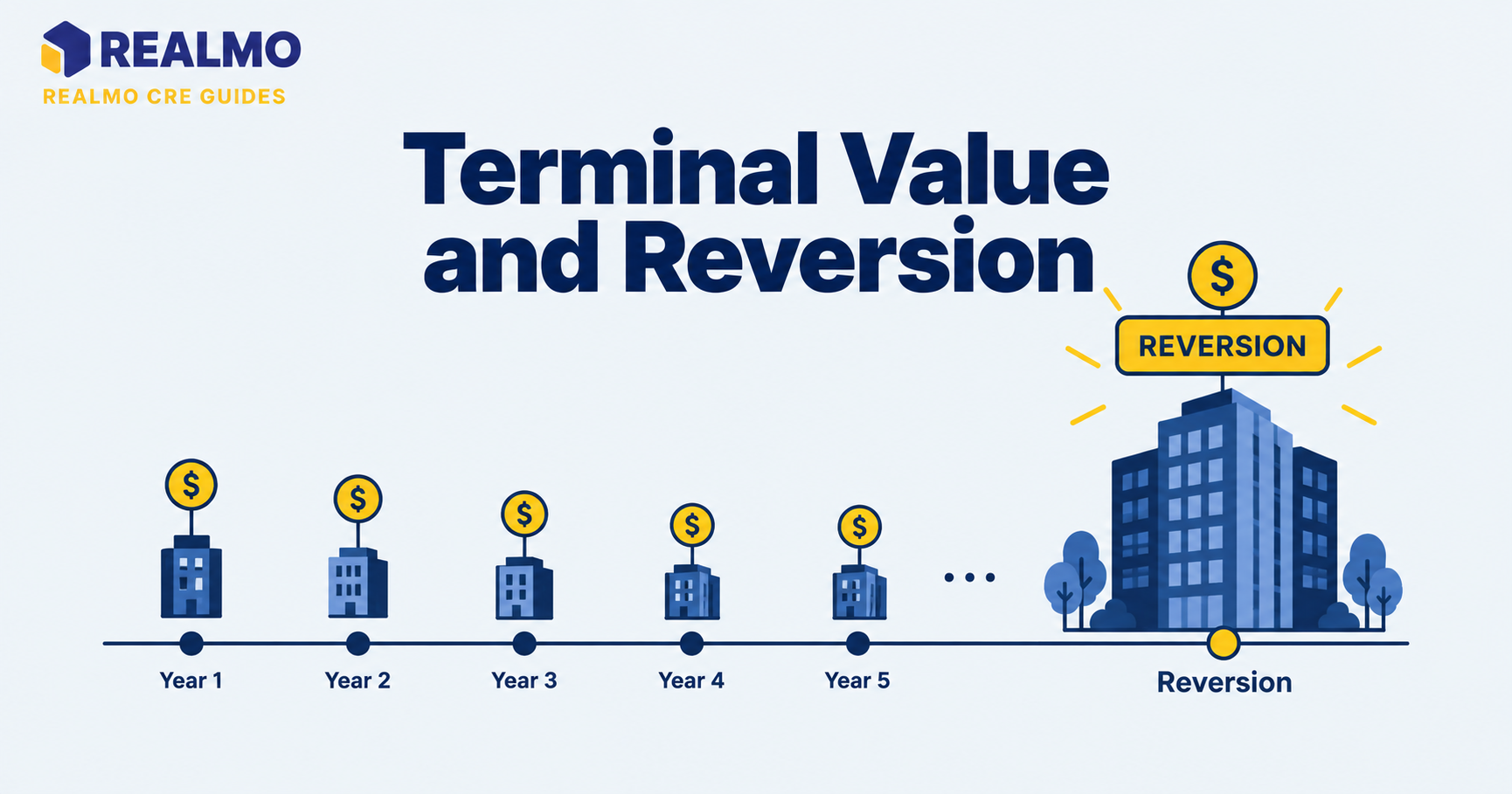
Terminal value is the projected sale price at the end of the hold, commonly calculated by dividing the first year of post-hold NOI by an exit cap rate, then subtracting selling costs. In a ten-year model it commonly accounts for roughly half of total present value. That single assumption frequently carries more weight than every operating projection combined.
Conservative practice sets the exit cap above the going-in cap by a modest margin, on the reasoning that the building will be older and its leases shorter at sale. Some underwriters hold the two equal when the asset class has structural tailwinds. What no defensible model does is assume cap rate compression to manufacture a return , that shifts the deal’s outcome onto a market movement you do not control.
Always divide by the year after the hold ends. Using the final year’s own NOI understates the buyer’s forward yield and silently inflates your exit price.
Worked Example: Ten-Year DCF on a Flex Building
The figures below are illustrative round numbers, chosen to show the mechanics rather than to describe any market.
| Input | Assumption |
|---|---|
| Asking price | $5,000,000 |
| Year 1 NOI | $350,000 |
| NOI growth | 3% per year |
| Hold period | 10 years |
| Exit cap rate | 7.0% |
| Selling costs | 2% of gross price |
| Discount rate | 8.5% |
Step 1, Project the operating cash flows. Year 1 NOI of $350,000 growing 3% annually reaches roughly $456,700 by year 10.
Step 2, Discount them. Each year is divided by 1.085 raised to that year’s power. The ten operating years carry a present value of about $2,581,000.
Step 3, Build the terminal value. Year 11 NOI is approximately $470,400. Divided by the 7.0% exit cap, that gives a gross sale price near $6,720,000; less 2% selling costs, about $6,585,000.
Step 4, Discount the reversion. Divided by 1.085 to the tenth power, the sale proceeds are worth roughly $2,912,000 today.
Step 5, Add them. Total present value lands near $5,493,000.
Interpretation. At an 8.5% required return, the asset supports about $5.49 million against a $5.0 million ask, so the deal clears the hurdle with room. Note the composition: the sale accounts for roughly 53% of value. Raise the discount rate to 9.5% and value falls to about $5.12 million , a one-point change moves the answer by roughly 7%. That sensitivity, not the point estimate, is the useful output.
The frequent error here: underwriters build ten years of clean 3% growth without inserting downtime or re-leasing costs at expiration. A model with no vacancy in a decade is not conservative, it is incomplete.
Common Mistakes in CRE DCF Models
- Discounting levered cash flow at an unlevered rate. Debt raises equity risk. Applying a property-level discount rate to after-debt cash flow overstates equity value, sometimes badly.
- Skipping capital reserves and leasing costs. NOI is not cash flow. Omitting tenant improvements, commissions, and structural capex inflates every year of the projection and the terminal value built on it.
- Setting the exit cap below the going-in cap. Unless justified by a specific, documented change to the asset, this books a market gain as an underwriting assumption and hides a weak deal.
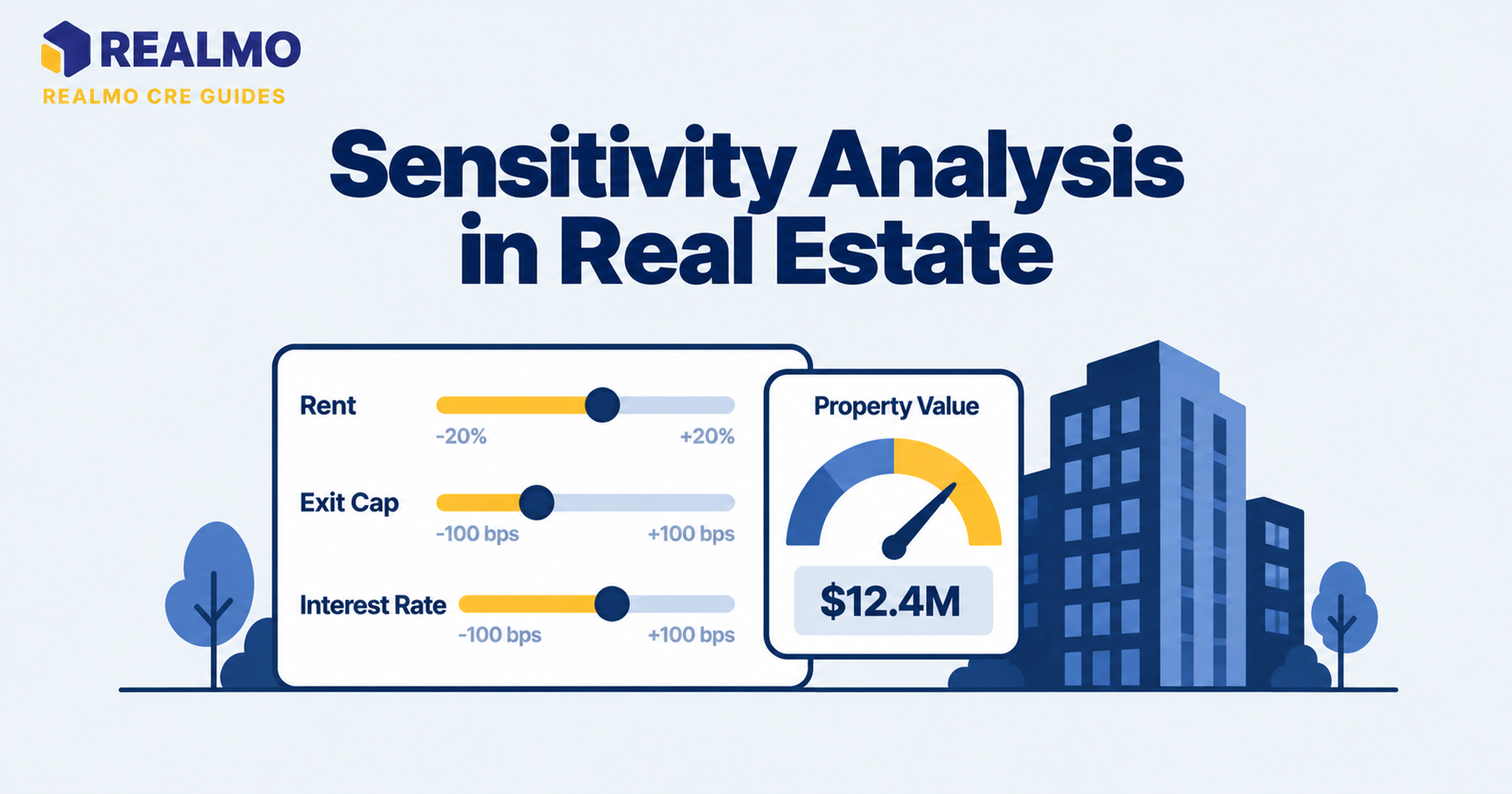
- Running a single scenario. A DCF without sensitivity analysis reports one guess with false precision. Flex the discount rate, exit cap, and market rent, then read the range.
- Ignoring lease structure. Gross, modified gross, and triple net leases assign expenses differently. Modeling reimbursements incorrectly can distort NOI by a wide margin over a ten-year hold.
Tax treatment, depreciation recapture, and entity structure change after-tax outcomes materially. Consult a licensed CPA or tax attorney before relying on any model for a real transaction.
Related Terms
Net Operating Income · Cap Rate · Internal Rate of Return · Net Present Value · Terminal Cap Rate · Equity Multiple · Pro Forma · Cash-on-Cash Return
FAQ
What is DCF in real estate?
How is DCF different from a cap rate valuation?
A cap rate divides one year of NOI by a market yield and assumes income stays stable. A DCF models each year individually, including lease rollover, downtime, capital spending, and a sale. Cap rates suit stabilized assets; DCF suits properties with uneven or changing income.
How is DCF different from a cap rate valuation?
A cap rate divides one year of NOI by a market yield and assumes income stays stable. A DCF models each year individually, including lease rollover, downtime, capital spending, and a sale. Cap rates suit stabilized assets; DCF suits properties with uneven or changing income.
What discount rate should I use for a DCF?
There is no single correct figure. Build it from a risk-free anchor plus premiums for asset class, tenant credit, lease term, submarket liquidity, and execution risk. Then test the value across a range rather than defending one number, since small changes move the result significantly.
How long should the hold period be?
Ten years is the institutional default because it covers a full lease rollover cycle. Shorter periods push more value into the terminal assumption and make the model more sensitive to exit cap rate error. Match the period to your actual intended hold, not to convention.
Does DCF work for value-add deals?
Yes, and it is required. Value-add and development deals produce low or negative early cash flow followed by a step change after stabilization. Direct capitalization cannot represent that pattern, while a DCF places the capital spending and the rent lift in the years they occur.