Biggest Risks in Commercial Real Estate
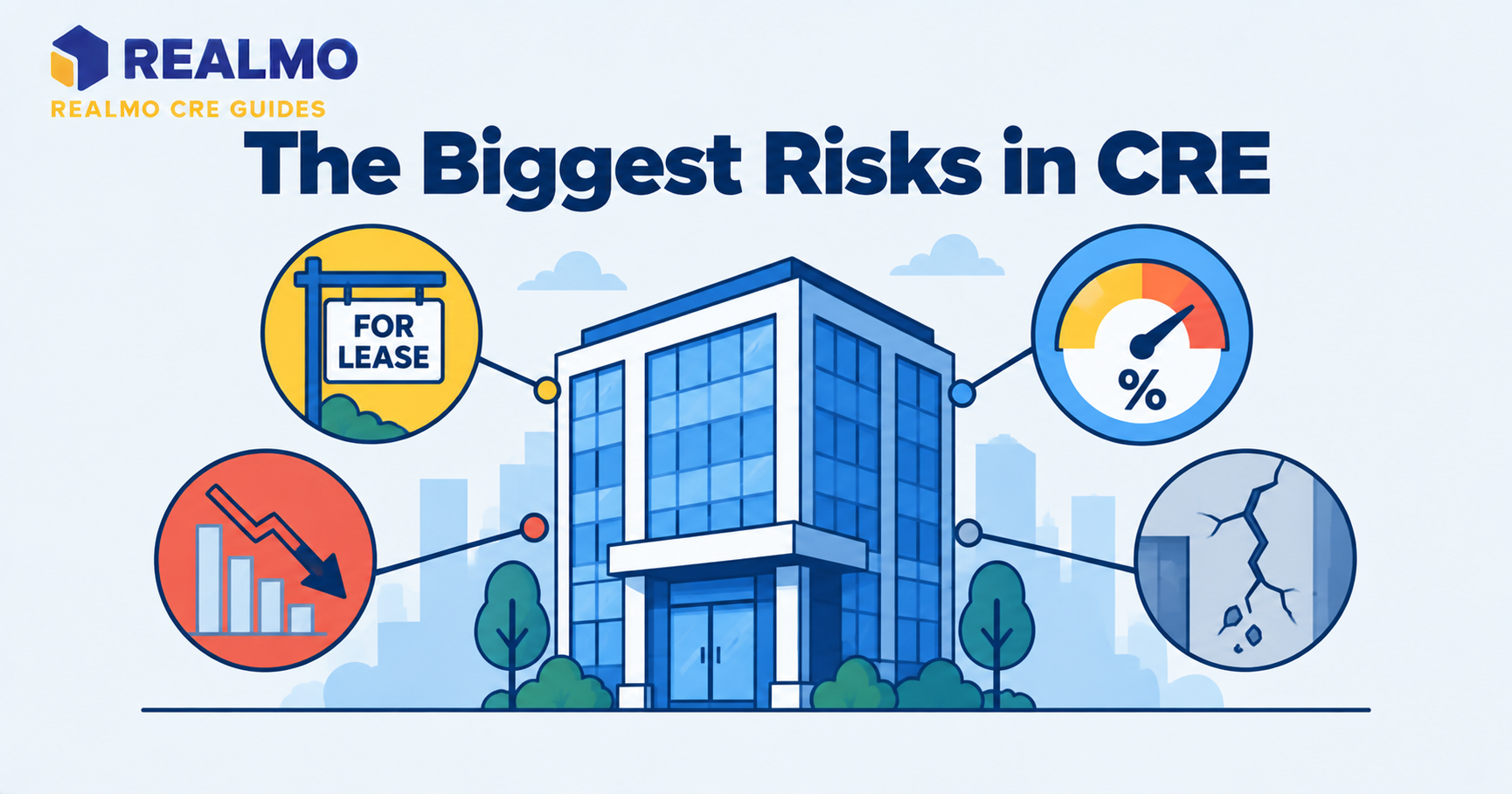
Commercial real estate risk falls into seven recurring categories. They are vacancy and leasing, tenant credit, debt and refinancing, capital expenditure, market and cycle, liquidity, and operating cost inflation. Each one shows up in the cash flow line by line, and each can be measured before you buy.
Why risk analysis decides your first deal
An investor buying a small multi-tenant retail strip usually underwrites the going-in yield and stops there. The seller’s rent roll shows full occupancy, the taxes look manageable, and the price per square foot sits below replacement cost. Two years later the anchor tenant‘s lease rolls, and the space sits empty for eleven months. The lender’s debt service coverage covenant trips, and the equity that looked like a 15% return is now negative for the year.
Nothing unusual happened. Every one of those events was visible in the lease abstracts and the loan documents at closing. Risk analysis in commercial real estate is not a warning label. It is the work of finding out which specific events could break the deal. It means estimating how likely they are, and pricing that risk into what you pay. Investors who skip it are not taking less risk. They are taking the same risk without getting paid for it.
Vacancy and leasing risk: the cost of an empty suite
Vacancy risk is the possibility that space sits unleased, or leases at rents below your underwriting. It is the single largest driver of variance in most commercial property returns. An empty suite compounds the damage: it costs money rather than simply failing to earn it. You pay taxes, insurance, utilities, and common area maintenance on the vacant square footage, and in most leases you cannot recover those costs from anyone.
Three factors determine how severe this risk is for a given asset. Lease rollover concentration matters most. If 60% of your square footage expires in the same 18-month window, you have bet the property on one leasing market. Re-tenanting time varies enormously by property type. A small office suite in a competitive submarket can take far longer to fill than a well-located industrial box. The pool of tenants is smaller, and the space needs more work. Finally, there’s the cost of the lease itself. Tenant improvement allowances and leasing commissions on a new lease frequently consume the first year or more of that lease’s rent.
Build a rollover schedule before you buy. List every lease expiration by year and square footage, then ask what happens to cash flow if the largest one does not renew. That schedule tells you more about the deal than the cap rate does. For deeper mechanics, see how lease rollover schedules affect valuation and tenant improvement allowances explained.
Tenant credit risk and why lease length alone is misleading
A ten-year lease is worth exactly as much as the tenant’s ability to pay it. Credit risk is the chance the tenant defaults, files for bankruptcy protection, or negotiates a rent reduction you have little leverage to refuse. The lease term protects you only against a tenant who has the money and would rather leave. It does not protect you against a tenant who has no money.
This is why investment-grade tenants trade at lower cap rates than local operators on identical buildings. The buyer is paying for a lower probability that the income stream stops. It is also why a single-tenant net lease property, marketed as the conservative option, concentrates risk rather than reducing it. Occupancy in a single-tenant building is binary: 100% or zero. A twelve-unit multi-tenant building with weaker individual tenants may carry lower total income risk simply because no single default takes down the whole property.
Look past the brand on the sign. In a franchise deal, the guarantor is usually the franchisee, not the national parent. Ask for the entity name on the guaranty, and ask whether it is a corporate or personal guaranty. Request financial statements where the lease permits it. See net lease structures and guaranty types for how these documents differ.
Debt risk: leverage cuts both ways
Debt magnifies whatever the property does. When the going-in yield on the asset exceeds the interest rate on the loan, leverage lifts the equity return. When it doesn’t, leverage does the opposite with equal force. That relationship is arithmetic, not opinion, and it is the first thing to check on any financed deal.
Refinancing risk is the version that has hurt the most investors. Most commercial mortgages carry a term shorter than their amortization schedule, which means a balloon payment comes due while substantial principal remains outstanding. At that maturity date, three things must cooperate: the property’s net operating income, prevailing interest rates, and lender appetite for the asset class. NOI can fall. Rates can run meaningfully higher than at origination. Lenders can pull back from the property type. Any one of those means the refinance proceeds will not cover the existing balance, and the borrower must contribute fresh equity or lose the asset.
Two structural details deserve attention in the loan documents. Recourse determines whether a lender can pursue your other assets after foreclosure. Non-recourse loans still carry “bad boy” carve-outs that convert to full recourse on specific acts. And covenants, particularly minimum debt service coverage ratio and maximum loan-to-value tests, can trigger a default even when you are current on every payment. Read debt service coverage ratio explained and recourse vs. non-recourse commercial loans before signing.
Capital expenditure risk: the roof does not care about your model
Capital expenditures are the large, irregular costs of keeping a building functional: roof replacement, HVAC systems, parking lot resurfacing, elevator modernization, facade work. They sit below the NOI line, which means they do not affect the cap rate you paid but do affect every dollar you actually receive.
The failure mode is predictable. An investor underwrites a reserve of a few hundred dollars per unit or a modest figure per square foot annually. Two years later, the roof turns out to have five years of documented patching history and needs full replacement. A property condition assessment from a qualified engineer, ordered during due diligence, is the standard defense. It gives you remaining useful life estimates on major systems and a schedule of immediate and long-term costs. Deferred maintenance is not a discount you inherit for free. It is a bill with an unknown due date.
Market and cycle risk you cannot diversify away
Some risk is specific to your building and some belongs to the market. Supply risk is the most direct: new construction delivering into your submarket competes for your tenants. Unlike most risks, it’s visible in advance through permit filings and construction starts tracked by the U.S. Census Bureau. Demand risk runs the other direction, driven by employment, population, and industry concentration. A submarket where one employer occupies a large share of the office inventory carries a concentration problem no lease structure can fix.
Interest rate risk deserves separate treatment because it operates on values, not just financing. Cap rates and prevailing rates on Treasuries and commercial debt tend to move together over time. When borrowing costs rise, the price a buyer can pay for the same NOI falls. That means an investor can lose value on a fully occupied, well-run property without anything happening at the property at all.
Liquidity risk: you cannot sell half a building
Commercial real estate does not trade like a security. A sale takes months, and costs several percent of gross price in brokerage and closing expenses. It also depends on a buyer who can obtain financing at that moment. In a market where credit has tightened, the buyer pool for a given asset can thin dramatically.
This has a practical consequence for how you capitalize a deal. If your hold period assumption is five years but your loan matures in three, you’ve created a forced-sale scenario. It falls on a date you do not control. Match your debt maturity to your business plan with room to spare. Hold enough operating reserve that a bad twelve months does not become a distressed sale. Realmo’s ownership records and valuation data across 9M+ properties can help you gauge how frequently comparable assets in a submarket actually change hands. A thin transaction history is itself a liquidity signal.
Worked example: sizing vacancy risk before you bid
Assume an illustrative 20,000 SF flex building, fully leased, with the following round numbers:
Inputs (illustrative):
- Gross rent: $20.00/SF NNN → $400,000
- Operating expenses (recovered from tenants): $6.00/SF → $120,000
- NOI at full occupancy: $400,000
- Purchase price: $5,000,000 → 8.0% going-in yield
- Debt: $3,250,000 at 6.5% interest, 25-year amortization → roughly $263,000 annual debt service
- Largest tenant: 8,000 SF, lease expiring in 26 months
Step 1: Model the downside. That tenant does not renew. You lose $160,000 of rent and now absorb $48,000 of unrecovered operating expenses on the vacant space.
Step 2: Apply a realistic downtime assumption. Nine months vacant, then a new lease. First-year rent loss: roughly $120,000. Unrecovered expenses over that period: about $36,000.
Step 3: Add the cost of the new lease. Tenant improvements at $25/SF and leasing commissions equal to roughly 5% of lease value on a five-year deal: call it $200,000 in one-time capital.
Step 4: Check coverage. During the vacant stretch, annualized NOI falls to roughly $244,000 against $263,000 of debt service. DSCR drops below 1.0. You are funding the shortfall from reserves, plus $200,000 of leasing capital.
How to read this: the 8.0% going-in yield was never the risk-adjusted return. The deal requires roughly $250,000 of accessible capital to survive one predictable event, and the lender’s covenant may trip before the tenant even vacates. Either the price comes down, the reserve goes up, or you pass.
Common error: underwriting the re-lease at today’s asking rent with zero downtime and zero TI. That single assumption set is responsible for more broken pro formas than any other.
Common mistakes investors make when assessing risk
- Treating the cap rate as a risk measure. A cap rate compares income to price at a single moment. It says nothing about lease rollover, tenant credit, or capital needs. Two properties at the same cap rate can carry entirely different risk profiles. The lower cap rate is frequently the safer asset, not the overpriced one. The consequence is systematically overpaying for risky income.
- Underwriting the seller’s rent roll instead of the leases. A rent roll is a summary a seller prepared. The leases contain the co-tenancy clauses, early termination rights, renewal options at below-market rents, and expense exclusions that determine actual cash flow. Skipping lease abstraction means discovering a termination right after closing.
- Assuming refinancing will be available on similar terms. Loan maturity is a hard date. Underwrite an exit or refinance under conditions materially worse than today, and confirm the deal still survives. Investors who assume continuity lose properties they could otherwise have held.
- Ignoring expense growth on gross leases. Property taxes get reassessed after a sale in many jurisdictions, and insurance costs in coastal and wildfire-exposed markets have moved sharply. On a gross lease, every dollar of that increase comes out of your NOI until the lease rolls.
- Confusing diversification with more properties. Owning five buildings in the same submarket leased to tenants in the same industry is one bet, not five. Genuine diversification requires variation across geography, property type, and tenant industry.
Related terms
- Cap rate
- Debt service coverage ratio (DSCR)
- Net operating income (NOI)
- Lease rollover schedule
- Property condition assessment
- Loan-to-value ratio (LTV)
- Net lease
FAQs
What is the biggest risk in commercial real estate?
Vacancy and leasing risk causes the most variance in returns for most property types. An empty suite stops income while taxes, insurance, and maintenance continue. For leveraged deals, refinancing risk at loan maturity is frequently the risk that actually causes loss of the asset.
Is commercial real estate riskier than residential?
Different, not uniformly riskier. Commercial income depends on fewer, larger tenants and longer leases, so a single default has a bigger effect. Residential has broader tenant pools but shorter leases and faster turnover. Commercial also carries less liquidity and more complex debt structures.
How do I reduce risk in a commercial property investment?
Stagger lease expirations, verify tenant credit and guaranty entities, and order a property condition assessment. Hold capital reserves sized to the largest realistic vacancy, and match loan maturity to your hold period with margin. Conservative leverage reduces the severity of every other risk.
What is the difference between systematic and unsystematic risk in CRE?
Systematic risk affects the whole market: interest rates, employment, credit availability. It cannot be diversified away. Unsystematic risk is property-specific, such as a roof failure or a single tenant default, and can be reduced through diversification and due diligence.
Do I need reserves even on a fully leased property?
Yes. Full occupancy is a snapshot. Reserves cover the gap between a tenant vacating and a replacement paying rent, plus the tenant improvement and commission costs of the new lease. Lenders frequently require this explicitly through escrow accounts.